

A few years ago now, it all started in the supermarket. Each with his or her own trolley, you tore the long list of provisions prepared weeks ago as a foretaste of the big departure in two. Then you chose your route, tacking up and down the aisles, until your legs start to ache, then your back, through loading/unloading, before everything was correctly stowed aboard. Fortunately, since then, internet shopping and drive-in delivery have been invented. With the ending of this chore, which had its charm, but which we can easily do without, two-up sailing really begins aboard the boat, and it's a good thing.
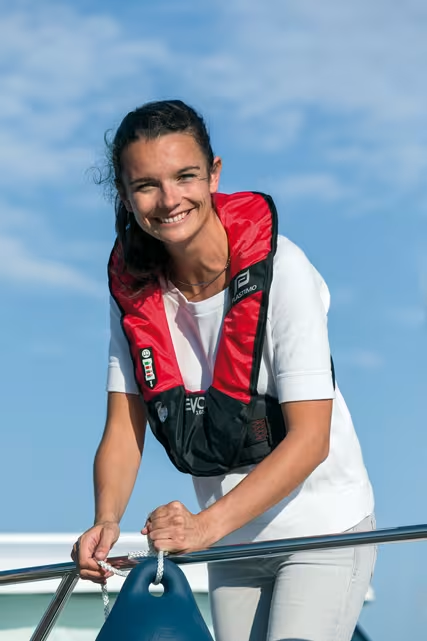
Whilst you are itching to cast off the mooring lines, it is without any doubt a good idea, (even more so than when fully-crewed), to carry out a short safety briefing. From the location of important safety gear to the equipment to be worn according to the circumstances and agreeing on the procedures in case of a man overboard, a mutual reminder of the elementary safety principles is essential. Whilst on this subject, even more so than usual, a lifejacket should be worn in all circumstances. In bad weather, of course, but also at night, once you find yourself alone, or leave the protective cocoon of the cockpit. Equipped with a personal beacon or an alarm bracelet in case of a fall overboard. This equipment is really affordable and prevention remains the best way of ensuring that nothing happens to us! Especially if, like your humble servant, you are not a fan of harnesses and jackstays. It’s true that the stability of our modern multihulls offers appreciable comfort and safety when maneuvering. Nevertheless, in the case of very heavy weather, or when working on the boom from the bimini, at the bows or on the bowsprit, there is no alternative, you must be clipped on. Because two-up, recovering your partner who has fallen in the water in bad weather or at night requires a miracle.
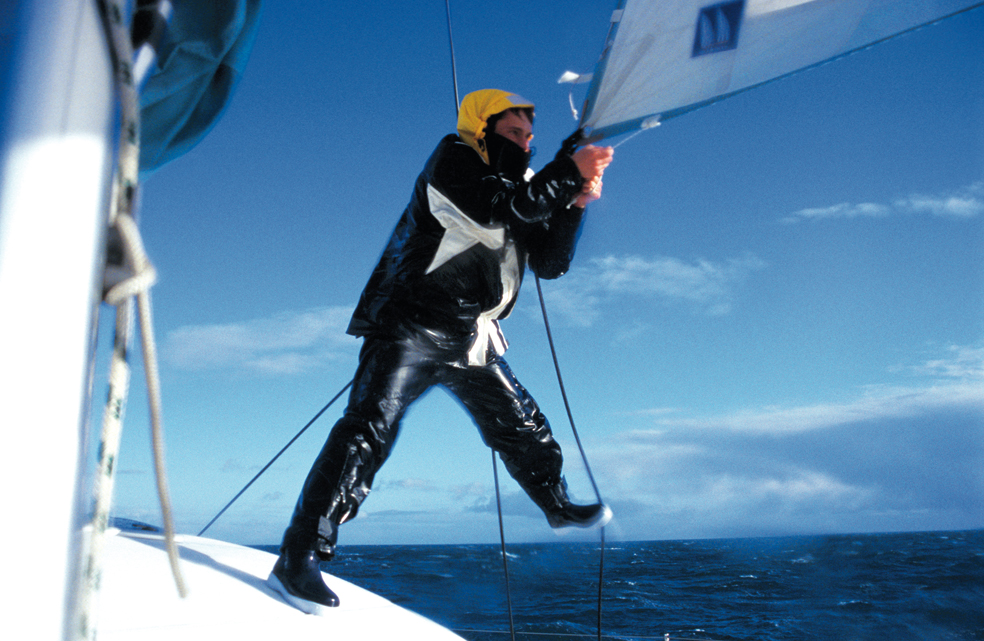
Safety rule n°1: always be attached, especially when the conditions become difficult, or you have to perform acrobatics aboard…
When two-up, depending on the weather conditions, the configuration of the berth, and your boat’s maneuverability and size, leaving the harbor may require a little organization. Shorthanded, it is even more important to anticipate well and share the sequence of maneuvers to be carried out. Who does what, when and with what aim for the boat. And to plan a few alternative scenarios if things don’t go as planned! When entering a new harbor or in an unknown anchorage, preparation and communication are even more important. If one of the two co-skippers is not comfortable carrying out these maneuvers, it’s not a reason to systematically leave them to carry out all the preparation chores: furling the sails, preparing fenders, mooring lines... The assistance of the autopilot, or a short changeover at the helm before approaching the destination more closely, form part of the ‘savoir vivre’ essential when two-up to establishing a lasting relationship.
At the chart table, it’s a pleasure to prepare the next anchorages or stopovers together, as well as analysing the freshly received Grib files. To choose by mutual agreement the route to go where you want to go safely and comfortably. To decide together the right moment for the gybe which will leave a perfect track on the paper or electronic chart. You will share for a long time the fond memory of the perfect ‘gull-wing’ you drew together on the Atlantic: low descent angle, perfect VMG, anticipation of the change in wind direction. A shame you weren’t racing, because you would have given the other crews something to think about! But there is also, and above all, the safety factor. Another view of the route may help you avoid running aground in the middle of the Indian Ocean because you hadn’t zoomed in the electronic chart sufficiently, and thus missed the fatal atoll. A second opinion, less optimistic about the depression’s trajectory, may allow you to steer a few degrees further south just at the right time, and thus avoid finding yourself in the wrong place at the wrong time. Sharing information, comparing analyses, choosing together is not only a pleasure, but also the best way of going far, for a long time...
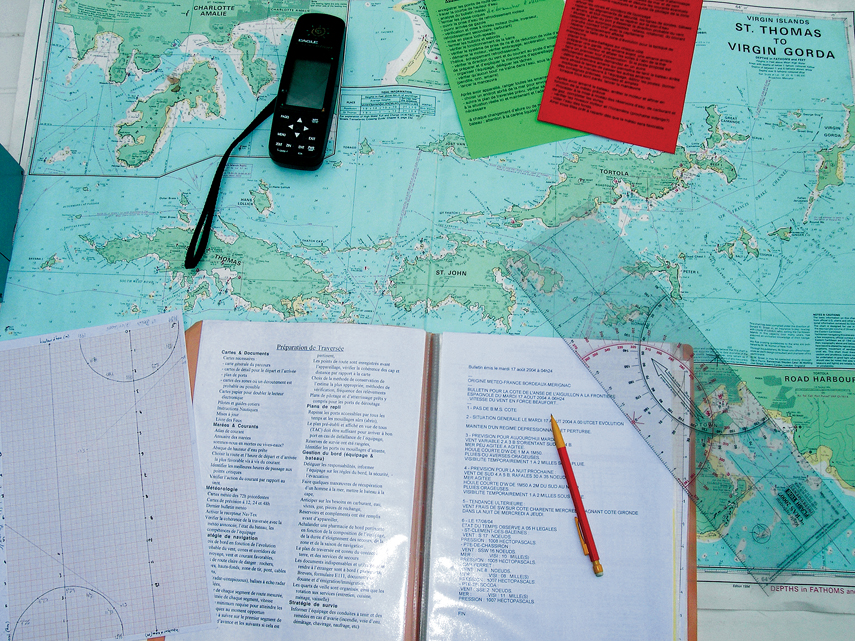
Before each departure, and even more so than when fully-crewed, it is advisable to prepare your cruise perfectly, and check everything aboard…
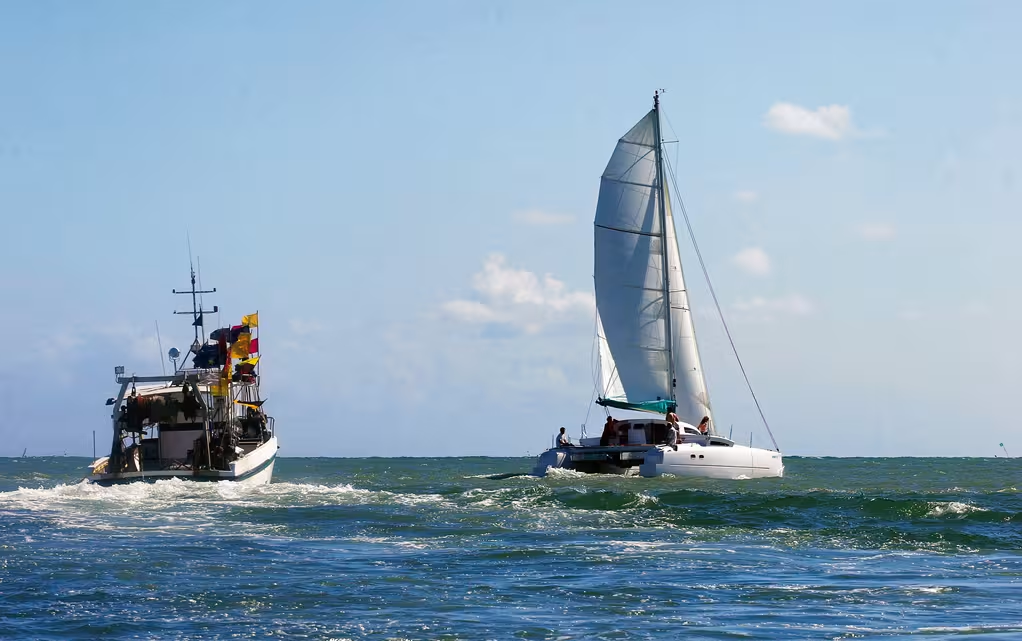
Once at sea, two pairs of eyes will always be more effective than one. Sailing two-up allows you to really approach the sacrosanct concept of permanent watchkeeping. The organization you adopt – informal or rationalized in the form of watch periods as when fully-crewed – doesn’t matter, the important thing is that the two co-skippers never think at the same time that the other one is on watch! Especially when coastal sailing, where natural obstacles, leisure sailors, fishermen, commercial vessels, buoys and lobster pots all seem to take great delight in throwing themselves in front of your bows - don't you find? Just like the cargo ships at sea. The probability of being on a collision course in the immensity of the ocean may seem infinitesimal. But it is much greater than you think. Of course you will pay less attention, but it must be regular and at a frequency depending on your boat’s speed. Without getting into complex details, a glance round the horizon every 10 to 20 minutes, depending on the visibility, should allow you to detect the approach of a container ship travelling at 25 knots.
For all the maneuvers, two pairs of hands will always be welcome. But a bit like when singlehanded and even more so than when fully crewed, when two-up each maneuver must be anticipated. Share the sequence for each sail change, reef, gybe, aloud... Particular care should be taken when furling the downwind sails. If you have delayed taking the decision, carried away with the speed, you will have to act quickly. In any case, if there is one golden rule to be applied, it’s that once a sail is hoisted, its halyard must be prepared for furling. On this subject, did you know that to avoid kinks in Spectra halyards, you just have to coil them in figure 8s around a winch? To ensure that the halyard is not jammed by a loop when furling, singlehanders throw the mainsail, spinnaker or gennaker halyard into the water, which also has the advantage of slowing their descent, leaving time to get from the helm to the mast.
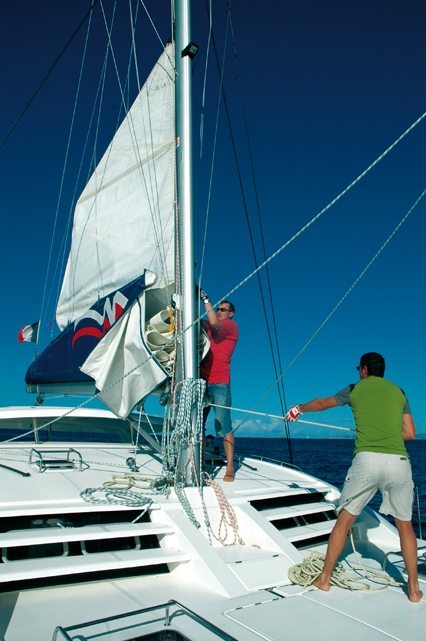
When chartering or on a long-term cruise, if you are to get on well, the chores and maneuvers must be shared.
The helm...more than ever when shorthanded, a completely reliable autopilot is an essential. Often over-sized aboard our multihulls, with incomparable longitudinal stability compared to the monohulls for which the autopilots were more often than not designed, they can rarely be faulted. But a mechanical or electronic breakdown can spoil life for you. At least if not your life, it can turn an idyllic sail into a real nightmare. Riveted to the helm 24h/24, the watches come round very quickly when two-up. So a spare ram and electronics box are without any possible doubt part of the essential spare parts to have aboard. Well-protected, stored in a dry place, they will be operational at just the right moment and will replace the defective elements.
When we start to talk about tasks or even chores, it’s important that you and your partner remain united, and that you don’t find yourself unintentionally singlehanded! There are three possible tactics, which can even complement each other, depending on your wishes. Firstly, dividing up the actions according to the areas of skills or appreciation of the task’s difficulty. An enthusiastic Cordon Bleu cook will take great pleasure in preparing nice little dishes for you three times a day. Another will find scrubbing the deck for three hours each day exciting. It’s just advisable to check the aforesaid enthusiasm when he or she wants to do this at six o’clock in the morning. Second choice: organize turns for each task. Not necessarily very motivating, but it can suit particularly Cartesian or rationalist spirits. But the one we prefer here at the magazine is sharing everything, in good humor: preparing meals jointly while discussing, cleaning the boat together while singing, or getting all four hands in the dirty oil and swearing amid peals of laughter! That’s sharing!
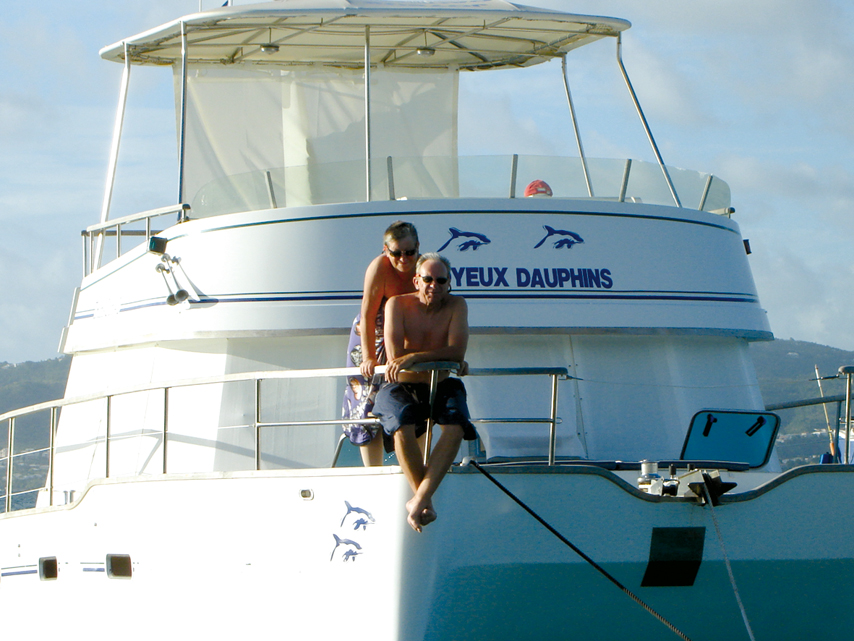
When shorthanded, power catamarans avoid numerous maneuvers, and therefore allow you to dedicate yourself to what is essential: your crew.
Finally, the key to a lasting duo, at sea as elsewhere, is communication. And for once, technology not only doesn’t spoil the charm, but can even participate in preserving it. Don’t you find a boat where the crew yell and shout from the steering position to the bows and vice versa unbearably vulgar? Well, we have something for you, inherited from the big ocean racing trimarans. Because of the distance, and an apparent wind often of over thirty knots, the helm and the n°1 equip themselves with small waterproof walkie-talkies, equipped with hands-free kits. Imagine your other half whispering gently that she would like to position the boat to the right of the west tower. You whisper back that an immaculate sandbank appears to be awaiting your anchor in three boat lengths. She murmurs the depth of water when the boat stops. You confide quietly the length of chain paid out and that the anchor seems to be holding. You can cut the engines. I don’t think the other three boats already anchored in this little creek heard a word...
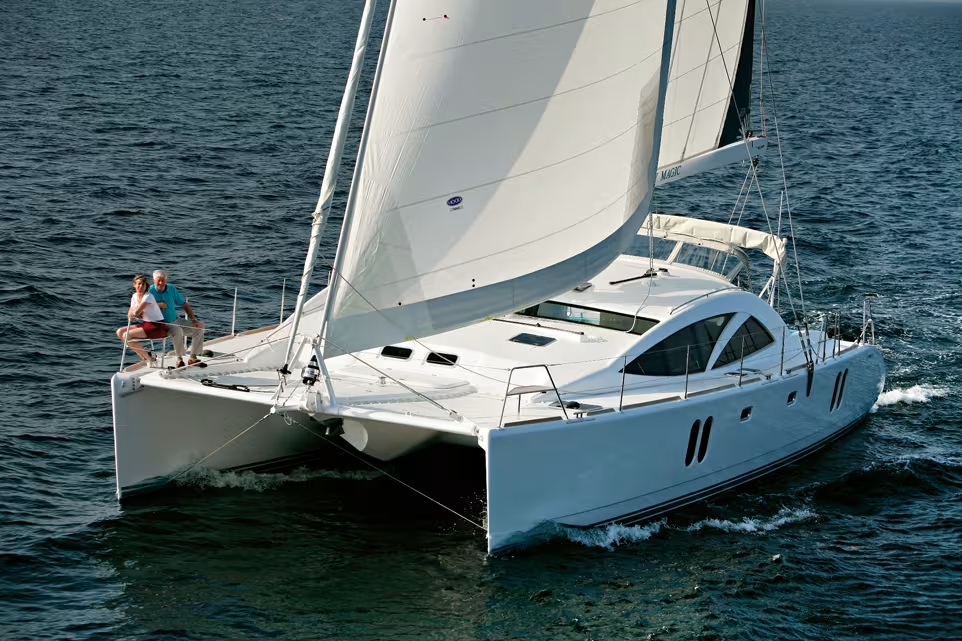
So, some good two-up sailing in view. Going to sea, whatever the crew, is always a pleasure for us enthusiasts. But sailing two-up has a particular flavor. Like the best of both worlds. Finding yourself regularly alone, as if singlehanded, but always able to count on someone in the case of a problem, and above all, to share the most magical moments. It’s a characteristic of human beings. Singlehanded, there is always a certain frustration at not having someone to call on in an emergency when the breeze gets up and the boat accelerates, or for the pleasure of hoisting more sail, watching the dolphins play at the bows, whilst the sun sets the sky and the sea aglow, marking the end of a wonderful day’s sailing with fireworks!
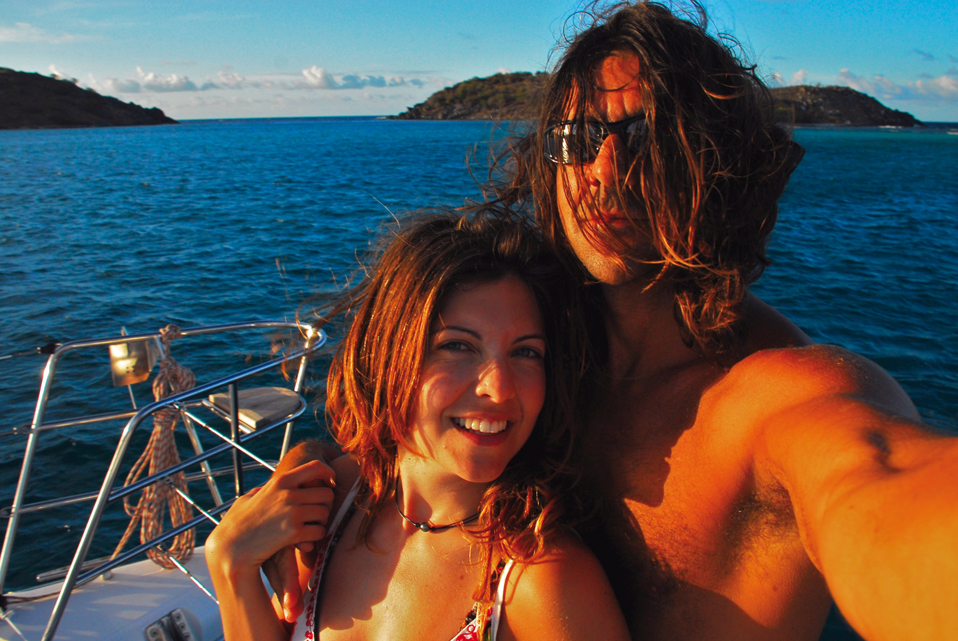
Round the world as a couple... Can you imagine anything better?
