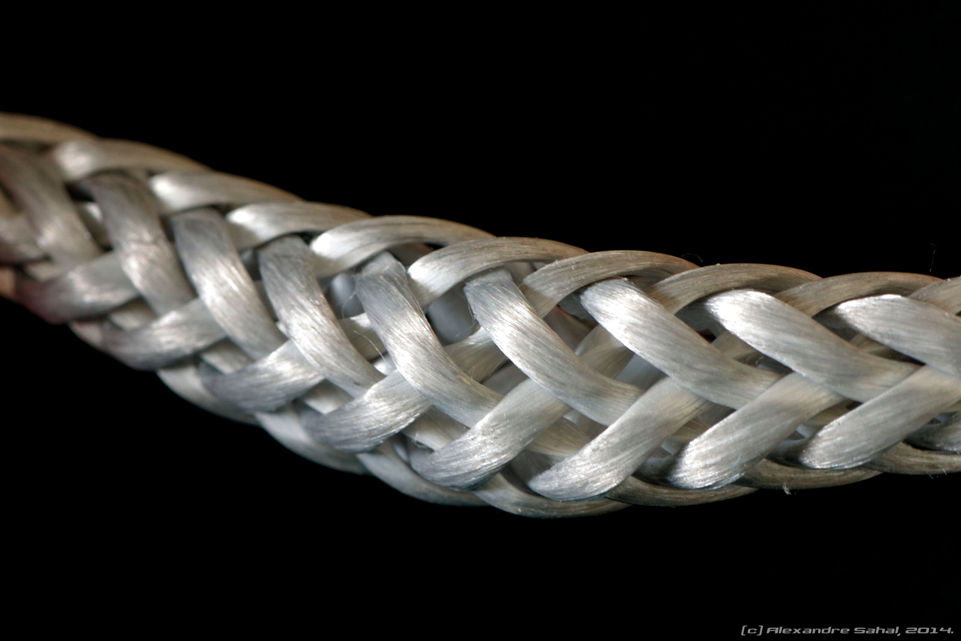


It feels like a lifetime ago that sails were made of “cotton”, and that sheets and halyards were “elastic”. Everything has become rigid, nothing flexes, and everything is transformed into speed. Even better, fiber has expanded its kingdom into domains until recently unknown: shrouds, stays, guardwires, shackles and even cleats are now involved. Lightness, resistance, mechanical efficiency all combine as much as possible to replace metal which rusts, grates and jams, with these new “strings”… But you don’t need to be doing the America’s Cup or the Vendée Globe Race to benefit from the huge advances brought about most often, it’s true, by the crazy racers. How nice it would be to replace the shackles on your mainsheet blocks with Dyneema. Silence…
Did you know that there is more to be gained in weight by swapping your stainless steel rigging for Kevlar or PBO than opting for an expensive carbon fiber mast? But most importantly, the pleasure of being able to keep your luff tension tight! And then a bit of aesthetics does no harm: with assorted colors, sail handling can be easier, and your crew will thank you! All you need to do is use the right man for the job, so your cleats, sails, blocks and chainplates hold fast… But that’s another story! Let’s get back to the point, or rather to our cordage. There are many factors involved, and the possibilities are infinite, so let’s have a look at the main characteristics which need to be considered:
- The core: this is the real heart of the rope, and it is this which determines its resistance or elasticity, its suppleness or stiffness. It all depends on the nature of the fibers of which it is made, their number, the order they are in, and of course, their final overall diameter.
- The sheath: the protective layer which shields the core from the aggressive action of cleats, from the friction of blocks, and allows your hands to get a better grip. The material it is made from is of course important, and its characteristics are determined above all by the number of strands that it is made up of. In effect, the more numerous the strands, the more the rope is resistant to abrasion.
- Elongation is a measure of the variation in length of a rope as a function of the load it is supporting. Within the same area, creep is how much a rope deforms irreversibly under load. It is contrary to elongation, in that it is irreversible. All new halyards or sheets creep during initial use, then become stable.
- The breaking strain gives the value at which the material will sever. This is not to be confused with maximum recommended loads, which take account of a not-insignificant safety factor compared to the former figure.
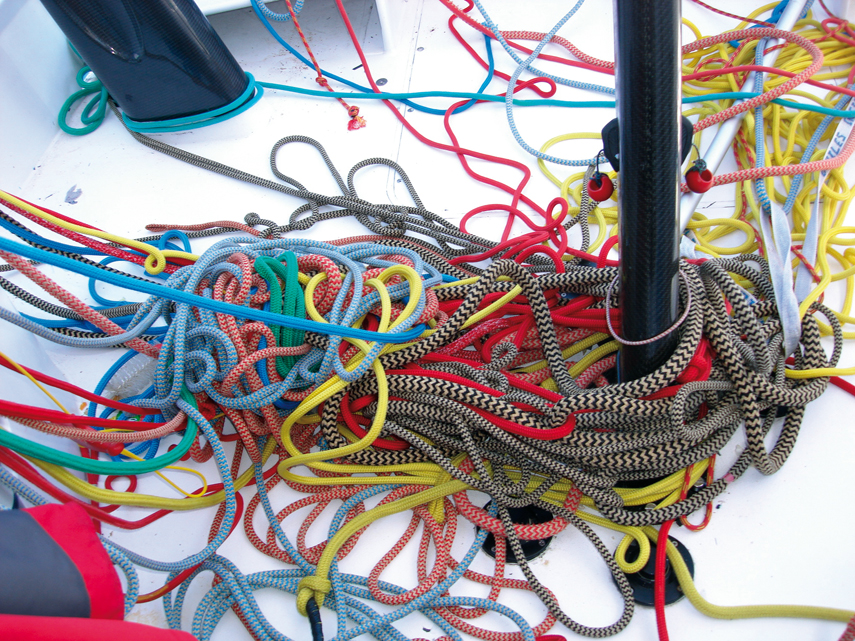
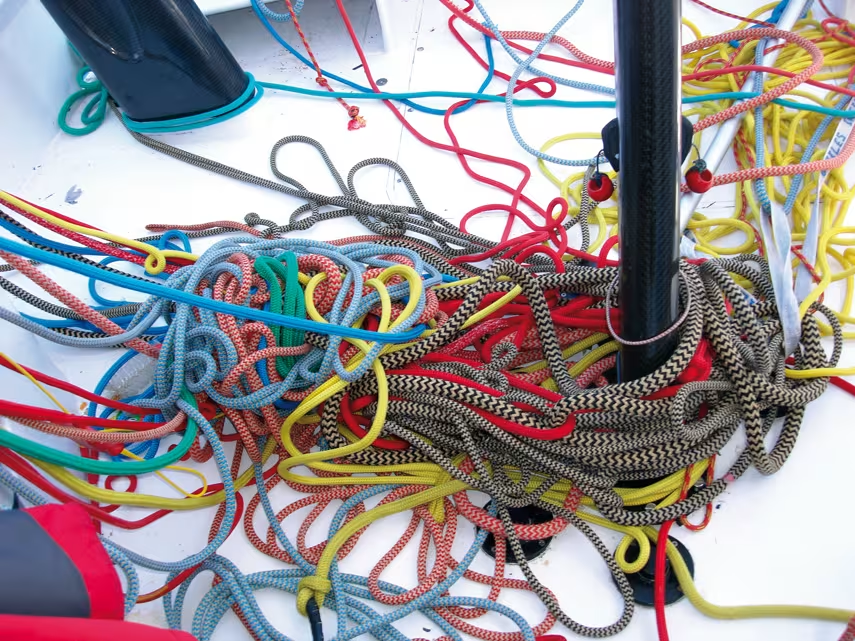
There are many ropes on board our boats, and each has its purpose… Even on a cruising boat, they can improve the look!
Note that stiffness and resistance must not be confused. This is why our mooring warps are large in diameter. It’s to ensure good resistance through their diameter and a certain suppleness, to your beautiful multihull when it is tugging violently at its mooring lines. Recycling your old halyards and sheets into mooring warps is absolutely not to be recommended. In conclusion, and before having a look in more detail at the various families of ropes, there are a few little rules to bear in mind when making your choice. First of all, choose the right rope for the job. There’s no sense in having the most high-tech halyard to hoist a cheap and cheerful polyester sail. Next, be aware of any possible chafe points, including, particularly, inside the mast, where the halyards can cross the bar between the spreaders for example. Finally, making sure of the orientation of your blocks is essential, not only to minimize your physical effort, but also to preserve your ropes. So instead of trying to line up shackles which can only offer you one or two possible angles, change over to fiber, where the possibilities are infinite! The result: your deck hardware and your cordage will be working in harmony, and always in optimal conditions!
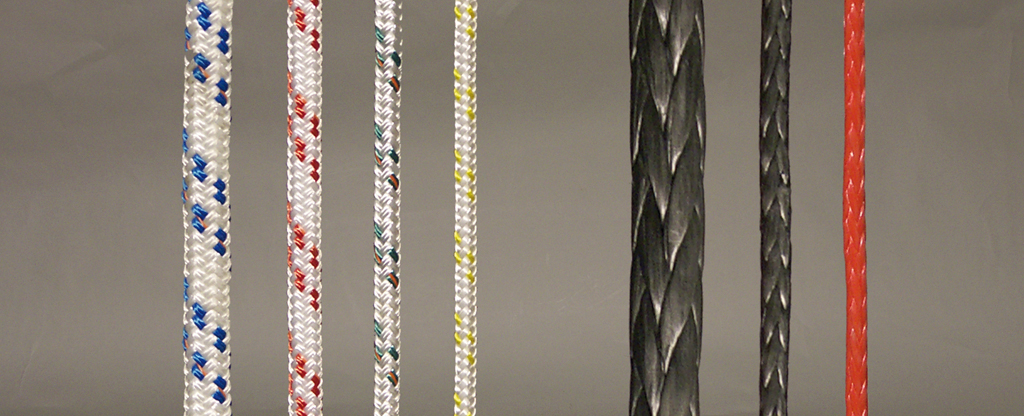
Core and sheath must be carefully chosen depending on the application.
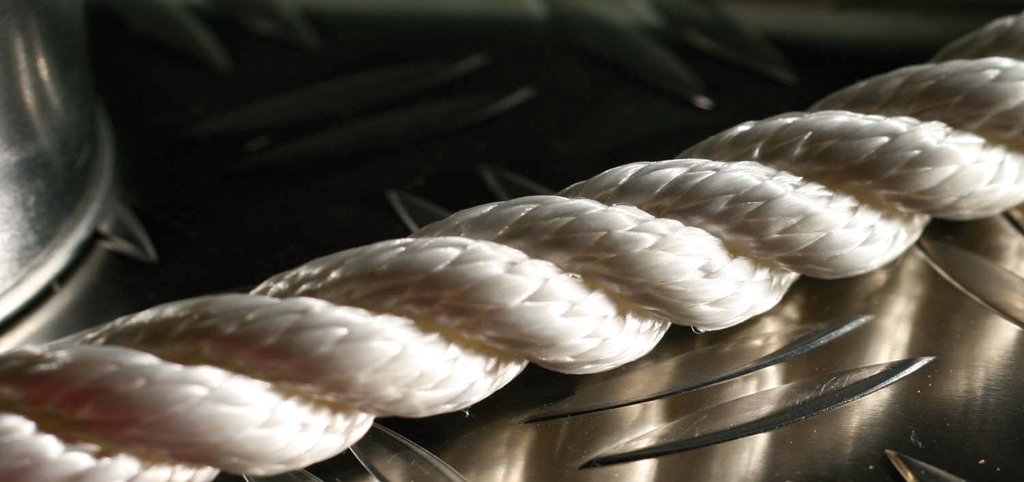
Polyester or Braided Polyamide
For mooring warps or fenders, it’s the ideal rope as it’s very supple. Having no sheathing, it’s easy to splice. It’s always better and easier to pass an eye around a cleat or a bollard ashore than to be trying to tie a bowline in a hurry. On that note, remember that a knot in a rope can cause it to lose up to 70% of its mechanical resistance due to the tight radii of the bends involved. A professionally made splice will limit this loss to 10%. The best compromise seems to us to be an eight-strand polyamide which in addition to the advantages associated with the material, gains in resistance to abrasion and holds better over time.
Pluses: Suppleness, doesn’t harden, resistance, easy to splice.
Uses: mooring warps
Price in 20mm: around €5 per meter
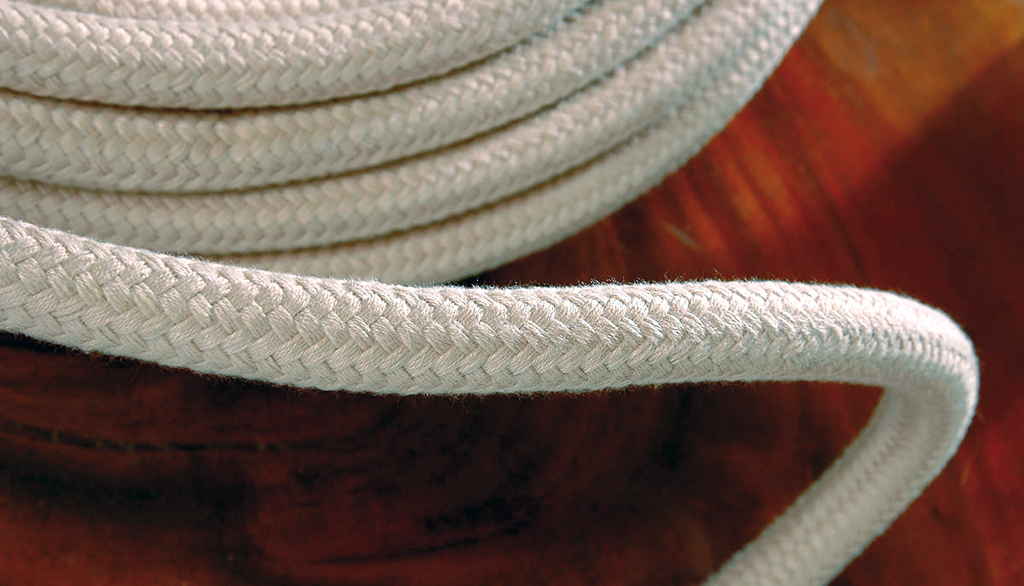
Polyester Sheath / Dyneema Core
To be honest, on board our multihulls, be they racers or cruisers, there is little use for polyester-cored ropes. As, for example, for a furling line, when you need a rope which is not too stiff, so it can take the tight turns of the furler drum, yet not to supple as to turn the effort you put in into furling instead of stretching the rope! Most importantly, as the capacity of the furling drum is finite and the diameter of the line remains limited. Also, the association of polyester and Dyneema presents the best compromise for resistance and for adapting to the tight radii of deck hardware.
Pluses: A good compromise, accepts tight turns
Uses: Furling lines, mainsheet travelers, genoa car tracks, etc
Price in 10mm: around €7 per meter
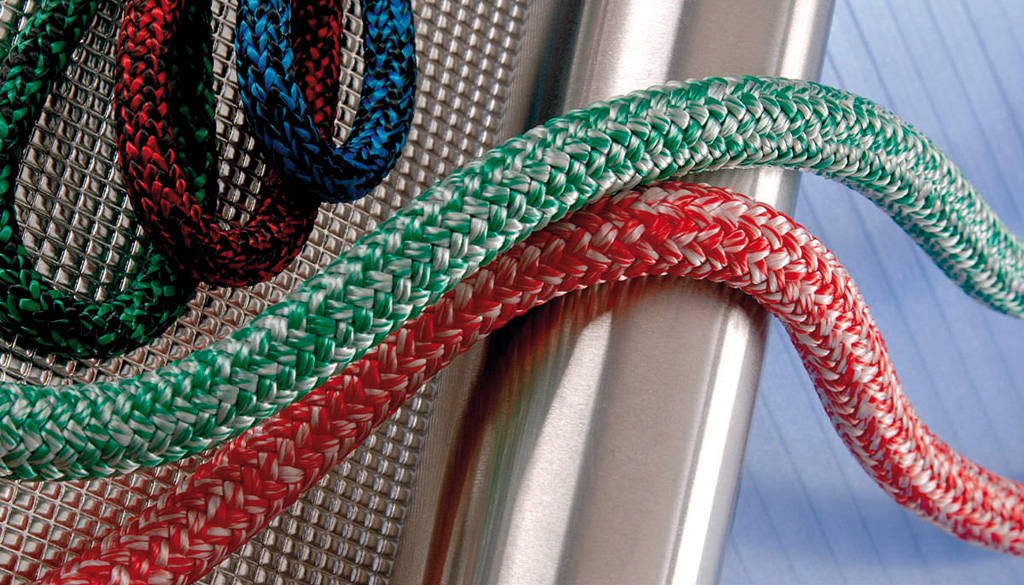
Technora Sheath / Dyneema Core
This is the Rolls Royce of ropes. It has exceptional tensile strength, making it the ideal material for halyards, particularly as it holds perfectly in modern clutches. For the sheets, which suffer enormously on the winches, a mixed sheath is preferable. In this case, Technora is replaced by a combination of Vectran, Dyneema and Polyester, which offers better resistance to abrasion and is easy to handle. The efforts made by manufacturers in recent years to produce original and diverse colors are much appreciated in making our boats look even more beautiful!
Pluses: Advanced technology, ultimate resistance, holding on cleats
Uses: Halyards and sheets
Price in 10mm: around €8 per meter
Braided Dyneema or pure Vectran
To our great delight, Dyneema is invading our decks and our rigging. Resistant, lightweight, with low elongation, and easy to splice, it has so many applications. In small diameters it can be used for lashing or securing points. More importantly, it can be used as fiber shackles or a loop for the mainsail sheet. With specific brackets, they can even make a padeye on the deck. It is the riggers’ material of choice, and you'll be eternally thankful for how much easier it makes sail handling, optimizing return angles and stopping those unbearable metal grinding noises. Now you can hear the water against your hull! In Vectra, or pure Kevlar, it is ideal for static applications, such as shrouds, runners or backstays.
Pluses: resistance, little elongation, easy to splice
Uses: deck applications for Dyneema, standing rigging for Vectran
Price in 10mm: around €10 per meter