
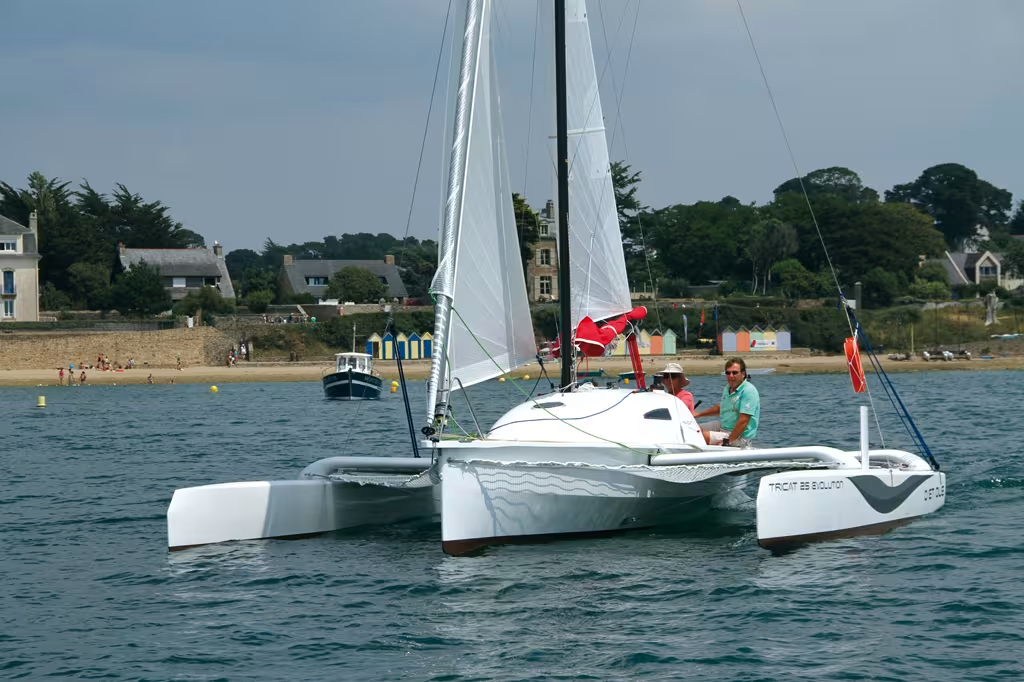


The Tricat 25, launched in 2005, was supposed to be a bit more sober, more of a cruiser than its boisterous little sister, the 22. With the new version, called Evolution, Tricat has set the bar a little higher. Antoine Houdet, the company's boss, has put an awful lot into it, as this time it's he who has designed the floats - validated by the in-house architect, Jack Michal. And not the other way round. Antoine has lost count of the number of miles he has sailed in his Tricat 25, and it was he who designed the 22, so he knows what he is talking about...
Yes, but what’s new? We find more volume in the floats, whose bows are now bevelled and inverted, crossbeams in composite, replacing the aluminum tubes – here advantage is taken of the expertise gained with the 30 – and a little more windward sail area. The mainsail’s square head is increased by 0.5m² and the genoa gains three times more. The spinnaker is also bigger. Enough modifications to put the Tricat 25 Evolution back in the game, by boosting its performance faced with the competition.
This restyling exercise will inevitably give it a second career from a commercial point of view: the builder has actually succeeded in maintaining the former price. To date, 28 examples of the 1st generation 25 have been sold, and the good news for their owners is that the sails, floats and crossbeams from the Evolution can be fitted to this first version of the new 25.
This model’s strong point is certainly its versatility. More sober than the 22, but also much more liveable, it retains great ease of transport, thanks to its folding floats. How does this work? The arms are held in place by two straps, one fixed and one free to move. The tackle which tightens the shrouds is first freed, then the moving strap’s jammer (equipped with a safety system) is opened. The forward netting is removed. Then a line is attached to the angle formed between the aft arm and the float, and pulled towards the stern. The arms are mounted on an axle and a hinge; the float comes to rest against the central hull. Folding time: less than five minutes each side. Finally, the boat in its folded configuration is 1.2m longer at 8.9m – to be allowed for, for the marina berth and transport. This configuration protects the rudder and the motor, but access to prepare for maneuvers is not easy. During the operation, the floats sink by 3cm, which optimizes the stability. We thus go from 70 liters submerged for each float, to 120.
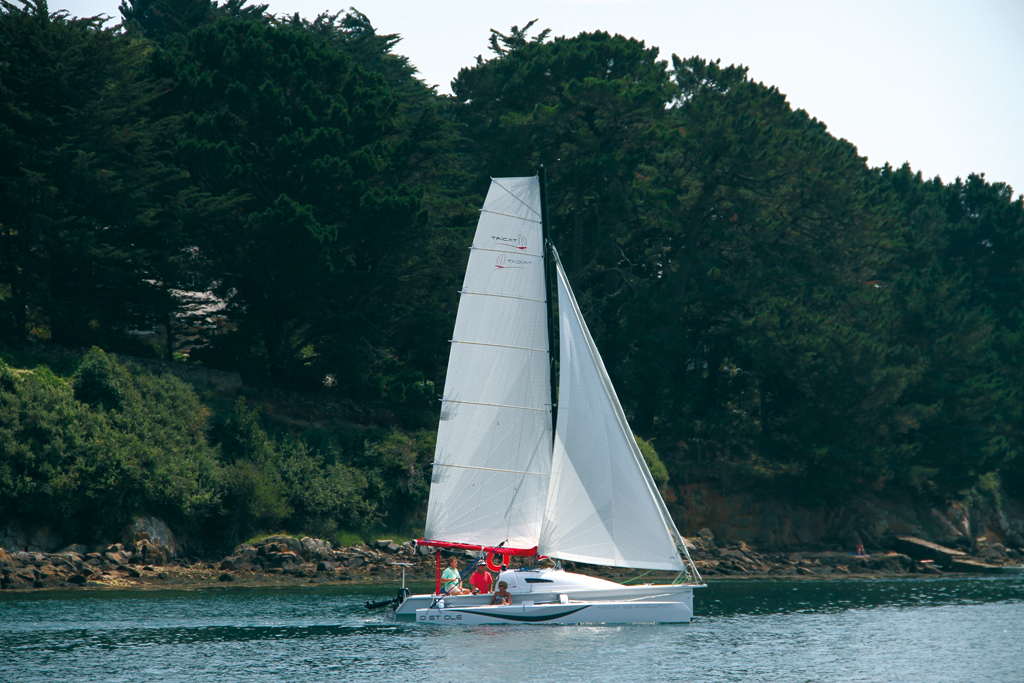
Particularly pleasant to helm, this little trimaran accelerates in the lightest of airs.
An airplane, from a force 2!
We started the engine to move off the dock, and off we went for a few legs, to discover the Golfe du Morbihan. The helmsman has easy access to the mechanics. We attached a shackle to the first mainsail slider to hoist the little square head, unrolled the jib...and off we went! Neutral helm, imperceptible wake. Yet we were sailing close-hauled (at 45° to the true wind) at over 8 knots, with a breeze of less than 10! Two daggerboards are integrated into the floats and can be controlled from the steering position. “In light weather, we leave them both down,” Antoine explained. “In strong winds, we raise the windward one for optimum balance at the helm.” With the wind on the beam, we unrolled the gennaker, catching a gust at 12 knots; the Tricat 25 Evolution sailed at the speed of the wind. It was exhilarating to overtake all the other sailing boats on the water and sail so fast in such leisurely conditions! The boat has already reached 20.8 knots. Antoine predicts runs at 22 or even 25 knots. Gosh!
The cockpit, whilst not large, offers good comfort, with two levels of seating. The saloon table can be set up outside. The mainsheet track is integrated into a polyester beam. Three lockers are provided to stow fenders, fuel tank and mooring lines. All the control lines are grouped round the foot of the companionway, with the exception of the spinnaker and/or gennaker sheets, which are led to the two winches on the coamings. The deck is appreciably wider than the hull, in order to retain a token foredeck and side decks. However, a footrest and a good foothold forward of the mast are lacking. And on the coachroof, a non-slip surface is cruelly lacking: it is not possible to envisage climbing on to it barefoot if it is wet!
The chain locker is sufficient for a Fob Light anchor and its warp. Moreover it was starting to get hot... To the beach! We raised the daggerboards and pivoted the rudder, to beach the boat gently on the sand. Disembarking via the stern is easy, but the bathing ladder seemed to us to be a bit short. When it was time to leave again, pushing the Tricat’s 800kg in 35cm of water was child’s play...
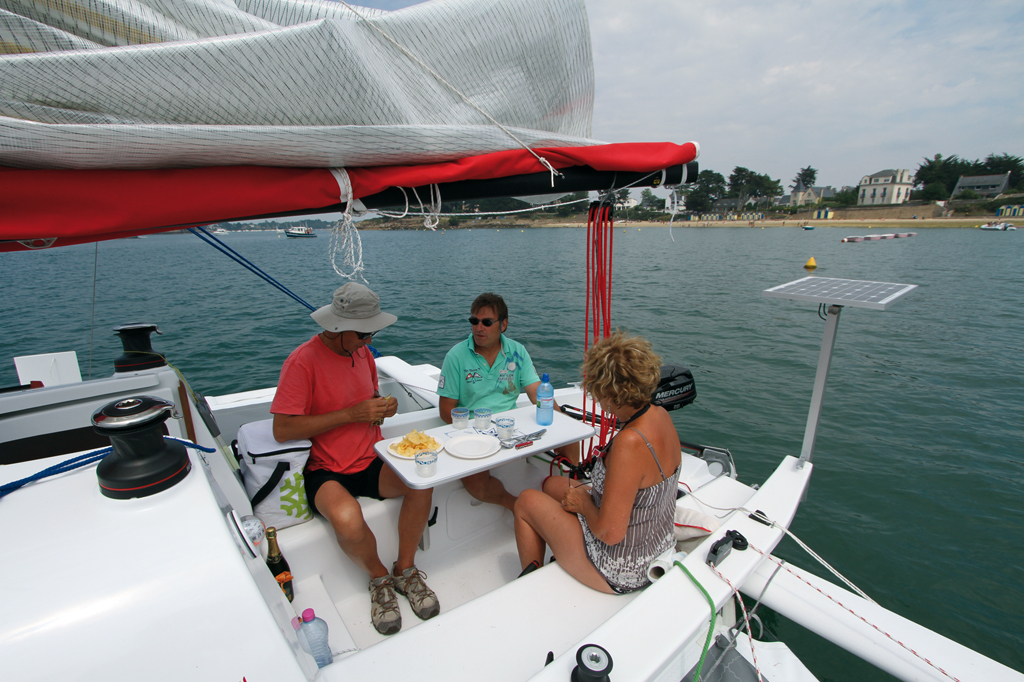
Narrow at the waterline, but a good width on deck: the cockpit is of a good size for four crew members. And then there are the trampolines for relaxing in good weather or at anchor.
Comprehensive but basic accommodation
Passing the companionway, you will discover relatively voluminous accommodation – the longitudinal steps in the hull play a large part in this. The headroom is 1.38m at the foot of the companionway. The Cruising version we tested offers relatively comprehensive equipment, to provide good comfort for the crew. The removable table – 44 by 88cm – acts as a navigation area when required, by fixing it against the companionway. We find four berths (2 meters long by 0.5 wide for the settees, 2.13 long by 1.26m wide at the head, 43cm at the foot for the forward double). A bit narrow, and the mattresses are only 5cm thick...but they are also lighter! A galley unit which slides into the pilot berth to starboard, a comprehensive electrical installation with a solar panel, lockers in wood and canvas are all fitted. As for the minor faults, we weren’t so keen on the interior finishing which is a little rough and ready, and the ventilation, which is limited to a small round porthole forward of the mast. All the same, you can live aboard as a family for a week, sailing flat and with unlimited siestas on the mesh trampolines!
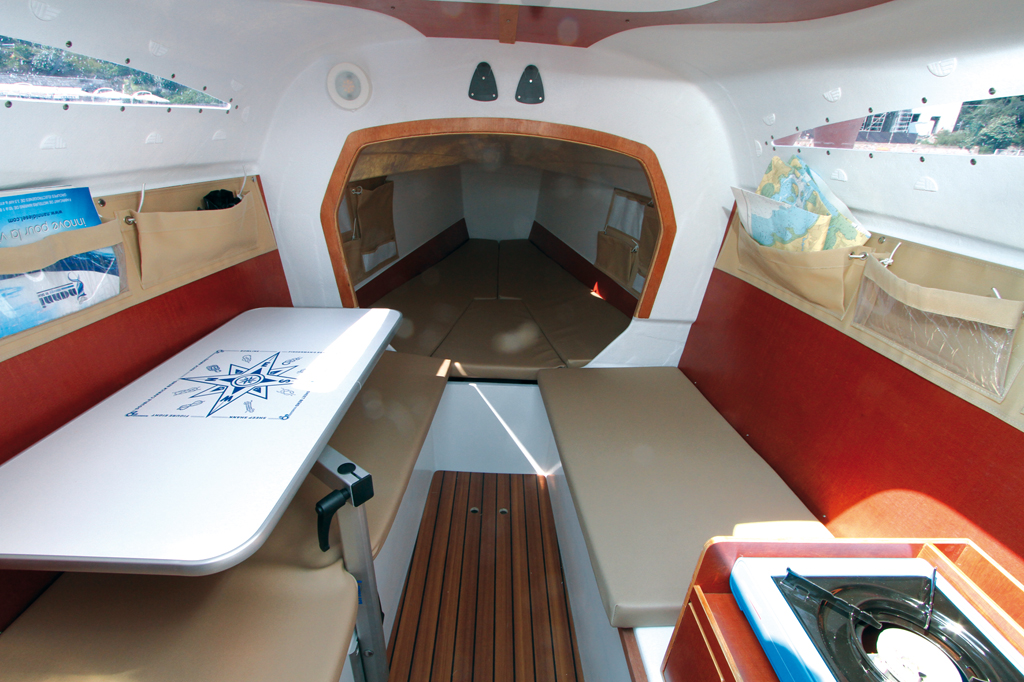
The volume is limited, but there are four good berths, a multi-purpose table, a galley unit and stowage space.
Conclusion
Sailing boats whose program is so wide are rare: quite frankly, apart from embarking for a round the world trip - and even then? - this Tricat can do everything and does it well: fast day sailing, regattas, cruises...it excels through its ease in all these programs. And the possibility of being easily transported on a trailer – the boat weighs less than 800kg and respects the trailing size limits – allows you to change cruising areas rapidly. What more could you ask for?
The plusses
Just one boat to do everything
Easily folded for transport and the marina slip
Exceptional performance
The minuses
Slippery deck forward of the mast
Almost 9m overall when folded
Comfort and finish could be improved
Technical specifications
Hull length: 7.70 m
Waterline length: 7.35m
Beam: 5.5/2.52m
Draft: 0.35/1.2m
Weight: 780 kg
Windward sail area: 40m²
Spinnaker: 38m²
Engine: Outboard, 4 to 8hp
EC Certification: C5/D7
Architect: Jack Michal
Builder: Tricat
Price: 54,900 euros inc. VAT
Main options:
Cruising version 5,000 euros inc. VAT
Spinnaker fittings kit: 750 euros inc. VAT
Asymmetric spinnaker: 1,980 euros inc. VAT
Gennaker on furler: 2,400 euros inc. VAT
Braked twin axle trailer: 5,870 euros inc. VAT
6hp long shaft 4-stroke motor: 1,800 euros inc. VAT
Carbon arms option: 4,800 euros inc. VAT