Review: 6 years on board JAMBO
A champion’s passion: research and development
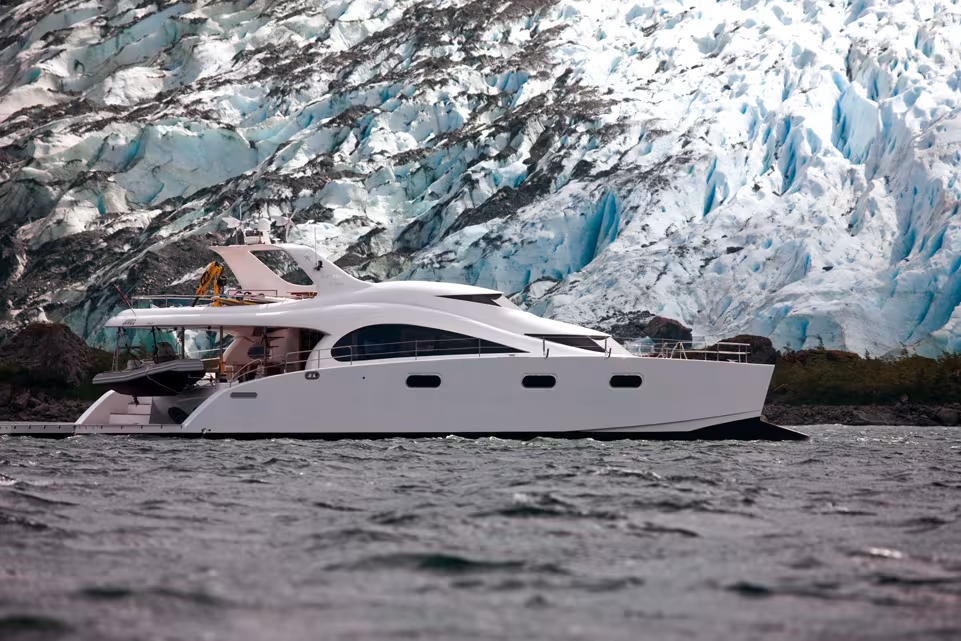
It’s in his blood! The twice-winner of the Route du Rhum and holder for 10 years of every category of single-handed 24 hour speed records is fanatical about helming, but also putting extreme vessels into action. After going over to the dark side of family motor-cruising, his passion for the challenge remains the same. Half a circumnavigation later (via the Patagonian channels), “Jambo” is now being used professionally as a diving expedition vessel based out of Tahiti and operating in Polynesia’s Leeward Islands (Raiatea and Maupiti) and the Windward Islands (the Tuamotus, Australs and Marquesas), before continuing on westwards. Already well set-up from the start (see Multihulls World No.104 March 2009 edition), the prototype Sunreef 70 has undergone two further evolutionary stages, the latter requiring six months work in New Zealand. This latest phase, described by Laurent as being economically difficult to justify were it not for its specific use also bears witness to his taste for technical challenges. This little “wandering dive school” provides excellent accommodation and top of the range equipment, and its reputation extends beyond Polynesia’s boundaries (the reconnaissance for James Cameron’s future sub-marine work was done on board!). What’s more, she is championing levels of economy (for a 60 ton vessel), and is gaining respect in all her areas of development.
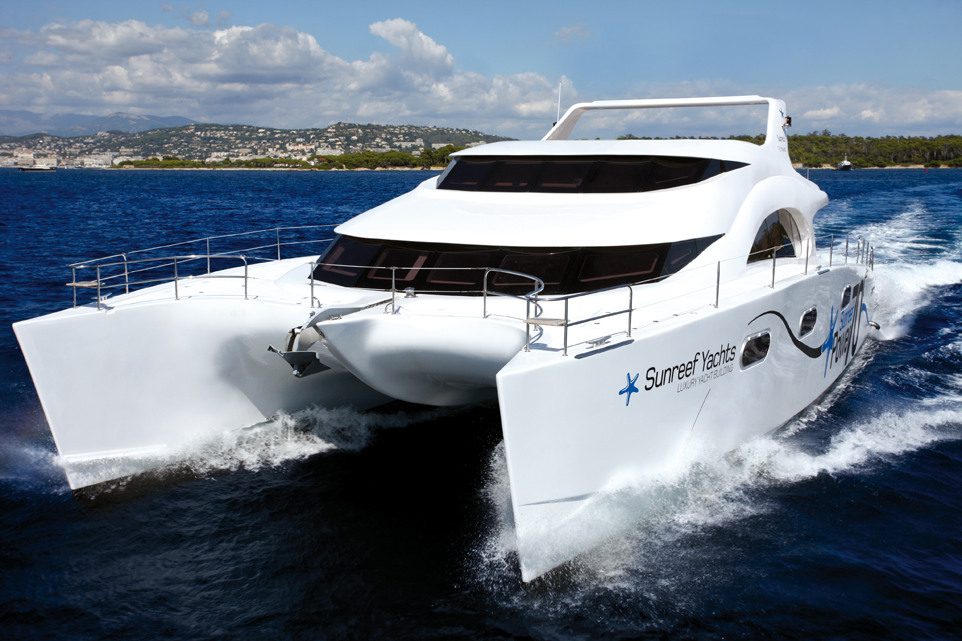
Jambo in her original form
3 stages of development
Phase 1: The evolution of a prototype
As we reported in our test in 2009, this was conceived as an experimental vessel , designed to serve as both a family cruising project, and also as a prototype for a future production model! Built in epoxy, and having exceptional self-sufficiency (20 tonnes of fuel) and significantly lengthened sugar-scoops, this special Sunreef 70 completed an inaugural tour of Europe at cruising speed (10 knots) and successfully handled its first severe weather in the Mediterranean. At this speed, fuel consumption worked out at 26.5 liters/hour with both motors at 2,500 rpm.
Phase 2: Accomplishing an expedition boat
During the voyage from the Baltic Sea, through the North Sea, English Channel, down the Atlantic coast and into the Mediterranean, the Bourgnon design team was working flat out and straight away came up with two points for optimization. The one concerned engine performance, and the other, the hydrodynamics. The two came together and led to a significant improvement in handling and economy. The talented team leader, who has a flair for finding the best organizations to work with, called on Sport Systèmes (a specialist in electronics management in motor racing). From the first live tests, the results immediately showed a significant reduction in fuel consumption following a torque adjustment at the desired cruising speed. The price to pay for this was the automatic suspension of the guarantee. Shame! The second line of evolution concerned lengthening the dynamic waterline: grafting on bulbous bows designed by team involved with the America’s Cup. This produced immediate results: passage through the water was transformed, and the combined effect of the two interventions lessened the pitching and dramatically reduced consumption, which leveled out at 15 liters/hour at 2,500 rpm, making a gain of 40%!
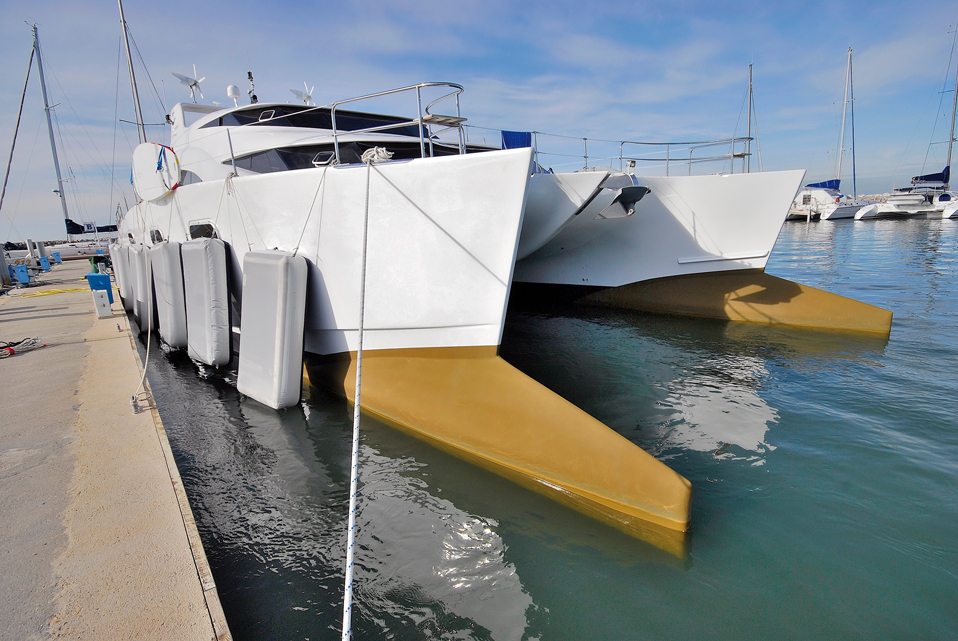
Jambo phase 2: Laurent Bourgnon had bulbous bows installed, and optimized the engine installations: the cat was now transformed…
Phase 3: A major step forward
20,000 miles and 4 years later, having crossed the North and South Atlantic, passed through the channels of Patagonia to get to Robinson Crusoe Island and then cross the Pacific without any problems on the way to French Polynesia, “Jambo” had to completely adapt to her new vocation as dive charter expedition catamaran. The skipper, not knowing how to just tinker with things, overhauled the boat to make every aspect better. The interior décor was redone, the diving system completely transformed, the motors were removed, re-located, optimized. The flybridge was significantly modified… New Zealand was the perfect spot to make all these changes. The family lived there for a year, and Laurent sought out all the necessary resources in this pioneering country. The resulting performance of Super Jambo now gave 12 liters/hour, still at 10 knots, but at 1,500 rpm! This extraordinary reduction in engine speed (1,000 rpm!) massively increased reliability and drastically reduced noise. According to the captain, “the motors are now in retirement”!
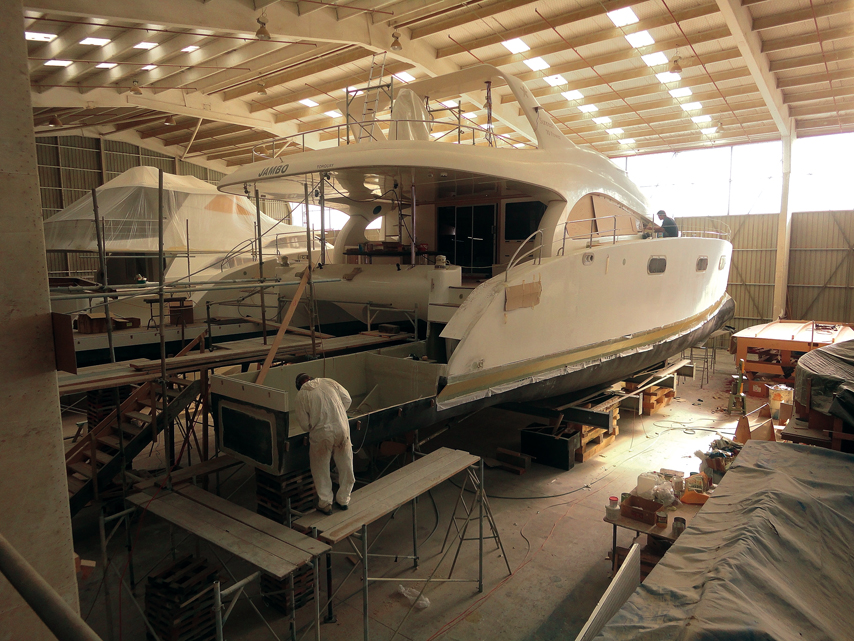
The final phase: Jambo is back in the yard for a new evolution, six months’ work for a complete transformation and adaptation to her program of yacht charter and dive expeditions.
A little analysis of Bourgnon’s solutions for evolution 3
• Fitting a streamlined hard-top on the flybridge
• The bulbous bows lengthened by 1.50 meters (substantial stiffening in the center + foam form and epoxy construction)
• The sugar scoops have been lengthened by 1.50 meters, bringing the overall length up to 26.80 meters! (as opposed to the original 21m). There are several reasons for this: optimizing the “dinghy dock” at the stern, improving the storage for diving equipment (including a 20m³/hour Bauer compressor!), improving access to the water via the retractable steps and, of course, increasing the waterline length.
• The little gullwing shape of the underside of the original bridgedeck has been transformed into a “third hull” whose bow now acts to deaden the waves from forward and also to carry more serious ground tackle, something always under-sized on yachts.
• The former rudder blades from Primagaz (former 60’ racing trimaran) have been moved aft and mounted on a very reliable Chatfield (NZ) system, which consists of cutless bearings (normally used for propeller shafts) below the rudder tubes and upper bearings made from Vesconite, which replace the costly and complicated self-aligning bearings.
• The engine installation has been modified and the motors realigned to reduce the angle of the propshaft which needs to be less than 10° (important for thrust).
• The diameter of the new four-bladed propellers, calculated by a local expert and cast by Chatfield, has been increased to… 1 meter! (Instead of 400mm… yes, you did read that right!). The performance calculated for 10 knots at 1,500 rpm allowing the motors to be governed to 2,500 rpm to avoid cavitation at the tips of the blades.
• Very simple new stern glands have been fitted, whose watertight joints are engaged in ahead, allowing quick operation without water ingress in the event of wear or leaks. (QED)
• An Aqualarm has been installed to alert in case of reduced raw water circulation (caused by a plastic bag for example) around the heat exchanger, before the system gets hot enough to activate the engine overheating alarms.
• The exhaust outlets have been modified, and now discharge below the waterline and in line with the hull, to reduce noise and improve the flow of exhaust gases towards the aft. Original, clever and very effective!
• A further stage is being developed with the Nantes-based specialist PG-SI. It will consist of installing a dry exhaust between the motor and the top of the swan-neck, then having the water injection in the downward column to reduce back-pressure at the gas outlet and to avoid any possibility of water ingress in the event of multiple attempts to start the motors.
• Final little tweak which is planned (borrowed from motor racing): cool air sucked from the flybridge (at 25°C as opposed to 50°C in the bilges!) blown via a compressor and custom-built air box, the turbo chargers will love this and it’s great for performance and reliability of the Volvo D6s which have now done more than 5,000 hours, yet are like new!
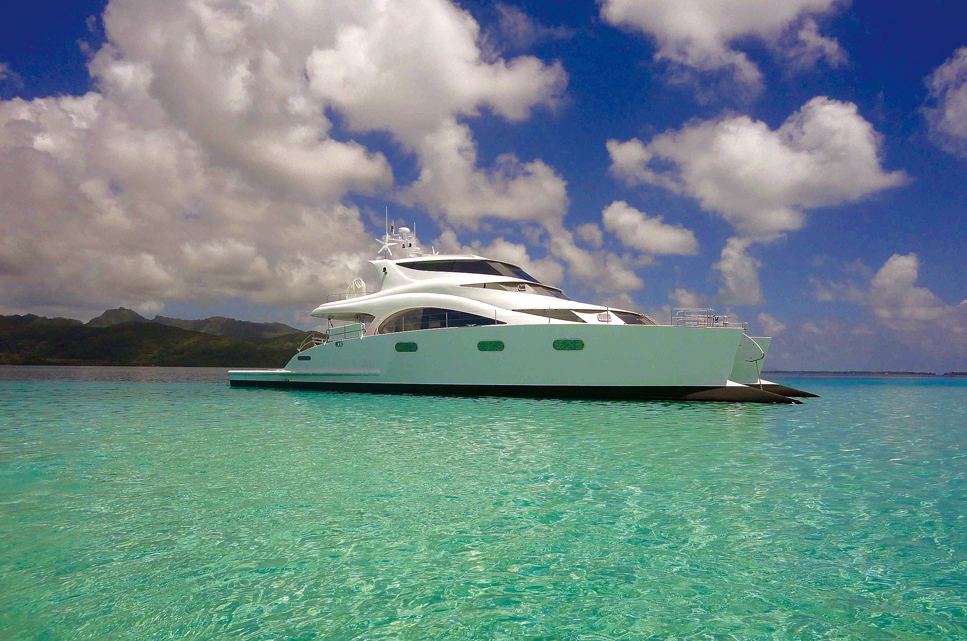
The results are impressive, and the profile shows the development of this machine. The third hull, the covered flybridge and the incredible bulbous bows are the most noticeable things, but there have been other developments…
Laurent Bourgnon’s Conclusion
The future of highly self-sufficient cruising catamarans (and therefore at moderate speed)lies in optimizing displacement hulls, propellers, engine function and reducing weight of superstructures and fittings (it’s better to have a carbon platform rather than more powerful motors). Also important is increasing the waterline length. To go fast you need to get a boat up on foils; every compromise between the two options is poor and you only succeed in using fuel to push water along!
A word from the First Mate:
I am the mother of four children (Jules was 15 when we set off, Justine 12, Basile 6 and Lou 4) This meant a long time preparing for the trip, between bedding, toys, books, organizing the home-schooling lessons… the boat may be big, but there are limits!
Departure day was filled with emotion: we had to say goodbye to the family and friends, and once we had left the dock, we knew we were underway for a great family adventure! Of course it was simply wonderful, as I was with my husband and my four children. The choice of this large boat was entirely justified, there being six of us, it was important that each of the children had their own cabin, particularly the teenagers. So volume was what we needed, and for me, having never sailed, a power catamaran was the best solution. In case anything was to ever happen to Laurent, it seemed easier to me to get a motor boat back to port than to have to try and handle sails. Life on board was organized around schooling: the children worked three hours a day (depending on the sea state) so as to be ahead in their program by the time we reached shore, because they really looked forward to donning masks and snorkels and diving in, or going on hiking trails or doing a bit of windsurfing! We made some great friends ashore among the locals and also with crews of other boats, with whom there is generally a great solidarity. One day we met a math teacher, who was able to help the older kids, then a French teacher who helped with a dissertation, but not forgetting the sundowners we enjoyed where everyone recounted their travels, their adventures and tales of people they had met. We are now so glad to have been able to offer our children the chance to meet people from different countries and discover their foods, traditions, architecture, culture and languages. I really think there’s nothing more enriching in life than travel, and I think it has made our children so much more open-minded. For the rest of their lives they will remember hunting pigs in the mountains of the Gambier Islands, the glaciers of the Patagonian channels, fishing trips and swimming with sharks and whales. There’s also the times when there was bad weather, bumps and bruises, long hours of work on the boat, seasickness (particularly for me), but all that is insignificant compared to the enjoyment of our life on board together!
The two older children have now left us to continue their studies, but I know that they still have a love of travel and discovery. After five years in French Polynesia, our thoughts are turning towards continuing on westwards. I am grateful to our captain who has given us the opportunity to live this fantastic family life, to my children who helped their completely non-seafaring mother and to our magnificent Jambo who has carried us across the oceans.
Caroline Bourgnon
SUNREEF POWER EXPEDITION TECHNICAL SPECIFICATIONS
Naval Architect: Sunreef Design Office/L.Bourgnon
Builder: Sunreef Yachts, Gdansk, Poland
Length: 26.40m (production model 21.40m)
Beam: 9.30m
Weight: 40t
Displacement: 60t
Construction: foam sandwich/glass/epoxy. Production model foam/glass/vinylester
Motors: Expedition version Volvo D6 2 x 370hp, standard version Cummins 2 x 455hp
Diesel: Expedition version 2 x 8,000 liters, standard version 2 x 2,500 liters
Batteries: 12 at 24V giving 1,200Ah
Generator: 19 or 27 KVA + 2 wind generators
Anchoring: 24V-3,000w windlass + 60kg Fob anchor + 80m of 13mm diameter chain
We suggest reading the following additional boat tests
(available individually on the magazine’s website or on our DVD of boat tests)
MARYLAND 37 Multihulls World n°51
LAGOON Power 43 Multihulls World n°57
QUEENSLAND 55 Multihulls World n°115
SANTORINI 65 Multihulls World n°60
ÉTOILE 65 Multihulls World n°134