


You were perhaps expecting a more ‘sexy’ beginning, but let’s be practical right from the start – if you want to get out of the port, THE ENGINES HAVE TO WORK! And for this, they have to start. Checking that the batteries are in good condition is one of the simplest actions. Whether they charge well when the engine is running is a second important action, especially if you decide to change them.
In any case, to go cruising with maximum serenity, plan on a minimum of a full service: oil change, oil, air diesel filters, impeller, belts. You can already budget for 800 Euros (inc. VAT) per engine. If your machines have run for a lot of hours, you must ideally add to this basic work the replacement of the rubber engine mounts, having the injectors and valves calibrated, and servicing the gearbox, which should lead to an extra cost of around 2,000 Euros (inc.VAT) per engine. With a bill of this size, if other work is to be carried out, it is perhaps best to make a fresh start with a replacement (reconditioned engine for around 5,000 Euros per engine) or a radical exchange for new engines, but the bill will then rise to over 12,000 Euros per engine.
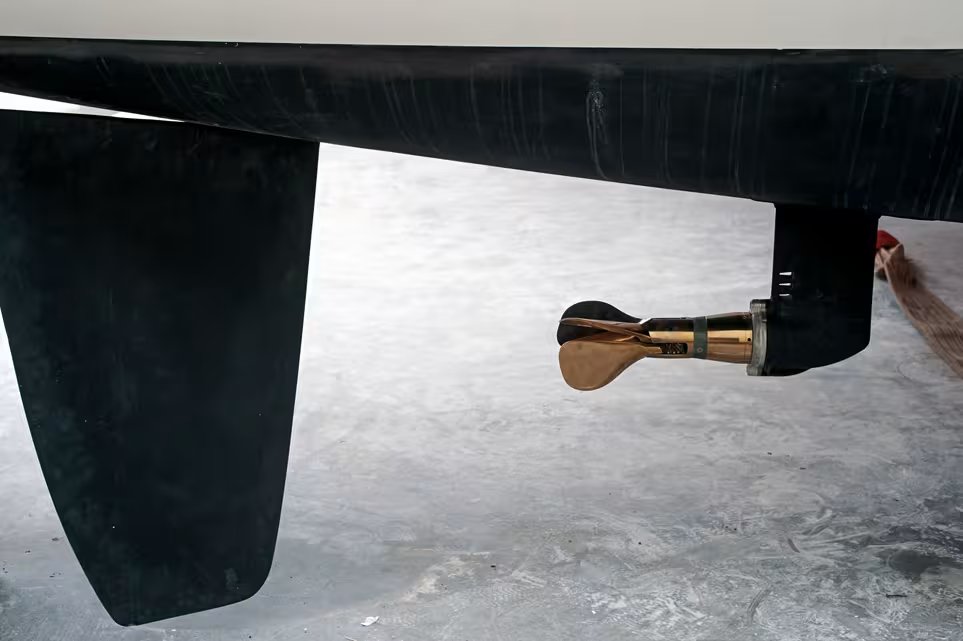
On a second-hand boat, many purchasers are tempted to replace their engines with more powerful models. Even though originally the builders actually offered two engine options, the least powerful can’t be completely unsuitable. In fact, not to state the obvious, but it isn't the engine which propels the boat, but- the propeller! Before launching into the perilous and costly adventure of changing the engines, we would strongly advise you to look into fitting a more high-performance propeller. For a fraction of the price of more powerful engines, you can fit a top of the range variable pitch propeller, which will give you extra power, notably astern, and lower consumption (500rpm less for the same speed is very realistic). Compared with fixed propellers, they offer much less drag under sail, and their adjustable pitch allows them to be adapted to the situation: a long crossing in flat calm conditions, or short legs against the wind in a choppy sea. At around 2,000 Euros each, this is a good investment.
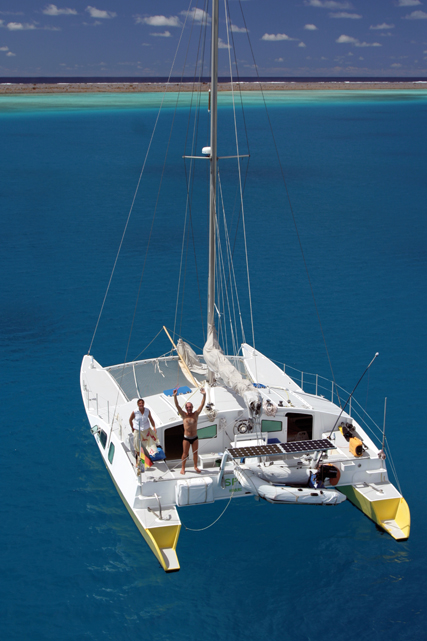
After a good service and excellent preparation, a second-hand boat could take you to the end of your dreams…
Now that we are ‘out of the port’, it’s time to look at another ‘motor’ - the sails! But of course from a safety point of view, we must start with their support, THE RIGGING. A simple visual check will confirm that the spreaders are in good condition, with no cracks, and are not being pushed into the mast. If the boat is very old, you will have to change what we call the diagonals. If the shrouds are more than ten years old, you mustn’t hesitate to change them. Moreover, this is often an obligation which appears in your insurance contract. Finally, if there is the slightest doubt, the forestay, which is subjected to torsion by the roller furling gear, must also be replaced. Allow a budget of 10,000 Euros (inc. VAT) for all of this work.
Once these important preliminaries are out of the way, it’s time to enjoy yourself! In the ‘SAILS’ DOSSIER, there are two aspects: replacement of the basic sails (mainsail and genoa) and optimization of the whole, by the acquisition of additional sails, to suit the weather conditions expected in your program, and with updated materials, shape and accessories (furler, roller reefing, snuffer...) Because it’s no secret, although the technology (reliability and performance) is much more than a pretext, the aesthetics of nice new sails in high-tech materials play a large part in the pleasure and pride of sailing your beautiful boat, don’t they? But even if we can’t remain reasonable, let’s try at least to be as rational as possible. The original Dacron sails, if they have been well protected from UV, are almost indestructible in their structure, but the profile suffers very quickly. Especially as the roller genoa and the mainsail have to cope with all weather conditions, and partial reduction when the wind freshens encourages very asymmetric distortion. To put it simply: if your sails are less than five years old, a simple renovation will probably be sufficient. Over ten years old, and for an offshore program, a change must be seriously envisaged. Between the two, everything depends on the budget you are prepared to dedicate to them, and your priorities. Let’s go mad, and change them all! For the two flat sails, three materials and three budget levels are possible: between the traditional Dacron, an upgrade to diagonal cut Hydranet-type, or even falling for the now very hard-wearing membranes, we would vote without hesitation for the intermediate solution: performance, strength, aesthetics – all for a still reasonable budget, you will have a beautiful mainsail/genoa combination.
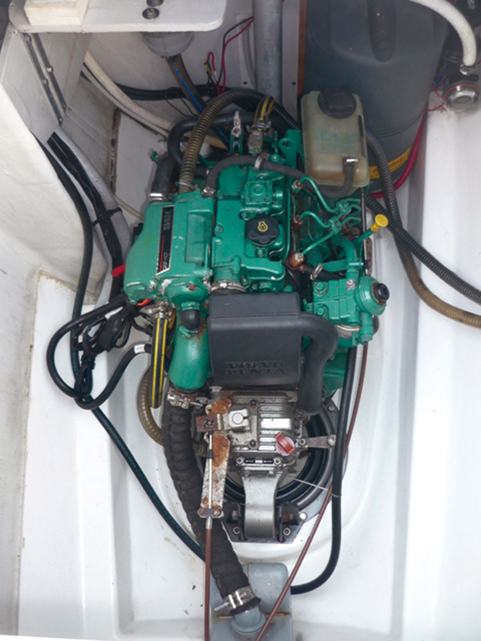
The engines must be perfectly checked and refurbished, for your safety and comfort!
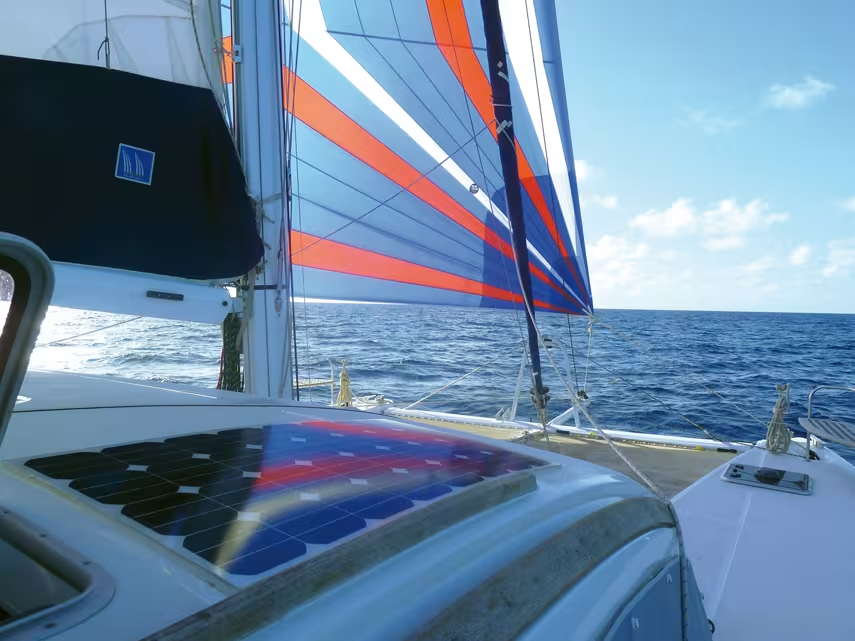
To complete this idyllic picture, and if your multihull isn’t equipped with a gennaker, this is THE sail to acquire as a priority. Easy to use, thanks to its endless line furler, it is versatile – from 60 degrees to the apparent wind in the lightest of breezes, up to 25 knots downwind, or even with the wind almost dead aft (around 155 degrees) for long crossings, once the tack is moved from the central bowsprit to the windward bow. Allow around 8,000 Euros (inc. VAT) for the sail and its furler.
Furler...AND WHAT IF WE HAD A LOOK AT THE FITTINGS? First glance at the genoa roller reefing gear. Although the drum doesn’t often give problems, you must on the other hand check the junctions between the aluminum tubes meticulously. They have a lot of strain put on them, and any play here will invariably leave a black mark on your sails, an irrefutable clue that it is time to do something, before the whole thing is reduced to a jigsaw puzzle. There is a risk of serious damage to your sail, or even finding yourself in the unfortunate position of being unable to roll up the sail at a crucial moment. The screws, aided and abetted by time and a salty environment, will without fail have become an integral part of the profiles and junction plates. Welded. It is best to start again, with new profiles and junction plates. A few hundred euros. Less painful, given the price of a complete new set-up, and the peace of mind you will have knowing that these crucial parts are brand new.
Even more important, before casting off your MOORING LINES, a good refit will also provide a completely reliable, even slightly over-sized, anchoring system. Windlass, length of chain and anchor of a size beyond criticism – 2,500 Euros which you must above all not hesitate to invest.
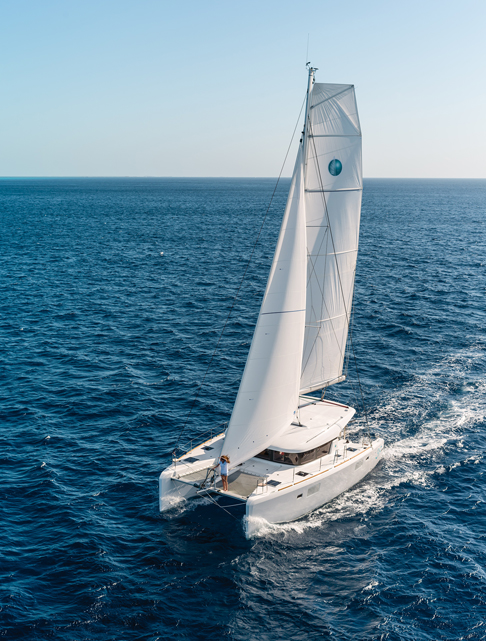
The choice of sails is essential: shape, cloth, cut... You will have to choose according to your program and...your budget!
Now you are ready to sail far and fast. The last thing you can do to make life more pleasant is TO MAKE MANEUVERS EASIER. If the winches are worn, don’t hesitate to replace them with bigger models. You will congratulate yourself each time you gybe, change a sail or tack. If you have a bit of your budget left over, note that here at the magazine, despite our youth and puritanism, we would not say no to the presence of at least one electric winch aboard. For example, for the mainsail halyard. But which you can also use for the reefing line, a sheet, or even from time to time, a mooring line. Your biceps will thank you. Don’t hesitate either to replace any ancient blocks with the latest models, again oversized – you will save yourself a lot of energy. As for the halyards, replacing the standard polyester with Spectra, or even if possible installing a 2:1 system for the main halyard are reasonable investments for comfortable sail-handling, which you will really appreciate in the long term. To please the eyes, and for some nice photos, a new lazy-bag for the mainsail will be the icing on the cake.
TALKING OF COMFORT, there is one element which has only recently become necessary on our cruising boats, one which purists have for a long time avoided and which fanatical weight-savers continue to find unappealing – the rigid bimini! Between a basic structure and one reinforced with carbon to keep the weight down to a reasonable level, the prices vary by a factor of 3 (from 6,500 to 18,000 Euros inc. VAT), but the protection, the access to the boom and the possibility of fitting solar panels are really incomparable. If you can afford brand-new cockpit cushions (from 3,500 to 5,500 Euros inc. VAT for the cushions and backrests, depending on the length of your seating and the material chosen), the comfort of the most modern catamarans is yours!
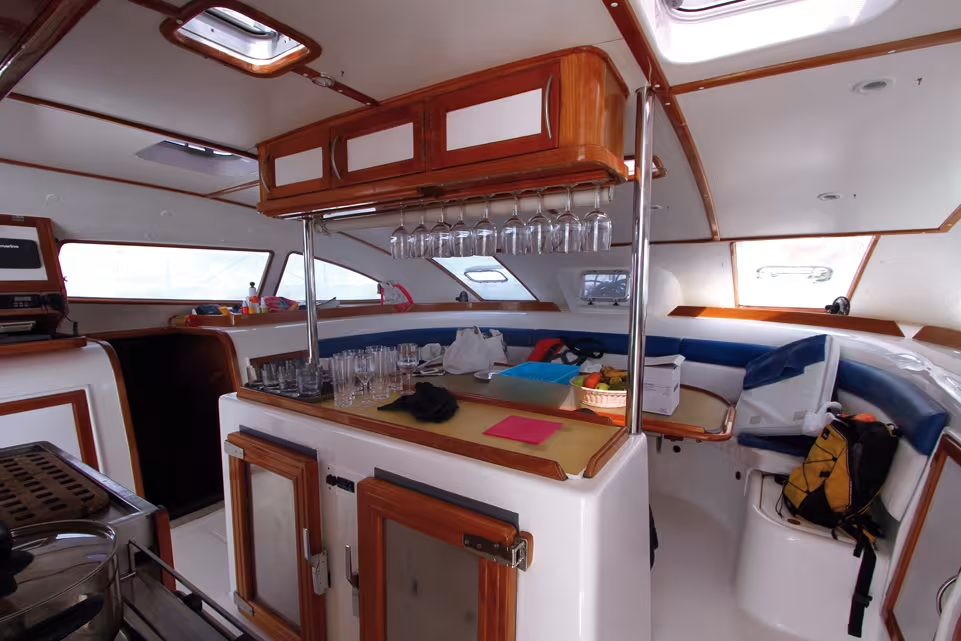
Once inside the boat, two areas must be studied: the technical and the accommodation. For the latter, the prices can vary significantly from one boat to another, but don’t forget to allow for headlining replacement, re-varnishing or painting if this is necessary. The technical choices are more rational; there are no less than four subjects to be tackled:
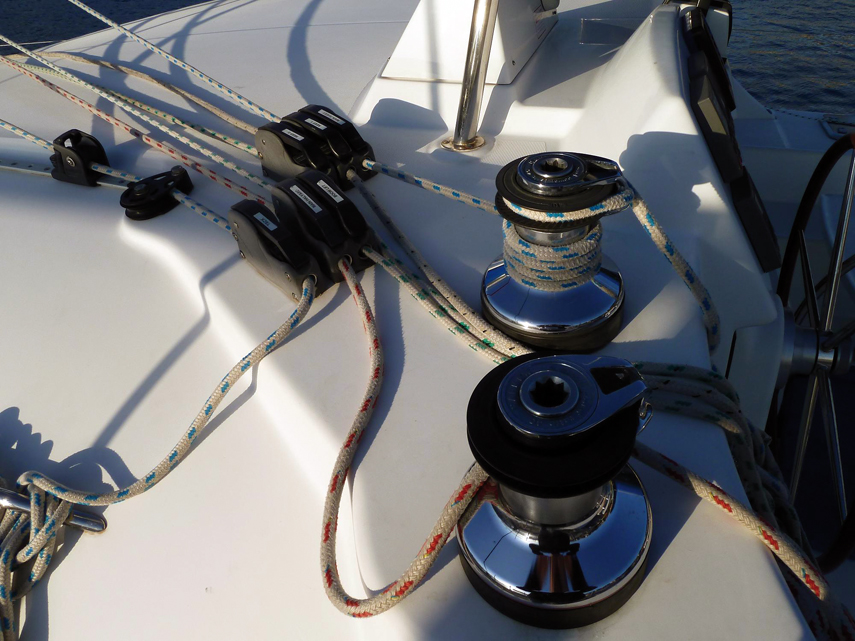
The winches also deserve an in-depth check. And if you have to change them, it is perhaps the opportunity to fit bigger ones and modify the deck layout…
1/ The electricity:
Beware, if the circuit is ancient, the bill may prove to be steep. Ideally you will merely check that the charger is of the correct size and in good condition, potentially invest in a good inverter, and above all ensure that the shore power system is well protected by a differential circuit breaker. Otherwise, a fairly cheap upgrade will be necessary. In any case, careful diagnosis of the domestic battery bank will be necessary. If your boat is equipped with classic batteries, the odds are that you will have to change them. So why not increase their capacity a little, and above all, opt for AGM technology. For less than 2,000 Euros inc. VAT, you will have 660 Ah, with better performance. If their excess weight bothers you, there is always the possibility of changing to lithium. A ‘must’, certainly, but at over 10,000 Euros inc. VAT, not to mention all the specific peripherals that you will have to change without fail (charger, alternators, regulators...). Simpler, and extremely efficient from a consumption point of view (divided by 5) and thus battery life, change all the halogen or filament bulbs aboard for their led equivalents, which in addition will last up to 20 times longer. Well worth a small investment. And this applies equally outside, for the navigation lights. With latest-generation solar panels. At 500 Euros per 130W rigid panel with back contact technology, it would really be a shame to deprive yourself of an energy source which is as clean as it is inexhaustible.
2/ Water:
For the overall circuit, if everything works...don’t touch anything! As with the electricity, if you launch into replacement of the whole circuit, you don’t know where the expense will stop. At worst, if you have doubts, change the water heater, and take advantage of the opportunity to increase its capacity slightly. Whilst on this subject, for a long-term voyage, a watermaker has become essential. Second-hand equipment which has run regularly is the best guarantee of good operation. If it has been unused for several months, changing the membranes will prove to be essential. For a new machine, a 100 l/h watermaker admittedly costs 12,000 Euros, fitted, but this is the price of long-term independence! Finally, a significant development in the past few years concerns (excuse this triviality) the WCs. Firstly, electric toilets are no longer taboo aboard. They are proving to be more and more robust, even more reliable than manual models, and above all much easier to use by crew members who aren’t familiar with the subtle ways of the hand pump, the levers and the valves to be opened or closed, depending on where you find yourself in the delicate flushing process. Quiet, economical in their use of both energy and water – if you can’t resist (1,500 Euros inc. VAT each) you could even treat yourself to the luxury of plumbing them into the fresh water circuit. Heresy? No. As we have seen previously, their water consumption has been optimized. Fresh water will protect their mechanism, and above all, now that they are almost systematically linked to black water holding tanks, it will reduce the foul odors. Because if your boat isn’t equipped, we cannot advise you strongly enough to fit at least one black water holding tank per hull (1,500 Euros inc. VAT). Failing this, you will be denied access to more and more areas in the world. With a simple three-way valve, the toilet will also be able to operate with sea water, to save fresh water on long passages, when it will drain directly into the sea.
3/ The electronics:
it’s not always easy in this particular case to separate the fads from the real safety elements. Two pieces of equipment are crucial in this field: a good automatic pilot with irreproachable reliability, and a chart plotter at the steering position. Beyond this, you are free to please yourself, but whether the boat speed, depth or the wind angle are displayed on the latest generation screen with a refined design, or on displays which are a bit dated, in the end all that is really important is the quality of the information provided.
4/ Comfort equipment:
New hotplates or a new sink only represent an expense of a few hundred euros, and will refresh your galley in an instant. More expensive, but something which you mustn’t hesitate to change as a preventive measure if you have the slightest doubt – the refrigerator is the vital organ of a cruise or a successful ocean crossing. For the latter, a small freezer is better (less than 2,000 Euros inc. VAT, fitted) and will allow you to vary the menus by incorporating some nice meat from time to time, and preserve the product of a miraculous fishing session for less fortunate days. If you plan to spend the winter north or south of the Tropics, a little diesel heater will allow you to get warm, and above all, to dry out what has become your ‘home sweet home’. Finally, slatted bases under the berths, new Bultex mattresses and brand-new soft furnishings in the saloon will complete the process of rejuvenating your treasured boat, whilst guaranteeing you deep sleep!
There you are, all that remains is for you to get out the calculator, add up what you are envisaging, and do your accounts. Well? Whilst the multihull market is suffering less from the crisis than that of sailing or motor monohulls, the second-hand offer remains abundant, and prices are becoming ‘almost’ reasonable. So a refit is an option to be envisaged seriously, if you tackle it methodically and with plenty of time ahead of you. If in addition you are lucky enough to be a reasonably good handyman (or woman) you can save quite a few expensive labor costs. Ah yes, one last thing, before we are criticized for it, we haven’t mentioned osmosis. Curious in a ‘refit’ dossier? Yes and no. We have a strong conviction on the subject: no boat has ever sunk following an osmosis phenomenon, even a serious one. It acts as a powerful psychological brake on transactions, but technically, squandering tens of thousands of euros on a treatment seems to us to be heresy. We would prefer to invest much less in a beautiful decoration. With adhesives, the possibilities for customization, or even changing the color of your hulls completely, are now infinite. Structurally, this will not provide anything more than an osmosis treatment, but you will enjoy looking at your superb and unique boat!
(All prices are given for information only, for a 40 - 45 foot boat - Ed.)
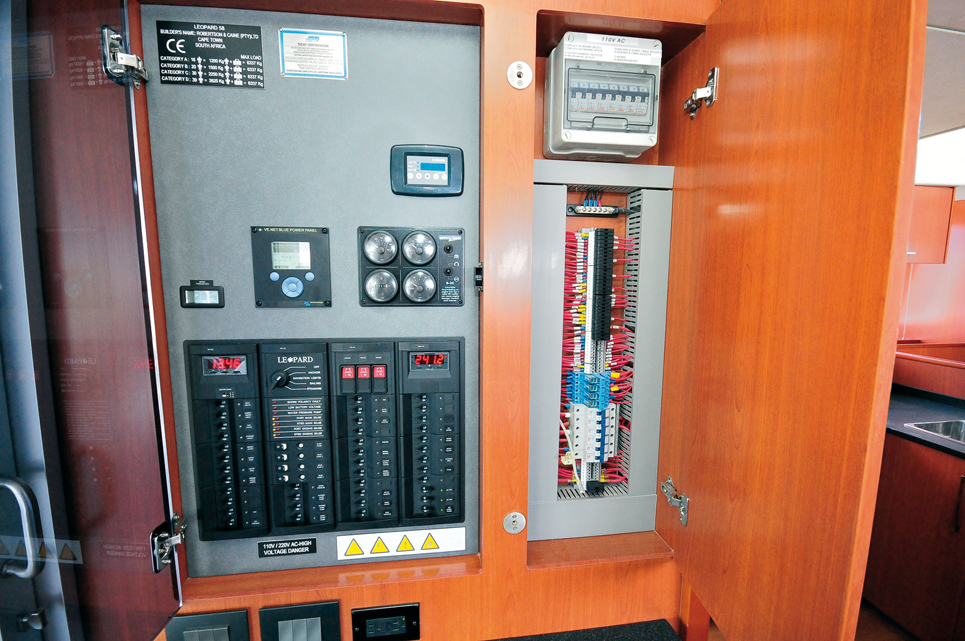
Behind the electric panel, numerous wires, connectors and other strange objects are hidden, which don’t necessarily enjoy life in a damp atmosphere. It's essential that you check them!