
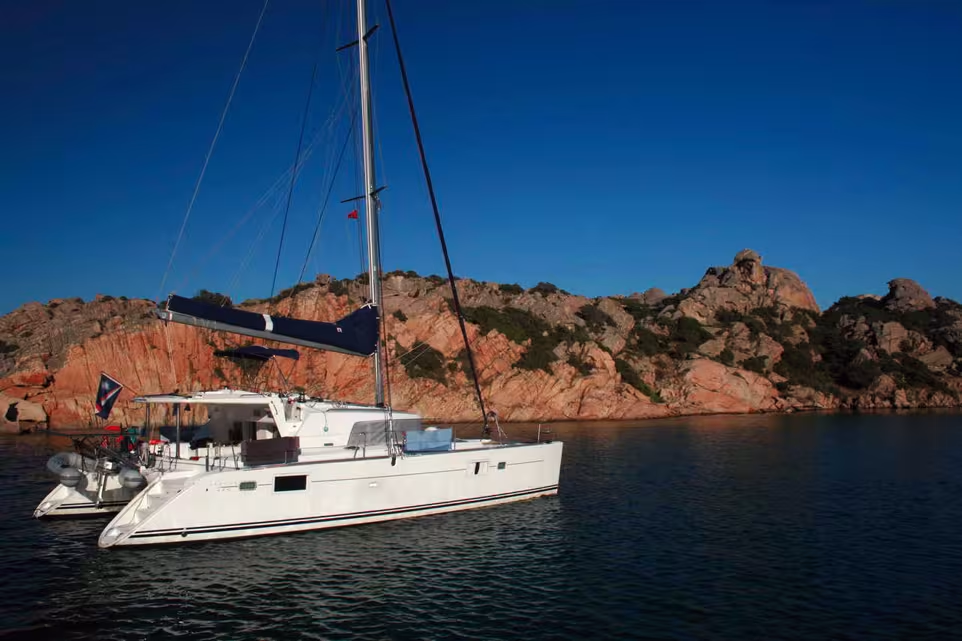

For our round the world program, we wanted a floating home, with water, electricity and...the internet. We wanted a permanent, fast and cheap connection, and we also wanted this connection to work in the remote anchorages which we prefer to expensive marinas.
For voice communication between ourselves, we use the VHF. Apart from the fixed VHF aboard, we have 2 waterproof portable VHFs (which are part of the watchkeeper’s safety kit – a man overboard could guide the boat to them, even at night). We also have 4 walkie-talkies, which we bought in a department store for 30 euros a pair. Their price/size/weight ratio is much better than that of the VHFs, but their performance is not as good. They are very useful with the children, who have a tendency to clutter up the airwaves...
For local voice communications, we use the GSM telephone. To call Europe, depending on the person we are speaking to, the time, and where we are calling from, we use Skype, the GSM or the Iridium.
For the internet, we have chosen wi-fi and the GSM, and ruled out the SSB and the satellite connection from the start - the first for its archaic bandwidth, the second for its prohibitive cost. We invested in an Iridium for emergencies and ocean crossings. It allows us to receive weather files, e-mails in a degraded form, and make calls in case of an emergency on the high seas.
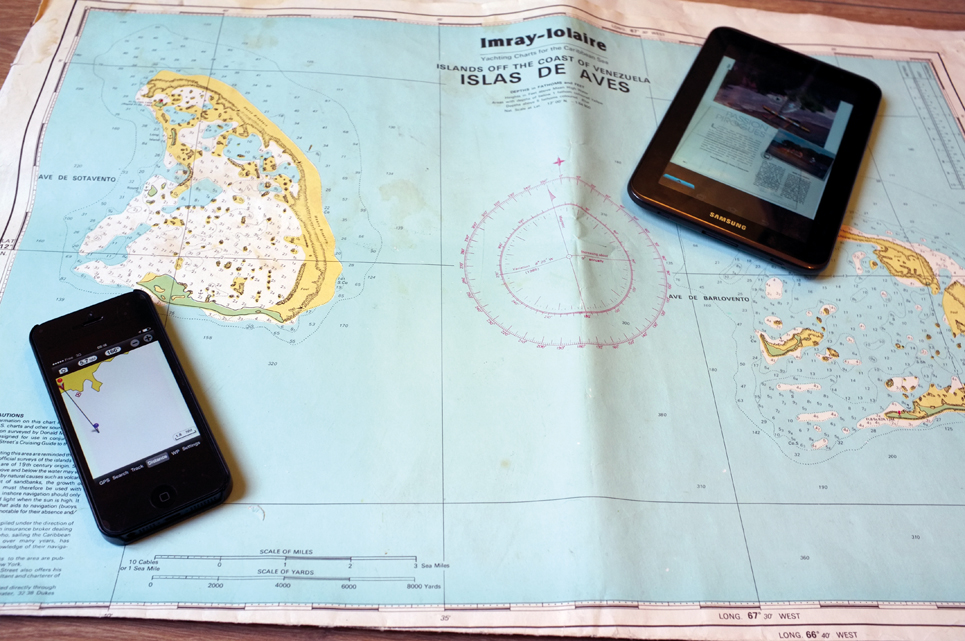
Remaining connected aboard: it’s easy with the modern tools.
There are therefore two solutions for the internet aboard, and we use them alternately: the GSM telephone serving as a hot-spot, and the wi-fi, which is obviously preferable when it is available.
Before examining these two options, let me explain how we use them. We have two PCs aboard, (one of which is permanently connected), a tablet and a smartphone, which serves as a hot spot. We are two adult users, and are well aware of things which swallow up data. Our e-mail volume is moderate, but we surf intensively. We try to avoid video and skype, especially with the GSM connections. Our total GSM consumption is in the order of one gigabyte per week, the major part of our traffic (>90%) coming from browsers and e-mails.

Pierre, a connected reader, gives us his tricks for surfing cheaply when blue-water cruising.
Controlling consumption
We have disabled all the automatic updates, particularly those of Windows which are very disadvantageous in terms of volume. We leave aside Facebook, Skype, Dropbox and other sharing tools, where just the ‘handshakes’, even in inactive mode, consume more than all the rest. We use Outlook (it’s not the most economical tool in terms of network traffic, but effective tools which function off-line are becoming rare) in off-line mode, and only download the e-mail headings, so we can delete those which we won’t read, directly on the server, and not download them. We manage two e-mail accounts, one for daily use, the other for registration for web sites and internet services, which will therefore receive spam and will be consulted differently. We configure the wi-fi connection of the tablets so that they are inactive when the tablet is in stand-by mode. For all these reasons, we don’t give details of our hot spot to our visitors, as we have found through experience that our credit is exhausted in a few hours...
As for pre-paid offers, the majority of operators manage them in the same way: there is a credit which can be recharged in tobacconists and other shops displaying the operator’s logo. Then, once the credit is ‘on the telephone’, you have to ‘purchase’ minutes of conversation, SMS or (what is of interest to us here) data with this credit. These different offers make the comparison between operators impenetrable, and this is their aim, as they all use the same technology, and even share a common infrastructure. It is essential to understand the chosen operator’s data tariffs, otherwise the few euros advertised can quickly become a few hundred euros...
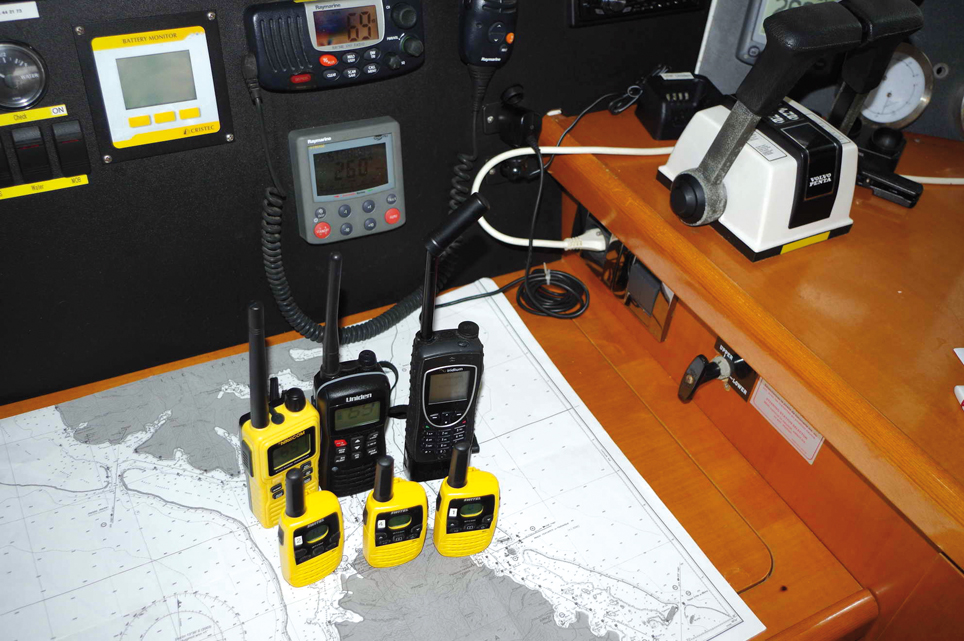
The 3 VHFs, the Iridium and the 3 walkie-talkies (the 4th died in the port).
TABLE KEY
Date: period of use Bandwidth: download speed (web pages, e-mails,...): 5 = as for a fixed line; 2 = frequent unsuccessful connections for ‘time-out’ reasons Availability: 5 = permanent connection; 2 = frequent internet unavailability despite a GSM connection. Coverage: 5 = total coverage of the territory visited First purchase: ease and time spent for the first purchase and the signature of the contract. Tariffs: clarity of the tariffs. Price: based on the tariff plan most appropriate to the consumption mode (4GB / month). €/GB: effective cost per gigabyte, excluding voice calls.
Comparison of pre-paid data offers
Country Operator Dates Bandwidth Availability Coverage 1st purchase Tariffs Price: €/GB Overall marks
France SFR 03/13 to 08/13 3 3 5 2 5 Approx. 15€ per week 15 3
Italy TIM 07/13 5 5 5 4 5 70€ for one month 16 4
Spain Vodafone 08/13 to 11/13 5 4 5 2 1 1,2 GB 15 € 13 3
Martinique Digicel 12/13 to 01/14 4 3 5 5 3 500 MB 10 € 20 4
Guadeloupe Digicel 02/14 2 2 5 5 3 500 MB 10 € 20 3
Grenadines Lime 12/13 to 01/14 3 4 5 5 5 2 GB 60 $EC 8 4
Antigua Lime 03/14 5 5 5 5 5 2 GB 69 $EC 9 5
St-Martin and St-Barth Dauphin 03/14 to 04/14 5 4 4 5 4 39€ unlimited no calls 9 4
BVI Lime 05/14 to 06/14 5 4 5 5 5 2 GB 35 $US 13 5
Panama Movistar 07/14 3 5 3 5 3 15 $ 2 weeks 5 4
USA T-Mobil 08/14 2 2 2 3 4 100 $ one month 17,00 3
The above table shows a comparison of the pre-paid offers based on our observations (inevitably subjective). Here is what emerges from our experience:
1) France – Cote d’Azur: off-season, the offer is very good, but deteriorates in July and August. Creative administrative complexity. On the other hand, the tariff plan is clear.
2) Spain (Balearics and Canaries): very complicated implementation. Impenetrable tariff plan. We had to buy 3 different SIM cards, one for data, one for local calls and a third for calls outside Spain.
3) Sardinia: the whole of July; apart from a certain delay in the SIM card coming into service, everything was remarkably simple.
4) Martinique and Guadeloupe are covered by the same operators. Whilst the service in Martinique was satisfactory, it was poor in Guadeloupe. We must also point out that our cruising area was limited on the two islands: Martinique – mainly Le Marin and St Anne, whilst in Guadeloupe we remained between the Saints and Saint-Rose, with a 10-day stopover in Deshaies. Overall, the availability of the data services on the 2 islands was poor, given what we had experienced elsewhere.
5) Grenadines: this was the least developed network on our route.
6) Antigua: we stayed for a month and moved around a lot. Given the price, it was far and away the best service we encountered, worthy of a European capital.
7) St. Martin and St. Barth: the only unlimited offer. The availability and coverage are poor in the Dutch part of St. Martin, contrary to what is advertised. The tariff plan is simple, but it seems to be impossible to have data and voice with the same SIM card.
8) BVI: very good offer, excellent coverage on all the islands. The only connection allowing video on Skype.
9) Panama: very good service on the Pacific side. Choice of operator according to the coverage in Shelter Bay Marina at Colon. Movistar wouldn’t work in the San Blas. Incomprehensible tariffs for data, but unbeatable over the whole voyage.
10) USA: very poor services outside the big towns. Internet connection almost impossible outside the urban centers during our voyage. Overall, the land-based offer in the American south-west, whether GSM or wi-fi, is clearly less effective than that we experienced in the islands. Only California is a cut above the rest.
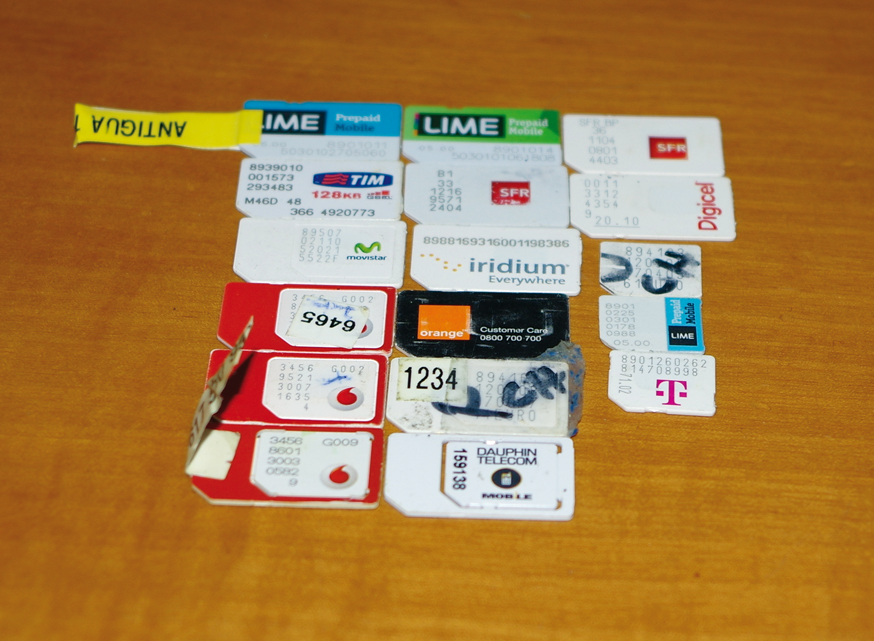
The collection of SIM cards with the basic management of the PIN codes and numbers.
And when at sea?
Connecting via wi-fi is possible in the marinas, and close to hotels and/or connection spots. Depending on the areas and the aerial heights, the GSM signal can be received up to 20 to 25 miles from the coast (in the USA and Europe). This means no internet connection once you move away from the coast, and even more so when crossing the oceans. In this case, only the Iridium and its 66 satellites can allow you to remain connected, but in this case, the bill mounts up quickly...
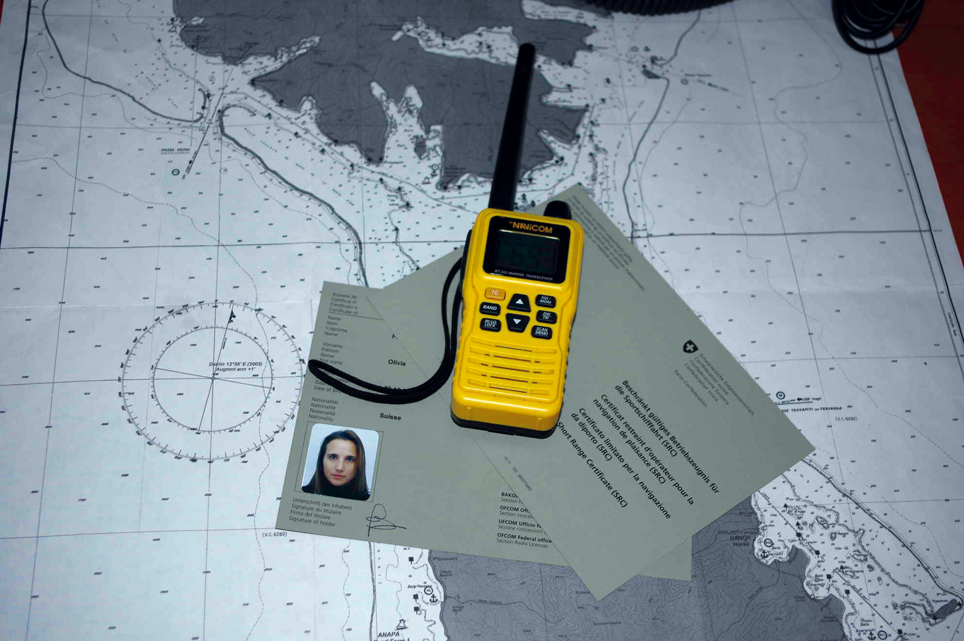
Our Short Range Certificates – we are very proud of them…
The points to understand when you change operators
- The tariff plan
- How to recharge, and how to ‘purchase' data.
- How to consult the balance of the account and the data balance.
- What happens when the data plan is exhausted? Is the service cut off, or does the operator switch to ‘off plan’ mode, where the data is infinitely more expensive, and the credit thus exhausted in a few minutes?
- Keep your old telephones, to juggle with the various SIM cards...
