Anyone who takes the slightest interest in ocean racing in multihulls will inevitably have come across this image one day or another. A little yellow dragonfly, 12 meters long, which seems to be flying over the water, overtakes Michel Malinovski’s big black 21-metre monohull on the line, and wins the first Route du Rhum by 98 seconds. That was in 1978, and nothing would ever be the same again. A new era had opened up, the development of the multihull was launched, and the race time would be divided by three in the following thirty years. Not to mention the lives of thousands of leisure sailors, who, as a consequence, would abandon their oilskins and life at an angle for the hedonism of the cruising multihull. Far from the large teams and costly budgets, Charlie Capelle keeps the flame burning. Just like that of Mike Birch, his Acapella is an A Capella. I hope you are following... The boat’s name is also almost the name of the model, which is somewhat reminiscent of that of the skipper!
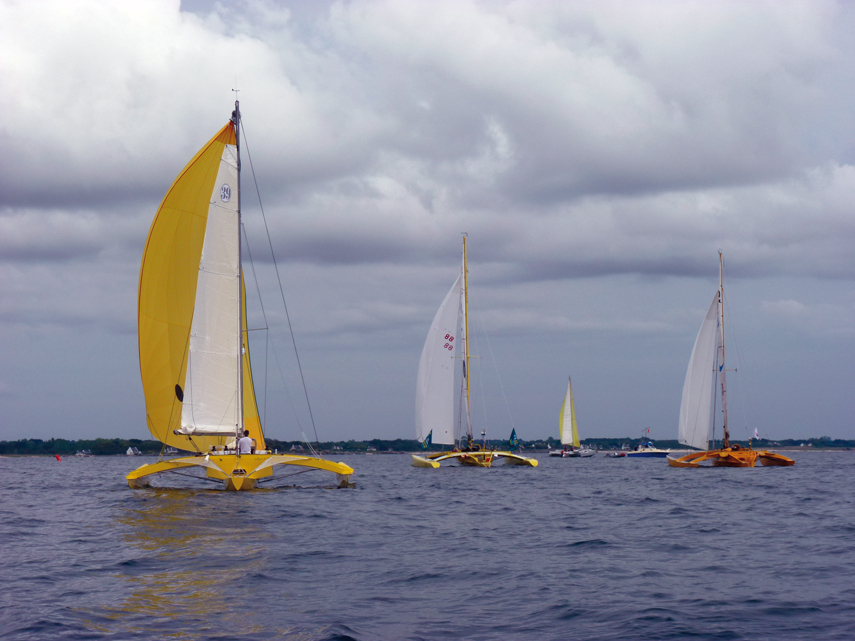
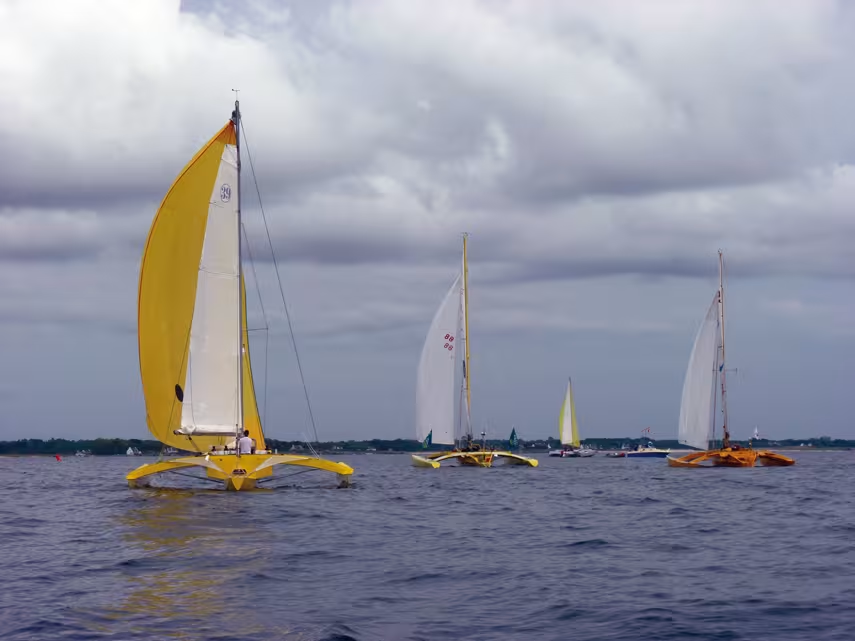
Three A Capellas on the same start line, to celebrate the tenth edition of the Rhum... Enthusiasts really bring ocean racing to life!
Was it really chance then which reunited Charlie and this superb boat? He who was a dental prosthetist from the Vosges and became boss of Technologie Marine in Brittany! And what a visiting card his Acapella is. It’s no longer a boat, but an extension of its skipper-owner. Originally recovered as a wreck, it took him seven years to give this attractive Walter Green designed boat a new lease of life. Three Routes du Rhum, two capsizes and as many refits later, it has taken a lot of time, passion and self-denial, as well as courage and encouragement, to achieve this gem. Everything about it is perfect. In the slightest detail. Every fillet joint radius, the smallest cleat support, the ergonomics of every control line... We liked the clear, precise labeling of all the lines and equipment, the multifunctional bucket seat inside, the folding seat which can be inserted in place of the washboards, a strategic watchkeeping position, the small folding saloon table in carbon, the immaculately varnished engine hatch, the teak cockpit floor and benches. The latter are the only concession to weight, but what class and what comfort! Three major developments have been integrated into the original model. The floats, which were destroyed following an accident at sea, have been rebuilt from existing, more voluminous molds. Designed by Nigel Irens, they give noticeable additional power and stability. Visually, they make Acapella appear bigger than its counterparts. The rotating carbon wing mast is not original either. It acts as a turbo on the very light platform (3 tonnes), superbly built in molded ply. Finally, as it is a showcase for the boatyard, the fittings are the best of the current production at the beginning of this third millennium.
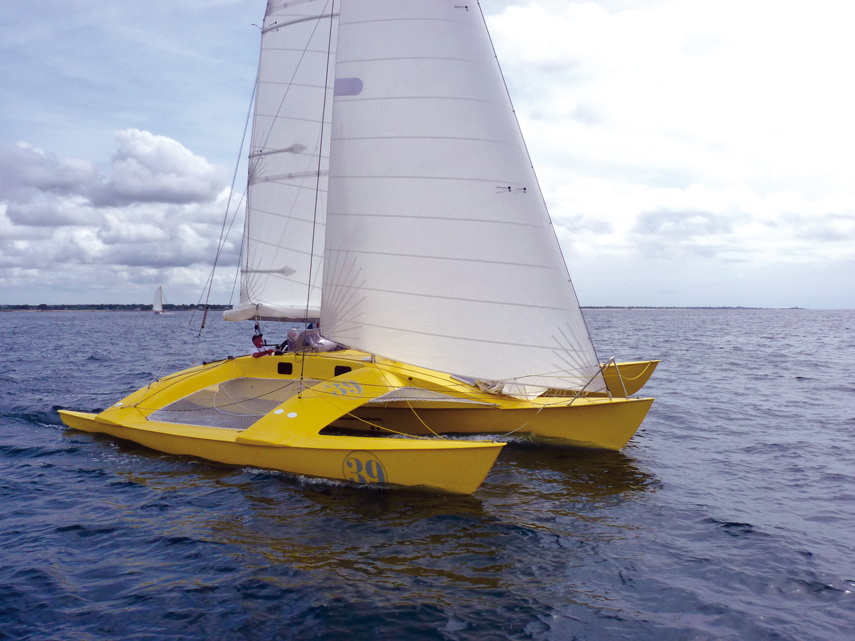
A Capella, a Walter Greene design which became legendary with the victory of Olympus Photo by 98 seconds after crossing the Atlantic.
We didn’t need these top-quality fittings to hoist the mainsail. Yet my shoulders had hardly recovered from the same maneuver aboard the 80’ Prince de Bretagne. Four men giving their all on two coffee grinder columns had had difficulty seeing the end of it. Here, two of us hauling directly on the halyard at the mastfoot had the headboard aloft! In the channel at Concarneau, propelled by the Volvo engine which had survived the last capsize, and which after a complete strip down and rebuild was running like clockwork, we were already trying to pick out our direct competitors. In fact, in the fleet of around fifteen ‘Golden Oldies’ united at the beginning of August in the Breton town, there were three yellow trimarans, three A Capellas. Charlie’s, of course, but also Jean-Paul Froc’s Bilfot and the one that everyone was waiting to see, which had arrived overnight from La Trinité sur Mer, Loïck Peyron’s Happy. Three men from different horizons, all madly in love with the same design, were united on the water: a professional from the marine industry, an entrepreneur, and a professional racer. And yes, Loïck Peyron, the well-known skipper, between two training sessions for the America’s Cup aboard Artemis, had joined this club of passionate aesthetes and restored a third yellow trimaran. To keep things authentic, and wanting to revive the techniques used at the time, he will be sailing without a GPS. Today it was his white, horizontally-cut sails which attracted all the attention. The simplicity of his cockpit seemed out of place, but we don’t doubt that with his experience, his talent and his competitive spirit, he will be a serious candidate for victory in his category, in the coming Route du Rhum. Because the three cousins will be on the start line at St Malo on 2nd November, and it was a privilege to see them confront each other for the first time, just three short months before the big date.
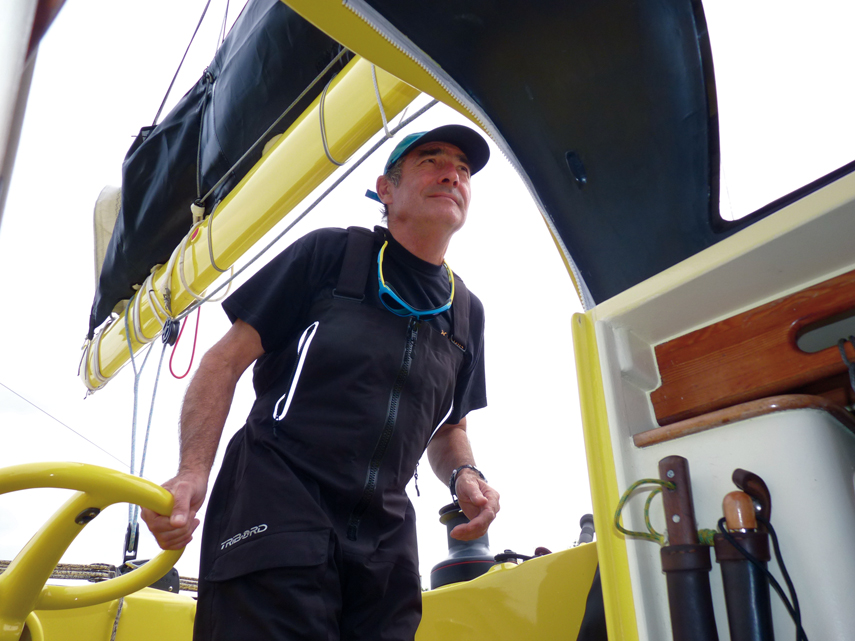
Charlie Capelle at the helm of his trimaran: they are both embarking on their fourth Rhum.
The sky was grey, the wind rather light. Between two much more stormy days, Concarneau bay was offering a respite to three beautiful ladies. As the first leg consisted of an out and back race, with a beam wind, pure speed would be decisive, and the choice of the right gennaker would be crucial. As all the control lines return to the cockpit, rolling up or unrolling the foresails was child’s play. In this light weather, we held the gennaker sheet directly in two hands long enough to change the angle of the tack. Charlie took advantage of the moment to whisper that these sheets, abandoned in the base at Lorient, had already been round the world aboard the VOR 70 Ericsson. Not everybody has the same idea of the word ‘worn’. The start line was wide. We didn’t want to damage our maritime heritage by excessively close action. We didn’t get the best start. Loïck was a bit ahead, to windward; Jean-Paul a bit behind, to leeward. Concentrating at the helm, which could be held between two fingers, Charlie encouraged us to refine the trim, and asked if we were on the optimum route. Propelled by its Code 0, Acapella clawed back meter after meter on ‘Happy’. On 8th August 2014 at 1.30pm, we overtook it. I have noted the date and the time exactly, as I don’t think I will overtake Loïck Peyron in a race twice in my lifetime! Even in a friendly.
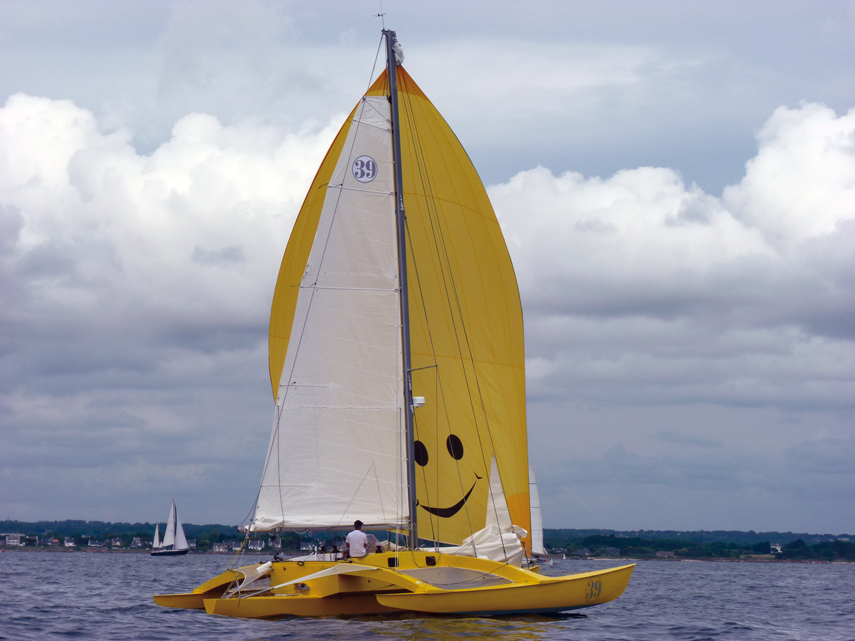
Aboard Happy, Loïck Peyron will be starting the Rhum just for the pleasure…
Let’s be honest, although the chassis is the same, Charlie’s boat clearly has more horsepower under the hood. Already the previous day, it had taken the best time in the Run arranged by the organization. Who would succeed in the initial coastal race was more uncertain, as we were at the mercy of the variations in both the direction and strength of the wind. But the maneuvers followed one another easily, without too much effort, the prerogative of boats which are light, with a good pedigree, and are well equipped and well sailed. The end of the day was approaching. Charlie, Loïck and Jean-Paul gave in to the wishes of the photographers and sailed for several long minutes side by side. What a pleasure it was to see these three dragonflies, these nine superb bows, these three masterpieces, sailing through the waves together. Loïck hoisted his big yellow spinnaker, signed with a Smiley. Happy !
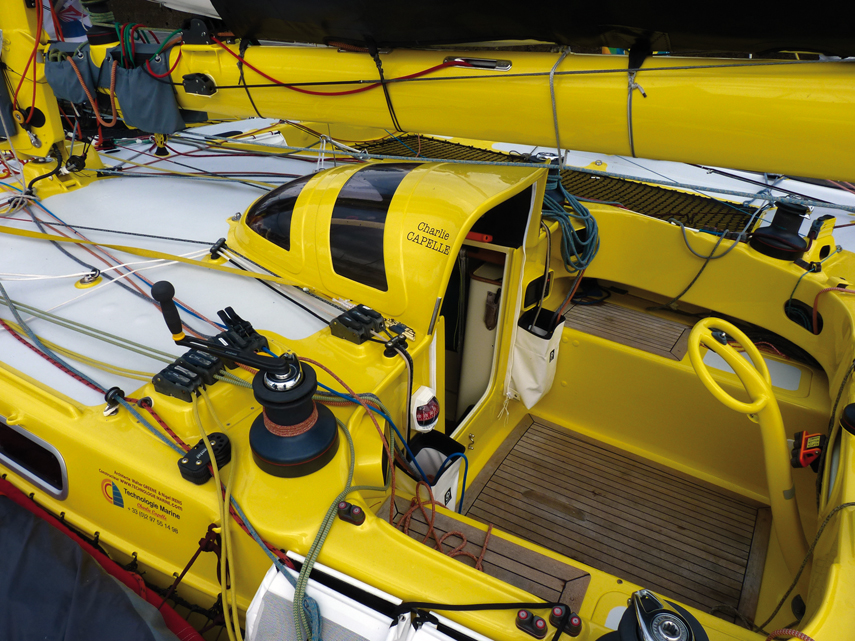
The cockpit of Charlie Capelle’s A Capella: here we are aboard a genuine racing boat, where everything has been designed for performance.