
1 :
The Route du Rhum is France’s best known yacht race… and after Rolland-Garros, the Olympic Games and the Tour de France, it is the fourth most mentioned sporting event. It’s also one of the most-followed sailing races in the world!
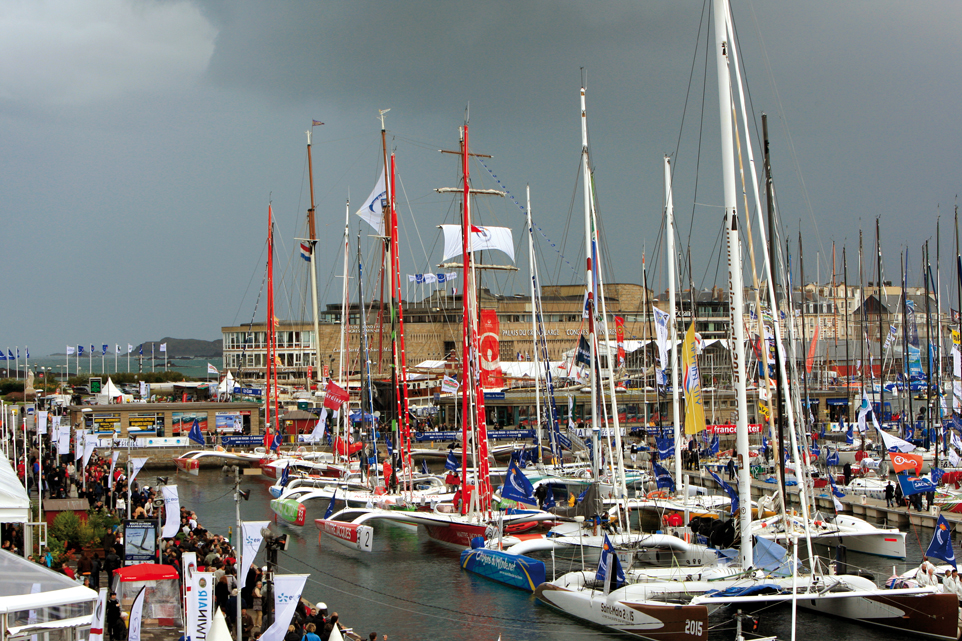
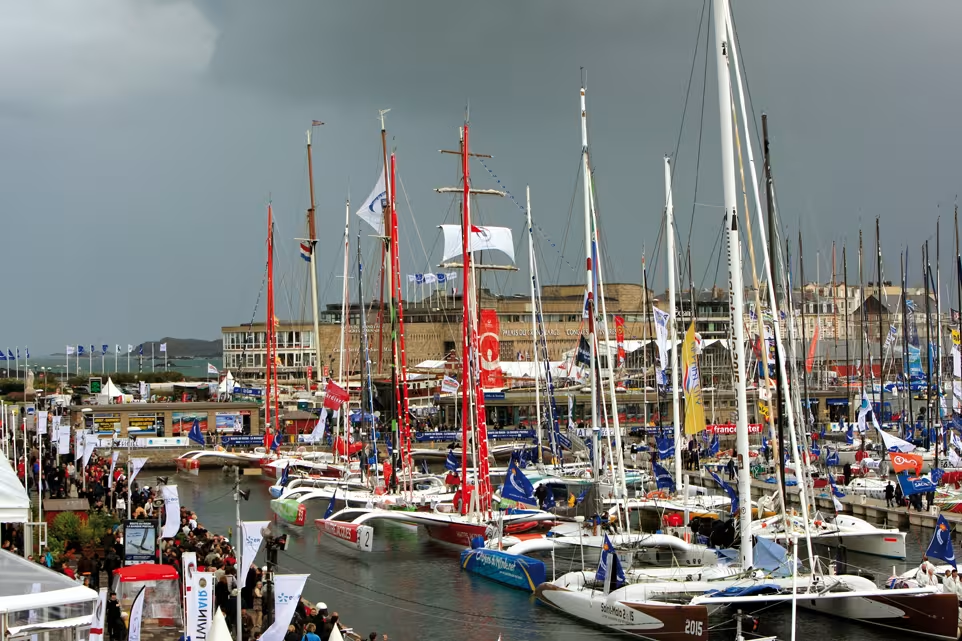
As every year, Saint Malo’s Bassin Vauban will not only be full of boats, but also spectators. More than 100,000 people traditionally come to the start.
1,4 :
The length in miles of the start-line, off the Point du Grouin. This rocky headland is located 8 miles northeast of Saint Malo. So the sailors start even further away from Guadeloupe!
3 :
The number of women entered by July 25th. All, according to the latest list of entrants, sailing on board monohulls… Don't they want to try and win? Multihulls World will find out in Saint Malo.
3 :
The number of ORMA trimarans which were on the start line in 2002, out of 18 entrants. This savage race signed the death warrant for the class, abandoned by both competitors and sponsors. Of the three “survivors”, only Lalou Roucayrol didn’t put into port for repairs. Michel Desjoyaux, winner of this difficult edition, despite his enforced stop, benefitted from Steve Ravussin’s capsize. The Swiss sailor, although comfortably in the lead, capsized while asleep. His own verdict following his misfortune, “I screwed up”
5 :
Since 2010 the race has had five different categories of boat. Two of the classes are multihulls - Ultime and Multi 50 - and one other class, the Rhum category, welcomes “older” monohulls and multihulls.
7 :
The length in kilometers of the telephone lines installed at the Press Center and at the Race Village in Saint Malo.
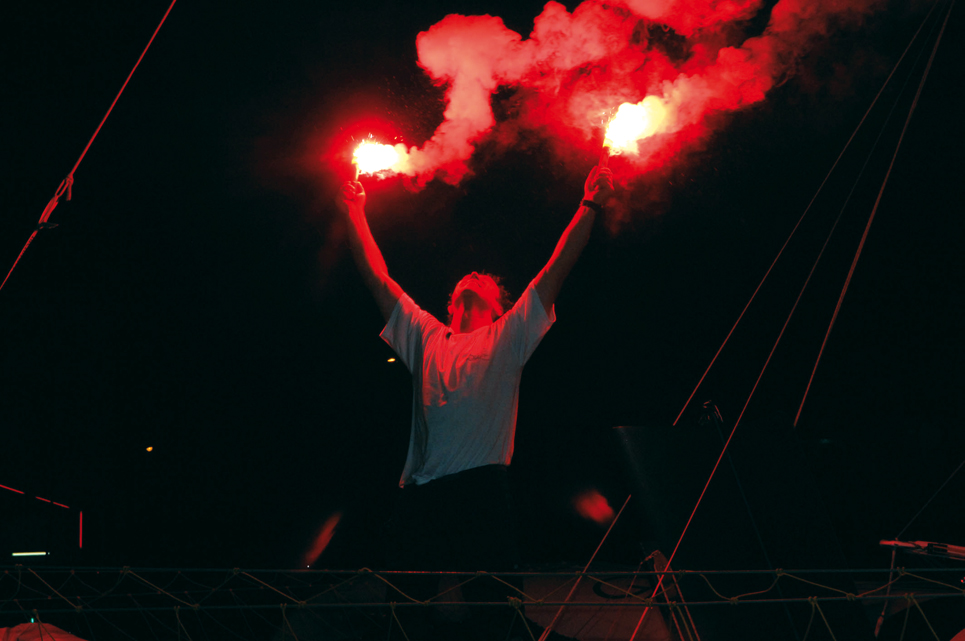
Lionel Lemonchois, overall winner in 2006 and in the Multi 50 Class in 2010 is going for a third success.
7 :
The number of times the lock will open between Saturday afternoon and Sunday morning to allow the whole race fleet to get to the start line.
7 days, 17 hours, 19 minutes and 6 seconds:
the record time for the crossing between Saint Malo and Pointe-à-Pitre. This record was set in 2006 by Lionel Lemonchois on Gitana 11. It wasn’t beaten in 2010, with conditions not being favorable enough for Franck Cammas on Groupama 3, who took more than 9 days to complete the course. Even so, that’s an average of 16.14 knots…will the record be beaten this year? Answer before November 8th…
VII :
the seventh Banque Populaire is on top form… though not the youngest boat. This VPLP-designed maxi trimaran is none other than the former Groupama 3, winner of the 2010 edition under the command of Franck Cammas. This 31.50 meter machine was re-launched in April 2013, and has since beaten numerous records - Mediterranean, Route de la Découverte, and a 24 hour run of 682 miles. Skipper Armel Le Cléac’h has withdrawn due to a recent hand injury. Who will replace him?
11.32:
Length in meters of the A Capella trimarans, sisterships to Olympus. There will be three of them on the start line, giving us a race within a race - see also “36”. Best of all, the famous Kriter V, second place in the first Route du Rhum - 98 seconds behind Olympus - will also be there!
12 :
The number of helicopters carrying photographers and cameramen covering the start from the air next November 2nd (2010 figure)
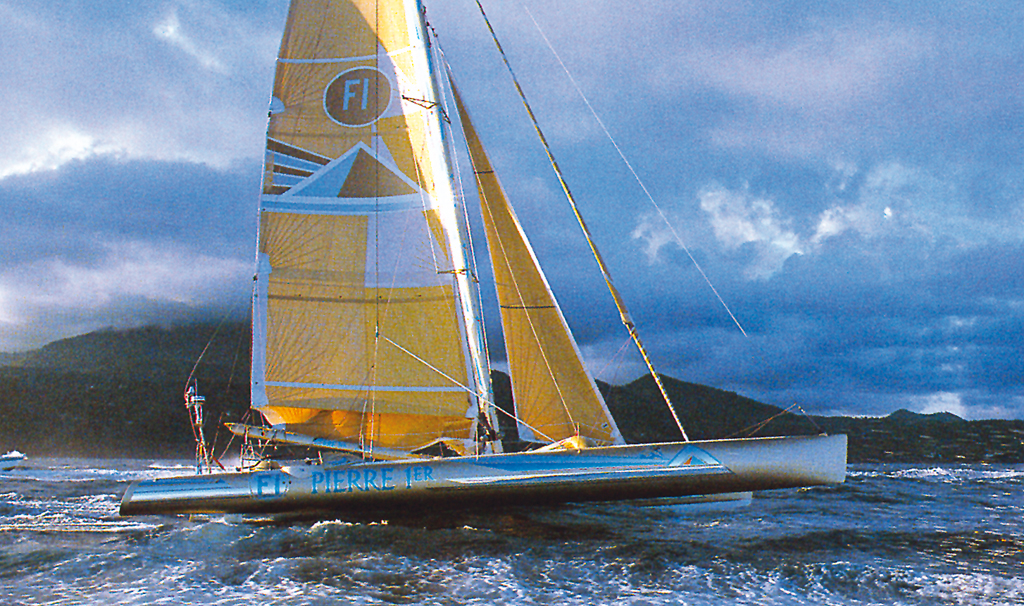
Florence Arthaud on Pierre 1er remains to this day the only female overall winner.
13.02 hours:
The traditional start time for the race - approximately local (solar) noon in Saint Malo, with a longitude of 2°W, during winter time (Central European Time). The weather won’t necessarily be nice, so you’ll likely have to imagine the sun being at its highest point of the day…
14 days 10 hours 08 minutes:
Florence Arthaud’s winning time in 1990. A real achievement for the woman who suffered not only a hemorrhage, but also whose trimaran, Pierre 1er, suffered radio and autopilot failure. While her transat was virtually over and she was on the point of retiring from the race, she learned she was actually in the lead and managed to stay ahead of her competitors.
18 minutes.
the shortest race for any entrant in the Route du Rhum. The unfortunate skipper was the well-known Guy Delage. The autopilot on his big 18 meter long and 21 meter beam proa disengaged, causing the boat to swerve, then spectacularly start to go astern, and finished off with the vessel capsizing and breaking up. It had been very hastily prepared.
19 years:
The age of the youngest-ever skipper in the race, Yves Le Cornec, on board the trimaran Journal de Mickey. The sailor, these days in charge of Nautor’s Swan yard at Villefranche-sur-Mer, was getting his 18 meter Eugène Riguidel trimaran ready at Lorient. He says that his mentor’s previous boat was out of work… Then a meeting with a journalist led him to be able to get his hands on 100,000 Francs, a budget just about big enough to enable him to join one of the great maritime adventures! This year, Paul Hignard, a few months younger again, will inherit his mantle. He is taking part on a monohull, a Class 40. “I am really surprised that my ’youngest competitor’ record hasn’t fallen sooner!” laughs Yves.
24 October, 18.00 hours:
All the entrants in the race will be alongside in Saint Malo. The exhibitors’ village will be open at 4pm. Every day food outlets will be open until midnight.
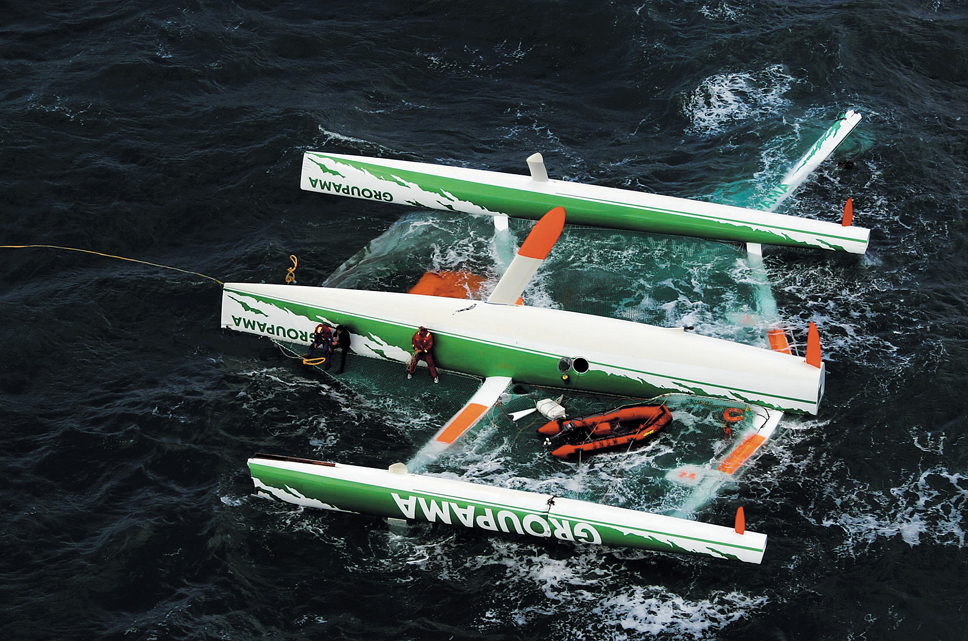
2002, the “cursed” year, with only three finishers out of the 18 multihulls which started the race…
31 days 21 hours 30 minutes:
the longest crossing by a multihull, another record to the credit of Yves Le Cornec. Equipped with dilapidated vane-steering gear, he was navigating by sextant and frequently thought he was off course. With no radio, he was out of contact for more than a month, and was even thought to be lost at sea… before emerging in the middle of the night. No-one was there to greet the young sailor, who was forced to wake up the skipper of another boat.
35 years.
Alain Colas’ age when he was lost on November 16th during the first edition of the race. The last-known position of Manureva, the former Pen Duick IV aluminum trimaran designed by André Allègre, was off the Azores. Then no further trace of the sailor, hampered by a severe foot injury, or his boat, leading to some staggering suggestions… and to a wonderful song by Serge Gainsbourg for Alain Chamfort, “Manureva… Où est-tu Manu Manureva?” (Manureva… where are you Manu Manureva?)
36 years:
The years between Mike Birch’s winning transat on board Olympus, and the one for which Loïck Peyron is preparing. The great sailor, at the helm of Happy, an A Capella itself, is preparing to race using a sextant and paper charts. “I want to do an old-style transat. To bring back the feeling of uncertainty on the water. Allow myself to get lost. And learn how to navigate properly again”, explains the skipper from La Baule. He will however be carrying a GPS in case of emergency. And the boat’s track will be followed… from ashore. Happy, very close to the original Olympus in terms of displacement, equipment and fittings, will be confronted by two identical, but modern, trimarans! The results and the de-brief at Point-à-Pitre will be exciting!
39 :
The minimum size, in feet, for entering this tenth race. The main reason - safety. The first part of the race, being early November, could turn out to be particularly testing for the smaller boats… and for their skippers.
40 meters:
the length of Spindrift 2, the largest sailboat in the Ultime category, once again open to maxi-multihulls since 2010. Yann Guichard, 39, has got a job on to manage this machine - previously known as Banque Populaire V - designed from the start to be sailed with a crew of 14.
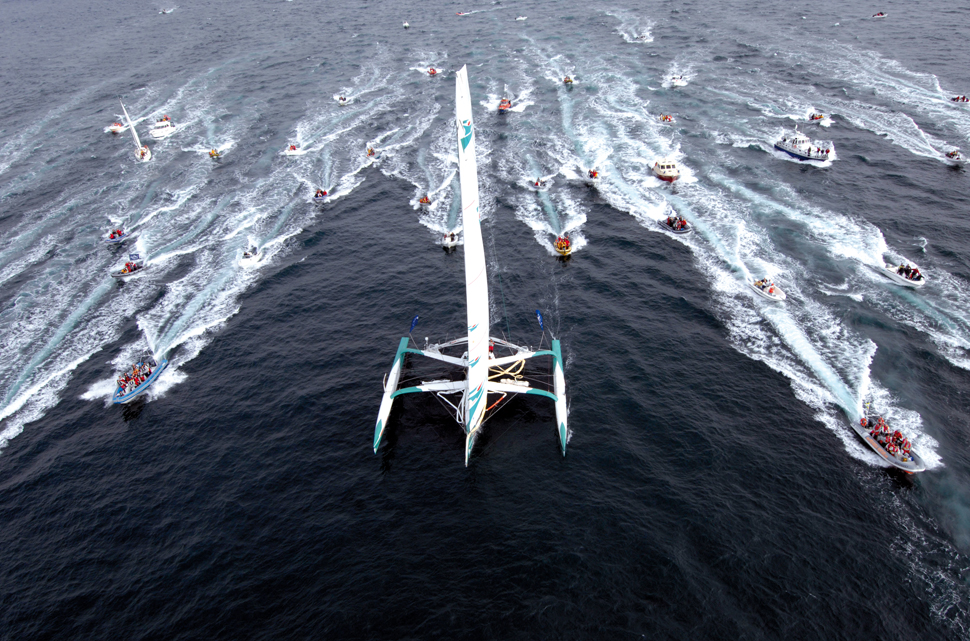
To win the Rhum, you have to be able to swallow up the 3,542 miles of this course all too often hit by winter storms…
60 feet.
Following the disappearance of Loïc Caradec in the 1986 race, following the capsize of his trimaran, Royale, the race organizers limited the size of the boats to 18.28 meters. Francis Joyon didn’t hesitate to chop his boat down to size, while Bruno Peyron set off unofficially, at the helm of the former (too long) Crédit Agricole. 1990 was also the year of carbon, which featured on almost all the new boats.
80 competitors.
That’s the estimate of the organizers of the 2014 Race. In 2010 there were six more than this, giving a total overall length of 4,220 feet, or 1,347 meters. The multihulls, all trimarans, make up 25% of the fleet. These 20 boats are spread between three of the classes.
90 :
The number of passenger vessels acting as spectator boats declared to the Affaires Maritimes (French maritime administration) for the day of the start (2010 figure). All these boats have to remain outside the starting area so as not to impede the competitors… as the latter have difficulty maneuvering single-handedly.
98 :
in seconds, the narrowest gap between first and second place. In the first edition of the race, after 23 days at sea, Olympus, Mike Birch’s little trimaran, managed to overtake Michael Malinovski’s big monohull, Kriter V. 1978 became the year the multihulls reigned supreme, with separate mono/multi classes being established for the 1980 Route du Rhum.
1,000:
The number of press passes issued to journalists. A figure which leads to several others: 14,724 items of media coverage in total. 57 hours of television on 88 channels, 40 hours of radio coverage, 719 articles written - 28% of the media covering the race - 5,675 articles on the internet, with 15 million hits. The official site has not been left out, with 25 million pages seen, 7.2 million hits and 2 million individual visitors.
3,542:
The distance in miles from Saint Malo to Pointe-à-Pitre (6,560 km). The mouth of the English Channel and crossing the Bay of Biscay are the most difficult parts of the route. Storms, accompanied by very big seas, are relatively frequent in these areas in November.
7,335:
The size (in m²) of the race village, which is open for ten days. The largest stand, that of Guadeloupe, measures 576m². Over the course of the ten days, the village is expecting to welcome close to two million visitors.
120,000:
The spectators who will brave the wind and the rain… or both, at the two viewing areas, Pointe du Grouin and Cap Fréhel - and then further west - to watch the start of the race. More than the number of fans that will be present at the race village at the finish line in Pointe-à-Pitre.