

So we need to have a suitable sail, ready to launch from the forward locker. A spi? Yes, but which one? Are you sure that it is in fact a spi that you need? Oh yes, I forgot to mention: If you have skipped the last thirty years, I have bad news for you, your great big old symmetrical spi made from slightly stretchy nylon, no longer has the monopoly on tradewinds. Numerous other solutions are available to you. Here we conclude our technical series looking at sails, with downwind headsails.
At last the wind is favorable. You are going to be able to lengthen your stride and make the speedometer sing. You open your sail locker, and there in front of you are four options. Yes, four! OK, so four theoretical options, because actually depending on your boat and your program, you might only have one on board. Or at best, two. Or in any case, not more than three. Unless you want to make your sailmaker rich! So which do you choose? To make the right choice, there are two factors to take into account: the direction and the strength of the expected apparent wind. And for apparent wind, you have to consider the potential acceleration of your multihull. In effect, a better-performing sailboat will have closer wind angles than one designed for more sedate cruising, which lets itself be carried by the wind. It’s on the latter that our good old symmetrical spi will continue to work. If you’re looking for a bit more stability, be ready to come up a bit more in relation to the true wind, even if you have to gybe to keep on track. So an asymmetric spi will keep you happy. But if you really love speed, you risk being under-canvassed as soon as you are at 60 degrees off the wind, so you must have a gennaker on board. And once you have seen how easy it is to handle with its endless-line furling system, you’ll only want for one thing - to have an identical system for your spinnaker. Certainly the spinnaker sock invented for our single-handed friends makes hoisting and lowering them easier, meaning they can be used for longer. But even if you have tried it only once in too much wind, where the lightweight foredeck crew is lifted off his feet with every gust, or the lines get tangled with the collar, halfway up, and it won’t go up or down, then you know what I’m talking about. To sum up, the good news is that whatever boat you have, and whatever the weather, progress and research originating from offshore racing means that there should be a sail to suit your needs. Two common things link them: a modern Superkote-type nylon, which comes in different weights of sailcloth depending on your requirements, and the fun you will have using them!
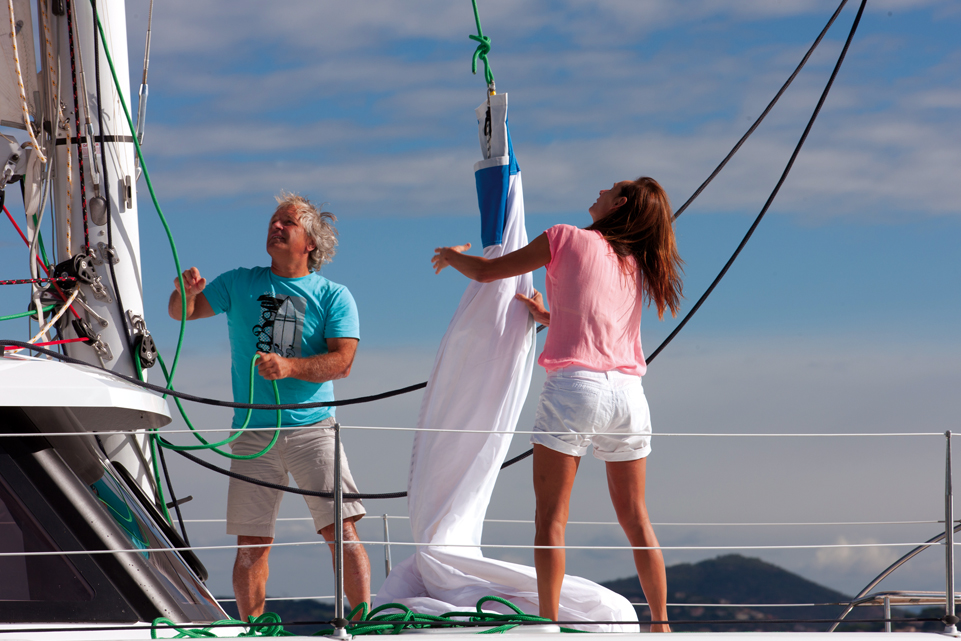
Modern fittings make handling headsails very easy.
The Gennaker
It is THE sail to have on board your multihull. Versatile, easy to use, it will acclimatize you with downwind sails. Its more or less triangular shape allows the use of a furler, which is attached to its loose luff whose shape is formed by a solid Kevlar boltrope. To avoid stress, go for an endless-line furling system rather than drum-type furler. The lighter the wind becomes, the more you can come up on the wind angle. Up to 60 degrees in light airs, and what stops you going further is the shrouds, which stop you being able to pull the clew any further aft, and the martingale stay which fouls the foot when you are sheeted in too tight. The more the wind picks up, the more you can ease it out. The recommended limit of apparent wind is probably around 25 knots. Any more and the sail struggles, and furling could be problematic. Ultimately, depending on the wind strength, the optimum range of use for your gennaker will be between 70 and 130 degrees off the wind. A little tip to allow you sail a bit lower, up to about 155 degrees of the wind, and to allow you to sleep easier: move the tack to the bow of the windward hull. Keep this for long ocean passages, as it means you have to relocate the furling line, and also gybing becomes a lengthy process.
Range: 70 - 120°
Plusses: An easy and versatile sail
Minuses: Its geometry is constrained by the rigging. Volume and surface area are limited.
The Symmetrical Spi
If it had never been invented, where would sailing be today? Its symmetrical luff and leech (where the name comes from) and its large volume make it sail of choice for round-the-worlders. We dream of tradewinds consistent in strength and direction. The spi is hoisted when off the Cape Verdes, to be lowered when entering the Caribbean chain. If it works wonders in strong trades, it can be stressful at night. Between the tack on the windward bow, and the sheet on the opposite hull, stability is not its strong point. With swell and a variation in wind strength and direction, the risk of the spi getting in a real mess with your genoa on its furler is not insignificant. Finally, when luffing up with the wind on the beam, even in light airs, keep it under control, as its large volume is not suited an efficient laminar flow. Choosing a modest sail area with a heavier sailcloth, can on the other hand give you a very good spi for heavier conditions, which is better balanced by the strength of the wind. With big shoulders and flown high, it helps keep the bows up and out of the spray.
Range: 110 - 180°
Plusses: ideal with the wind right behind
Minuses: Is this really the point of sail you want?
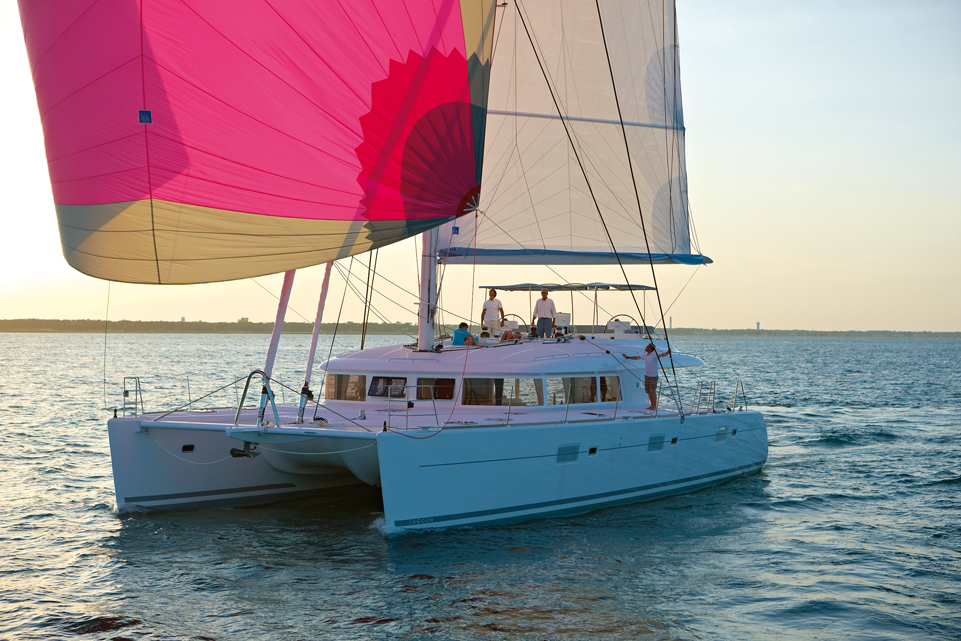
The Asymmetric Spi
With more volume than the gennaker, though less than its big brother the symmetrical, it is well suited to our modern multihulls, which don’t like the wind dead astern. They prefer to come up a few degrees to create some apparent wind, which in itself will bring the angle further forward. The tack of its free luff is secured to the windward bow. Also, when gybing, as is the case with the symmetrical, two guys and two sheets need to be set. Its ideal range of use is really between the two previous sails: somewhere between 90 and 150 degrees depending on the cut of the sail and the strength of the wind. But in all cases, don’t forget the indispensable spinnaker sock. It remains sufficiently sporty as the wind picks up, that the traditional method of dropping a spi downwind really doesn’t have a place on our boats. Not only for reasons of comfort or practicality, but also of safety. The power of spi which suddenly re-inflates is enough to knock one or more crew overboard.
Range: 90 - 150°
Plusses: Well-suited to multihulls. Easy to handle with a sock
Minuses: Gybing requires careful planning
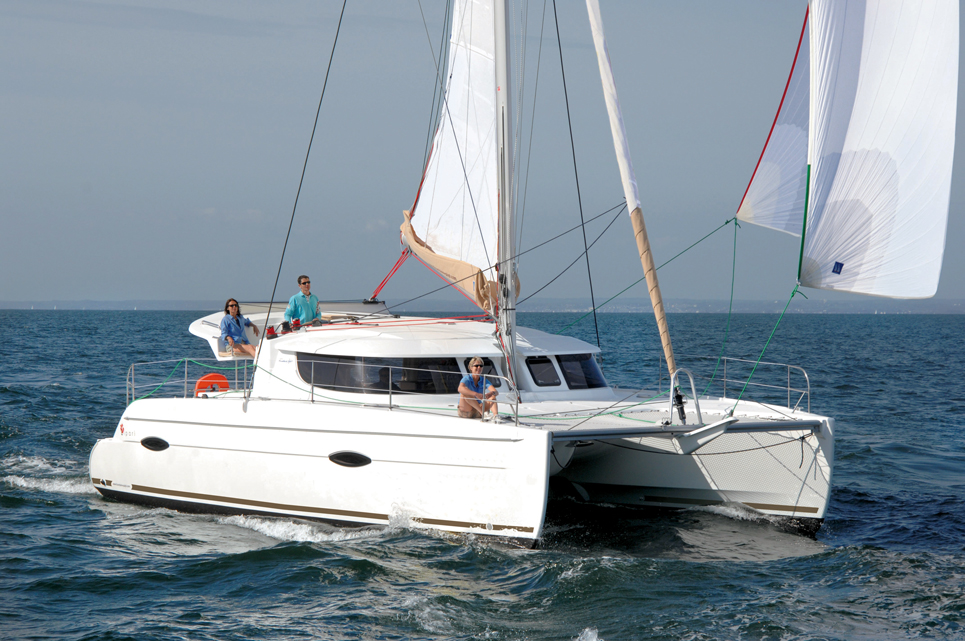
The Code D:
Depending on which sailmaker you choose, this sail may go by a different name. Nevertheless, it has been popularly known as a Code D. What does it do? It combines the advantages of the asymmetric spi, with the ease of handling of a gennaker. The compromise between these two sails lies more in terms of the volumes than the dimensions. Using the free luff of the asymmetric spi, it uses the same type of furler as the gennaker. Instead of snuffing the Code D with a sock, it is furled like a gennaker. Be careful, as with the latter, it can only be used as all-or-nothing. There is no option to sail with it partially furled. It will be attached to your bowsprit and will not have quite the range of the two other sails (that would be too much to ask), but is to be flown ideally between 100 and 140 degrees off the wind. This range can of course be extended: lower in light airs, and higher, as necessary, as the wind picks up. Made in a middle-weight sailcloth, the Code D can be a great heavy weather spi downwind.
Range: 80 - 140°
Plusses: A good complement to a Code Zero. A very attractive compromise…
Minuses: … but nonetheless a compromise!