It was on a clear December evening, with 30cm of snow on the ground and a temperature of -20°C, that this idea was born. The team from Design Catamaran were having their monthly meeting at La Cage Aux Sports bistro in Repentigny, Quebec. The main aim of these meetings is to iron out any important issues, but there's always time in the "après-meeting" to relax among friends.
It was during this second part of the evening that Bobby made his suggestion: We should stick the Toro in a container and go and race in the Heineken Regatta in St. Martin! Were we up for it? It didn't take long for Bob to convince us, as we are all seasoned racers! Beers in hand, we agreed to do it.
Firstly, the Toro 34 needed to go into the shipyard for a full service, and to be made race-ready and have reef points and some electronics fitted. We had got a month and a half before the container was due to leave. After that, some of the crew were due to go and take delivery of the boat. As the arrival wasn't expected before February 15th, we had three weeks to take the boat out to sea and to make any adjustments.
The rest of the plan involved Sylvain taking his family cruising, along with Augustin the Design Catamaran engineer, in the week following the regatta. What more could we ask?
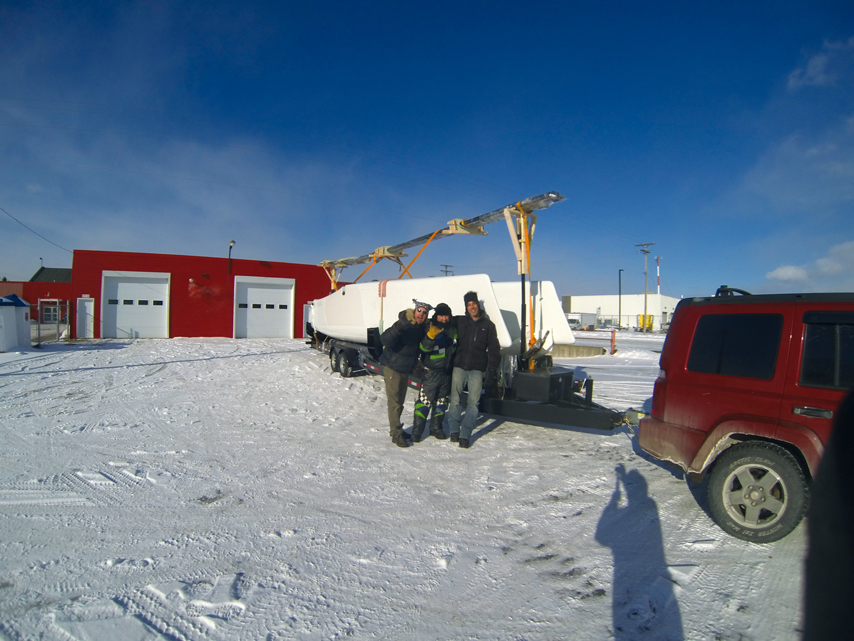
The idea of sailing in the West Indies will always sound attractive when winters get down to -20°C...
First Race Day
Our base in St. Martin is in the lagoon. We needed to go under the swing bridge to get to the sea and make it to the start line, which we did using the motor. Due to hold ups with the container ship, the boat had only arrived in St. Martin three days earlier. Despite this, we were ready to go and couldn't wait to go into battle.
We hoisted the sail and..."Stop!" A halyard was stuck in a spreader. Olivier tugged at it to try and free it, but the halyard disappeared inside the mast! Unfortunately there was no knot at the end of the halyard! We were due to set off in 60 minutes. The swing bridge had closed: there was no time to get back to the marina and get our tools. We needed to find a solution as quickly as possible! We hailed a passing inflatable to help us go and get our bosun’s chair from the marina. Ten minutes later, we were harnessing Christian on so that he could go up to the top of the mast and pass the halyard from the outside of the mast. From up above we could hear swearing: Hoisted up on the halyard of the Code 0, he was still 1m50 short of the top of the mast. On the edge of despair, but still not prepared to give in so early, we suggested to Christian that he attach himself to the uphaul...4mm thick and with no protection. In theory, it's strong enough to hold him, but at that height, if anything goes wrong it is no laughing matter. As he's also still attached to the first halyard, the risk is reduced, and he manages to make the last few meters and fix the masthead so that he can extricate the mainsail halyard. We finally hoisted the mainsail ten minutes before the staggered departures are due to begin. Phew!
There was a good 15 to 18 knots of wind, and we were anxious to see how we measured up against our competitors. We were in the Multihull 2 category and would be setting off after the 5 Gunboats in Category 1.
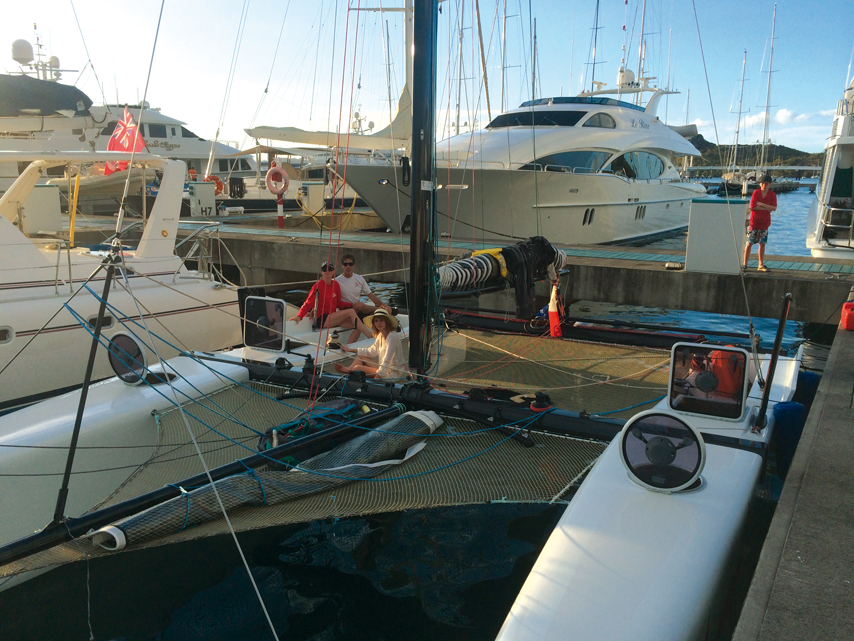
At the pontoon, the Toro 34's neighbors were all millionaires' yachts... So what? As long as you have fun it doesn't matter what you sail on
The starting signal sounded but we hesitated due to the flags not being properly synchronized, which left us just behind our three competitors. They were a 40' racing trimaran flying a French flag, a formula 40 catamaran named Soma and a Seacart 26 trimaran. We had to go past a windward mark which was quite near, before taking on a long downwind tack on the west coast of the island.
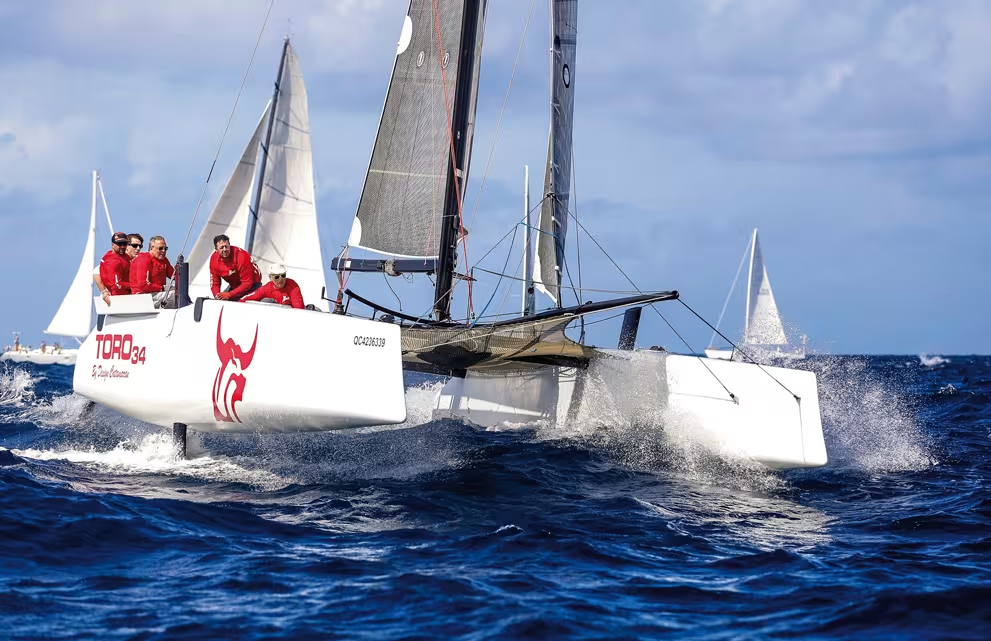
Although we set off fourth, we quickly reached 12 to 14 knots, pushing us into second place. After the stress of the moments before the start of the race, the atmosphere on board was now bordering on the euphoric. The Toro's speed, agility and ease on the tiller are intoxicating. Our joy was shortlived however: under pressure, the end of the outhall came out of the cleat, and we lost precious seconds, and places, trying to fix it.
Back in the race and now tacking, we advanced under a Code 0. We started to catch up with the two multihulls, but the Formula 40 was getting further ahead. We reached the north of the island, and our point of sail was further and further over, with the wind between 20 and 25 knots. Going around the island, we started to move upwind, and it was a moment that will last long in the memory. With a stiff east-south-east wind blowing at more than 20 knots, the Toro reached an amazing 18 knots. Even though I had designed the boat, I never thought it would be capable of such speed.
For these maneuvers, Christian and Olivier were dealing with the mainsail, and I was at the helm. The Toro shot along in the gusts of wind and the waves, and we worked out a simple way to maximize performance: in the gusts we left the mainsail partly open, the Toro accelerated and the deep drift raised the platform. The speed increased to 18 knots, and I carefully steered to negotiate the waves. Christian tucked in the mainsail so that it is stretched tight in the accelerations. A rhythm had been created, between the gusts of wind, the waves and the crew. We managed to get ahead of the Seacart and the racing trimaran. We had got our second place back, and were hot on the heels of the fleet of Gunboats. The crew is in synch with the Toro and the mood is good. It's at this moment that a particularly aggressive and fast tack leads to a cracking noise.
In emergency mode and with all senses heightened, we tried to work out what had made the noise. We soon find out: a spreader had come away from the mast. The jib had got caught in the spreader whilst we were turning. We had no alternative but to withdraw from the race. We were hugely disappointed, but managed to put a positive spin on things: our catamaran is quick...and we had had a great time in this leg!
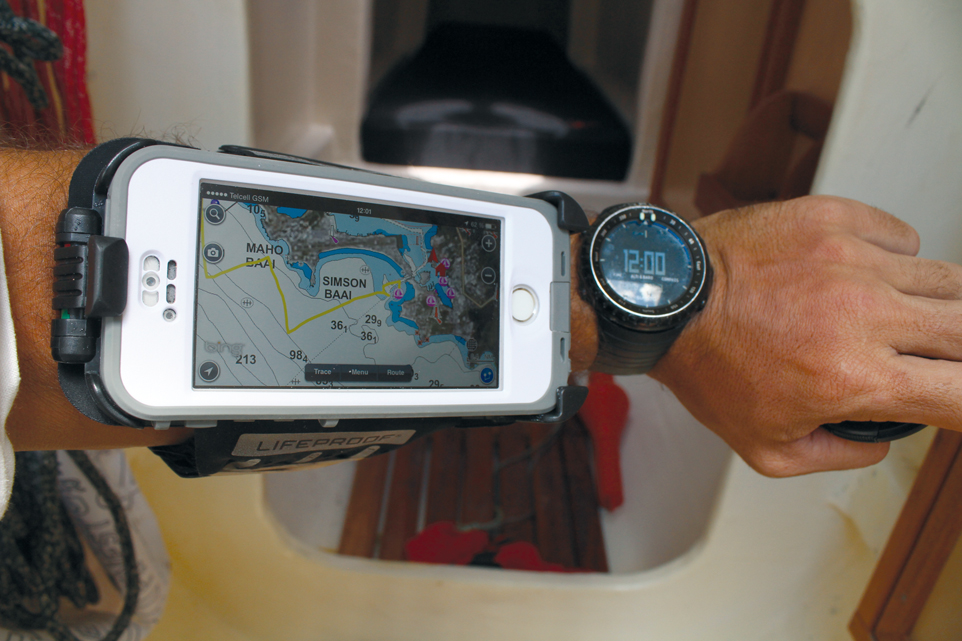
This was the extent of the onboard electronics: an iPhone and a watch!
Second Race Day
Back into battle! We had used the previous evening to relaminate the spreader, and the mast now seemed fully operational. We set off with all the boats tightly packed. We were the first to head to the port side. We are in a solid second place behind Soma, the F40 catamaran, a boat designed by none other than Gino Morelli, who is also part of their crew for this regatta. Broad reaching in a 1.5m swell and 18 knots of wind was a memorable experience. With its big volumes and solid build, the Toro was like a rocket in the testing conditions. We were all euphoric, and we consolidated our position with second place. We were covered in the spray that the boat throwing up, and it was clear that the boat is capable of more.
Unfortunately, the last tacking maneuver sounds the death-knell for our hopes that day. Too much hesitation during two headers lost us all the lead we had built up and we had no chance of a podium finish. However, our mood was still positive given the way the boat had behaved in tough conditions.
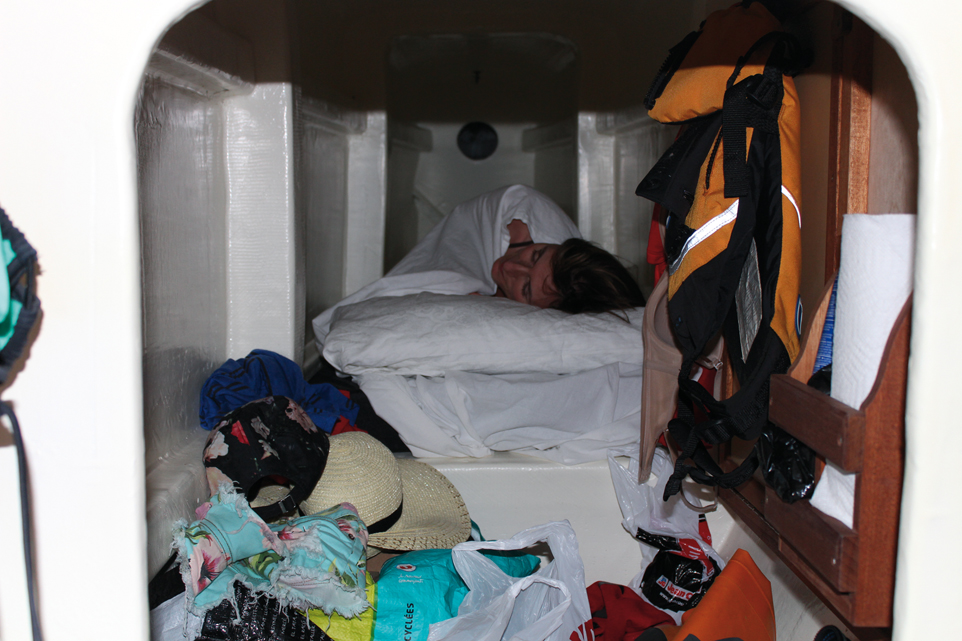
Four people can sleep in the hulls, well-protected from the elements.
Third Race Day
We are now known as "Speedy Toro." Our performances have been noticed and we are pleased and honored to be congratulated by our fellow crews. Crew members from some very large yachts tell us what it's like to be passed by us in the waves at 15-18 knots. As previously, our third day was also great fun. We held on to second place for a while, but the light winds once more held us back. The Toro prefers rough weather. We finished third
Looking back, we met our objectives. We had had fun, our boat looked impressive and proved itself to have potential and to be reliable. But we were hungry for more...did we dare to have a go at another regatta in the near future? Les Voiles de Saint-Barth perhaps?
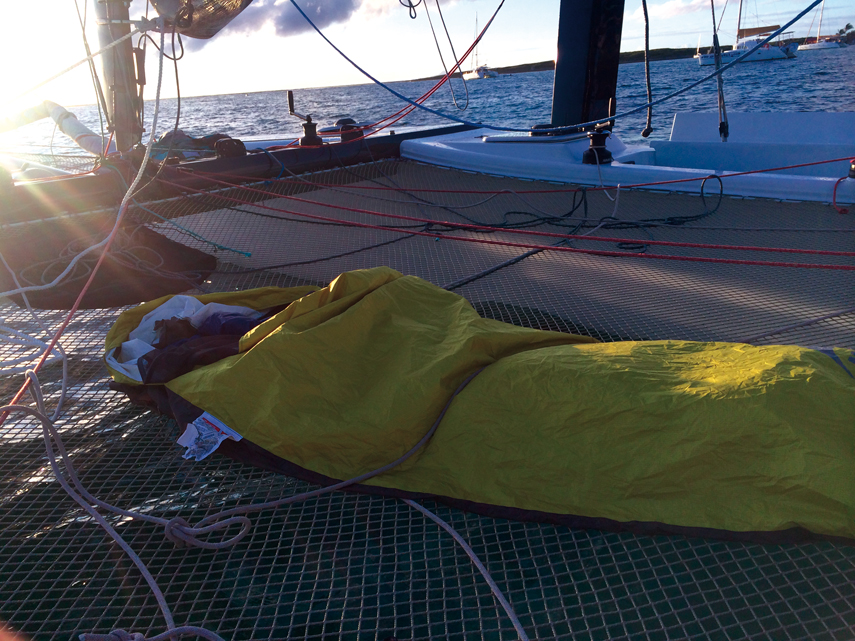
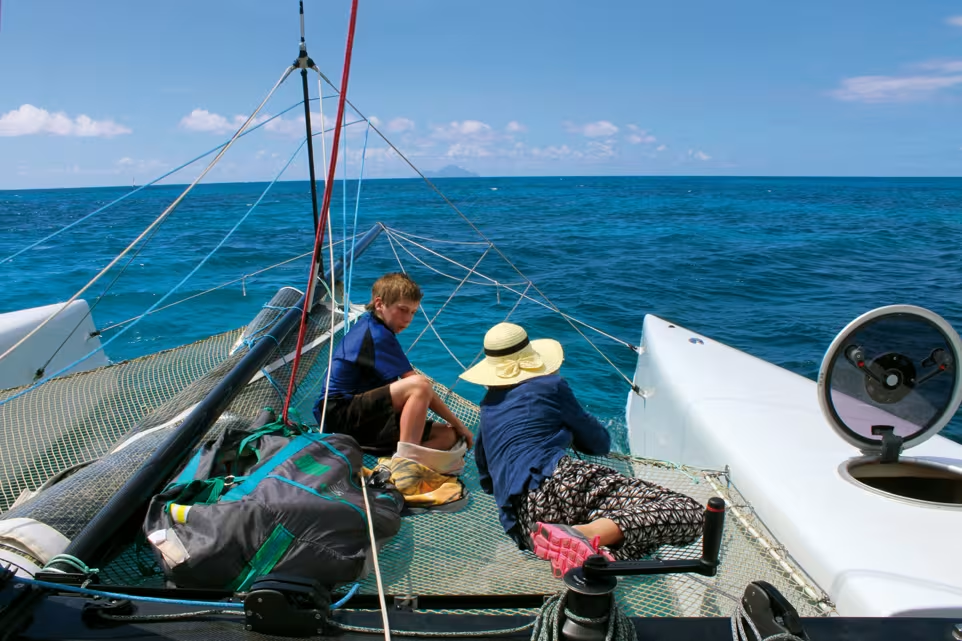
With only 4 berths on board and 5 people travelling, Sylvain had to sleep on the trampoline: very comfortable as long as it doesn't rain!
What About Cruising?
The idea of cruising on the Toro 34 can seem a little far-fetched in St-Martin, surrounded as one is by yachts and sailing boats that can rival many a terrestrial palace for luxuriousness.
But that's the interesting thing about this sporty catamaran. After the crew had given their all in the Heineken Regatta, the boat, which hadn't suffered too much, despite some intense sailing, offered just what we needed to take a quick family trip around this magnificent island. Above all, the Toro 34 is a dayboat, a sculpted beast, made for high performance and extreme sensations. However, thanks to the volume of the hulls, and its simple rigging, we would be able to maneuver easily and would be able to sleep comfortably. Of course, knocking up a five course meal would be out of the question: sandwiches would be the order of the day, and in the evening we could moor in the bays where there are restaurants close by.
So we set off, on a pleasant tropical morning, with a plan to visit the island of Tintamarre, a nature reserve just a few nautical miles from St-Martin. On board were Sylvain the CEO of Design Catamaran and his family: his wife Annabelle, Léa 13, Hans 11 and myself. As a friend of Sylvain and member of the design team, this trip interests me for several reasons as I design practically all of the boats’ custom parts.
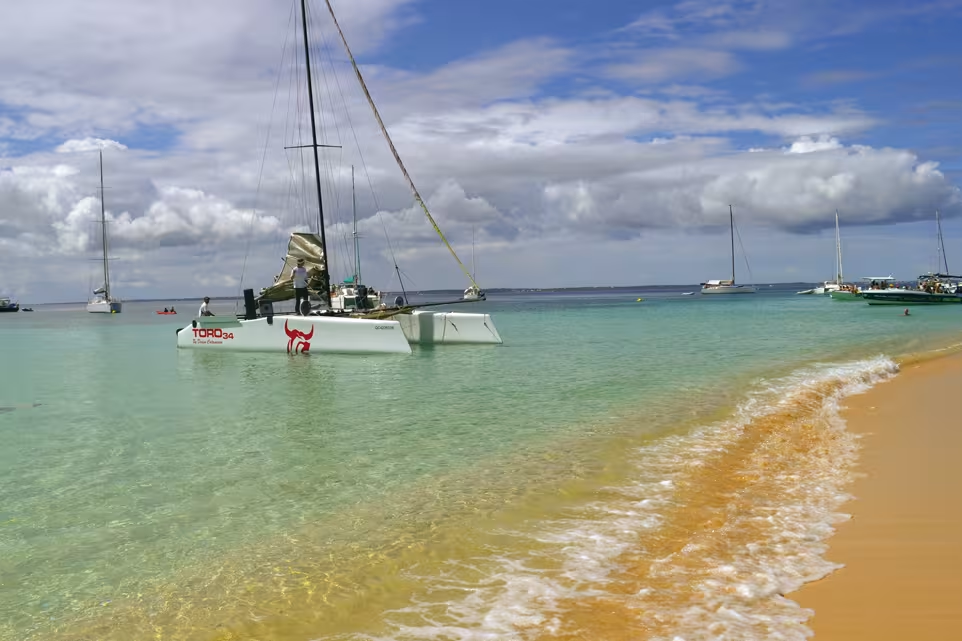
We have to wait for some time before leaving Simpson Bay as the swing bridge only opens at certain times. This bay which is effectively a boat parking area is a large lagoon which covers around one sixth of the island. We were the first in the queue for the 10.30 am opening. The light breeze meant that we had to constantly maneuver to keep the boat ready to pass through. The Toro 34 is light, and any wind which catches it means that we have to quickly make the correction before being taken too far off course. Thankfully the boat responded well. The large rudders make maneuvering easy, even at low speed, and even though the 10hp outboard motor has a central position.
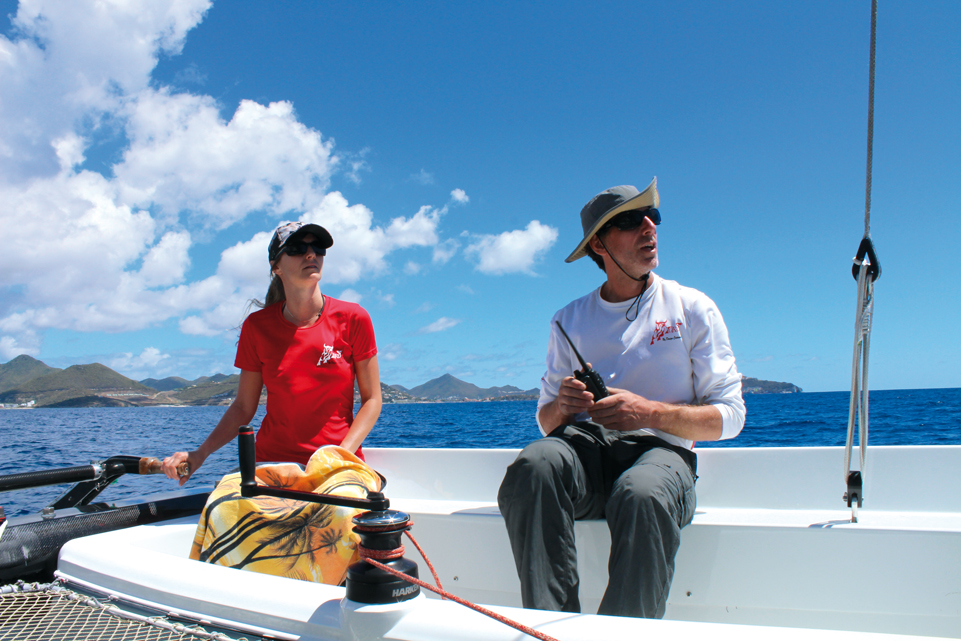
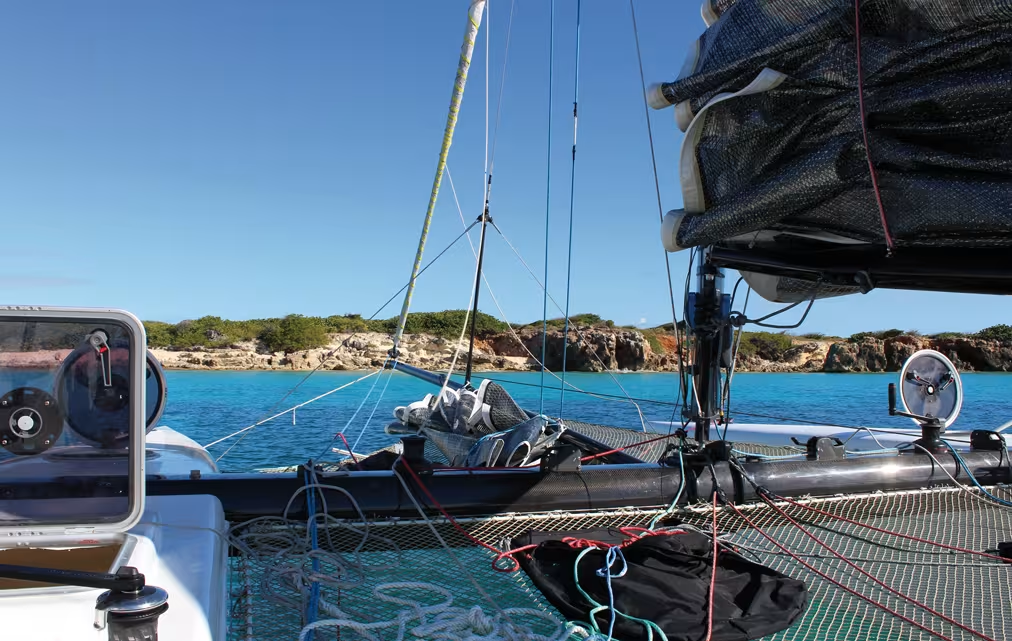
As there is no bimini, the crew needed to protect themselves from the sun's rays, otherwise they would have finished up burnt to a crisp...
Just before the bridge opens, we had to give way to a bigger vessel. A pretty yacht, about 150' long, which seemed to have all the necessary help and technology to stay almost still in the water. After the opening, we followed it through the gap and immediately went past as soon as we were out in the bay. Hans and Sylvain hoisted the mainsail and the self-tacking jib, and off we went at 8 or 9 knots, sailing with 12 knots of wind on a pretty calm sea.
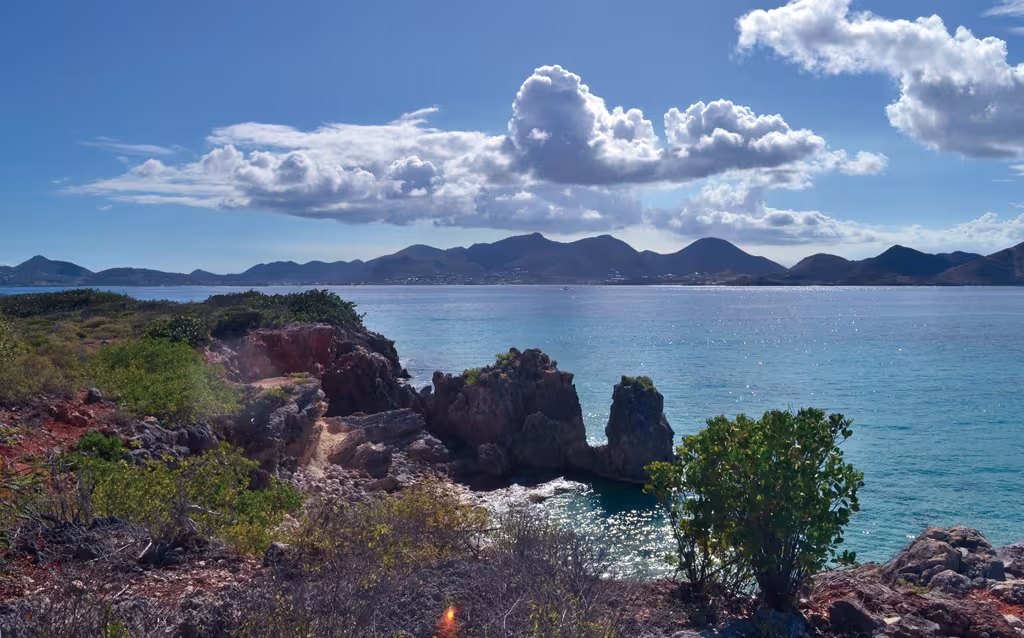
Just off St-Martin, the view is superb. The island is covered in mountains, with the Pic Paradis climbing up to 411 meters. Looking around, there are other islands visible too on the not too distant horizon. Saint Barts, is just 10 miles to the east, as well as St.Kitts, Statia and Saba. Going around the south eastern extremity of the island, Tintamarre came into view, as well as Anguilla further to the north. What a fantastic playground!
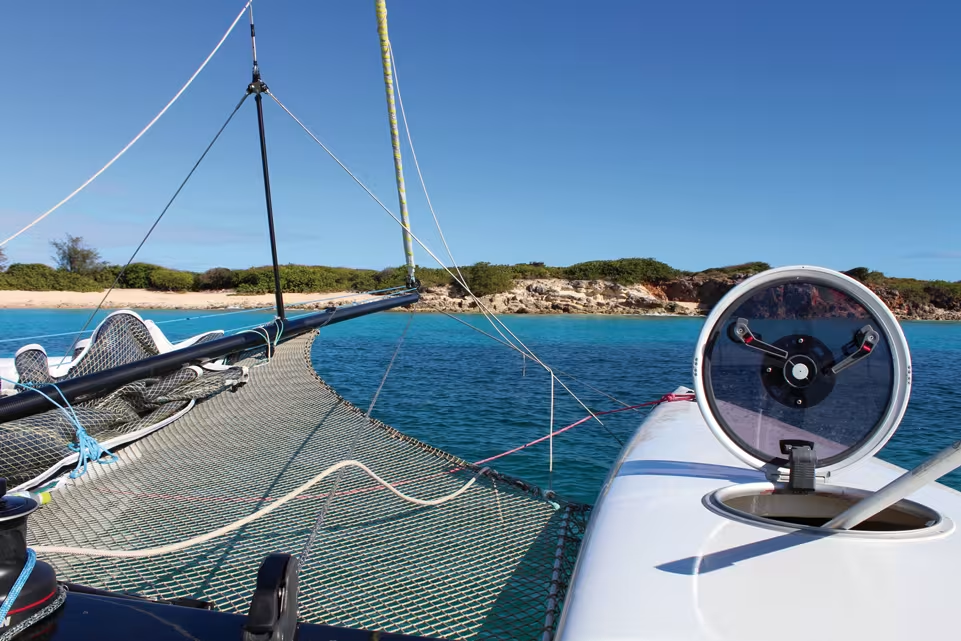
In the light breeze, we hoisted the Code 0 and started to move a bit more swiftly, even though with only the mainsail and jib being used we were sailing almost twice as quickly as the Outremer that had been chartered by friends who were accompanying us. We covered the 13 nautical miles that separated us from Tintamarre in just over an hour. We lowered the sails and tried to find a mooring in Baie Blanche. Unfortunately they were all taken, but a nice bearded chap in a jellaba had noticed our plight, and came over. He offered to let us join his monohull on his mooring, which we readily accepted He also dropped us on the beach with his dinghy. We had toyed with the idea of beaching the catamaran, but we decided against this due to the heavy surf and the fact that the island is a nature reserve. After a swim and a wander around the island, we made it back to our catamaran, some swimming, some in the dinghy, where we shared a drink with our new neighbors.
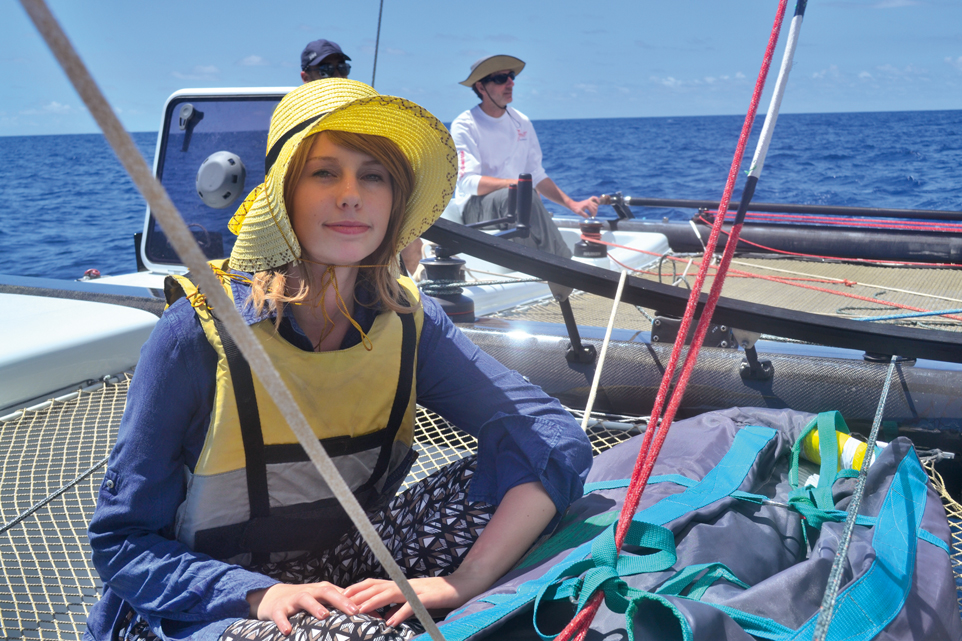
Sailing in cruise mode, the Toro is safe and comfortable.
We hoisted the sails again, and headed for Saint-Martin where we moored for the night in the Baie Orientale, a well-protected location and where there are several restaurants close to the beach. To reach the beach, we used the dinghy of our friends on board the Outremer who are moored close by. We hadn't brought our dinghy to Saint-Martin because of the regatta. This meant that we were rather dependent on other boats, however we could easily have carried a couple of kayaks or even paddle boards, especially as there are now some very user-friendly inflatable versions. We'll make sure that we bring them on future trips!
Our first night was spent in a soothing calm. As there are five of us but only four berths in the hulls, I got comfortable on the large trampoline. This is not a problem as I'm used to bivouacking up mountains or in forests. A cry of "it's raining!" in the middle of the night dragged me out of a dream where I was walking in the rain, and I pulled my sleeping bag over my head whilst the others closed the hatches which had been wide open until then.
After a good breakfast consisting of bread, jelly (jam) and fresh fruit, we were ready to get going, and we raised the anchor in preparation for a short sail. The boat itself didn't have too many technical instruments, so we navigated using an iPhone 5s, loaded with marine charts, and handily attached to my forearm via a dedicated armband. It's a practical and solid piece of kit which allowed me to get around easily. The charts, downloaded in advance and saved on the telephone, coupled with the phone's sat nav, meant that we could effectively navigate as though we had a genuine navigation system, but for a fraction of the price (as long as you don't include the cost of the telephone). The marine charts for the West Indies are available for $15 with the Navionics app, on Apple's app store. We did have a small, portable sat nav just in case, but the iPhone's high res, colors and touch screen make it a much more user-friendly way to operate.
After tacking a few times at a fair speed in the Anguilla Channel, we decided to head for what would be our second anchorage: the Anse Marcel. We took a mooring close to the beach and jumped into the water. All that afternoon, we made the most of our charming location, and in the evening we dined at a restaurant in a resort nestled in the lovely bay. Once again, an affable neighbor (obviously interested in the Toro) helped us get back to our catamaran at the end of the evening, thus saving us having to swim back as night was falling.
Our second night of mooring was less comfortable than the first for me, compared to the others in the hulls. In fact my slumber was disturbed all night by a stiff breeze which whipped up every fifteen minutes and which lasted for a minute or so. It was probably down to the temperature fluctuations and the fact that the cove was surrounded by mountains.
Our last sailing day was the longest, with a 15 nautical mile trip. As the wind was stronger than on the previous days, we set off with a reef in the mainsail. The rough sea was splashing against the boat, and we were rewarded with the wonderful spectacle of two humpback whales passing between Saint-Martin and Anguilla.
We gybed downwind at over 14 knots without any effort at all. The last part of the trip saw us tacking close to the wind at a speed of 10 to 12 knots in a meter of swell. On the hull in the wind, I got more than my fair share of spray. However, our progress, under a reef was always stress-free and comfortable. The boat was always predictable and reassuring, and it handled the waves well.
We ended our short trip waiting for the swingbridge to open, whilst moored in Simpson Bay. We were back in the lively part of the island, which is much more developed than the northern extremity. Despite the fact that the Toro 34 isn't a real cruising catamaran, it did allow us a unique experience: to race in a regatta followed by a coastal cruise. A superb trip, short but peaceful. The level of comfort was obviously relative, but it was a really pleasant cruise.
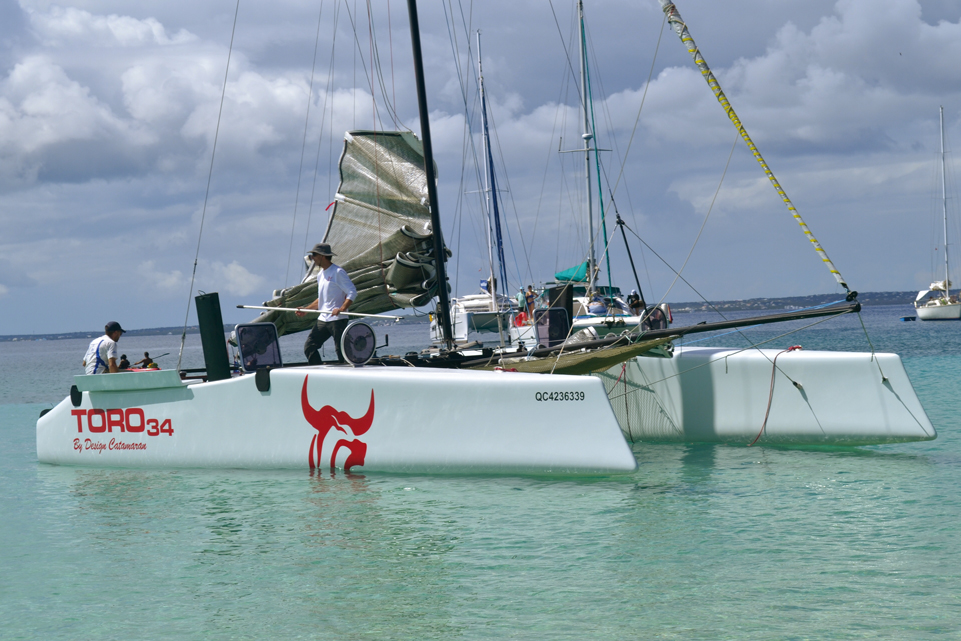
Whether you want a super sport catamaran or a gentle cruising catamaran, the Toro 34 can handle any situation