
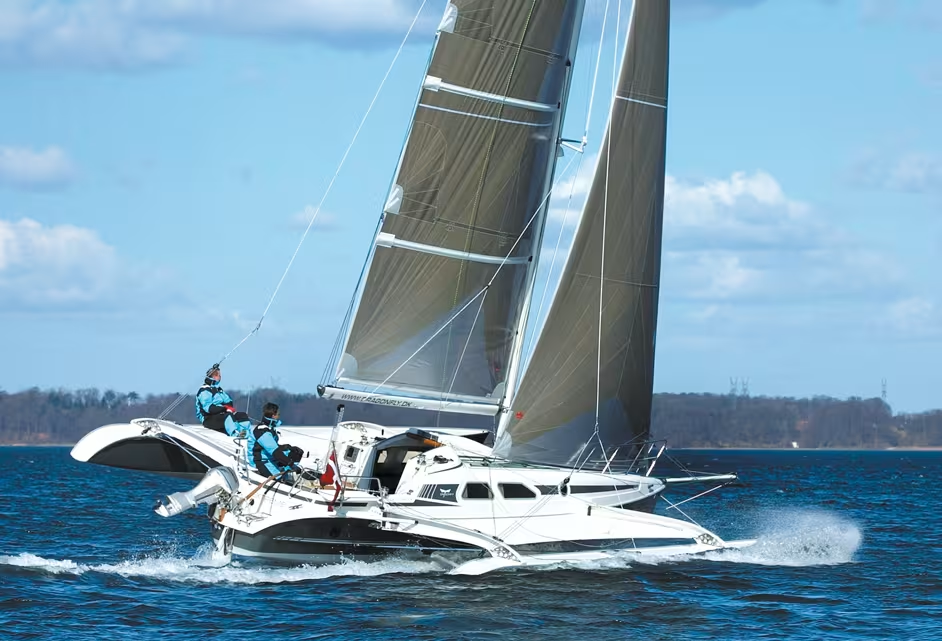


We are agreed - if you have a copy of Multihulls World in your hands, monohulls which heel in the first gust are not your thing. And you are right! It remains that although the choice has been made, it is not fixed...because, like 95% of cruising multihull fans, you are certainly thinking of a catamaran. We admit that the major part of the production is two hulls capped with an XXL nacelle – and that works very well. But other boats exist! We are not going discuss the proas here, which despite their great speed potential are not available on the market, apart from a few former glories from the ocean racing world, dear to the Golden Oldies... It’s therefore the trimarans which interest us. Ready to count the points with us? Let’s launch the trimaran v catamaran match!
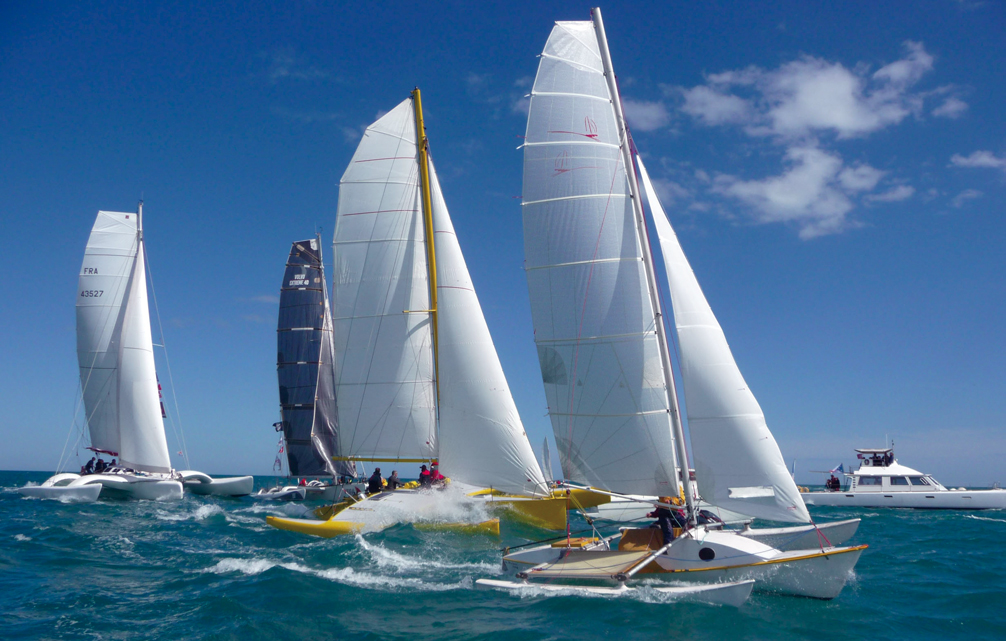
Tri or cat? Whether racing or cruising, the question is justifiable…
Comfort aboard
Let’s start straight away where it hurts the most... Catamarans, with their big nacelles, offer a particularly convivial living area, which includes a large saloon, a navigation area and a well-ventilated galley, thanks to its opening into the cockpit...of course here we are taking the most appealing configuration, but one which in reality is the also the most frequent. The advantages are therefore numerous: large volume, panoramic view, optimal stowage capacity, fluid movement, even when the cook or the navigator (or even both of them) is busy. Even aboard a (relatively) small boat such as the enduring Lagoon 380, the comfort is surprising; it is possible for a total of two couples and four children to live together. Faced with this, the trimaran is a sorry sight... Firstly because its floats are empty – at best they contain a stowage volume in their central part. Then because its central hull, even with the aid of a longitudinal step, will not be any better than a monohull. Result: the saloon is narrow and often cluttered with a centerboard case, stowage is reduced to 'just enough', the galley, supported by the side of the boat, as well as the chart table, hinder movement around the boat... And what can we say about the cabins? They nestle in the ends of the boat, whilst the cat distributes them around the four corners of its hulls, thus preserving absolute privacy. There are nevertheless a few exceptions: the former racing trimarans designed by Walter Greene or Dick Newick – here we are thinking about Moxie or Aile Bleue – whose wing shaped arms can house a double berth. A special mention also for the Corsairs; whose models of 28 feet and over fit in an aft cabin which is well isolated from the rest of the accommodation. And the Neels – the 50 and the 45 – have recently broken all the rules: they also have a large nacelle which covers most of the deck, just like the catamarans. However these models (with the notable exception of the Neel), which are very attractive on paper, are much more expensive for the same size – and services – as a production catamaran.
Cat: 1
Tri: 0
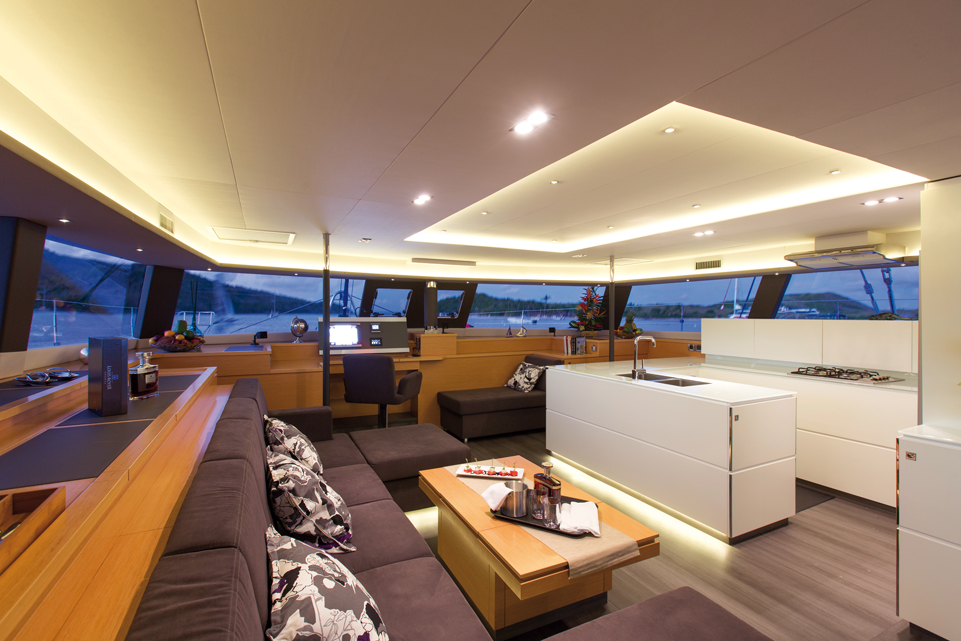
Incredible volumes aboard: undeniable advantage to the catamaran! (Photo: Fountaine Pajot).
Deck plan
Most catamarans offer one or two trampolines close to the bows, a large locker forward of the mast foot, uncluttered side decks, a cockpit protected by a rigid bimini, an aft passage at the level of the dinghy davits, two nice sugar scoop sterns... The boat as a whole is functional and spacious. The steering positions can adopt several configurations: well-protected against the coachroof, offset and double at the aft end of the hulls, or again, raised on a flybridge. None of that aboard a trimaran! The foredeck is inevitably very narrow, which doesn’t help when it comes to anchoring gear. As for the sidedecks, of course they are narrow, but more often than not you can count on the lateral trampolines. However these nets, which are more exposed and lower than those on a cat, are inevitably wetter and uncomfortable. In the cockpit, things get seriously worse: narrow, more often than not with no table or bimini, it can’t rival the genuine open terrace of a catamaran. And the single sugar scoop stern, although quite convincing when it’s time to go swimming, can’t take the dinghy’s davits. It therefore has to be deflated when sailing (unless you stow it on one of the trampolines) and the outboard removed.
Cat: 1
Tri: 0
Comfort at sea
Although multihulls don’t heel (or almost), they pitch freely! The fault of tall rigs, ends which are sometimes too slim, and perfectible weight distribution... In this respect, the catamaran has trouble ignoring heavy chop or waves on the nose which sometimes collide with its two bows in an offset manner. The movements, especially the diagonal ones, are often brusque and unpleasant. And the underside of the nacelle slams freely in the highest waves. The builders and the architects have put a lot of work into this set of problems: sail aboard a Catalac 12M on a heavy weather day, then on a latest generation cat, and you will see more than a development, a genuine revolution. Thanks to lighter rigs, higher and more voluminous bows, modern catamarans behave better than their elders. Lagoon’s efforts aboard the 39 and the 52 to move the rig back and lengthen the hulls are with this in mind... Clear progress, certainly, but we will never reach the comfort levels of a trimaran close-hauled! With its natural heel – it rests on its leeward float – it suffers less violent forces in the rig and passes through the waves better. Reduced pitching and impacts means more comfort!
Cat: 0
Tri: 1
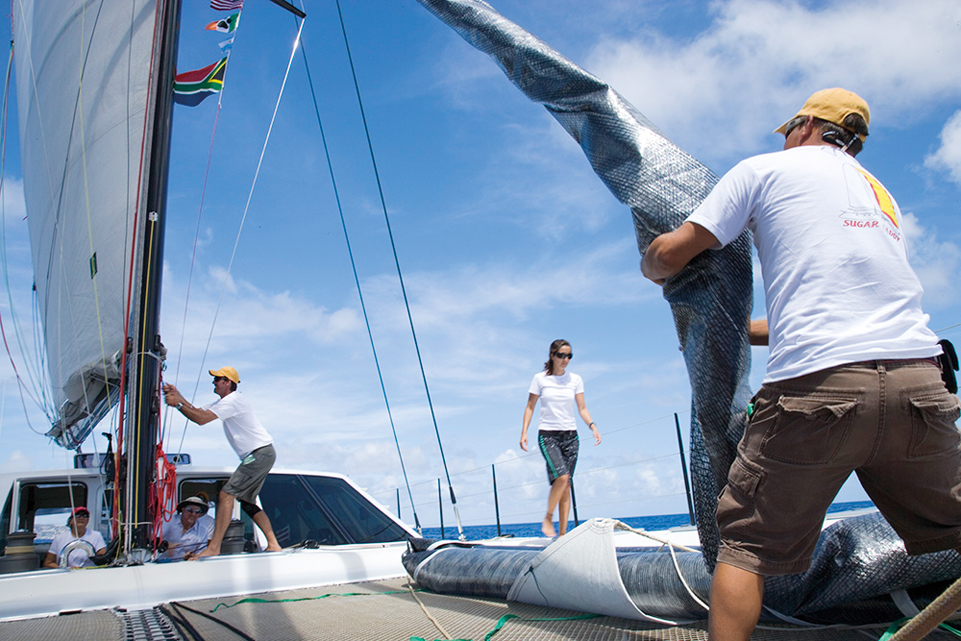
With its very stable deck area, the cat has a great advantage concerning maneuvers. (Photo Gunboat)
Performance and pleasure at the helm
In the cruising catamaran category, the gap between the peaceful, voluminous cruiser and the fighter plane, capable of around 25 knots off the wind, is very wide. The price also: technical sophistication, carbon rigs, the daggerboards...all these elements have a high price. The biggest part of the market nevertheless favors comfort aboard and on deck. The displacement increases, as does the windage. So the architects try to increase the sail area – the masts are higher, the mainsails adopt powerful square heads, the overlapping genoas are still on the forestays and gennakers on furlers are enjoying great success. At the helm, the speed-oriented two-hulled machines – for example the Outremers, Loopings, TS, Freydis, Alibis, Schionnings, etc) are exciting to helm, especially if they are equipped with two steering wheels. The Catanas or Nautitechs are also rather good. On the other hand, the models with a less favorable sail area/weight ratio are sometimes boring to helm, despite steering linkages which are more and more carefully designed and sensitive. So we let the autopilot do its job... It’s nothing like this aboard a trimaran, which is often equipped with a single tiller. Livelier, more maneuverable, they accelerate in the slightest gust and tack in a pocket handkerchief. They are moreover so light that if they fail to tack, you can quickly go astern...be careful with the rudder! As for their performance, there's no contest: even a little Dash 750 can see top speeds of 20 knots. Most trimarans are much faster than their colleagues with two hulls of the same size, and are above all much faster to windward, thanks to their centerboards. Sailing to windward, only cats which themselves are equipped with daggerboards can put up a fight. Those content with fixed stub keels can only watch the trimarans’ transoms disappearing in the distance...
Cat: 0
Tri: 1
Ease of maneuvering
On this subject, the debate is less clear-cut than previously...we are dealing with similarly-sized sails to be handled with very similar fittings. The difference comes firstly from the narrowness of the foredeck, which doesn’t make anchoring operations or hoisting/furling light wind sails any easier. The control lines, on either side of the coachroof and sometimes the cockpit coamings – just like a monohull – are easy to handle on a trimaran...but they don’t leave a real relaxation area. This isn’t a problem on a sporty cruise, but more so on relaxed cruises with the family. Aboard the older generation catamarans, the control lines – and particularly the sheets – can be adjusted from two or three points in the cockpit. Today, the builders like to bring them all together around the steering position. This progress in terms of ergonomics is striking, particularly aboard the models which have adopted a steering position on the flybridge – introduced by the Lagoon 440. One person alone can then easily handle the boat.
Cat: 1
Tri: 0
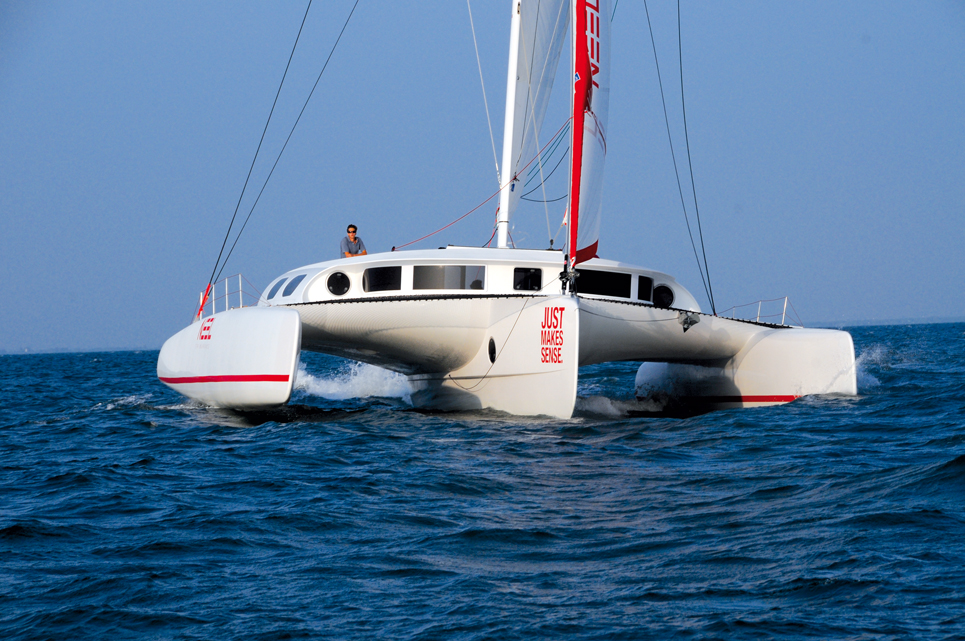
Well-supported on its leeward float, the trimaran passes better through the waves, and is more comfortable under way... (Photo Neel Trimarans)
Safety
On paper, advantage trimaran. Firstly, all three hulls must be holed at the same time for the boat to find itself awash - remember, all multihulls are unsinkable. A cat may perhaps have more problems in the case of a sizeable leak, as the two hulls are joined via the nacelle in most cases. The trimaran is beamier, stiffer and therefore less likely to capsize. The wider angle of the shrouds also guarantees better support for the rig. Structurally, a monobloc catamaran with a nacelle is without a doubt stronger than a trimaran assembled using simple linking arms. On the other hand, the catamaran is generally equipped with two engines, whilst the trimaran only has one. And this, in the case of a breakdown - which can happen – is nevertheless very important! This simple characteristic is enough to balance the match...
Cat: 1
Tri: 1
Size in harbor
Catamarans have to put up with a beam which is 50 to 70% greater than that of a monohull. This area leads to prohibitive harbor tariffs – for those who can find a berth. There is a reason that most cruising catamarans are dedicated to a blue-water cruising program: their route passes via heavenly anchorages, not marinas! Obviously trimarans start this round at a disadvantage, as they are even beamier than a catamaran of the same size...this is true for the biggest models, as the smallest – up to 35 feet – are more often than not foldable, as are for example the Corsairs or Dragonflies. This feature, now perfectly mastered from a technical point of view, allows the beam to be halved, thus giving access to monohull berths (and tariffs!). Another advantage: the possibility of transport by road...on the other hand, the areas of the deck which are submerged when the trimaran is folded become fouled very quickly, and are hard to protect from contact with other boats and the pontoons.
Cat: 1
Tri: 1
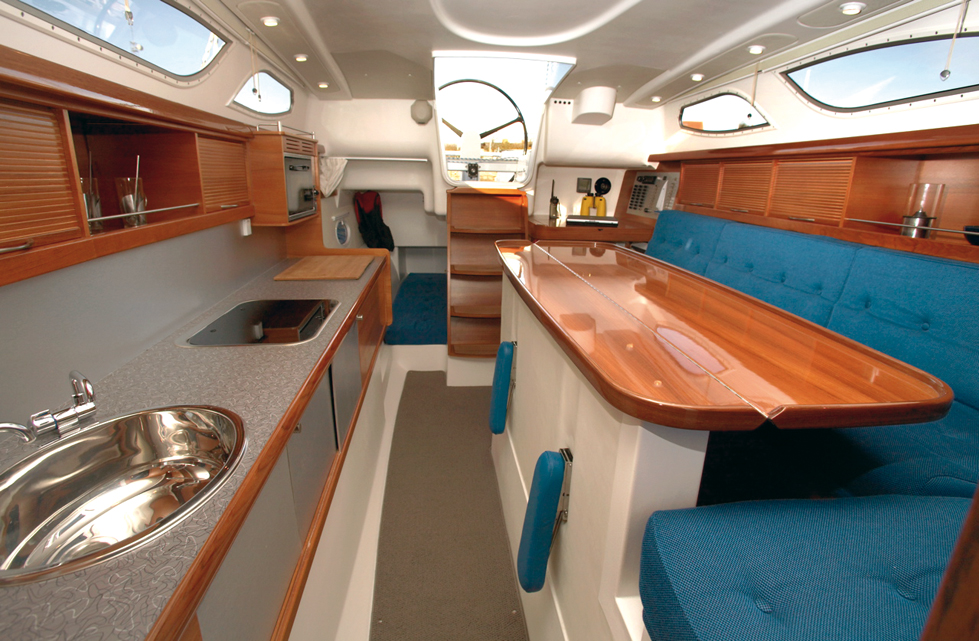
As for the accommodation, the trimaran (here a Dragonfly 35) has difficulty rivaling the catamaran…
Draft:
Two schools in a catamaran: daggerboards or stub keels. The first guarantee a pointing angle close to 45/50° to the true wind, and the possibility of controlling the feel of the helm by progressively raising them according to the speed reached. Raising them completely downwind obviously increases the speed possibilities, and avoids the possibility of the boat ‘tripping up’ – you can even keep half of the windward daggerboard to optimize the impact of a breaker hitting the boat abeam, which is always possible. Raised daggerboards offer the possibility of beaching...but beware of the slope of the beach, as the rudders are not necessarily strong enough to support beaching. But a large part of the catamaran fleet is equipped with fixed stub keels. Their draft is greater – 1m – 1.5m from 33 to 50 feet – but the boat can be beached with no risk of damaging the rudders! Most trimarans are equipped with a centerboard in the central hull – sometimes offset, to optimize the accommodation. And more often than not, their rudder(s) can be raised. A draw.
Cat: 1
Tri: 1
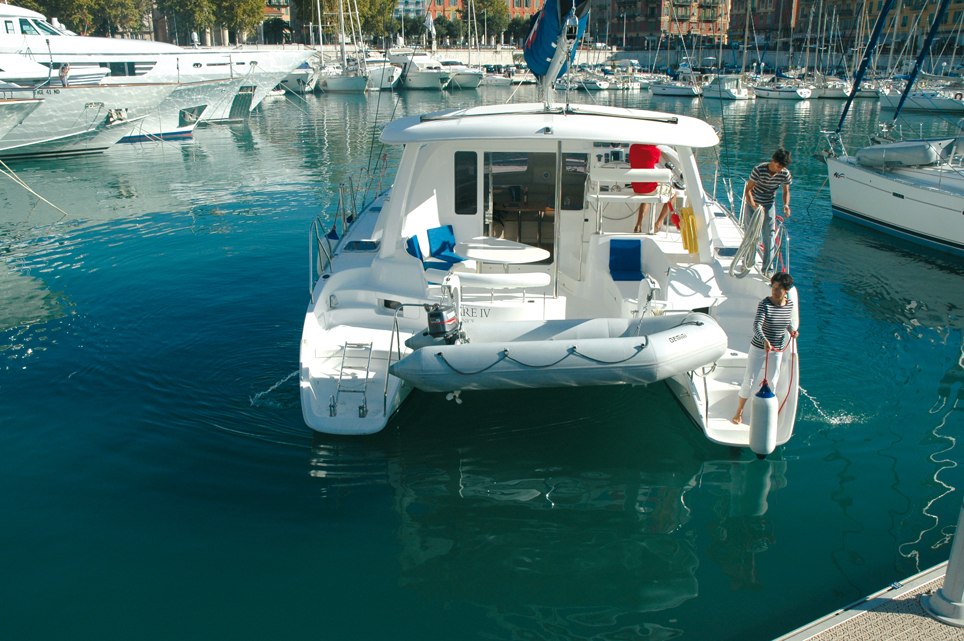
During maneuvers in crowded marinas, the cat has an undeniable advantage with its two engines.
Load-carrying capacity
One of the easiest matches to decide: advantage to the catamaran, whose relatively load-bearing hulls – especially if their hull sections are semi-circular – are able to carry a significant load. 45-foot cruising catamarans can embark a payload of close to three tonnes, whereas a trimaran of the same size could barely take half of that. That’s a lot less equipment! No washing machines, air conditioning, generators or diving compressors... Cruising in a trimaran is about having fun, but accepting that you must travel light! For all that, although (relative) overloading is acceptable aboard a monohull, it is poison for a multihull, even the most comfort-oriented catamarans.
Cat: 1
Tri: 0
Harbor maneuvers
We come back to the end of the safety round: the catamaran’s two engines, as against just one on a trimaran. On condition of course that there are actually two motors behind (or under) the cabins! Multihulls are actually hard to maneuver in an enclosed harbor, victims of windage and significant beam. Two engines, by reversing the throttles, allow rotation in the boat’s length. And the hulls of a catamaran are easy to fend off and protect with fenders. It’s not so easy aboard a trimaran, whose single, central engine considerably limits the maneuvering possibilities. And it is hard to protect the ends of the floats, as access is not easy... Help from an inflatable with an engine – your own dinghy, or that of the harbor which you have previously called on – is often welcome in harbors...
Cat: 1
Tri: 0
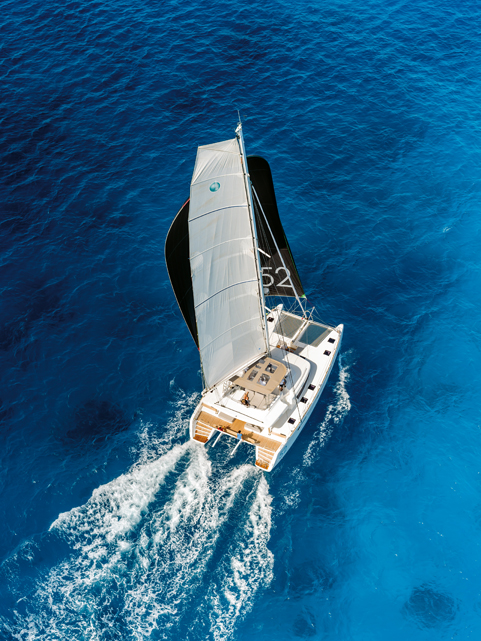
Trimaran or catamaran? The right boat is finally the one which allows you to go sailing... (Photo Lagoon - N. Claris).
Well?
On paper, the advantage goes to the catamaran. But be careful, the result must be adapted according to your way of sailing. In small sizes, the sporty, fun trimaran, which in addition can be folded and transported, is a must.
Over 40 feet, and for blue-water cruising, the cat is ideal. This confirms the tendency of long-term cruisers, more and more of whom choose this support for their voyage, even to the detriment of monohulls. And then there is the Neel, a cruising trimaran which combines the advantages of the cat and those of the trimaran...
