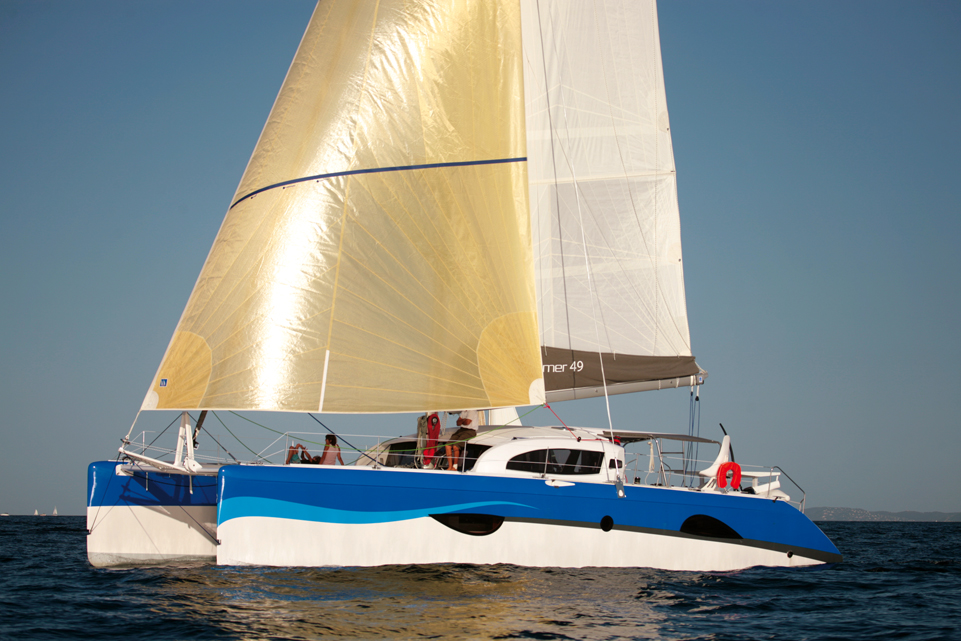
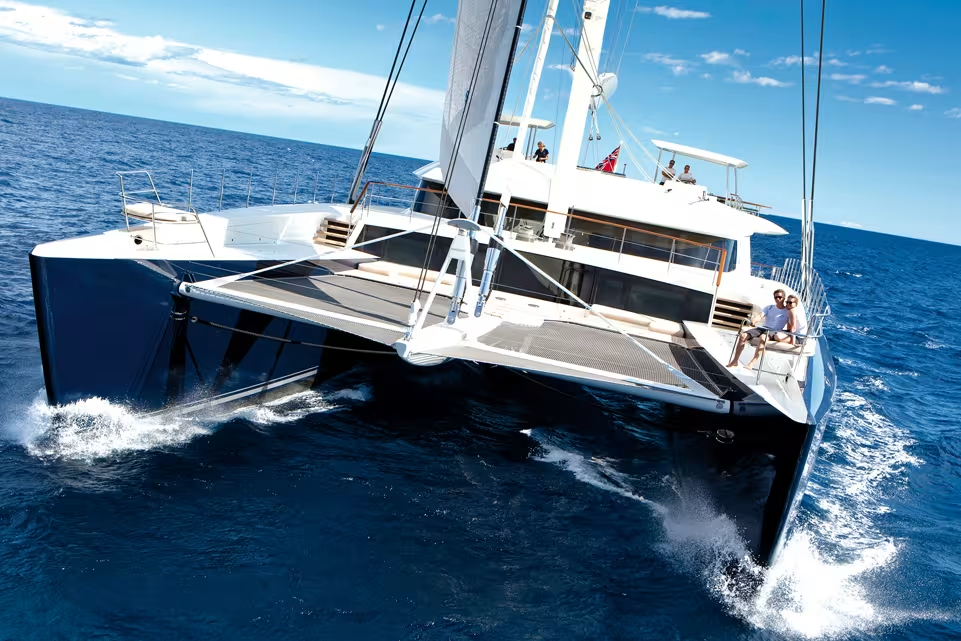


Are there so many combinations that the possibilities seem endless? Everyone is giving you different advice? Stop! In order to simplify the subject a little, and even though they complement each other, let’s start by separating upwind and downwind sails. And let’s have a go at solving the first part of the equation.
This mainsail is very practical. You hoist it when you set off, you drop it when you arrive, and at worst, you have had to take in one or more reefs and then let them out again. But up forward, you remember all too well from your youth, the waves crashing over you on the foredeck as you changed one genoa for another, and then back again…according to the wind, and also the mood of the skipper! Of course, in the early 80s the furling genoa came on the scene, initially for single-handed racers, then on all our cruising boats. But while we acknowledge that we don’t have to swap sails every time the wind changes by a few knots, neither the sailcloth nor its shape can do everything satisfactorily: either you have a genoa which is too flat and too heavy when unfurled all the way, or you have one which has too much depth and is too light when partially furled as the wind picks up. Or worse, both these faults together!
Another constraint comes from the design of our multihulls: for years, the sailplans have favored mainsail area over that of the genoa, which is, more often than not, self-tacking. If, in the last couple of years, designers have been shifting masts back a little, to rebalance things a bit, at less than 12 knots or so of wind, the feeling like there’s “more horsepower under the hood” does no harm. Rest assured that a solution does in fact exist.
Several round the world racing nutcases, while exploiting a loophole, which gave it it’s name, invented the sail that you need: the Code Zero. A lightweight genoa, set on a bowsprit, overlapping the mast, but coming inside the capshrouds to allow you to go upwind on the open sea, even in light airs. It can also act as a gennaker when there’s more wind, by easing it out as the wind picks up.
More traditional is the combination of an overlapping, furling genoa with a staysail. The difficulty with this is that when the staysail is set, the windage is increased, as is weight aloft, and it fouls the genoa every time you tack, often to the point that you have to resign yourself to rolling it up every time. If the staysail is not set, you have to go and bend it on when the wind picks up as the bows are starting to dive a little and the spray is coming up through the trampoline…those with delicate stomachs can pass!
To conclude, at the magazine, we like:
-Using our headsails to the max, with an “all or nothing” approach, partially furled as infrequently as possible.
-More making sail-changes when the wind is light, rather than when it is picking up.
Also, on condition that your boat can take it, or have the necessary modifications made, we would vote for the combination of a self-tacking Solent and a Code Zero.
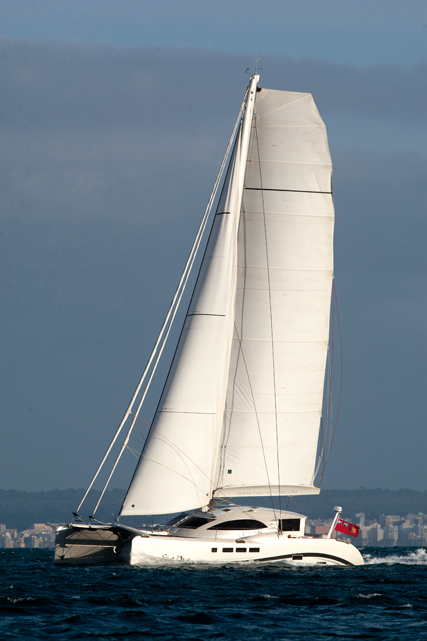
Self-tacking solent unfurled, Code Zero and gennaker in position, your cat is now ready for all eventualities…
Furling Genoa:
An all-purpose sail, it propels your multihull in a few knots of breeze, up to a strong wind. Because it overlaps the mast, you have to release it and then sheet it in again every time you tack, reminding you of your monohull apprenticeship which kept you fit. It has a large surface area for light airs, and then when the apparent wind gets up towards 20 knots, shortening sail is as easy as pulling on the end of the furling line. Unfortunately once rolled up, despite the most sophisticated systems to deal with the hollow shape, the shape of the leading edge always leaves us wanting. With too big a volume, we are prevented from making good upwind progress, making sailing difficult if not dangerous in a rising wind. In order to limit the problems with this arrangement, we tend to use a tri-radial cut and a good quality sailcloth. Your genoa won’t become so hollow over time, particularly if you sail mostly with it fully unfurled. But then ideally it could do with a bit of help from a little sister…
Pluses: Multi-functional, performance in light airs, ease of use
Minuses: The cloth and cut are a compromise, sail shape when partly furled
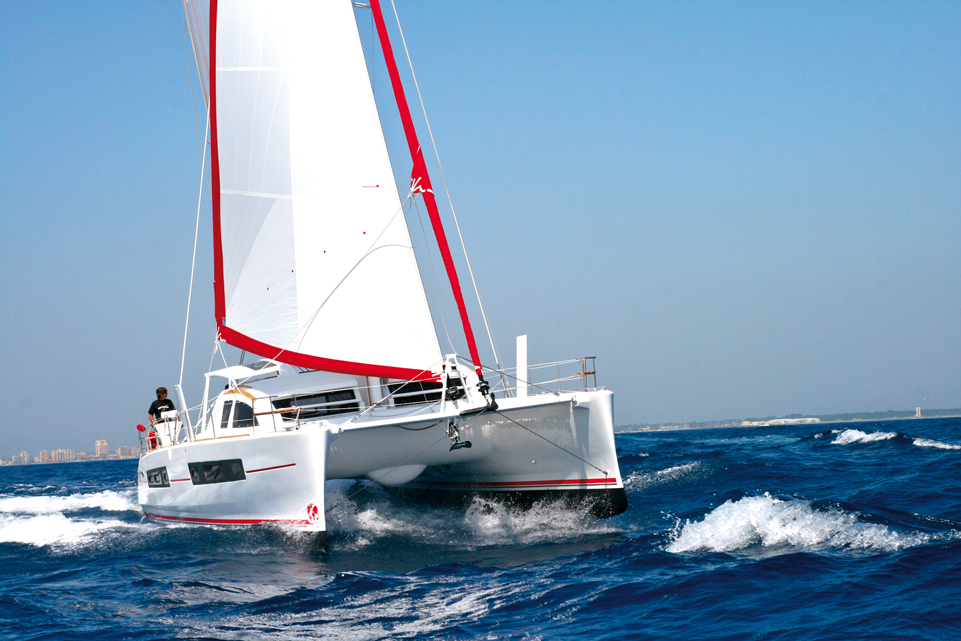
Staysail:
THE sail for globetrotters, the real, traditional purists: No serious circumnavigation without a staysail, to be able to cope with all possible weather conditions. This is easily justified if you have an overlapping genoa, and your boat isn’t the fastest in the fleet. In effect, if we are sure of having sufficient speed to choose our weather window, it’s best to have all the bases covered. Set on a removable stay and snapshackles, they’ve been around for a few years now, on furlers and with Kevlar anti-twist boltropes. If the longitudinal beam is not structural, it’s always possible to fix the tack down to a pair of bobstays crossing the trampoline. On some catamarans, it could also be mounted on a fixed roller, making it immediately available when required. This is the ideal combination for long crossings, but becomes tedious with the genoa when coastal cruising demands lots of tacking. Made from a particularly strong cloth, don’t hesitate to go for a heavier weight and oversized reinforcements. A woven Spectra-type cloth will earn it a reputation as being an indestructible sail, which will bring you home no matter what the conditions. But be careful, some alterations to the mast may be required (reinforcement, sheave, halyard…)
Pluses: Safety, area and shape always good
Minuses: Cumbersome or awkward to set up, requires specific fittings
Self-tacking solent:
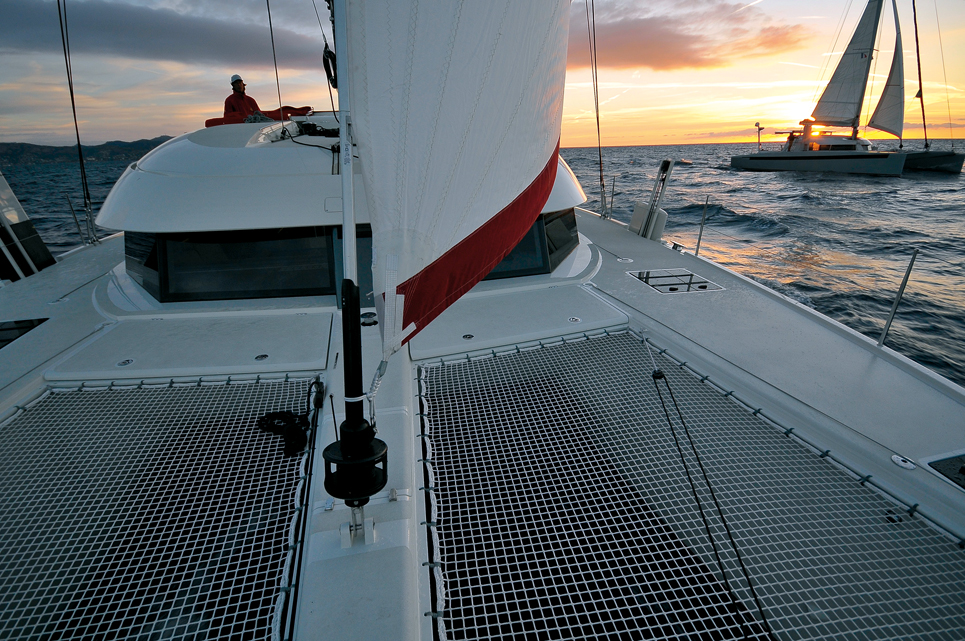
This is the sail which fully unfurled you can carry in 15 to 35 knots of apparent wind. Relatively flat-cut, taking account of its sleek profile and its multi-function use, the choice of cloth will be similar to that for a mainsail. A horizontally cut Dacron sail will follow you to the ends of the earth, but you can’t guarantee it maintaining its shape. A Hydranet cloth with a tri-radial cut will offer better longevity. If you are tempted by a membrane sail as being the perfect material, be aware that the extra cost and the fact that this sail is multi-purpose don’t necessarily warrant investing in such a high degree of precision. Whichever you go for, large reinforcing points will ensure the longest possible life of the sail. At the clew, a plate with several attachment points for the sheets means you will always be able to get the optimum sheeting angle. Finally, if this sail is permanently rigged, an anti-UV strip is ESSENTIAL!
Pluses: Ease of taking, tolerates strong winds, always the perfect shape
Minuses: Too small for light winds.
Code Zero:
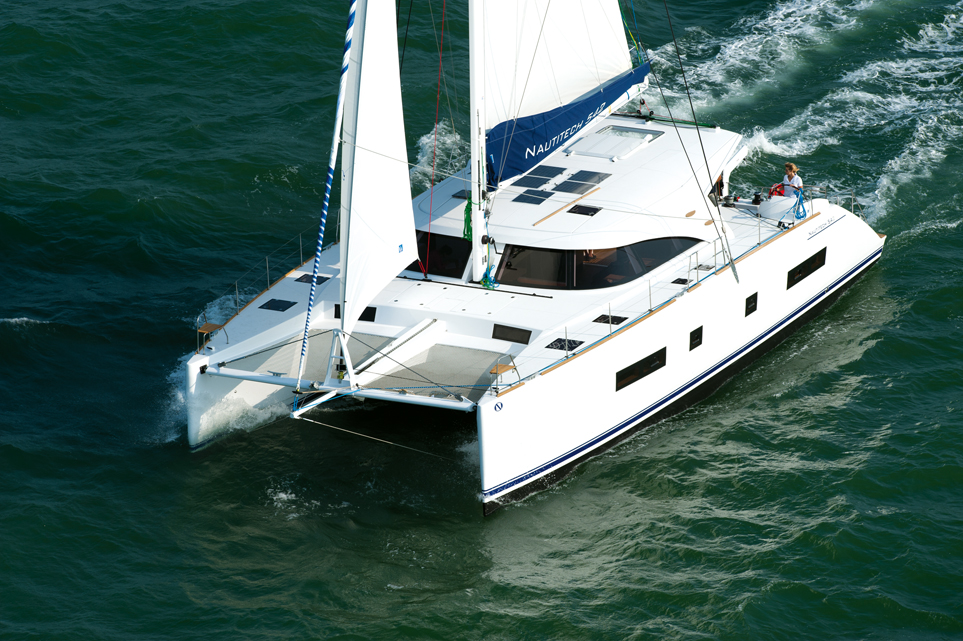
Calculating the right shape and choosing the right cloth are the key points to a successful sail. Shape, because its furler, which could be the same as the gennaker one, is fixed to the bowsprit. In order that the foot of the sail, once it’s sheeted in for going upwind, can’t touch the martingale stay of the forward beam, and that the sheeting angle is close to 45 degrees, careful dimensioning and the use of 3D design software by the sailmaker, including the rigging, is essential. To make sure that the sail doesn’t unfurl accidentally, to limit pitching and windage, it’s best to systematically take the sail down when it’s not in use. But for the times when it does stay in place, and for times when it is stowed on the trampoline, a very light anti-UV strip could be something which significantly increases the life of this sail, which will quickly become your favorite! And since it is your favorite, treat yourself to the best materials. For this light sail, with large sail area, a top of the range material is appealing: slender and stable in shape, if a membrane is out of your price range, a CZ GP sandwich type from Dimension Polyant seems to be a particularly well-suited compromise. If you are planning a big trip, a woven taffeta layer on each side will make the sail heavier, but protect it from harmful chafe and from folding (even rolled up, the sail will at some stage be stowed in the sail locker!)
Pluses: A real turbo-effect in light airs, a heavier gennaker as a bonus
Minuses: High cost (large sail area and very technical sailcloth), tricky shape to make