Checking out a new 30-foot cruising catamaran is always going to be a joy for the Multihulls World team - we’ll never tire of promoting these affordable and easy-to-handle boats. So it was with great interest that we discovered the Ventio, unveiled for the first time at the La Rochelle boat show back in 2024. Admittedly, we had to wait until the following season for the opportunity to finally sail aboard this little adventurous craft - a boat so original among the current offerings - and to be able to share our first impressions with you.
Infos pratiques
- Le chantier : Ventio
- La fiche technique
-
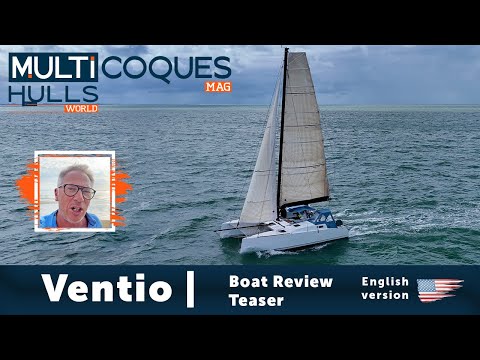 Découvrez notre vidéo exclusive
- Financez votre Ventio
- Assuez votre Ventio
- Articles autour du Ventio
Conditions: 10 to 16 knots of wind, moderate sea state
Four Basic Versions
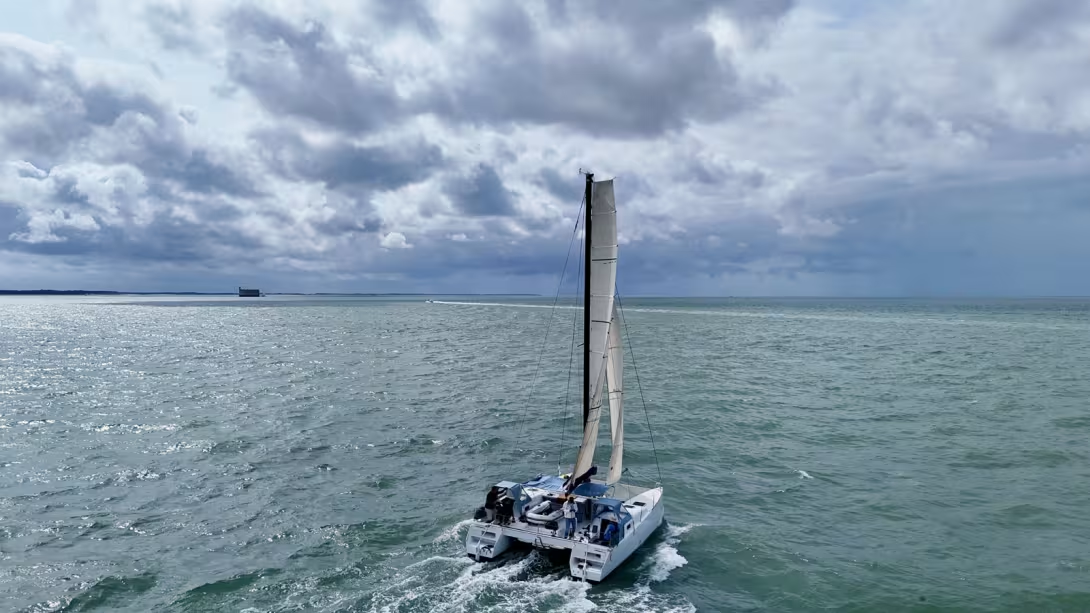
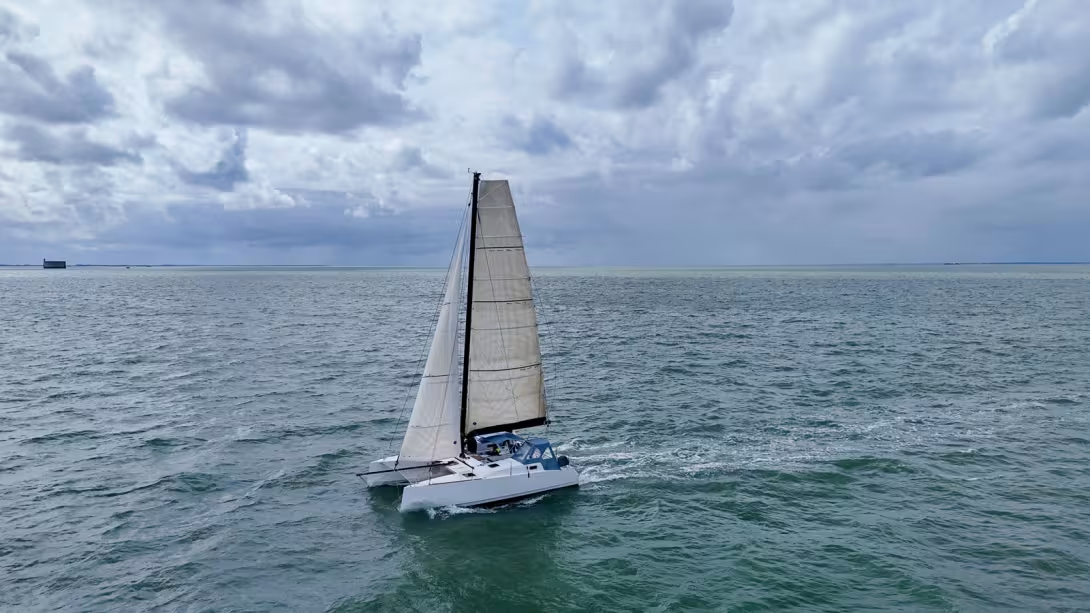
The model we tested is almost a one-off, designed in consultation with its owner, a former Dart sailor. The culture of lightweight catamarans is reflected on board in a wide range of technological options aimed at optimizing performance, and we’ll come back to that a bit later.
The yard offers four basic versions with various possible combinations: OpenSpace, Spirit (performance-oriented version), Grand Tourisme (enclosed cabin), and Electric.
The construction (hulls, deck and bulkheads) is in PVC polyester foam sandwich with 10 or 15 mm marine plywood reinforcements. The Ventio is unsinkable thanks to its structure (3,300 liters/117 cubic feet of buoyancy), 500 liters (18 cu ft) of watertight crash boxes, 700 liters (25 cu ft) in the sugarscoops, 370 liters (13 cu ft) in the aft beam, and 1,150 liters (41 cu ft) beneath the cockpits. There is also 30 cm (12 in.) of foam behind the mast bulkhead (750 liters/26 cu ft) and another 10 cm (4 in.) on the sides of the forward cabins (440 liters/16 cu ft). This gives a very reassuring total buoyancy of 7,210 liters (255 cubic feet) for a maximum displacement of 5,400 kg (11,900 lbs).
Near the waterline, the hulls have a discreet chine, and each hull is topped by a small streamlined coachroof flanked by a small rectangular porthole - it looks like the same model as the one found on the Sun 2000 trailer-sailer. As for the hull, we’re not looking at slim hulls like those of a Kat 28, but rather closer in size to a Maldives 32 - albeit 0.90 m (3 feet) wider.
The Ventio we tested, which combines aspects of the OpenSpace and Spirit versions, could therefore be defined as a catamaran with relatively large-volume hulls, a wide platform, and powerful rig – at least in our test configuration.
Open Deck Plan
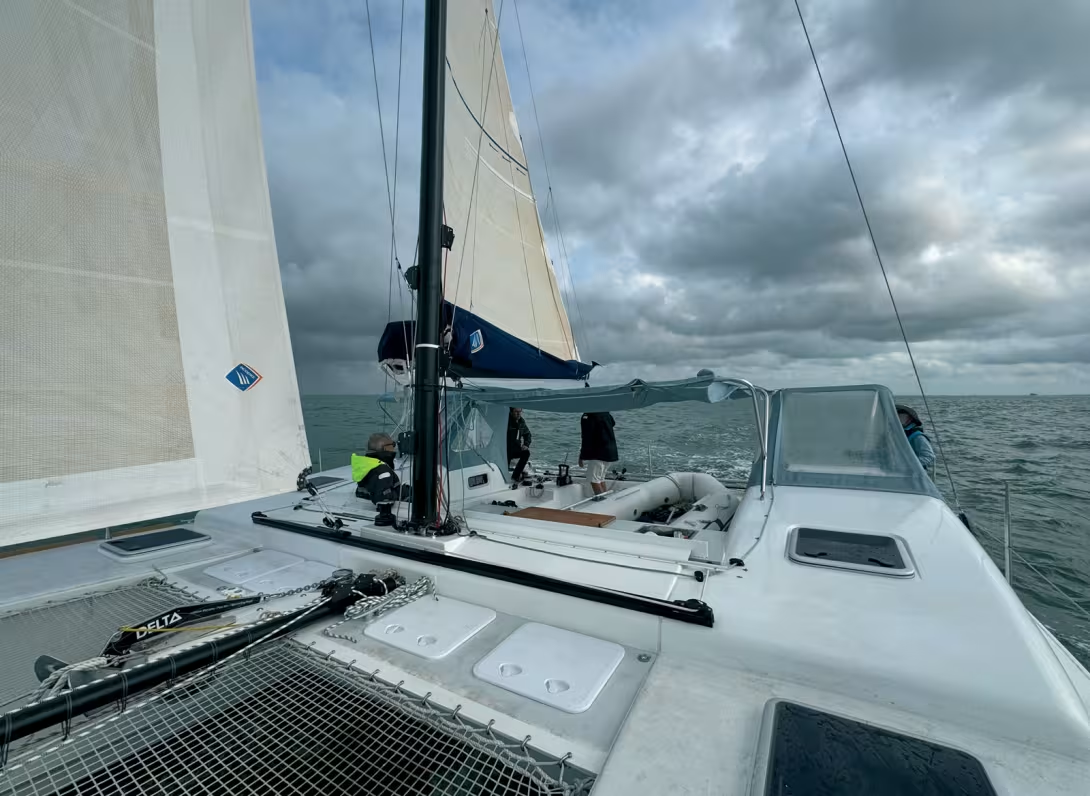
The configuration without a nacelle is reminiscent of the Aventura 23 and 28, but this time in XXL mode, as the central deck offers a vast 10 m² (108 square-foot) saloon/galley area. The layout is flexible, or almost, in terms of the location of the saloon (U-shaped or L-shaped, with a 135 x 78 cm (53 x 31 in.) table mounted on sliding legs) and the galley, depending on the owner’s preferences. Our test model features a forward galley with a large 195 cm (77 in.) worktop on the port side and a smaller 50 cm (20 in.) worktop on the starboard side. Obviously, this configuration is best suited to mild weather conditions, but a full set of covers provides shelter in case of rain. A small moveable staircase leads the crew to the large trampoline at the front. The aft part of the cockpit could benefit from an additional stiffener to increase rigidity. Sailing maneuvers are concentrated at the foot of the mast and at each aft helm station. Logically, tiller steering has been chosen. The helmsman can shelter under the hoods that cover the companionways. Right at the stern, two 120 x 50 cm (47 x 20 in.) sugarscoops have been incorporated.
Three steps lead down into the hulls. These companion- ways are removable to allow access to the aft storage areas. The builder offers a wide range of layout options in these hulls, which have a generous headroom of 1.88 m (6’2”). The port hull is fitted out with a central bathroom and a forward berth measuring 200 cm long by 110 cm wide (78 x 43 in.) at the head and 50 cm (20 in.) at the foot. On the starboard side, there is space for a chart table that is home to all the on-board electronics. The finish is rustic, with most of the cabling exposed, although there are a few conduits ducts here and there. The advantage is that this makes maintenance easier.
The coating is a simple two-component paint.
Again, this is in keeping with the Ventio’s mini-adventurer program, except that the two layers arealready flaking off - no doubta problem with the preparation of the substrate. In the central section, there is a 200 x 140 cm (78 x 55 in.) berth that can slide out and be converted into a sofa - a nice touch! Various options are available, such as installing a head or a berth in the forepeak.
A Platform that Doesn’t Necessarily Need a Ton of Power...
A pair of 9.8 HP outboard motors ensure easy maneuvering in port and they’re more than powerful enough to pull away against wind and current if necessary. The yard also offers two 6 kW electric pods with hydrogeneration function, 19 kWh of batteries, and 1.1 kWp of solar panels.
The outboards were tilted up against the inboard side of the hulls, but first, we hoisted the imposing 40 m² (430-square-foot) Aramid mainsail made by Incidences on the 14 m (46-foot) carbon rotating mast - the more modest versions of the Ventio make do with a 33 m² (355 sq ft) mainsail and a 12.10 m² (39’8”) mast. The self-tacking solent is less powerful: it measures 17 m² (183 sq ft) compared to the standard 16 m² (172 sq ft).
When sailing close-hauled, I felt that the machine was somewhat restrained - it seemed to me that the sheeting angle of the jib, at the end of the rail, is too far outboard. However, architect Nicolas Purnu suggests an angle of 11 or 12°. The fact remains that it is difficult to find the right “mix,” which is quite typical with very narrow self-tacking jibs. A more centered setting can be achieved by involving the windward sheet... at the risk of closing the leech excessively. Ideally, there should be a stop on the track. With the leeward centerboard all the way down, we maintained 7/8 knots at 45° to the true wind of 15 knots over a somewhat choppy sea, feeling that we could be doing much better. When we eased sheets, heading for the island of Aix, the Ventio finally breathed and managed to exceed 10 knots - our top speed for the day being precisely 10.5 knots. But at that point, the helm becomes hard.
Fortunately, the helmsman is comfortably seated – to windward or leeward - in his cockpit on a 125 cm (49-inch) bench seat. Firmly secured here, he remains in control even though the sprayhood is too angled. When the deck is wet, it becomes a bit slippery here and there - the non-slip coating is sometimes insufficient - and the liferaft, cleverly stowed under the aft beam, causes a bit of splashing at the back of the cockpit. In this somewhat mixed-bag atmosphere, a flying jibe resulted in a little damage to the fittings of the mast spanner. The outcome of our trip reinforced my belief that the Ventio is designed to be peaceful - it is suited to a more sensible and tolerant rig. Less mainsail (and especially less roach) to move the center of the sail forward, less mast rake and less overlap for the headsail would seem to me to be the right formula to get the most out of this catamaran, which is in any case limited in pure performance due to its relatively beamy hulls and displacement. In the same vein, I prefer the idea of standard skeg keels to daggerboards - keels are cheaper, simpler, more robust and, finally, allow you to take the ground without worrying about the rudders.
Conclusion
On paper, the Ventio is certainly appealing and is quite unique on the market - at least today’s market. Hull #1, rigged with an extended carbon mast and daggerboards, is clearly performance-oriented while offering comfortable (though basic) accommodation in the cabins. I personally don’t find this combination the most convincing: the wide hulls would be much better suited to a more sensible and, above all, easier to manage rig, not to mention the budget, which would become much more affordable. At the time of our test, some necessary adjustments were still required regarding the balance of the helm, the efficiency of the rig, and the finish. Nevertheless, this platform has genuine potential, especially since the builder offers a wide range of options, including a central cockpit with a composite coachroof, rigs of varying power, and a twin electric powertrain.
Technical Specifications
Architect: Nicolas Purnu
Material: PVC/glass/vinylester foam sandwich
Length: 30’2” (9.2 m)
Beam: 20’4” (6.2 m)
Draft: 35” or 20”/6’11” (0.89 m or 0.5/2.1 m)
Air draft: 44’4”/54’6” (13.5/15.4 m)
Displacement: 6,830 lbs (3.1 t)
Mainsail: 355/474 sq ft (33/44 m²)
Self-tacking solent: 183 sq ft (17 m²)
Code 0: 474 sq ft (44 m²)
Powertrain: 2 x 10 HP
OpenSpace version: € 185,000 ex-tax
Spirit version: € 260,000 ex-tax
Grand Tourisme version: € 236,500 ex-tax
Electric version (GT-based): € 255,000 ex-tax
www.windpearl.com