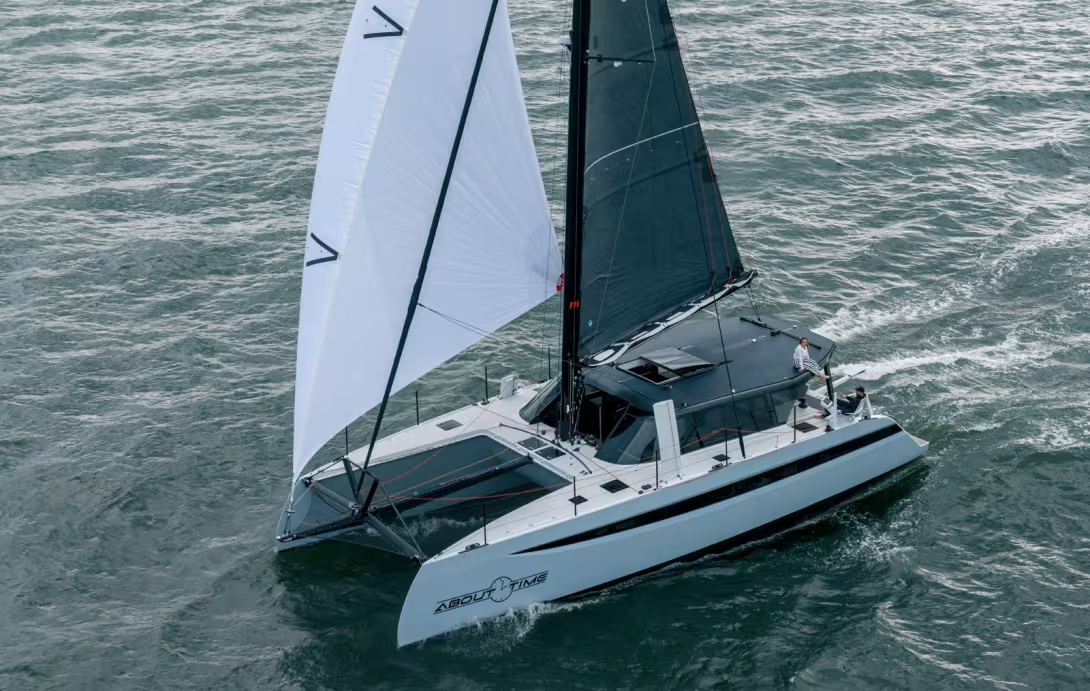
The successor to the 50, the HH52 is entering the sport cruiser market with big ambitions, promises of high performance, and lots of ideas and innovations. It’s an appealing combination on paper, and once at sea, it proves even more attractive.
Infos pratiques
- Le chantier : HH52
- La fiche technique
-
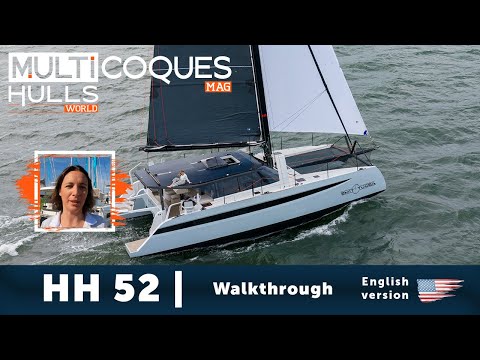 Découvrez notre vidéo exclusive
- Financez votre HH52-SC
- Assuez votre HH52-SC
- Articles autour du HH52-SC
Test conditions: Southeast wind 15 to 20 knots, flat sea
Few people know that HH stands for Hudson and Hakes, the founders of the shipyard, but all catamaran enthusiasts know HH, so... It took just over 10 years for the manufacturer with the same two initials to make a name for itself in the world of multihulls. Built in Asia, HHs sail on the seas of the world with a range of sailing catamarans from 44 to 88 feet. The new 52 has the daunting task of being the successor to the HH50, a highly successful multihull that is also positioned in an extremely competitive segment. The HH52 is in line with modern “performance-cruising” catamarans, with a dual focus: comfortable offshore cruising and performance under sail. Drawn by the renowned naval architecture firm Morrelli & Melvin, this catamaran has also been designed to optimize hybrid propulsion.
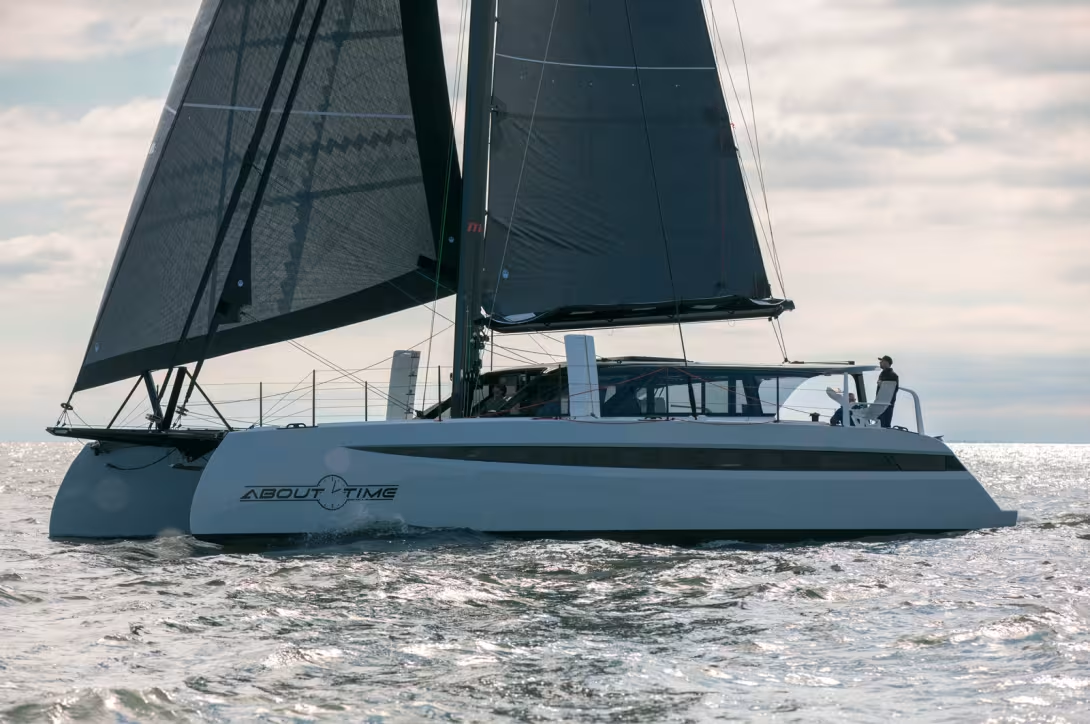
To counter the competition, the shipyard decided to strike hard while building on a proven foundation. The newcomer is therefore based on the 50 and retains an undeniable family resemblance, particularly with its long hull portholes that taper towards the bow. The designers have also retained a nacelle with a slender upper profile. However, the large rear side strut has been replaced by a lighter solution that maximizes space in the cockpit and improves circulation. Above all, the big change is in the helm stations. Formerly located in an elevated position on each side, they are now completely pushed back onto the gunwales with a seat almost above the water and... the ultimate surprise, a tiller. In addition to the benefits for sailing, which we will come back to later, this layout frees up a lot of space in the cockpit.
Another new feature is the catamaran’s forward maneuvering cockpit at the foot of the mast, which is directly accessible from the saloon.
Modern Manufacturing and Weight Reduction
Regarding the manufacturing, the HH52 features a carbon/epoxy sandwich construction, with a distinction between the Ocean Cruising (OC) version, which uses a sandwich combining fiberglass and carbon in high-stress areas, and the Sports Cruising (SC) version, which uses carbon almost everywhere (structure, hulls, furniture, etc.) to optimize weight while offering maximum strength.
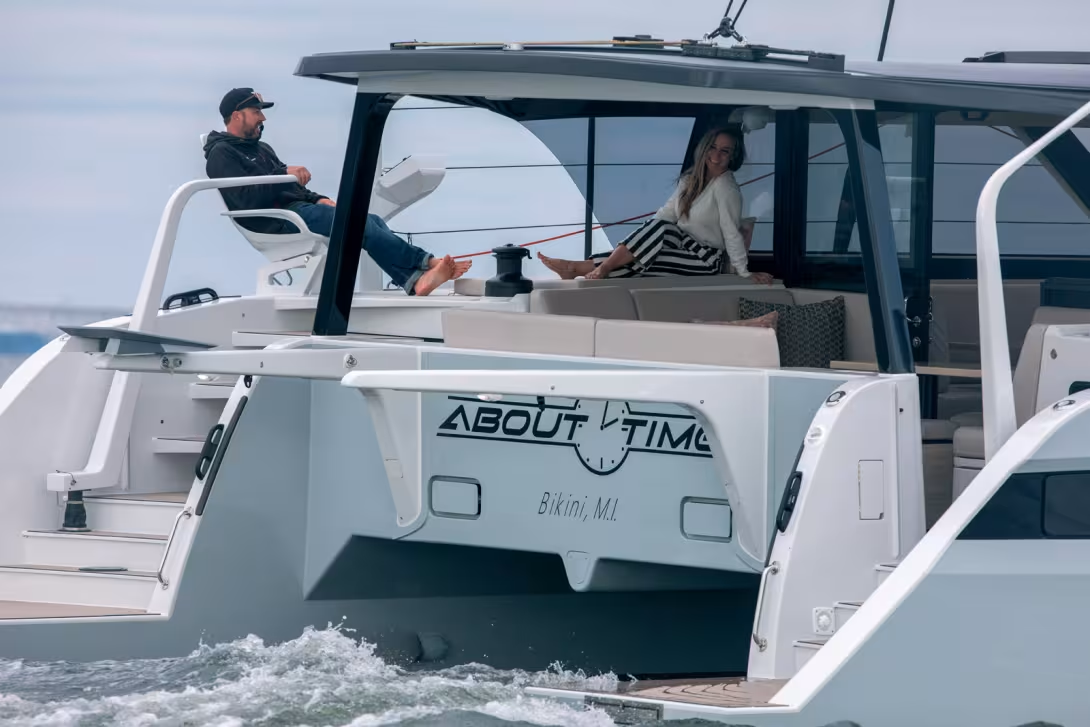
Access to the boat is via long sugarscoops and three steps. This layout is convenient for accessing the tender; however, the dinghy will have to make do with davits rather than a platform, a choice that saves a little weight and is more economical.
On our test catamaran, the cockpit was free of “traditional” steering wheel helm stations, but we’ll come back to that later. Taking advantage of the available space, the cockpit offers two L-shaped seats with a table on the starboard side and another bench seat against the transom. The whole area is protected by side windows, and, on each side, a staircase leads to the side-decks. A simple and functional layout.
The side-decks are wide and the flush deck hatches make it easy to move around. The daggerboards are set well outboard, and so don’t get in the way. To improve performance, the designers have equipped the bow of the catamaran with a large trampoline without too many lockers, a choice that again saves weight. A carbon bow beam provides rigidity, while a central longitudinal reinforcement extends into a bowsprit, also made of carbon. Three furling systems are located at the bow so that most maneuvers can be carried out from the cockpit. However, the anchor, located under this structure, will be difficult to access from the deck - in the event of a problem, the dinghy will have to be used.
A Functional, Modular, and Soothing Interior
The cockpit also provides direct access to the interior saloon. Thanks to a wide door and a top-hinged window, the separation between the interior and exterior disappears. Once inside the saloon, the HH52 retains the minimalist look of the cockpit with a dining area on the port side, an L-shaped galley at the rear and on the starboard side, and finally a central island that also serves as a leaning post for the interior helm station. This is a somewhat unusual layout, but one that facilitates circulation. The helm station itself is very well equipped and a door on each side provides quick access to the forward cockpit at the bottom of the mast, which is really practical and also improves ventilation on board.
Let’s go back to the galley: it’s a very functional area, designed with easy-to-maintain materials such as Corian, and includes everything you need for passage-making. The equipment offered by the shipyard includes a UV water filtration system for the galley and high-end appliances, but all of this can of course be customized when ordering.
Another good point about this interior is the huge glass surfaces and large deck hatch, which provide excellent light and panoramic views, no matter where you are in the saloon.
From the saloon, a comfortable staircase and handrails cleverly integrated into the bulkheads facilitate access to the cabins. For sleeping arrangements, the HH52 offers a great deal of flexibility, with generally two or three cabins that can be partially converted. On our test multihull, we enjoyed an owner’s cabin on the port side with a queen size bed in the rear and a beautiful head in the front. In addition to the available space, the bed is surrounded by portholes (including a safety hatch) and mirrors, providing extraordinary brightness. The hallway conceals plenty of storage spaces and the head features a very large shower, in short, great comfort...
The starboard hull offers a slightly different configuration with a double berth at the rear, a central bathroom, and another multifunctional cabin at the bow. This front cabin can be customized according to the customer’s wishes to become a workshop, a gym, an office, or simply an additional cabin. It also features a fold-down bed that disappears into the bulkhead when closed.
As with the rest of the catamaran, the interior is very bright, and the materials and colors can be fully customized by the owner. Another positive feature is the effective sound insulation, which ensures a quiet environment even when under way.
A Tiller for Thrills
The HH52 is classified as a “Sport Cruiser,” which implies performance worthy of the name. To achieve this, the designers literally hunted down every ounce of weight and also adopted a larger sail area than on the HH50. In fact, the mast has been moved back slightly, allowing for a larger headsail. Similarly, the boom is anchored to the mast a little lower down, which also allows for an increase in the main sail area.
There are several options for controlling the boat: on days with bad weather or when the sun is too strong, the inside helm station is the ideal place, especially since it is located about 3 feet (1 meter) from the forward cockpit. This helm station also benefits from a large deck hatch for keeping an eye on the rig and all the necessary electronics. On the mast, there are two large Harken electric winches and a third more versatile one. The rope clutches are accessible, and bags are provided for storing winch handles and other necessary accessories. Finally, three steps facilitate access to the foredeck when needed.
The other option is to steer from the aft helm stations. Although traditional helm stations are available on the SC version, it’s a safe bet that most buyers will opt for the side tillers. Here you can enjoy a comfortable seat above the water, optimal visibility and, above all, the pure pleasure of steering this speedy 52-foot catamaran with a tiller! To make the helmsman’s job easier, a console with a screen and all the main controls is installed on each side, with the daggerboards, mainsheet traveler and most of the halyards being electrically assisted.
Given the catamaran’s performance, the side tiller station is definitely an excellent choice. In practical terms, thanks to its moderate displacement, the HH takes off at the slightest breeze and accelerates quickly to reach a respectable cruising speed. During our tests, with 15 to 20 knots of wind, we regularly sailed at around 10 to 12 knots, which is an excellent average. With slightly more favorable wind conditions, we even reached 14 knots, which is very impressive. The shipyard claims top speeds of around 22 knots in the right conditions. On the SC version, the deep, lateral daggerboards also allow for efficient sailing close-hauled, which is of course not the case with many catamarans equipped with shallow keels.
Whether under Code 0 tor gennaker, the HH also proved to be stable, comfortable, and easy to steer thanks to its impeccable sail plan balance - in short, everything you could ask for in a fast cruising multihull. For an even more personalized experience, the shipyard offers a wide choice of sails.
Packed with Technology
The HH52 incorporates cutting-edge technology in both its engine and energy management systems. On the propulsion side, we find the brand’s beloved EcoDrive hybrid system, now offered as standard. This is a hybrid electric/diesel propulsion system consisting of two 5-kW motors combined with twin Beta Marine diesel engines. The large surface area of solar panels (4,900 W) integrated into the catamaran’s roof powers a 48 V battery bank with a capacity of 43.2 kWh. To assist the solar panels, the system also uses hydrogeneration to keep the batteries charged. In practical terms, all short maneuvers (entering and leaving marinas and channels) are carried out in electric mode with a range of 5 to 6 hours, without polluting emissions and in silence. The system also provides sufficient energy for on-board consumption, meaning that the catamaran does not even need a generator. The diesel engine remains available for fast motorsailing or as an emergency power source, and the entire system is managed by a CZone interface.
These features make the HH52 an ideal candidate for ocean crossings without the fear of running out of power.
Conclusion
With the HH52, the shipyard has not only capitalized on the success of the previous model, but above all, it offers innovative and practical solutions with a number of innovative technologies, without going overboard. The roadmap seems to have been followed to the letter, as this catamaran is undoubtedly a comfortable and fast cruiser that is just waiting to set sail.
Technical Specifications
Architects: Morrelli & Melvin
Length overall: 55’11” (17.05 m)
Hull length: 49’6” (15.8 m)
Beam: 24’5” (7.44 m)
Draft (Daggerboards up): 5’5” (1.65 m)
Draft (Daggerboards down): 11’7” (3.54 m)
Draft (Fins): 5’1” (1.56 m)
Air draft: 79’8” (24.29 m)
Light displacement: 28,700 lbs (13 t)
Mainsail: 958 sq ft (89 m²)
Overlapping solent: 657 sq ft (61 m²)
Code 0: 1,163 sq ft (108 m²)
Gennaker: 1,732 sq ft (161 m²)
Standard hybrid propulsion: 2 x 38 HP and 2 x 5 kW
Cabins: 2/3
Bathrooms: 2
CE Certification: A
Base price: € 1,570,000 ex-tax
www.hhcatamarans.com
Tiller steering
Performance
No four-cabin version
No aft platform

The layout is perfect for managing everything from this location.