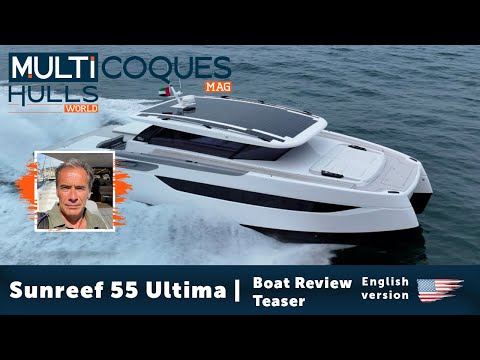
It’s been almost two years now that Sunreef Yachts announced their new Ultima range. The shipyard finally launched and presented its first model a few months ago, reserving the European premiere for the Cannes Yachting Festival. With its modern design, high technology, hybrid propulsion, and foil, this new semi-open coupé yacht presents an innovative character with the aim of conquering new market shares in the highly dynamic sports powercat sector.
Infos pratiques
- Le chantier : Sunreef 55 Ultima
- La fiche technique
-
 Découvrez notre vidéo exclusive
- Financez votre Ultima 55
- Assuez votre Ultima 55
- Articles autour du Ultima 55
Conditions: 12 to 15 knots of wind, sea state moderate
For two decades, the Polish brand Sunreef Yachts, founded and controlled by Frenchman Francis Lapp, has taken a leading position in the market that the CEO himself invented: the semi- custom luxury catamaran. Several ranges, from 60 to over 110 feet in length, have been launched and are now competing with luxury monohull superyachts, both sailing and motor yachts. The large beam, XXL amount of living space, and economic operation quickly attracted a clientele that was somewhat weary of the constraints of large motor yachts but obviously sensitive to the fact that they could have additional volume and enjoy even more luxury. And if you add that fuel costs could be reduced by 30 to 40%, interest will only increase... Nevertheless, the issue of access to marinas and docks, which is important to users of such craft, can ultimately become a factor when talking powercats. This is where Sunreef Yachts scores points by incorporating into the design of its new Sunreef range a width that is, let’s say, intermediate between the “traditional” powercat and the monohull sports coupé yacht. While the Ultima range starts with the 55 we’re presenting in this article, it will be available in 44, 55, 66, 77, 88, and 111 feet with an undeniable family resemblance - and above all, a resolutely modern design.
Whereas the brand had previously been content competing only with much larger monohulls, it is now also hunting down the sport yacht, semi-open coupé, and other yacht sectors - but on a much smaller scale. Let’s now take a closer look at the width mentioned above: if we compare the beam of the 80 Sunreef Power with that of the Ultima 77, we go from 37’9” (11.5 m) for the range to 26’11” (8.2 m), while both models are 77’ (23.5 m) long. And as for the Ultima 55, don’t you find its beam of 18’4” (5.6 m) closer to that of a Princess V55 (15’1”/ 4.6 m) or a Pardo GT 52 (16’3”/4.96 m)? I choose this final comparison because the silhouette of the latter, with its inverted bow and windshield, corresponds to the target segment of modern 40- to 60-foot sport weekenders, for which the selection of available models has literally exploded in recent years.
New Design, New Factory
To produce its new range, Sunreef Yachts didn’t hesitate to build a new production facility in the Persian Gulf, in Ras Al Khaimah, north of Dubai (see inset). The prospects for the development of boating in the Middle East are indeed very promising, particularly for the sectors the Ultima range is aiming at. During my visit to the yard last spring, I saw the second and third 55s in the water, while in the workshops, several 55s were on the assembly line, as well as two 88s. Francis confirms that more than twenty models are on order, so we can say that the range has well and truly splashed. With temperatures reaching 50°C (122°F) in the port, my investigations were relatively brief, so I took advantage of the presentation of the Ultima 55 at Cannes to take a more detailed look.
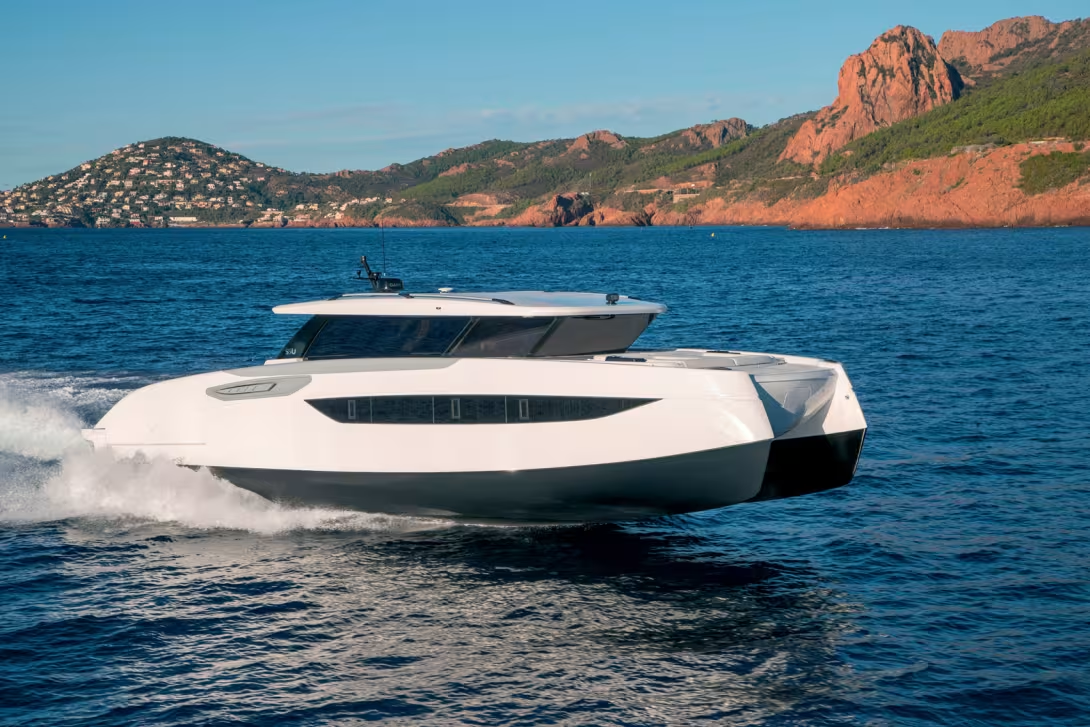
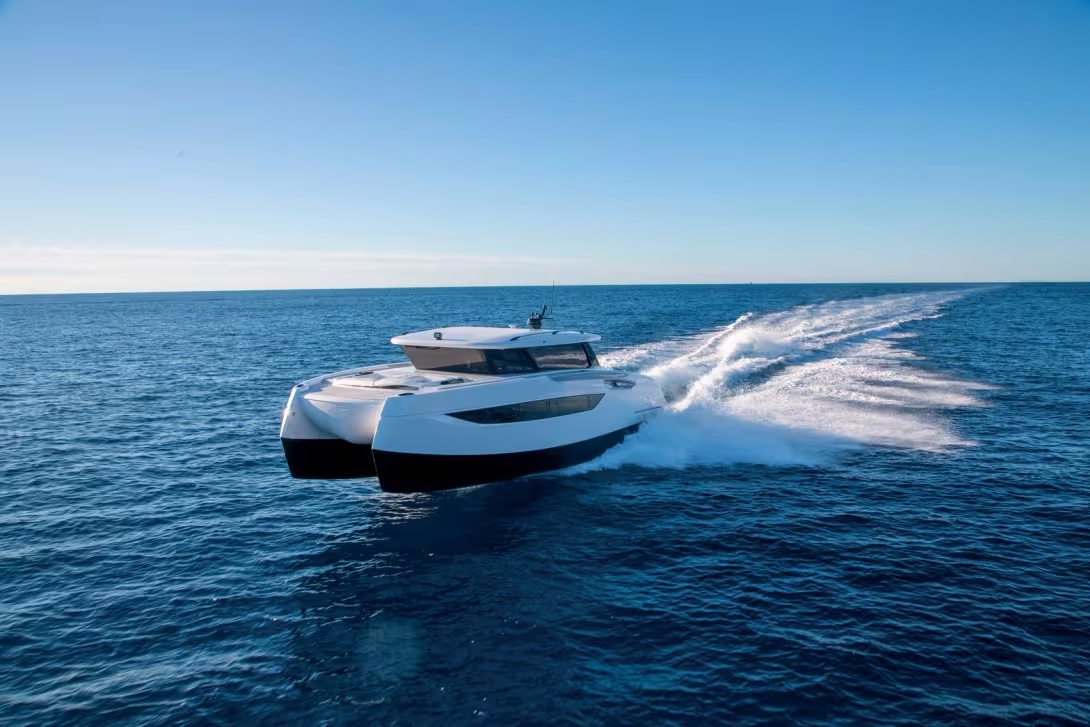
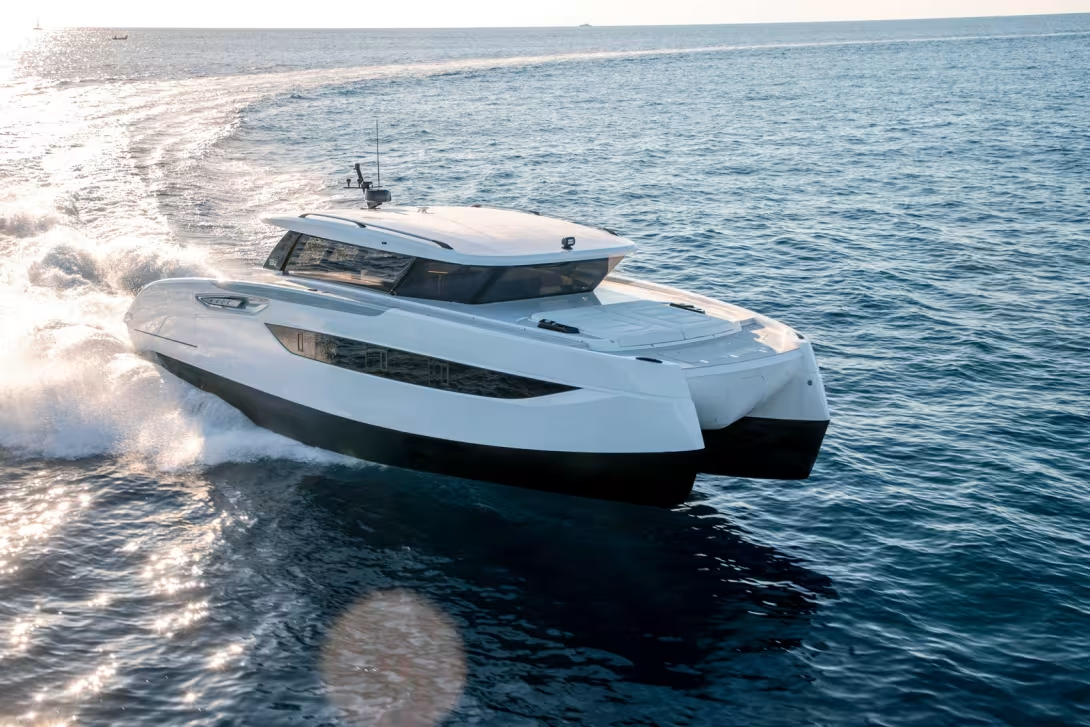
First impression: the silhouette is a clever mix of flowing lines and sharp angles. The wave-piercing shape of the bows is not continued below the waterline by bulbous bows, but creates an aggressive and dynamic silhouette, especially as the reverse slope is repeated on the windshield. The deck, which has no handrail (the width of the side-decks and the presence of handrails on the coachroof are sufficient for certification), only serves to highlight its inverted longitudinal sheer. The coach- roof is well centered and its over- hanging peak appears to be suspended thanks to the effect of the tinted windows, which gives the whole a feeling of lightness and evokes performance. These features were created by the in-house design teams. No detail has been left to chance, as can be seen, for example, in the aft sunbathing areas, whose rounded corners contribute to the overall modern feel that is so popular in the luxury circles that the Ultima 55 is likely to frequent.
Hybridization and Technology
At this end of the market, a top speed of over 30 knots (or even 40 knots) and a 25-knot cruising speed are the minimum requirements to be in the game. That being said, concerns about energy consumption and environmental protection are becoming more pressing, so Sunreef Yachts is going to be equipping its Ultima yachts with modular technology to meet this demand. A classic version, which delivers 30/35 knots and easy handling, features Volvo IPS 650 (800 as an option). A version equipped with a 600 HP Volvo powertrain, but driving a long propshaft, can be equipped with surface propellers for those who want to exceed 40 knots. Finally, a hybrid version is available with the same engines, coupled in parallel with 350 kW electric motors. This latter version allows for quiet, pollution-free cruising at lower speeds and also recharges the 220 kWh battery bank at 625 V while the internal combustion engine is running. It should be noted that the engines are located very far forward, which provides the necessary space for this electric coupling and the direct propshaft transmission, which is simple and more reliable. But these are not the only reasons. On the one hand, particular attention has been paid to drag with very narrow hulls requiring a well-centered load distribution. On the other hand, a foil has been developed and installed between the two hulls. Obviously, this foil is not designed to make the boat fly, but it further relieves Archimedes’ pressure and stabilizes the trim when passing through waves. This semi-load-bearing surface also benefits from a well- calculated balance of masses. In the same spirit of reducing drag, the deck is made entirely of carbon composite. The in-house designed lithium-ion batteries, with a density of less than 5.2 kg per kWh, are recognized as being 30% lighter than standard battery systems used around the world. To further reduce the CO2 footprint, several other solutions have been developed. The air conditioning system is designed to consume only 50% of any other product on the market, and the same goes for the watermaker.
Predetermined Design
On a Sunreef Yacht, they usually start with a blank slate when it comes to laying out and decorating the interior. However, on the 55 and likely the smaller 44, the layout and furniture are pre-designed to match the structural constraints of the vessel. That being said, it is possible to choose between two or three cabins, as well as adding a cabin for a crew member or child, which then fits in below a bench seat in the saloon. In terms of materials, a grained oak version and a walnut version are available - the shipyard’s interior design department, which employs no fewer than a hundred people, likes to point out that customers can request any fabric or material of their choice. The two large aft sun-lounging areas conceal storage compartments and access to the engine compartments. Then the sloping bay window slides into its recesses to provide access to the interior - welcome aboard a semi-open catamaran! Two inviting L-shaped bench seats are located before the galley counter, which separates the space dedicated to the helm station at the front and access to the cabins on the sides. The steps leading down to the cabins could do with being wider, as it is easy to bump into them when heading back up. The narrow width of the hulls means that these cabins are located in the passageway, but the king-size beds at the front are high enough to be partially housed in the nacelle. Aft, the bathrooms are trimmed with a grainy material that looks very flattering. These facilities are designed for day trips or long weekends at most, but the contemporary atmosphere created by the subtle blend of carbon fiber and paneling is as attractive as it is pleasant.
Increased Stability
During our trip out in the Bay of Cannes, the wind was blowing hard enough to cause quite a chop. Such conditions didn’t make it ideal for assessing the effectiveness of the foil. Our test model was equipped with Volvo IPS motors with the 650-horsepower option. Despite the sea state, we managed to reach the advertised maximum speed to within one knot: 35 instead of 36 in this case.
When we were making into the wind and waves, conditions became more difficult and the front of the nacelle ended up slapping the water from time to time. Given that half of the berths are concentrated in this area, it would be advisable to reduce power to a reasonable speed when on passage at night to ensure a certain level of comfort for passengers. It is therefore difficult to comment on the effectiveness of the foil’s lift (the appendage appears to be very effective when seen in videos taken in calm seas). However, we found that stability in rough seas remained excellent. Our fuel consumption test showed just under 250 l (66 US gal) at maximum speed and 120 l (31.7 US gal) when cruising at 22 knots, the perfect speed during our test, which allows you to cover a good distance with the 1,500 l (396 US gal) in the tanks. In the absence of any options currently available, we are left wanting more when it comes to hybrid propulsion and are eager to get our hands on such a system, preferably with surface propellers. And in calm waters, please!
Conclusion
Blending technology with design, reconciling hybridization with performance, all in a new concept that manages to combine modernity, comfort, and functionality on the water: this is the feat that Sunreef Yachts has just achieved with this first Ultima. Most of the minor flaws I noted in Ras Al Khaimah have already been ironed out. It’s a safe bet that fans of single-hulled semi-open boats will likely be changing their minds anytime soon...
Ras Al Khaimah Site A Factory Dedicated to the Ultima Range
A significant investment has been made to establish a 65,000 m² (16-acre) production area comprising 15,000 m² (160,000 square feet) of workshops (metalworking, carpentry, upholstery, composites, and assembly), as well as integrated CNC robotic systems, a vacuum and hot pressing system, and finally, high- capacity overhead cranes (8+8 and 12+12 tons). This infrastructure, which employs 750 people, enables the entire Ultima production process to be carried out at this single site, from hull manufacturing to final fitting out. Many components for models built at the yard’s base in Gdańsk are also manufactured here – in fact, containers are exchanged between the parent factory in Poland and the Persian Gulf unit on an almost weekly basis. Composite parts are sent to Europe, as are electronic components, as the Ras Al Khaimah design office develops the complete multihull management and onboard energy control system that all Sunreef models are now equipped with. Finally, this new production facility provides an opportunity to develop more environmentally friendly manufacturing processes. In these new workshops, 90% of waste is recycled or recovered, and this serves as a model which the facilities in Poland are set to adopt in the near future.
Modern and intuitive technology for the user
Very reasonable fuel consumption for this type of semi-open boat
Some ergonomic details need to be reviewed
Access to the crew cabin somewhat impractical
Technical Specifications
Architect: Sunreef Yachts
Interior design: Sunreef Yachts
Overall length: 54’6” (16.6 m)
Beam: 18’4” (5.6 m)
Draft: 3’ (0.9 m)
Light displacement: 57,300 lbs (26 t)
ICE powertrain: 2 x 480 HP Volvo IPS 650 or 2 x 600 HP Volvo IPS 800
Hybrid powertrain: 2 x 350 kW + 2 x 600 HP Volvo and 220 kWh of batteries
Max speed: 36 knots
Cruising speed: 25 knots
Cabins: 2 + 1 crew
Fuel: 396 US gal (1,500 l)
Water: 79 US gal (300 l)
Prices
Base price: € 2,300,000 ex-tax
Price of model tested: € 2,700,000 ex-tax
www.sunreef-yachts.com

The buildings behind are accommodation for some of the 750 employees.