Based at the Xquisite Catamaran Center in Freeport, Grand Bahama Island, the Sixty Solar Power is part of a unique approach to the power multihull market. Both a technological laboratory and a true bluewater yacht, this powercat takes a pragmatic approach to energy transition applied to offshore cruising. Far from making grandiose claims or offering gimmicky solutions, Xquisite Yachts seeks to demonstrate that it is now possible to combine self-sufficiency, comfort, transoceanic range, and a significant reduction in energy footprint without sacrificing the fundamentals of the modern powercat.
Infos pratiques
- Le chantier : Xquisite Sixty Solar Power
- La fiche technique
-
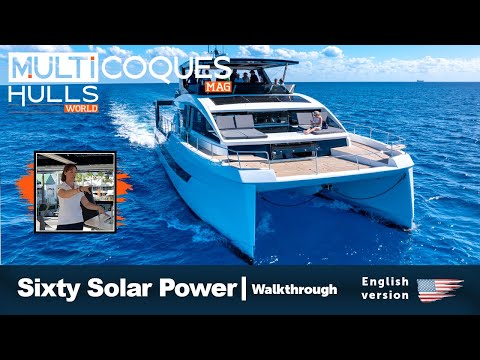 Découvrez notre vidéo exclusive
- Financez votre Sixty Solar Power
- Assuez votre Sixty Solar Power
- Articles autour du Sixty Solar Power
Conditions : 8 to 9 knots of wind, flat sea
I am currently carrying out a small project on another boat at Bradford Marine (the only shipyard capable of handling large-beam units in the Bahamas), and I happily accepted the invitation from Tamas Hamor, CEO of Xquisite Yachts, as a neighbor. So, I’m undoubtedly one of the first journalists to have tried out the brand new Sixty Solar Power.
This first unit, owned by the shipyard, has served as a full-scale test bed. Even before welcoming its first prospects and charter customers in the Bahamas, the Sixty Solar Power undertook a transatlantic passage between Aveiro, Portugal, and Freeport, Bahamas, in September 2025. This voyage of several thousand miles, completed at an average speed of around 8 knots, provided an opportunity to test the advanced hybrid propulsion system developed for this model in real-world conditions. Such a crossing is no small feat for a prototype: it tests the reliability of the systems, the overall energy efficiency, and also the long-term comfort of life on board.
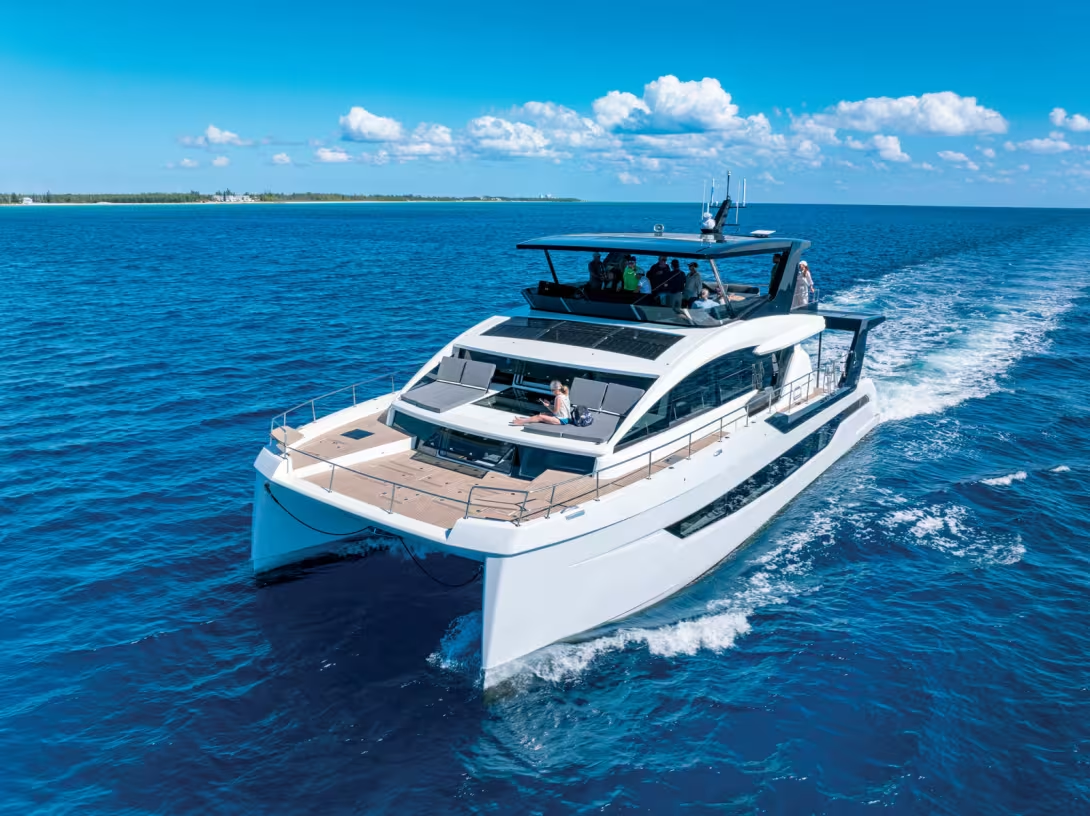
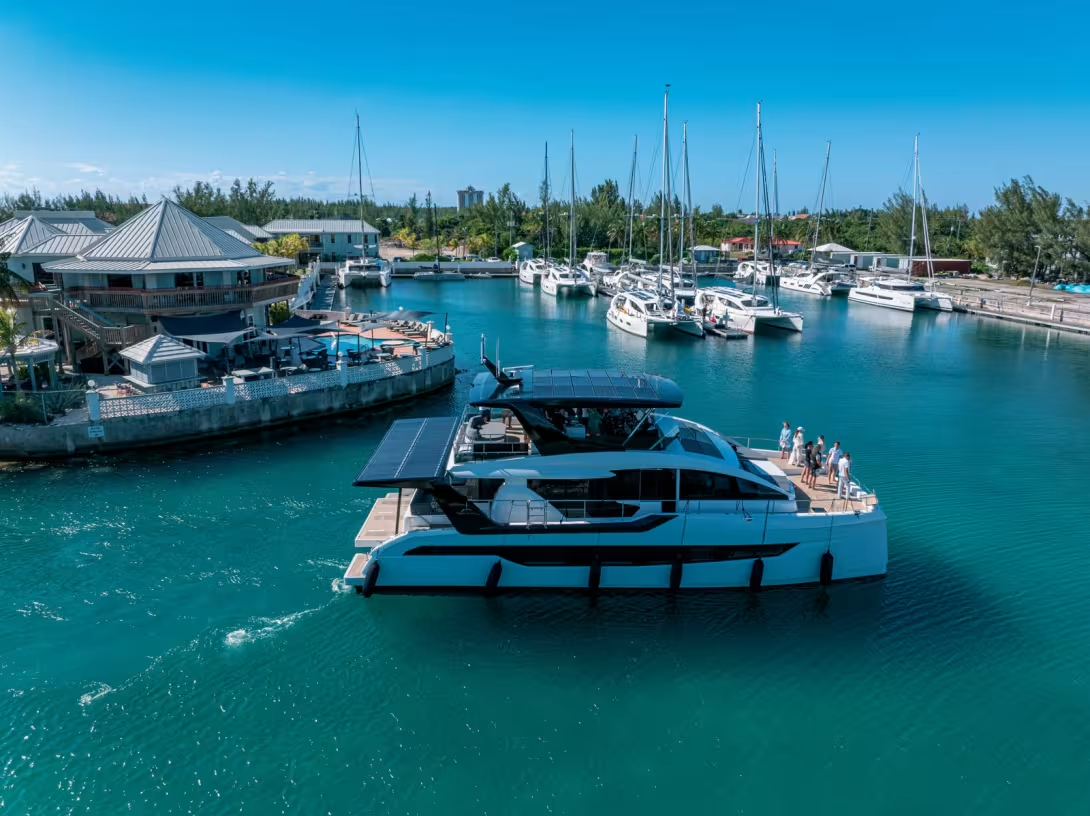
My test took place the day after an exclusive event for Xquisite Yachts customers and prospects, which ended with a grand evening party. Fortunately, the appointment was at noon in the shipyard’s private marina. Conditions are excellent: a bright blue sky with just a few cumulus clouds, a light breeze of less than 10 knots, and perfectly flat seas. The young couple who manages the powercat are at the helm and are doing very well, proving that this large multihull is easily maneuvered by two people, even in a somewhat cramped marina. Meanwhile, Tamas is taking care of his guests, all current or future owners of Xquisite catamarans.
A Powercat Designed for the Long Haul
With the Sixty Solar Power, Xquisite Yachts is clearly targeting a clientele of long-distance sailors, often experienced owners who are sensitive to energy and environmental issues but refuse to compromise on safety, range and comfort. The positioning is clear: this is not a fast powercat intended for day trips or mainly coastal use, but rather a yacht capable of covering long distances over time, living at anchor for long periods, and drastically reducing its dependence on fossil fuels.
The overall lines reflect this ambition. The high freeboard, generous volumes, comfortable width, and protective superstructures are more reminiscent of an expedition yacht than a sporty powercat. However, the multihull architecture allows for a moderate draft, remarkable natural stability, and unparalleled living space for a boat of comparable length. This compromise between safety, comfort, and efficiency is one of the pillars of the concept.
The multitude of different spaces gives the impression of being on a much larger vessel, and despite the large number of people on board, we never felt like we got in each other’s way.
Hybrid Propulsion is Central to the Concept
Having cleared the channel in 100% electric mode, the crew offered to review the various propulsion modes.
The real technological heart of the Sixty Solar Power lies in its diesel- electric hybrid propulsion system, developed around a parallel architecture provided by e-Motion Hybrid Systems, a well-established Italian company. This technical choice is fundamental. Unlike so-called “series” hybrid systems, where the internal combustion engine is used only to generate electricity, parallel hybridization allows the diesel and electric motors to act directly on the drive shafts, either separately or jointly.
Aboard the Solar Power, each hull is equipped with a 440 HP (≈ 324 kW) Yanmar diesel engine, providing a combined power output of close to 650 kW. These engines are coupled with 140 kW electric motors supplied by e-Motion Hybrid Systems with shaft-driven props. The entire system is powered by a bank of 184 kWh high- voltage lithium-ion batteries, specifically sized to meet both the needs of electric propulsion and on-board domestic loads.
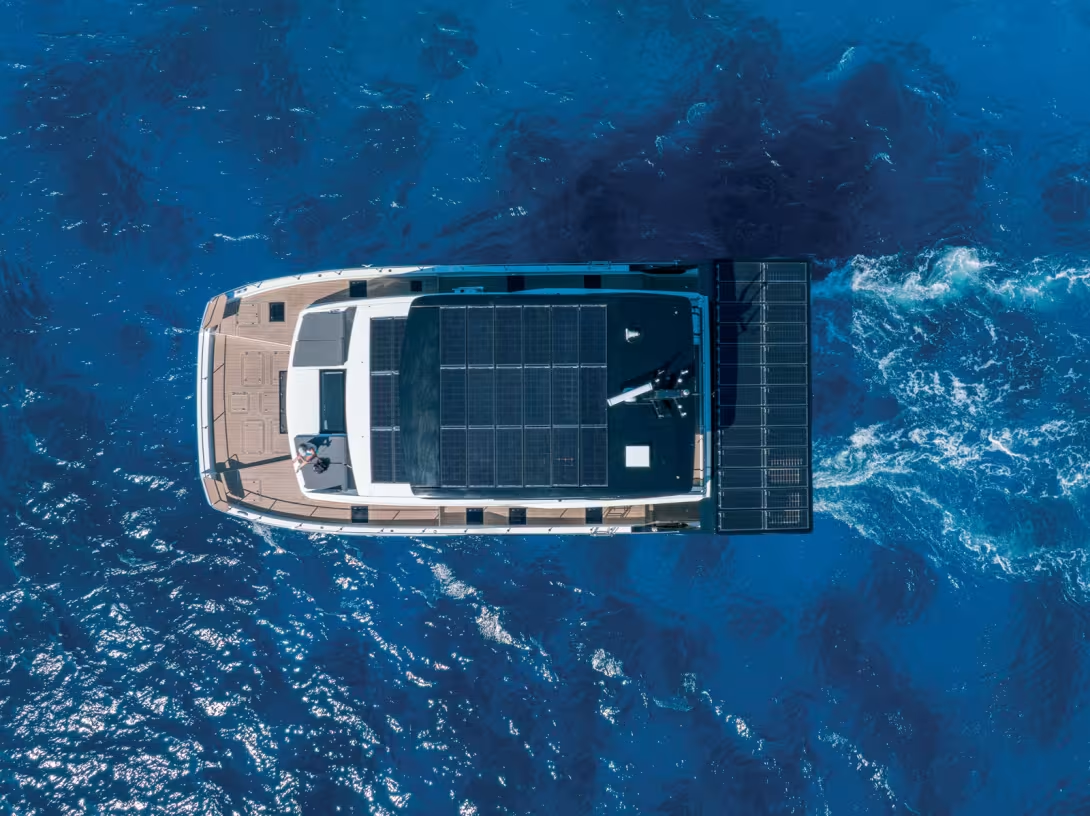
Added to this architecture is an integrated solar power system of around 8 kW, spread over the coachroof and higher surfaces. While this solar power is not intended to propel the powercat on its own, it plays a key role in reducing the use of the internal combustion engines: powering auxiliary systems, maintaining battery charge at anchor, and contributing to the overall energy balance over long periods. The strength of the e-Motion system lies in the diversity of its eight operating modes, which the skipper can easily select from the interior helm position or from the flybridge depending on the sailing conditions.
Diesel Mode
Conventional operation: the Yanmar engines drive the shafts directly, without electrical assistance. This mode is used for high speeds or in demanding sea conditions.
Electric Mode – Zero Emissions Boating
Propulsion is provided solely by the electric motors, powered by the batteries. The catamaran then moves in almost total silence, without polluting emissions. This mode is ideal for ports, protected anchorages, and sensitive areas.
Hybrid Mode
The diesel and electric motors work simultaneously on the shafts, combining their respective powers to optimize efficiency or performance as needed. In this mode, the electric motors are restricted to 80% of their power.
Economy Navigation Mode (1 diesel + 1 electric)
Only one diesel engine is in operation. It mechanically drives one shaft, while the other is propelled by the electric motor. The necessary energy is produced by the shaft generator. This mode keeps two propellers active while operating the diesel engine in its optimal efficiency range and is the preferred mode for long passages such as the boats Atlantic crossing at a steady speed of around 8 knots.
Charge Mode
Recharging of batteries while under way via the shaft-driven alternator, without resorting to the use of generators.
Boost Mode
Diesel and electric power are combined to provide additional power on demand, allowing the powercat to reach speeds of up to 24 knots. The crew demonstrated this during the trip, and it was quite impressive, although this mode consumes a lot of energy.
Hotel Mode – Zero Emissions
At anchor, all on-board services are powered solely by the batteries, without starting the diesel engines, ensuring silence and comfort.
Shore Power / Fast Charge Mode
Fast recharging of batteries at the dock via shore power.
Energy Management and Ergonomics
While the technical sophistication is very real, Xquisite Yachts has taken particular care to make it invisible to the user. Propulsion, energy, and systems management are all centralized via several touch screens connected to the Simrad navigation center, providing a clear readout of energy flows, battery charge status, and active modes.
The electrical system is based on a dual architecture:
- a high-voltage network dedicated to hybrid propulsion
- a 24 V network for domestic services.
This separation guarantees safety, efficiency, and ease of maintenance, while ensuring great operational flexibility.
Comfort and Long-term Living Aboard
Beyond all the technology, the Sixty Solar Power remains first and foremost a cruising yacht. The interior spaces are impressively generous and coherent. The main saloon, with its large windows, benefits from abundant natural light and a panoramic view of the outside. The connection with the cockpit is seamless, promoting a way of life on board focused on the sea.
The interior is available in several configurations - the prototype we tested had a large owner’s suite and two guest cabins, all with private bathrooms. The flow throughout is well designed, with plenty of storage space and materials chosen for their durability as well as their aesthetics. The overall effect is one of high-end luxury without being ostentatious. The equipment is all of high quality, such as the gangway door, worthy of a super yacht.
Navigation and Sensations Under Way
Out on the water, the Solar Power favors a serene and economic approach. At 8 or 9 knots, the powercat moves along in remarkable silence, with the internal combustion engines operating in their optimal range and vibrations very well controlled. The catamaran’s natural stability contributes to overall comfort, both underway and at anchor.
The transatlantic passage completed by this first unit confirmed the robustness of the concept. The hybrid systems demonstrated their long-term reliability, while the overall energy management system limited the use of internal combustion engines for domestic needs, thanks in particular to the contribution of solar power.
Unfortunately, weather conditions on the day weren’t going to allow us to test the catamaran in rougher seas, but after talking to the crew who took part in the delivery from Portugal, I understand that they were very satisfied with the multihull’s performance on the high seas, despite encountering some very active weather fronts.
Even though this first unit is, by definition, still in the development phase, the level of maturity achieved is impressive. Feedback from private seatrials in the Bahamas, carried out in the presence of potential customers, confirms the consistency of the proposal. Five units have already found buyers, a sign that the market is ready to adopt this type of solution - provided it is credible and proven.
Conclusion
With the Sixty Solar Power, Xquisite Yachts is making a big splash and offering much more than just a new model: it is presenting a fully-fledged vision of the powercat of tomorrow. A yacht capable of crossing oceans, living at anchor for long periods, significantly reducing its fuel consumption and environmental impact, while offering a level of comfort and safety that meets the highest expectations.
Although there is still room for improvement in certain details and a few adjustments are likely to be needed, particularly in terms of the electric propulsion system, this 60-foot yacht is nonetheless a convincing demonstration of what offshore yachting can be in the era of energy transition. A multihull that doesn’t just follow a trend but clearly defines its true colors.
The Great Escape A Circumnavigation Reserved for Xquisite Catamarans

Tamas Hamor:
Marine Industry Rockstar?
Talking to the shipyard’s customers during this private seatrial, I quickly realized that Tamas didn’t really need salespeople... The owners of Xquisite catamarans do all the work for him!
Touchscreen interface with electric propulsion
Quality of equipment and deck hardware
The mild weather did not allow us to test the powercat in more difficult conditions
Range in 100% Electric mode and even more in Boost mode is a little tight
Technical Specifications
Overall length: 62’3” (18.98 m)
Beam: 26’8” (8.13 m)
Draft: 3’9” (1.15 m)
Displacement: 92,600 lbs (42 t)
Hybrid propulsion: 2 x 440 HP and 2 x 140 kW
Max speed: 24 knots
Transoceanic speed: 8 knots
Fuel: 1,580 US gal (5,980 l)
Solar panels: 8 kWp
CE Certification: A
Price: as the powercat is still in the development phase, there is no price list or options available yet, but you can expect to pay between € 5 and € 6 million for an Sixty Solar Power.
www.xquisiteyachts.com
And to top it all off, the surroundings aren’t too shabby, are they?