
Making its avant-premiere at the Cannes Yachting Festival exactly a year after the 5.8, the Bali 5.2 is already shaping up to be one of the flagship models in the range, as it’s replacing two models at once, the 4.8 and the 5.4, each of which was built in 200 units. In line with the Catana Group’s new commercial strategy, the latest Bali model is very well positioned in terms of price compared to its competitors. This positioning has certainly contributed greatly to the excellent launch of this model, but that’s not all...

Infos pratiques
- Le chantier : Bali 5.2
- La fiche technique
-
 Découvrez notre vidéo exclusive
- Financez votre Bali 5.2
- Assuez votre Bali 5.2
- Articles autour du Bali 5.2
Conditions: 15 to 17 knots of wind, slight chop
Our boat test was scheduled for December 2 at Port-Pin-Rolland, the 500-berth marina owned by the Catana Group on France’s Mediterranean coast. Being December, it was pretty chilly of course, but Boris Compagnon and Benjamin Sueur gave us a warm welcome that made up for it... The Catana sales team explained that every Bali model is present at this base and operated through a mini-charter company controlled by the Group. The aim is to test the shipyard’s production in real conditions and over the long term, but also to make modifications/improvements.
When I boarded, two things caught my attention: the first was the incredible size of the hydraulic platform - it can accommodate a dinghy up to almost 14 feet (4.2 m) and 770 lbs (350 kg) - and the second was the name of the catamaran, “Olivier,” written on the stern of the starboard hull. Boris later explained to me that the Bali 5.8 #1 was already named Olivier, in tribute to the former head of the Catana Group, Olivier Poncin, who passed away in May 2023. The Bali 5.2 is also the first model of the new era for the manufacturer, now led by Aurélien Poncin. It should be noted that of the four Catana Group factories, this model is built at the group’s Marans site, near La Rochelle on the Atlantic coast.
Still the Bali DNA
But while this latest Bali stays true to form (the brand’s DNA is clearly evident in the rigid foredeck, the up-and-over door, the forward door, flybridge, and large fuel/water/refrigerator capacities), the new multihull we are discovering adheres to the standards set by the 5.8, namely a very high level of comfort that’s verging on luxury. Gone are the early days of the 4.5s, when you could clean the saloon with a pressure washer! “Since Covid, we’ve seen a shift to a 50% charter/50% owner split. Previously, it was 70% charter/30% owners. The difficulty is finding a compromise between demands and expectations... So the offer has evolved, and we now have catamarans with much better finishes,” explains Boris. The 5.2 offers the opportunity to cater to a wide variety of programs, as the new catamaran is available in multiple versions with 3 to 6 cabins (+ one or both forepeaks that can be converted). “You can accommodate up to 16 people on board,” smiles Boris.
The usable surface area is 1,242 square feet (115.4 m²) - yes, with these comfortable catamarans, the shipyards have understood that the surface areas (deck, nacelle, cabins, etc.) of the various models are compared by buyers and, ultimately, play a major role in the purchase decision.
Outside, there is a large forward cockpit that can be shaded in port or at anchor, and the flybridge, which we’ll come back to in more detail later. The aft cockpit is as much outside as it is inside, as we’ll also see later.
Even though the side-decks are narrower than those previously seen on the Bali 5.4, circulation remains excellent throughout, with well-placed handholds. We also note that comfort goes hand in hand with technical aspects: there is no need to remove the straps from a sun lounger to open the deck lockers or the chain locker.
Electric Autonomy and Anticipating Hybrid Propulsion
The main innovation of the 5.2 lies in its energy management. This catamaran has been designed in such a way that its battery bank is capable of powering all the major appliances on board (for air con, refrigeration, cooking) - without the need to fire up the generator or one of the motors during the night. To achieve this, the shipyard has thought big (everything that follows is optional, but it is very much in the spirit of this new model): 4,156 Wp of solar panels, 22 or even 44 kWh of batteries, a complete 48 V circuit, and powerful alternators (up to 2 x 8 kW). As for the engines themselves, the yard recommends the twin 80 HP units, which is what there was on our test model. But what about electric propulsion? It looks like it’s coming soon... Although Catana Group has long pretended to stay out of the energy transition, the yard was already discreetly testing electric motors 20 years ago, and the team now tells us that it has had an electric Catsmart since September, as well as a Bali 5.8 hybrid demonstration model. In short, electric propulsion is not being neglected at Bali: it will soon be making an appearance, and the 5.2 has been designed with this in mind.
Touching 10 knots at Times
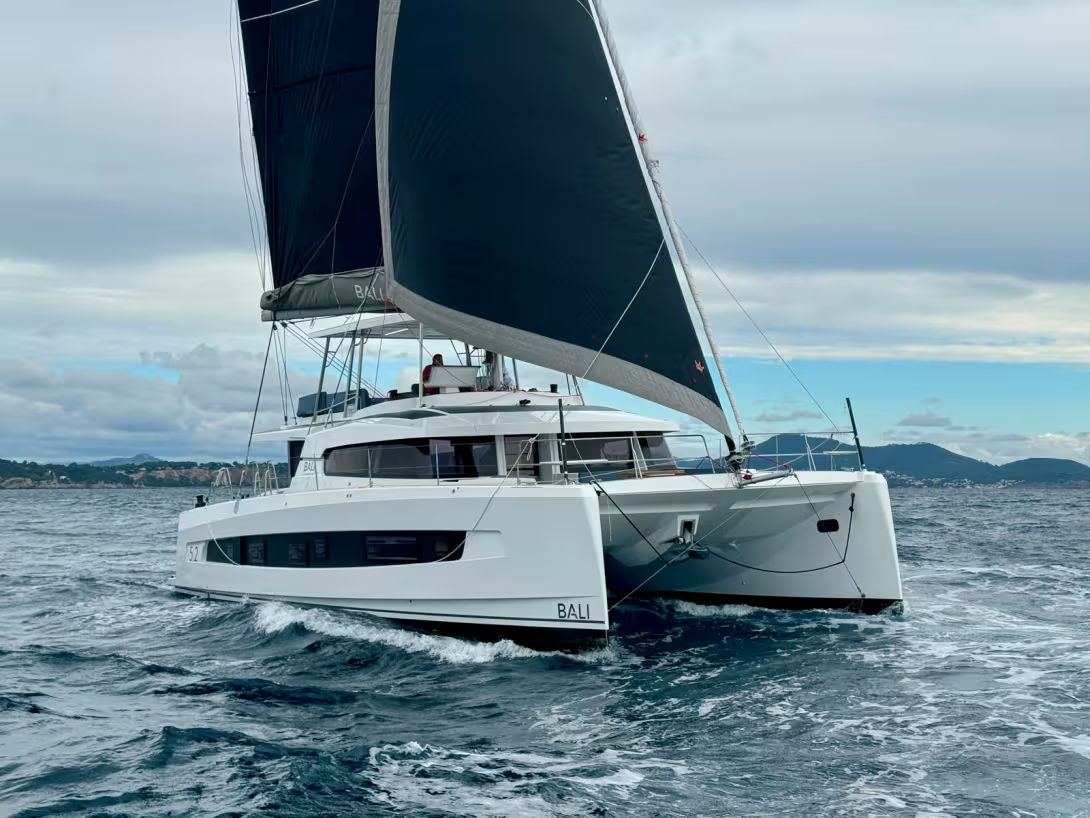
It was time to cast off and Nicolas, our skipper for the day, came off the berth with flying colors, despite the turn being incredibly tight and the ground lines being very close. The powerful motors, whose propellers (three-bladed folding propellers on our model) are located forward of the rudder blades, and the bow thruster make it possible to overcome the 5.2’s considerable windage. Once we reached open water in Lazaret Bay, we conducted a speed test, recording 9 knots at 2,200 rpm and 9.4 knots at full throttle at 2,500 rpm, meaning this powertrain is therefore perfectly suited to the 5.2.
The 80 HP motors are easily accessible in their large engine compartments at the rear of the hulls, though an intermediate step would be a useful addition, and the soundproofing seemed well done to me, even at high revs.
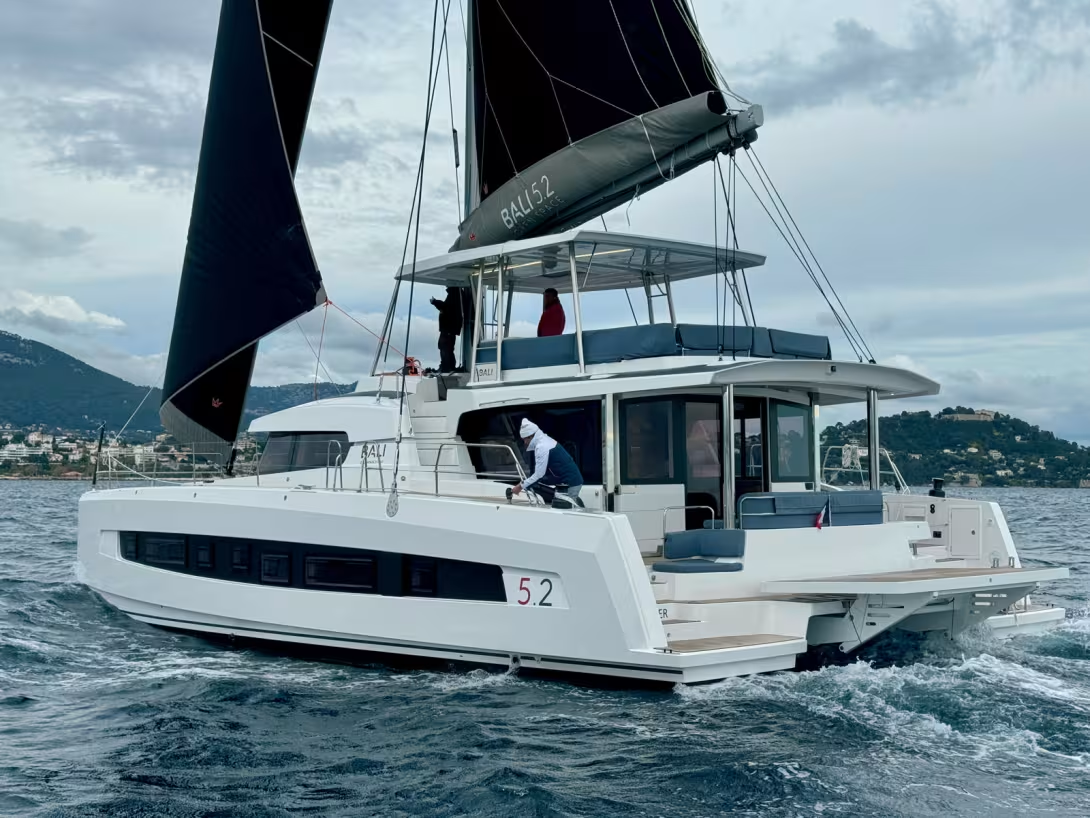
The Bali was brought head to wind and crew prepared to hoist sail as I positioned myself on the starboard side to watch the process, and the square-top mainsail rose smoothly up the mast. The boom is obviously very high but remains relatively easy to access thanks to the T-Top, which can be reached via a kind of “ladder cage” just behind the mast. If there’s any work to be done at the other end of the boom, then obviously, those prone to vertigo should refrain!
As for the headsail, our test boat had an overlapping genoa - a welcome option that offers a significant bonus in terms of power. The sheets run outside the forward struts of the T-Top, protecting the occupants of the flybridge, particularly when tacking, but this does (slightly) hinder the ability to sail at angles higher than 55° to the true wind. The T-Top struts could do with being a little more “pinched,” even if that means reinforcing them. All sail maneuvers are concentrated around the helm station, which is slightly offset to starboard so as not to be obstructed by the mast.
Behind the helmsman, there is a modular bench seat, a mini outdoor galley, a large table, and an XXL-sized sun lounger. It’s hard to imagine a more attractive flybridge aboard a 52-foot catamaran. Just one comment: we would like the stitching details on the upholstery (here, a prototype version) and the appearance of the solar panels to match the beautiful invitation to XXL relaxation that the 5.2 offers.
With the wind blowing at 15/16 knots, plus a few stronger gusts, and slightly choppy water, conditions proved excellent for a boat test. Despite its 20 tons, this replacement for the 4.8 and 5.4 managed to maintain an average speed of 7 knots close-hauled and even climbed to 10 knots with the Code 0. Inside, nothing moves or creaks. The platform, thanks to its careful composite sandwich construction and rigid foredeck, proved to be particularly stiff.
The hydraulic helm provides excellent control - the autopilot doesn’t strain at all.
A padeye on the bowsprit whose anchoring point seemed a little lightweight forced the crew to cut short our wonderful sailing session where we’d seen average speeds of 8/9 knots. But not for very long... A long black RIB and its crew of French navy commandos intercepted us and ordered us to head back to port as quickly as possible: in the wake of their boat loomed the silhouette of the nuclear aircraft carrier Charles-de-Gaulle, flagship of the French Fleet - “OK, we’re on our way!”
A 4-cabin 3 + 1 Version
This all made for a longer opportunity to take a look at the Bali 5.2’s layout. After the large sugarscoops, the plancha grill illuminated by its own dedicated spotlight and the mini sofa aft on the port side, I tested the 9-foot (2.7 m) aft bench seat and the deck that allows you to walk all the way around the catamaran - a concept that has been standard on Bali boats since the 4.1. I then discovered the wet lockers and the clever storage space for the liferaft which is launchable and accessible whether the boat is right side up or upside down. Finally, I got to the inevitable “Bali door.” This imposing 13-foot-5-inch (4.08 m) part swings open in a matter of seconds at the push of a button - magic! The door fits perfectly into the upper section, but the closed position has also been improved with a new housing and a double seal system at floor level. This improvement eliminates any water leakage and drafts, though at the cost of a slight threshold that spoils the flush effect we love on multihull; but you can’t have everything. On the sides, 3-foot (1 m) high by 2 x 3’9” (1.15 m) window panels are fully integrated into the structure, making it possible to enjoy the cockpit/nacelle area in fully open, fully closed, or a mix of both modes. In use, this is much more practical than the canvas covers that have to be rolled up and down on most other catamarans.
The overall atmosphere, already enhanced by the colossal volume (6’9”/2.05 m headroom) is further enhanced by multiple little details such as indirect lighting and very soft colors. Clearly, the designers (Agence Berco Design and Piaton Yacht Design) have done a great job.
The imposing 86 x 44” (2.18 x 1.11 m) table, which can seat twelve, is offset to port, facing a large TV bench. There is also the option of having two coffee tables that can be joined together. The U-shaped galley is huge: countertops, storage, appliances – there’s nothing missing. On the starboard side, a beautiful, forward-facing chart table (22 x 36” – 55 x 91 cm) makes a perfect desk if needed. The screens reveal themselves with a few taps and swipes of the index finger, proving that the Bali 5.2 is indeed a modern catamaran, i.e., 100% connected. The forward door provides direct access to the rigid foredeck. The front of the coachroof forms a very effective visor against vertical sunlight - the most aggressive - whose interior finish will need to be upgraded. But at the risk of repeating myself, this is hull #1, whose minor flaws will, as always, be addressed.
So, this first Bali 5.2 we tested was a 1 + 3 cabin model, but the model is also available in a 4 cabin 2 + 2 configuration. The port hull was therefore entirely dedicated to the owner, with a 70” (1.8 m)-wide bed, storage space everywhere (including unprecedented high volumes), an XXL closet and an equally spacious bathroom. The impression of volume is striking and the headroom of 6’7” (2 m) confirms this feeling. This XXL cabin has two access points – one via the nacelle and another aft, from the cockpit.
Opposite, on the starboard side, the shipyard has managed to fit in three cabins. The forward one has a 60” (1.5 m)-wide bed set athwartships, with a shower room at the front. The central cabin is inevitably a little more confined, with one side of the 55” (1.4 m)-wide bed against the aft bulkhead. The remaining cabin is accessible from the cockpit and has a small double bed below and a single bed above.
Conclusion
The figures speak for them- selves: signing 60 orders of a 52-foot catamaran in three months in the current economic climate is a success... reserved for a new model that is well designed, well thought out and offered at an aggressive price. Without denying the brand’s heritage, the Bali 5.2 manages to offer a luxurious package that will appeal to both owners and charter fleet managers alike. We also appreciate the technological aspects developed on this model: 48V circuit, XXL energy production and storage, and finally, an intelligent control system.
Price War A Well-positioned Bali!
Very attractive cockpit/nacelle layout
Electrical and technological performance
Interaction between genoa sheets and T-Top struts needs to be optimized
Some finishing details need to be reviewed
Technical Specifications
Architect: Xavier Faÿ
Interior design: Agence Berco Design and Piaton Yacht Design
Length overall: 53’10” (16.41 m)
Hull length: 50’6” (15.4 m)
Waterline length: 50’3” (15.32 m)
Beam: 26’9” (8.16 m)
Draft: 4’7” (1.4 m)
Light displacement: 42,220 lbs (19.15 t)
Standard sail area: 1,571 sq ft (146 m²)
Powertrain: 2 x 57/80/115 HP
Fuel: 317 US gal (1,200 l)
CE category: A14/B16/C24/D40
Prices in € ex-tax
3-cabin version: 953,000
Excellence Pack: 81,000
Air conditioning for hulls + nacelle: 51,900
Watermaker: 21,120 to 23,080
Sound system: 2,530
Rigid hard top: 42,000
Extra for fully-battened mainsail, reinforced solent UV strip, lazy bag and lazy jacks: 8,200
Genoa: 3,845
Genoa hardware: 4,800
Code 0: 9,000
Downwind sail hardware: 8,190
Supplement for 2 x Yanmar 80 HP: 11,980
Supplement for 2 x Yanmar 115 HP: 46,500
Lithium batteries 4 x 24V x 230 Ah: 33,120
Lithium batteries 8 x 24V x 230 Ah: 55,020
3-blade folding propellers: 5,400 (for 57 and 80 HP engines)
Bow thruster: 12,900
Generator: 29,820 to 40,300
Full solar panel kit of 4,156 Wp: 36,000
Price of the model we tested: 1,250,000
www.bali-catamarans.com

