
The largest of the Astus models… is still a small multihull, with a hull length of just under 8 meters. The Breton builder has always embraced this straightforward positioning as a specialist in affordable, trailerable trimarans, but the collaboration with VPLP since 2016 - starting with the Astus 16.5 - has added a touch of glamour and a welcome boost in performance.
Infos pratiques
- Le chantier : Astus 26.5
- La fiche technique
-
 Découvrez notre vidéo exclusive
- Financez votre Astus 26.5
- Assuez votre Astus 26.5
- Articles autour du Astus 26.5
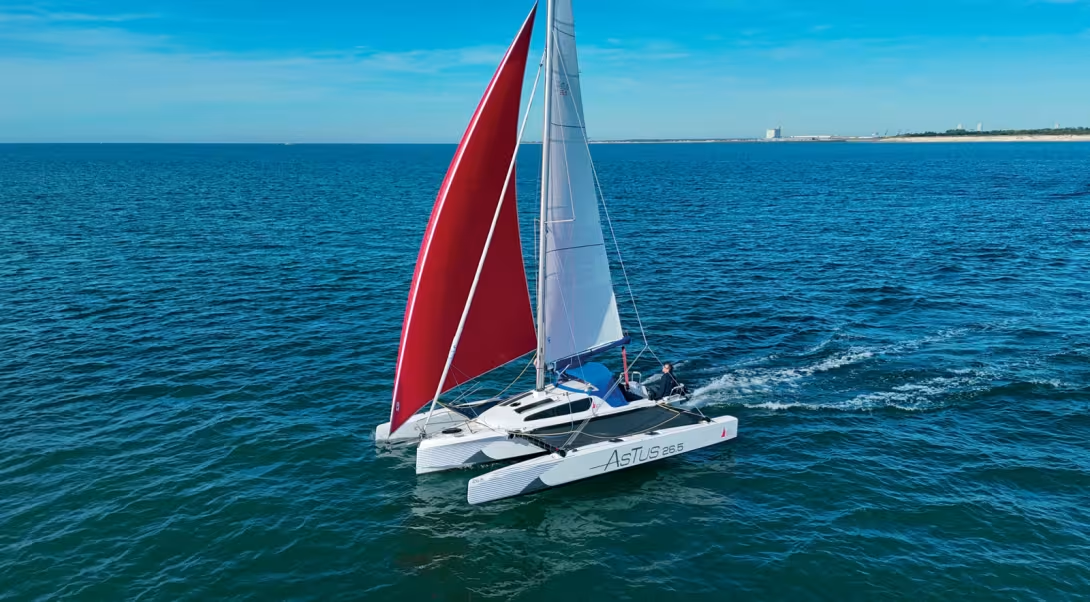
Conditions: 10 to 12 knots of northeasterly wind, sea state slight
Astusboats entered the world of multihull builders more than 20 years ago now, when its founder, Jean-Hubert Pommois, converted his former mink breeding shed into a shipyard in 2004. The company occupies the niche market of small transportable trimarans. Its models are all equipped with simple telescopic tubes so that the floats can be easily moved inward towards the main hull, and have all been very successful, as evidenced by the Astus 20.2, of which more than 120 have been sold. The launch of the 16.5 marked a turning point with the signing of the prestigious firm of naval architects, VPLP. Design, speed, ergonomics: Astus boats are winners on all fronts, without compromising their original simplicity.
Announced two years ago, the Astus 26.5 has been eagerly awaited: «The 24 was removed from our range when we launched the 22.5. I thought this new model would be our flagship... but no, we had demand for an extra meter, for water under pressure. Hence this proposal for a larger model,» Jean-Hubert explained to me.
So there we were in La Rochelle, three days after the Grand Pavois boat show closed - it was at this show that the 26.5 made its world debut. The trimaran was due to begin its journey back to Brittany by sea later that day, which gave us a few hours to discover this new model.
An Understated Design by VPLP
This 5th collaboration with the renowned VPLP firm has resulted in a rather understated design and a very large central hull volume above the chine. Construction is in GRP polyester using the infusion process – including the floats.
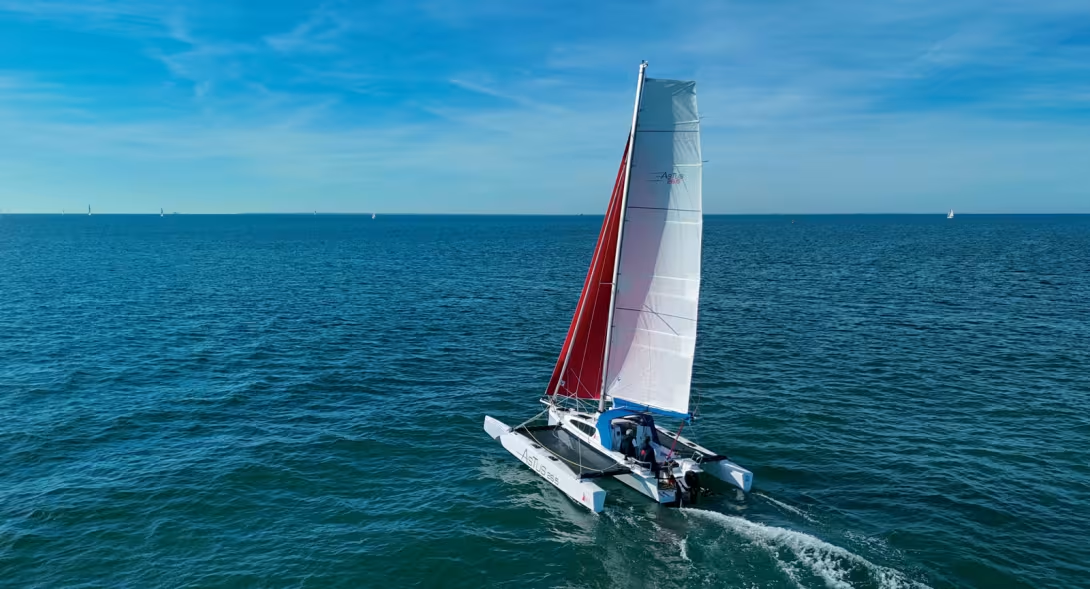
The lengthening of the rig and the appendages promises excellent performance. The Astus 26.5 is available in three versions - Leisure, Cruising and Sport - to suit almost any program. Aboard an Astus, you can go daysailing, coastal cruising or even racing.
A first glance at the deck plan from bow to rudder reveals an off-center bowsprit (which can be retracted into the forepeak) for securing downwind sails, a Selden genoa furler, two well-placed mooring cleats flush with the deck line, and a large storage locker for all kinds of gear. The front of the coachroof is mounted on hinges - this is where the anchor locker is found. As a result, the bow roller is set back (and offset to starboard) to be just forward of the connecting arm.
The side-decks are not very wide, but the large trampolines (13 feet/4 m long) cover most of the distance, and safety is ensured by a handrail on each side. Each float is equipped with two lockers. The coachroof is equipped with a small opening hatch and, aboard our test model, solar panels.
The rig features a classic aluminum profile with one set of spreaders. All the controls are located at the after end of the coachroof except for the gennaker sheets, which are further back. This area is protected by a sprayhood, though this could benefit from a handle on each side, but would require moving a winch. On the other hand, the integrated halyard well is a success. The cockpit obviously benefits from the chines in the central hull – it isn’t very wide, but four people can sit there comfortably. The helmsman sits back behind the tubes and the mainsheet traveler – the rounded shapes prevent shin injuries. A cushion and foam protection on the pushpit ensure a very comfortable seat.
Stripped-down but Functional Interior
The central hull of this small trimaran is obviously nothing like the nacelle of the 38-foot-plus catamarans we’re usually testing. However, it has a comfortable headroom of 5’11” (1.8 m) and a width of 6’9” (2.05 m). It’s a miracle really... but this is due to a special feature of the Astus: “We’re at the bottom of the hull! I removed the floors 15 years ago - you gain more height, and you can see everything,” jokes Jean-Hubert.
The companionway steps are removable to free up access under the cockpit, while the small 28” x 16½” (71 x 42 cm) multi-purpose table is hinged and can be converted into a desk or galley worktop.
The 6’7” long by 20” wide (2 m x 50 cm) benches can be extended by 6” (15 cm). Can’t see the centerboard casing? That’s normal, it has been cleverly offset against one of the bench seat sides. This casing is molded into the hull without any additional lamination.
Two cabinets at the structural bulkhead can be fitted out as a galley unit, i.e. sink and stove (which occupies the space previously dedicated to a drawer). At this separation between the living area and the cabin, the headroom is still 5’5” (1.65 m).
In the bow, the double berth is relatively large, measuring 6’4” (1.94 m) long by 4’6” (1.38 m) wide at the head end, and 3’1” (0.95 m) at the feet. This mini-cabin can be closed off with a curtain, and a section of the mattress is removable to allow access to the chemical head.
Gliding Through the Water Without Worries
This small trimaran is very easy to handle. Better still, the Astus (even in the Sport version with its additional 54 square feet/5 m² of sail area) is so docile that it can be sailed perfectly well by novice sailors who are keen to progress. But sailing enthusiasts can rest assured: the 26.5 is just waiting to glide at over 10 knots, especially when the downwind sails are set. The very large floats ensure perfect stability, guaranteeing power and speed.
As we had an offshore breeze, we started out downwind. On almost flat water, the 26.5 easily exceeded 8 knots, while the true wind speed was barely any stronger. A little further offshore, the wind picked up a little and the trimaran even regularly flirted with 11 knots, in a relaxed manner.
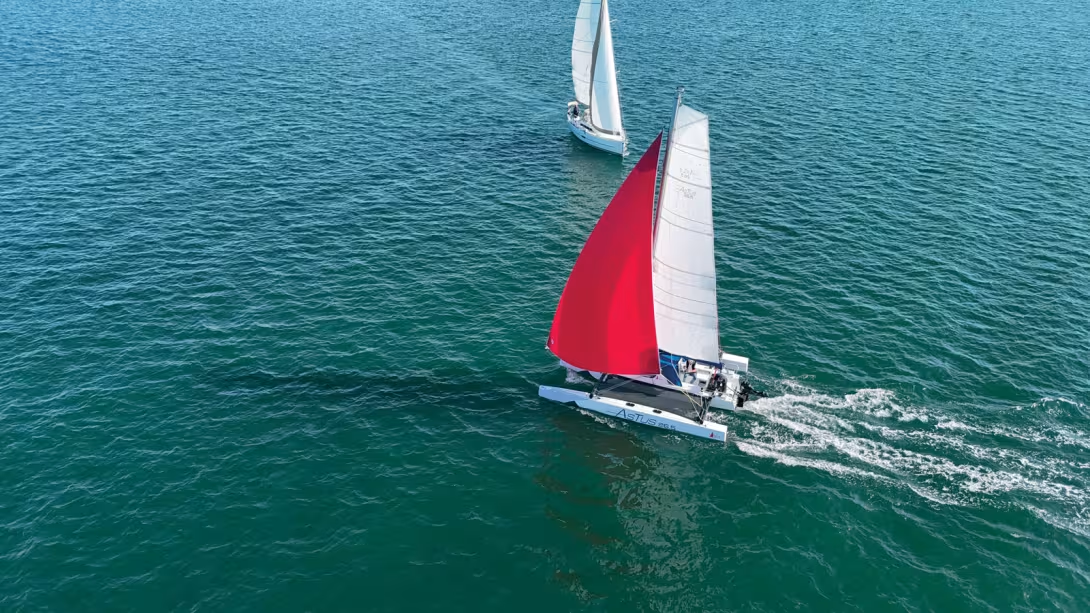
A monohull on port tack looked to be on a closing course with us... but in the end, as we were sailing three times faster than him, we escaped far, far ahead of his bow!
The pivoting appendages work very well upwind - on both tacks, it should be noted for the off-center centerboard. Despite the absence of faring on the centerboard case, the sensation of gliding across the water is excellent. We came up to 100° off the wind on both tacks and reached a speed of 8.6 knots in 17 knots of apparent. The centerboard and rudders are safe in the event of a collision - they both kick up automatically thanks to a safety system. The Astus 26.5 can therefore take the ground easily and float in only 16 inches (40 cm) of water.
Conclusion
Even though it is the largest model ever offered by the shipyard, the 26.5 remains accessible, both in terms of handling and budget. Will it do as well as the current best-seller, the 20.5, which has already been built in 80 examples? For the time being, the manufacturer is cautiously forecasting 5 to 6 units per year, but in our opinion, this new model has all the qualities to establish itself as a must-have in the world of three-hull sailing boats. For the time being, half of sales are guaranteed in France, with the other half spread across Germany, Austria, Great Britain, and, of course, the United States, where Astusboats has a distribution network.
Folding/Unfolding Jean-Hubert’s 3-minute instruction manual

“You hook the line and the return block onto the gunwale of the central hull and secure the line on the float. You install the tackle on the pushpit, then slacken the backstays. You slacken the trampoline, remove the pins from the tubes, and winch...
Once the trimaran is folded, you can choose between 11’2” (3.4 m) on the water or 8’4” (2.54 m) for transport. You then put the pins back in and reattach the backstays.”
Unfolding
“You repeat the operations in reverse but using a pole to provide outward traction. I should point out that the kinetics have evolved since the first Astus models, particularly thanks to the tubes being sleeved along their entire length.”
Ease of handling
Attractive budget
Some deck hardware details need reviewing
Technical Specifications
Naval Architects: VPLP
Hull length: 26’ (7.9 m)
Beam: 19’ / 11’2” folded when afloat (5.8/3.4 m)
Width folded on trailer: 8’4” (2.54 m)
Light displacement: 2,650 lbs (1,200 kg)
Mainsail: 258/290 sq ft (24/27 m²)
Solent: 118/140 sq ft (11/13 m²)
Gennaker: 376 sq ft (35 m²)
Max. power: 10 HP outboard
CE Category: D7/C5
Price: from € 82,417 ex-tax
www.astusboats.com
