Leopard continues to renew its sailing range. Following on from the 46 last year, it’s now the turn of the 52 to take to the seas. The replacement for the 50 naturally builds on the brand’s heritage, but adds quite a few features, innovations, and even performance.
Infos pratiques
- Le chantier : Leopard 52
- La fiche technique
-
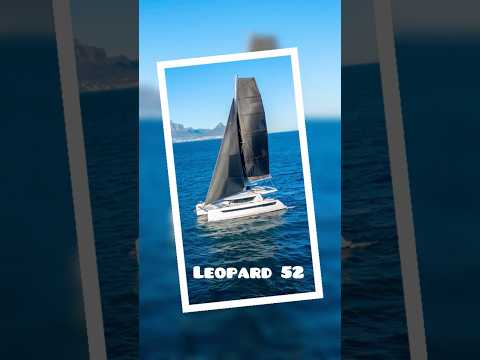 Découvrez notre vidéo exclusive
- Financez votre Leopard 52
- Assuez votre Leopard 52
- Articles autour du Leopard 52
Unveiled somewhat by surprise at the last Cannes Yachting Festival, the Leopard 52 was announced in early September and quickly established itself as one of the must-see boats of the show. This flagship model replaces the 50, an iconic Leopard model with nearly 250 units sold. This is quite a challenge, especially since the 52 is also the second model of the latest generation.
To understand the genesis of this model, we need to take into account market developments. Whereas Leopard used to specialize mainly in charter catamarans, owner-operated units now account for around 50% of sales. In addition, habits have changed, particularly in terms of crew, who no longer want to sleep in rudimentary, cramped cabins with no light in the forepeaks. This observation prompted the shipyard to completely revise its deck plans. Finally, to keep pace with technology, the 52, like the 46, is available in a hybrid electric version.
Three Distinct Outdoor Areas
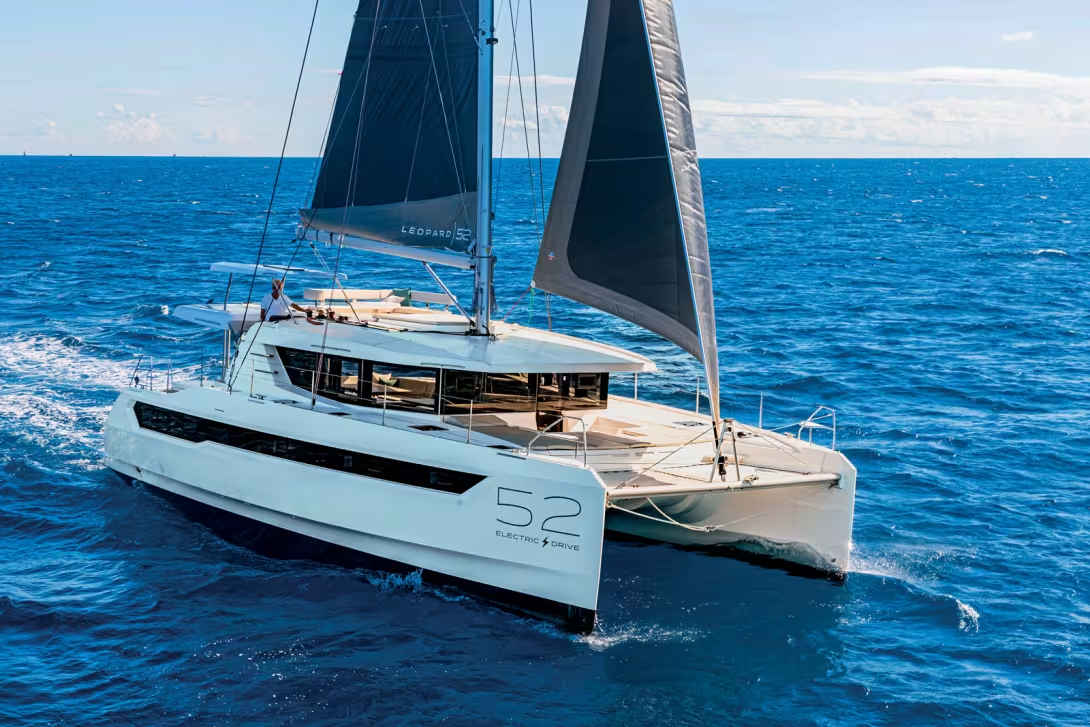
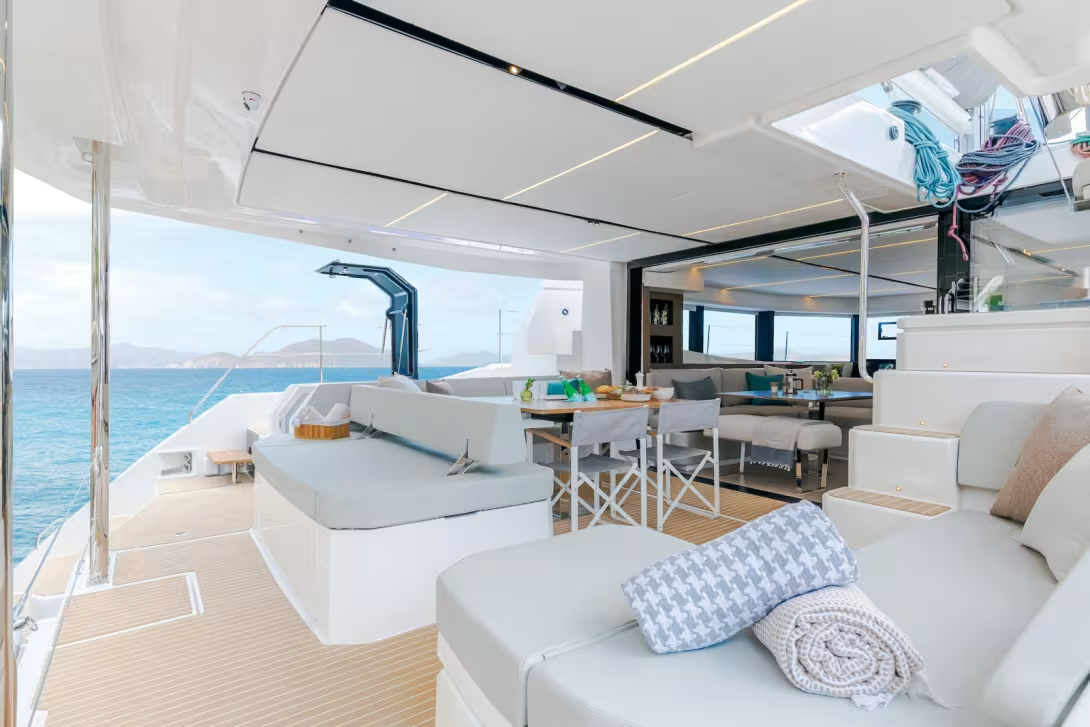
Like the 46, the 52 was drawn by Simonis Voogd Design, so it has a familiar look with sleek lines, vertical bows, and a long hull window that takes up almost 80% of the catamaran’s length. To encourage outdoor living, the Leopard 52 has three distinct areas, starting with the aft cockpit. This follows the layout of most Leopard models, with an L-shaped bench seat on the port side, a table for six guests, and another L-shaped seat on the starboard side, right next to the grill and the stairs leading to the helm station. The cockpit extends aft with an optional electric center platform that raises, lowers, and slides to facilitate launching the tender. Railings block access to the large aft decks when under way, while three steps provide easy access to the wide side-decks.
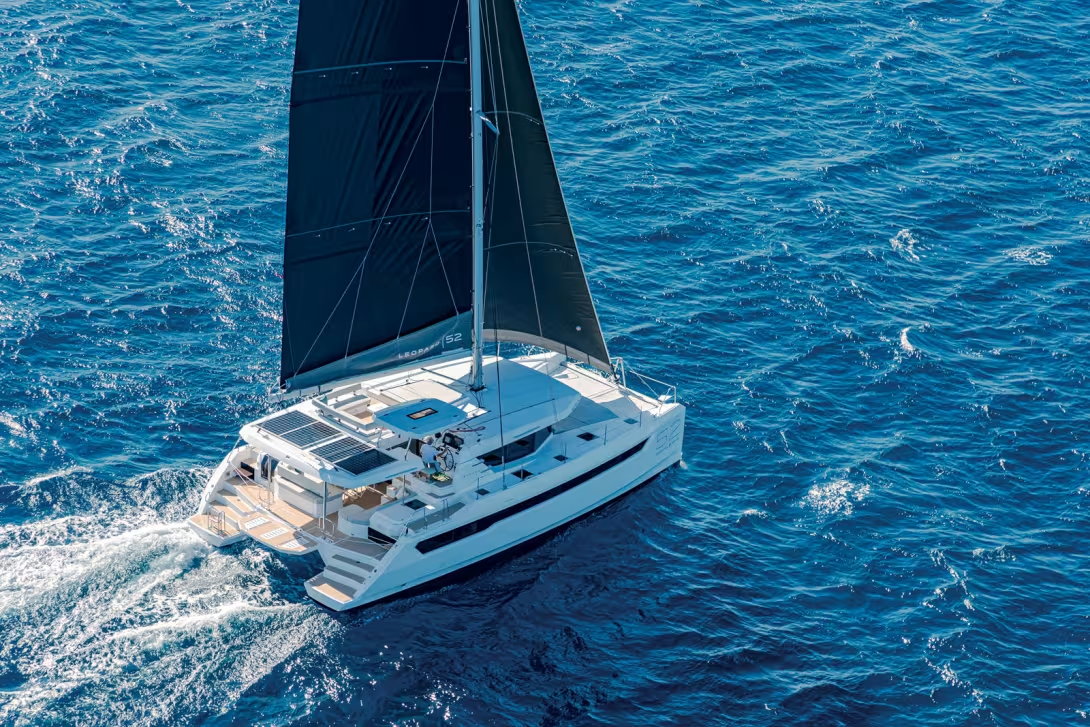
From there, you can easily reach the foredeck thanks to the guardwires and handrails installed throughout. The foredeck consists of a trampoline section – with a new material that is very comfortable underfoot – and a “rigid” section, attached to the living area. This is where you will find a comfortable, well-protected small lounge and a few sunbathing areas to enjoy the view. Finally, in keeping with brand tradition, the Leopard 52 has a sun lounge on the roof with a U-shaped bench, a coffee table, and even a sunbathing area, all within easy reach of the boom and the helm station. It is a very pleasant place, especially as it is easily accessible via a built-in staircase on the port side. This sun lounge is extended by a large fiberglass section that provides shelter for the cockpit but also allows for the integration of solar panels (4 x 400 Wp) while preserving an access path for working on the boom. The integration of the solar panels saves the owner from having to install an additional arch and offers a more practical and aesthetically pleasing solution.
Light-filled Interior, Open Concept and up to Six Cabins
From the cockpit, a very large sliding door opens onto the main deck. Mirroring the cockpit layout, the main deck features a comfortable L-shaped sofa on the port side with a central table. As an option, you can choose a fold-out cockpit table which, once the sliding door is open, can be joined to the saloon table to form one huge table, a feature that should appeal to the charter market.
Completely open, this large interior space (3 feet/90 cm wider than on the 46) features a large galley occupying the starboard and forward starboard sides of the saloon with a small central return. As usual with Leopard, the equipment is comprehensive, the appliances are of very high quality, with, for example, a water filtration system installed as standard, and the whole thing can of course be customized to suit your needs. The central return also houses the compression post, which is supported by a horizontal bar under the floor to allow for better distribution of the loads from the rig.
The tour ends with an interior navigation station on the port side forward and a waterproof door leading to the forward cockpit. In addition to the truly appreciable volume, we appreciate the brightness of this saloon thanks to the large windows all around. It should be noted that these windows are now made of treated glass with reinforced frames and stronger mullions. This solution is more durable, provides better thermal and sound insulation, and is more pleasing to the eye.
One of the most interesting features of this catamaran is undoubtedly its living space, as the shipyard claims a living area of nearly 440 square feet (41 m2) which is quite respectable for a 52-foot vessel. Better still, the engineers have completely redesigned the layout of the cabins, with the disappearance of the crew quarters in the forepeaks, a space now reserved for storing sails and other bulky items. From there, Robertson & Caine designed an ingenious deck plan that can be adapted to suit the multihull’s use. To be more specific, the Leopard 52 is available in 3, 4, 5, and even 6 cabin versions! What’s more, some cabins can be modified on request. One example is the utility room, a very popular concept that allows you to enjoy a cabin that can be converted into a cabin to start with, but also into an office, a workshop, a storage area, or for any other specific use you may wish. In fact, there are many possible combinations, as this utility room can be placed at the front or rear. Similarly, the owner’s cabin can be located on the port or starboard side, depending on the buyer’s choice. You can also opt for a crew cabin on the port side aft with a separate entrance from the aft deck. In total, a dozen configurations are available.
For example, the catamaran we tested had an owner’s cabin on the starboard aft, with a private head, of course, and a VIP cabin forward on the starboard side, with a perpendicular bed and a forward head. The utility room was located forward to port, and, as a final surprise, a guest cabin was located portside, aft. This cabin is definitely worth stopping to take a look at. Pretty long with a perpendicular bed thanks to the width of the hull, it also features a very elegant piece of furniture that serves as storage and a bookcase. There is also a full head and, the icing on the cake, an opening that leads directly onto the aft platform. This provides completely private access and, in the early morning, allows you to enjoy a unique space where you can have a coffee without waking up the rest of the crew, or even take a dip, knowing that the port side sugarscoop is less than six feet (two meters) from this cabin. It’s almost like having a private terrace – if I had to choose a cabin on board, it would be this one without hesitation!
Logically, the number of heads matches the number of cabins, with between four and six heads, depending on the configuration, almost all of which are ensuite. As always with Leopard, the atmosphere is both understated and refined, with modern woodwork, soft- colored fabrics, and indirect lighting that adds a lot of warmth. Another bonus point is the natural light, which is abundant in all cabins thanks to the long hull portholes and transparent deck hatches. The electrical systems are well integrated, with plenty of sockets, reading lights above each bed, and USB sockets or wireless phone chargers. Finally, each cabin has separate air conditioning, allowing occupants to adjust the temperature to their liking. Of course, this is just an example, and all the equipment can of course be extensively customized at the time of purchase
A Hybrid System Acclaimed by Customers
To produce the energy needed on board, the Leopard 52 can incorporate up to 1,600 W of solar panels, plus a 24 kW Kohler generator and, if you choose the option, two 25 kW (34 HP) electric pod motors with a hydrogeneration system, a technology that allows the batteries to be recharged at speeds of 4 knots and above when under sail. The system charges a 2 x 27 kWh lithium battery bank, promising impressive range without even needing to start the generator.
The system is controlled by the HMI, a simple and intuitive interface that displays the status of the electrical system in real time, i.e., solar energy production or energy from hydrogeneration. This also allows the system to be adjusted to refine settings, including choosing the desired percentage of hydrogeneration. If the battery is too low, the system automatically starts the generator to replenish the charge; in the event of an overload, the system automatically switches to safety mode. This is an effective solution that allows for almost total energy autonomy when cruising. In terms of safety, the battery bank is equipped with a fire extinguishing system to prevent fires on board and is also designed to withstand humidity, high temperatures, and vibrations. It is EMC-compliant, meaning it is designed to operate without creating electromagnetic interference with other electronic devices on board.
The batteries are rated for 4,000 cycles, which should last a long time.
For windless days, the standard version of the Leopard 52 features twin 57 HP Yanmar engines, which can be replaced by 2 x 80 HP as an option. However, based on initial orders, most customers are now opting for the hybrid/electric version, which makes sense. Finally, the vacuum infusion construction system keeps the weight down, which ultimately improves performance and reduces energy requirements.
A Catamaran Designed for Long Passages
Previous generations of Leopard catamarans were sometimes criticized for their modest performance under sail. That is definitely a thing of the past, because in recent years, these catamarans have nothing to be ashamed of when pitted against the competition. In this area, the Leopard 52 goes one step further, as compared to the 50, the 52 features a larger mast and a slightly longer boom, which has increased the sail area by around 17% for the same displacement.
The standard sail wardrobe, with a fully- battened mainsail and overlapping genoa in Dacron®, can be upgraded with a roach and, above all, a complete set of aramid sails by Ullman Sails – we had this option, but with standard fixed-blade propellers.
The wind was moderate on the day of our test, but with 12 knots of wind, we still managed to sail at nearly 6 knots upwind (46° to the true wind), 6.5 knots on a broad reach/beam reach, and up to 7.5 knots downwind. The polar curves, established with folding propellers, promise 10 knots on a beam reach with 16 knots of wind, and even a little over 11 knots with 20 knots of wind. You can also gain an extra knot with a downwind sail. The yard offers a Code 0, a Code D, and an asymmetric spinnaker as options. Given that the hydrogeneration system starts working at 4 knots, the batteries are recharged almost as soon as the wind exceeds 6 knots.
On a practical level, the Leopard 52 is rather well designed. The helm station is located on the starboard side, in an elevated position, and is easily accessible from the cockpit or the starboard side-deck. It is also close enough to the cockpit and even closer to the sun lounge to remain in contact with the rest of the crew. Another good point is that the helm station is protected by a T-Top and can even be completely enclosed with transparent canvas, allowing you to steer sheltered from the rain. Visibility remains excellent and a roof window also allows you to keep an eye on the rig. The electronics are grouped on the right, in front of the wheel, while two electric winches allow you to perform almost all maneuvers from this location without having to run around the deck. A third winch is available as an option and is highly recommended to facilitate maneuvers. Finally, a nice space between the stairs and the sliding door serves as a line well, which is a good idea to avoid getting tangled up in the halyards.
Last but not least, this catamaran benefits from hulls that are optimized to reduce pitching and improve handling.
Even though we haven’t tested it in rough seas, it’s clear that the Leopard is really comfortable, both at the wheel and when moving around on board, making it an excellent choice for long passages.
Conclusion
In line with the 46, the Leopard 52 offers a spacious and well-designed interior. This catamaran is available in multiple configurations, making it an ideal multihull for chartering, family sailing, or even cruising very short handed. With a larger sail area than the 50, it also offers significantly improved performance. For windless days or in sheltered areas, the option of hybrid propulsion is a real bonus. In short, this catamaran builds on the brand’s heritage while offering remarkable modularity and a high level of innovation.
Hybrid propulsion
Multiple configurations available
Optional aft platform
Technical Specifications
Architect: Simonis Voogd Design
Overall length: 51’8” (15.75 m)
Waterline length: 50’3” (15.31 m)
Beam: 269” (8.16 m)’
Draft: 5’7” (1.7 m)
Light displacement: 45,250 lbs (20.52 t)
Mainsail: 1,054/1,140 sq ft (98/106 m²)
Genoa: 757 sq ft (70.3 m²)
Asymmetric Spinnaker: 2,583 sq ft (240 m²)
Motors: 2 x 57/80 HP Yanmar diesels or 2 x 25 kW (Electric)
Fuel: 238 US gal (900 l)
Water: 185 US gal (700 l)
Cabins: 3/4/5/6
Heads: 3/4/5/6
CE Certification: A
Price and main options in € ex-tax
Base price: 899,000
6-cabin layout: 4,399
2 x 80 HP engines instead of 2 x HP: 25,913
Full hybrid propulsion with generator: 206,166
4 x 400 W solar panels: 10,591
Raymarine basic electronics package: 17,096
Watermaker: 19,667
Electric mainsail winch: 4,954
Electric genoa furler: 16,904
Complete exterior cushions: 15,214
Electric rear platform: 55,147
Performance mainsail and genoa: 30,262
Asymmetric spinnaker and associated running rigging: 9,110