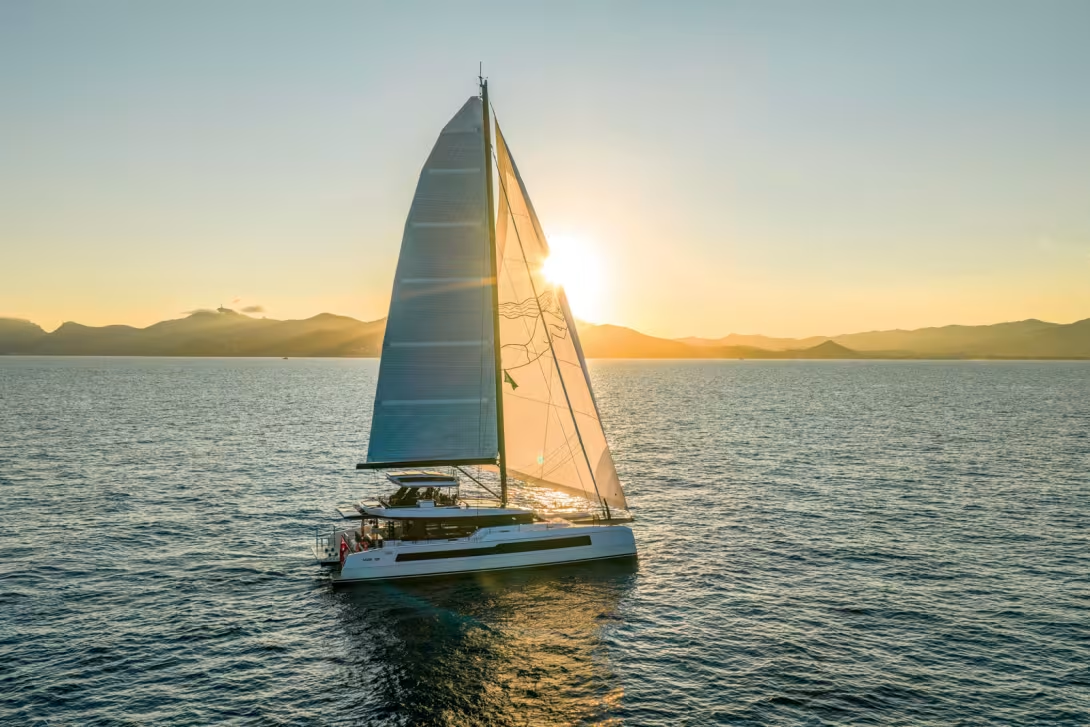
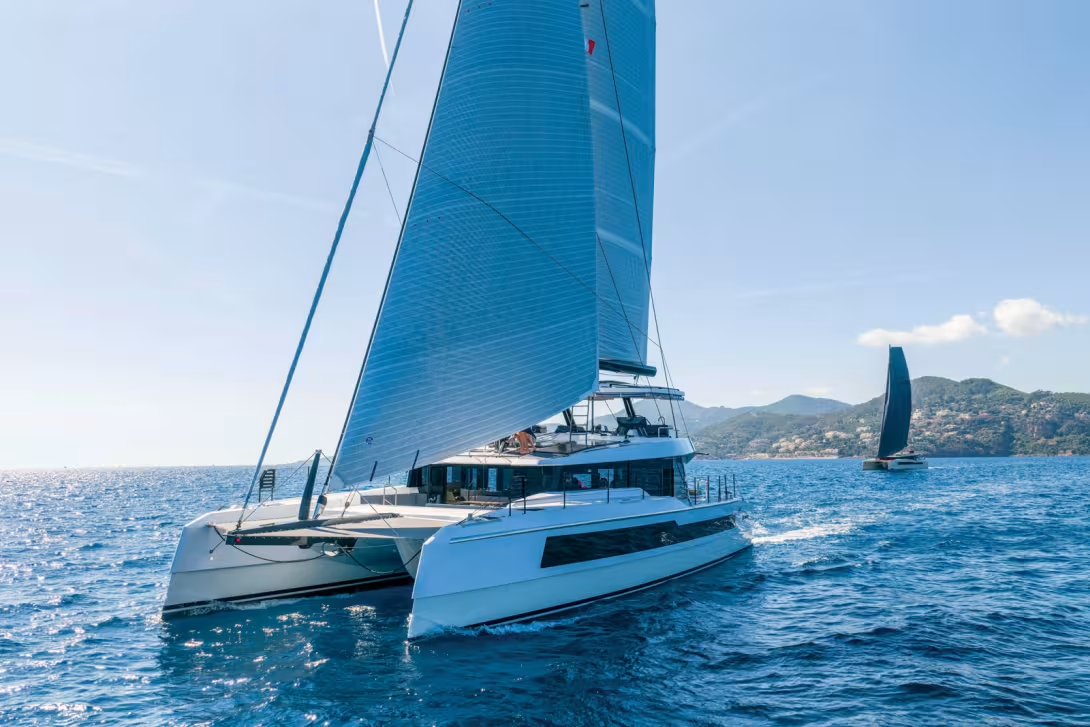
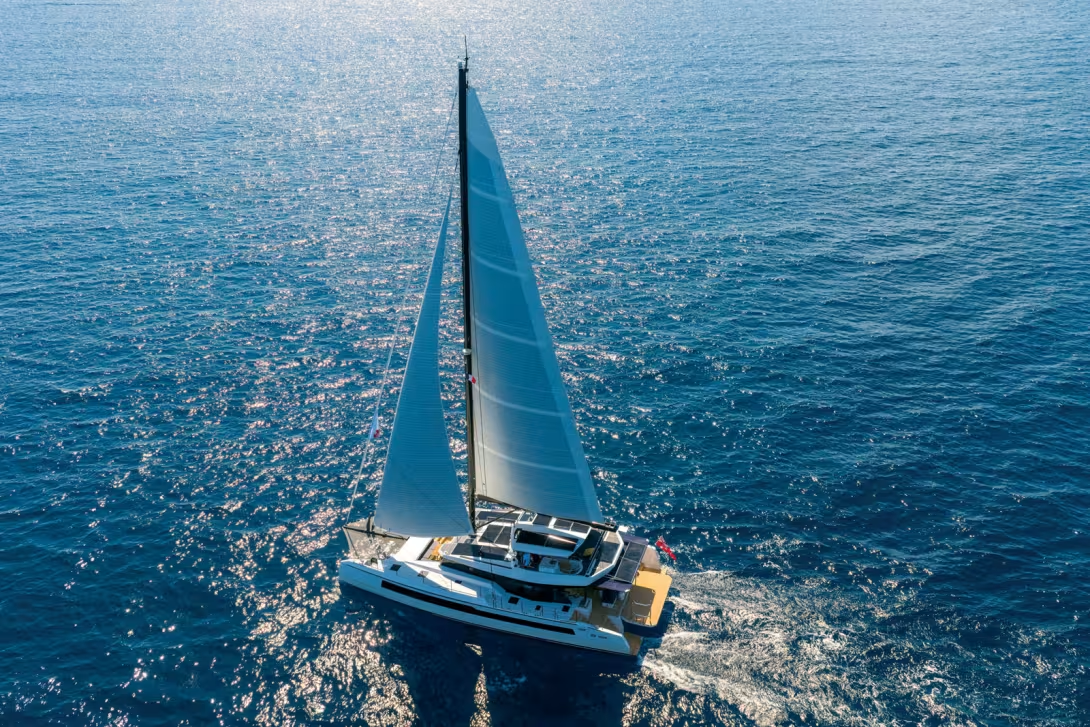
The Chinese-Australian shipyard is expanding its range (which now includes no less than seven multihull series) and launching ever more supercats, both sail and power, all of which are semi-custom. The catamaran we’re looking at here, the MC68, left the shipyard at the beginning of the year and was presented as a world premiere at the Cannes Yachting Festival in September. Combining luxury and impressive performance, this model was largely shaped by its owner, who had a particularly demanding set of specifications.
Infos pratiques
- Le chantier : MC68
- La fiche technique
-
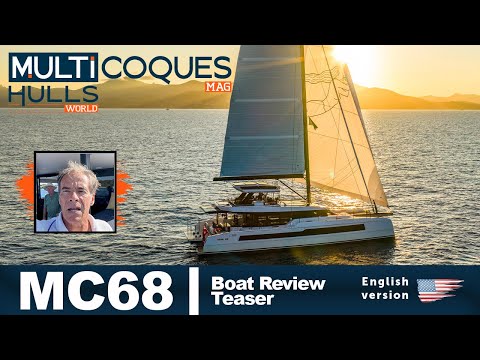 Découvrez notre vidéo exclusive
- Financez votre MC68
- Assuez votre MC68
- Articles autour du MC68
Conditions: 7 to 8 knots, calm sea
Just after the show, the MC68 was moored in the bay of Cannes, in front of the city’s famous boulevard, La Croisette... but it had already hoisted sail. We joined it via a tender while enjoying the first comments from its owner, Ross. Unusually, it was the man himself who had come to pick us up at the Port Canto dock. We sensed a little pride in his words, and we would soon discover why. We remember the positioning that both the brand and its naval architect, Jason Kerr, like to reiterate: “Our typical customers are catamaran owners who want to acquire a prestigious, high-performance vessel that can handle a wide range of conditions and wind angles, but also offers a spacious and attractive living area.” This bold positioning, which consists of offering opulent, palace-like interiors - Sunreef Yachts’ style - with a speed close to that of Gunboat or HH, is contradictory to say the least, as we know only too well. So we were eager to find out more, and we were in for a treat, as an MC75 was also part of the show. A photo/video team was on hand to immortalize the two models, side by side, for much of the day.
Both MCs were under sail and, with a bit of hydraulic help, the 68 furled up its genoa and came into the wind to slow down and allow us to board via the huge hydraulic platform. The platform, with its stainless steel guide rail accommodating the 13-foot (four-meter) Williams tender, is equipped with a lift-type cutout to allow a diver with scuba tanks to descend and ascend wearing all his gear – the tone is set.
We then entered the saloon through an electrically retractable bay window. There is no doubt that the amenities are of the highest standard – the shipyard has set the bar very, very high.
Meticulous Construction
Andrew McPherson, the sales manager, reminded us that McConaghy uses glass/epoxy/foam infusion techniques for the hulls and superstructures, coupled with a carbon-infused frame and reinforcements of different samples depending on the stresses they have to withstand. It should be noted that the shipyard is a master in the infusion of this material, and there are countless technical and decorative parts distributed throughout the boat, such as hardtop supports, ladders, pulpit seats, etc. The forward beam is a work of art, not to mention a masterpiece of carbon fiber. It supports the forestay and the bow roller for the anchor. Everything has been planned in the design, with the integration of the gennaker furler, the forestay tensioning system, and the chain lead. The rigidity of the forward section eliminates the need for an inelegant crossbeam between the hulls, and the simple mast that supports the martingale does not obstruct the forward view. The only parts that have not yet been produced by the shipyard are the mast and furling boom. However, these will be made in-house for the next model in order to further refine the details of this fairly complex rig and ensure that it functions optimally. This mastery of carbon infusion allows for architectural innovations, as evidenced by the door giving access to the forward cockpit. To provide a feeling of well-being, it is double-paneled and opens outwards to withstand the pressure of waves in very bad weather, a first for this type of equipment. Another feat is the mechanism that allows the pivoting centerboards to be lowered to a depth of 12’4” (3.75) meters with a single press of a finger, but also to stop them in an intermediate position - for sailing on a reach, for example. This high-tech construction helps to ensure excellent rigidity but also eliminates any creaking while under way and at anchor, which is what every demanding owner wants. Above all, it allows for fairly controlled hull weight, because the deck hardware (even if it is all made of lightweight materials) and equipment inevitably add weight in order to achieve the required level of performance. The lightship displacement figure of 69,500 lbs (31.5 tonnes), this is not the lightest boat in its category, but the finish of the MC68 is worthy of a superyacht - in this context, we’re a long way from other vessels offering similar features, whose displacement often comes in closer to 60 or 70 tons in this size range.
À la carte Interiors and Finishes
Although the plans and details on the brand’s website show up to five double cabins - probably intended for large families or even charter use - this is not the case on Lady Bountiful, which Ross and his wife Rozz have designed according to their own wishes. This Australian couple came to boating late in life, and their first catamaran was a Lagoon 620. Wanting to spend a lot of time sailing, they needed a real apartment on the water with a layout and level of finish that would allow them to live on board in great comfort. They were heavily involved in optimizing the plans and details of this first model, which now serves as the standard for future models. Three double cabins, including two large suites with huge walk-in closets, make up the sleeping quarters. The crew has its own cabin with a Pullman bed forward in the port hull, with private access like all the other cabins. The hull portholes, with their stylish composite frames with rounded corners, provide a view of the sea from the beds. At the after end of the two hulls, instead of additional cabins, there is an XXL laundry/ pantry on one side and, on the other, a fully equipped workshop. “These kinds of details, which are not really details at all, change life on board!” Ross assures us, and he is not wrong: laundry and DIY are part of everyday life when living aboard long-term. On the flybridge, the large open space houses an American-style saloon-galley. The large table can seat ten guests, while no less than ten linear meters (32 feet) of marble worktop cover the galley and its central island equipped with the best appliances and exceptional refrigeration and freezer capacity. The layout of the numerous cupboards and drawers is flawless. Rozz was able to comfortably prepare beautiful platters of hors d’oeuvres for the lifestyle shots of the photo shoot. A very large desk and a nav station complete a space that is a pleasure to live in.
As for the coachroof windows, they slide open on each side. The feeling of being inside and outside at the same time is very pleasant, and ventilation is greatly aided by the double front door that provides access to the forward cockpit terrace equipped with a shade sail on poles... made of carbon, of course. The outdoor areas are entirely clad in teak, as luxury yachts still make no compromises on this point. Aft, the cockpit is fairly traditional but is boosted by the platform which vastly increases the space. Accessible via a spiral staircase, the flybridge doesn’t give in to the trend for open spaces to be furnished. Here, everything is installed and carefully configured. Ross even had a bench/daybed added for a quick nap. Everything you need for meals or snacks is there. This vast flybridge is surrounded by side panels for privacy if needed, so you can spend a lot of time here while sailing. It goes without saying that the quality of the seats and benches, with their velvet covers, is impeccable and contributes to the feeling of cozy comfort, even outdoors. You can tell that the owners took pleasure in fine- tuning all these details - and Ross concludes, “It all works very well in the end!” Finally, for power supply, a 15-kW Fischer Panda generator kicks in on demand when the 5 kWp solar panels on the coachroof and hardtop struggle to top up the lithium battery bank – if it’s very cloudy, for example.
The Pleasure of Sailing
I’ll admit right away that helming a catamaran of this size equipped like a five-star hotel is not necessarily going to be very exciting - but we were in for a pleasant surprise in terms of sensations. We joined the captain on the flybridge in a light breeze of 6-7 knots to sail in company with the 75. The command station is very user-friendly, with a double helm station providing the best possible visibility of the sails and the water. In the middle, are four large Harken Performa electric winches to manage all sailing maneuvers, including the gennaker sheets that run back to blocks at the rear of the hardtop. It’s simple and effective, especially since the big-roached mainsail furls into the boom - a wise choice considering that this spar is 20 feet (6 meters) above the waterline. The Stratis cruising sail set from Doyle seems very well cut, as we are on a par with the MC75 - which is of course larger and equipped with a square-topped mainsail. We were making 7.5 knots hard on the wind, and tacked very easily, activating the daggerboards from a button on the console, then, after stopping to collect the photographers back on board, we set off again with renewed vigor. The acceleration is noticeable in light gusts - we were surprised by the liveliness of this MC68, which picked up speed to over 8 knots when bearing away slightly at 50 degrees. The Reckmann furling system was quick to roll up the genoa, and we immediately unfurled the gennaker. Tacking through 90 degrees in a 7-knot wind, the boatspeed reached 7.5 knots, demonstrating the MC68’s ability to exploit the slightest breeze to sail without using the engine at all speeds. With the electric mainsheet traveler, the hydraulic furling headsails and the ergonomics of the flybridge helm, the ease of maneuvering is astonishing. It feels like being on board a much smaller catamaran - which is precisely what was stipulated in the specifications. While the standard description lists 80 HP motors, Lady Bountiful did not refuse the generosity of 110 HP Yanmar engines which are actually much better suited to this size of boat. The engine compartments enjoy good access and are properly soundproofed, but we think a higher-output alternator system would be an advantage to supplement the small generator.
Conclusion
The MC68 is a fast cruiser that’s remarkably efficient and easy to handle, which is very reassuring. It’s safe to say that the version with a classic coachroof will prove to be sportier as it is lighter and has more sail area. Finished like a real luxury apartment on the water, the 68 benefits from a very thorough design. Combining speed with this level of comfort is an undeniable success. It’s just a shame that everything comes at a price.
Highly sophisticated onboard living solutions
Extremely high-quality semi-custom construction
Very exclusive price when all options included
Technical Specifications
Architect: Ker Yacht Design
Interior design: McConaghy Boats
Overall length: 67’11” (20.7 m)
Beam: 30’2” (9.2 m)
Draft (centerboards): 4’7”/12’4” (1.4/3.75 m)
Light displacement: 69,500 lbs (31.5 t)
Laden displacement: 83,775 lbs (38 t)
Upwind sail area: 2,766 sq ft (257 m²)
Motors: 2 x 110 HP
Fuel: 422 US gal (1,600 l)
Fresh water: 264 US gal (1,000 l)
Prices in US$ ex-tax
Standard price (carbon mast): 5,200,000
Price of the boat we tested: 6,600,000
Main options:
Complete Doyle sail set: 153,650
North Sail performance sails: 210,140
B&G electronics: 54,100
Teak deck: 78,600
Solar panels: 45,000
Retractable passerelle: 53,000
OC 350 15 HP tender: 36,500
Air conditioning in cabins and saloon: 84,500