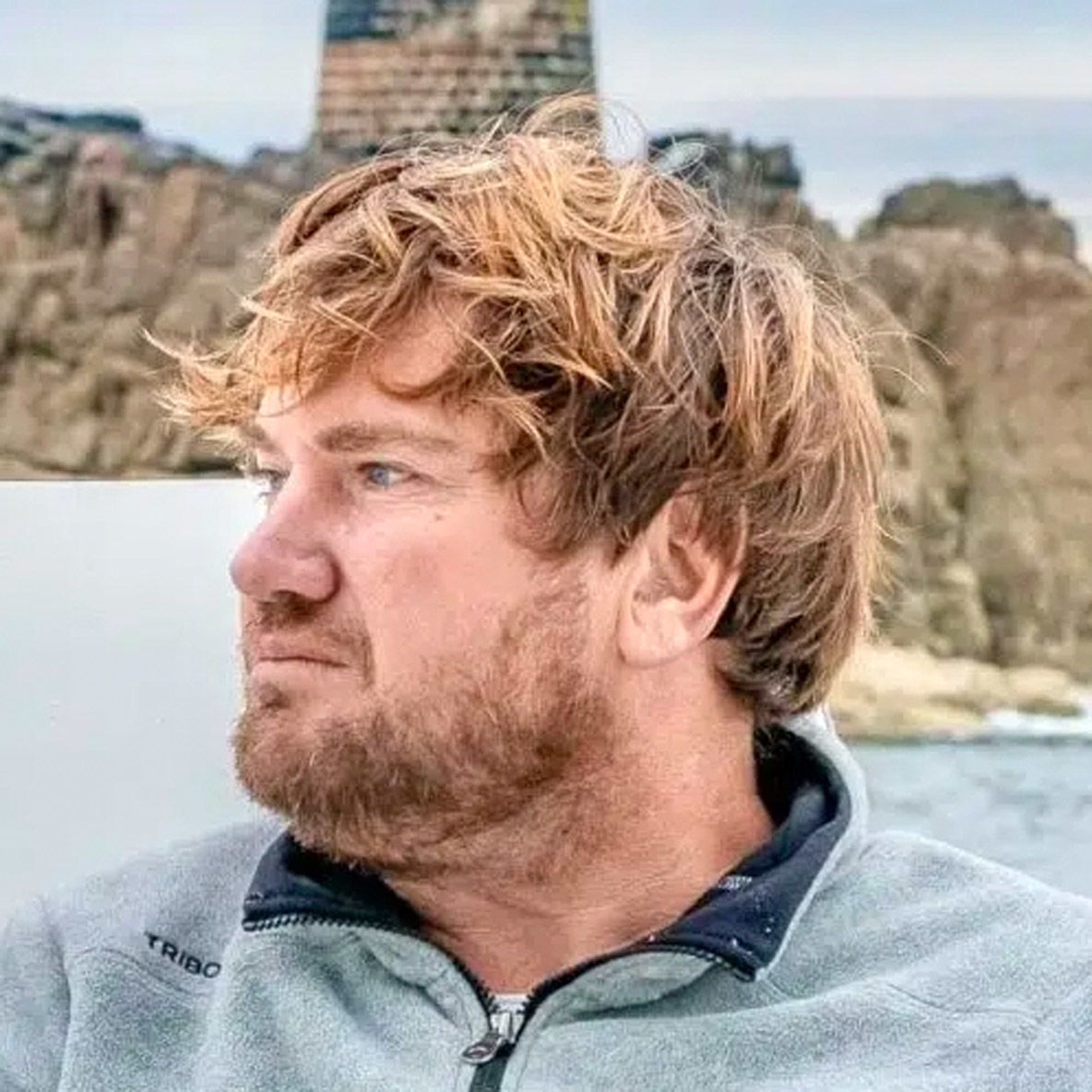
Then we raced against each other in Class40, before finding ourselves shipwrecked together in the Azores in November 2022, after capsizing our respective multihulls in the same storm during the last Route du Rhum... that kind of adventure inevitably creates bonds... And it was while discussing a proposed article on the Ocean Fifty class that Thibaut made me this offer: “Come and sail with us from Saint-Malo to Le Havre!” The kind of offer you can’t refuse...
In the early morning, I wandered down to the pontoons of the Bas-Sablons Marina, where I could see from a distance the mast of the three-hulled “beast,” which towered high above the spars of all the other boats.
On board, I met Lolo, the boat captain, who was busy preparing the multihull while Thibaut was welcoming a distinguished guest, Gabrielle Tuloup, a teacher and novelist who would also be making her debut aboard Solidaires en Peloton. Also signing on for the adventure was Thomas Gaveriaux, an excellent sailor with a background that includes the America’s Cup and project management in Imoca.
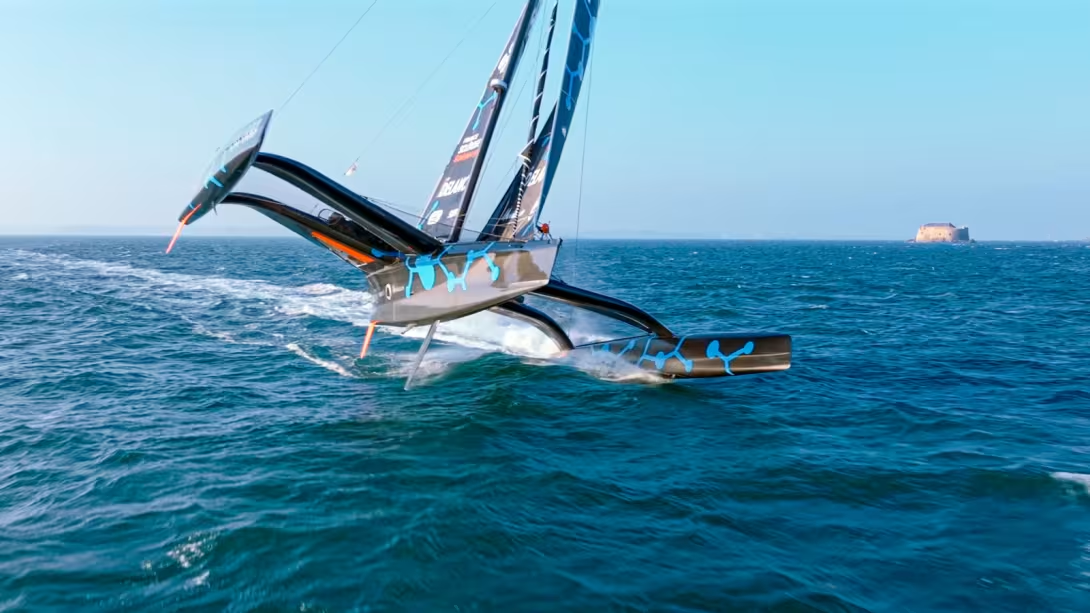
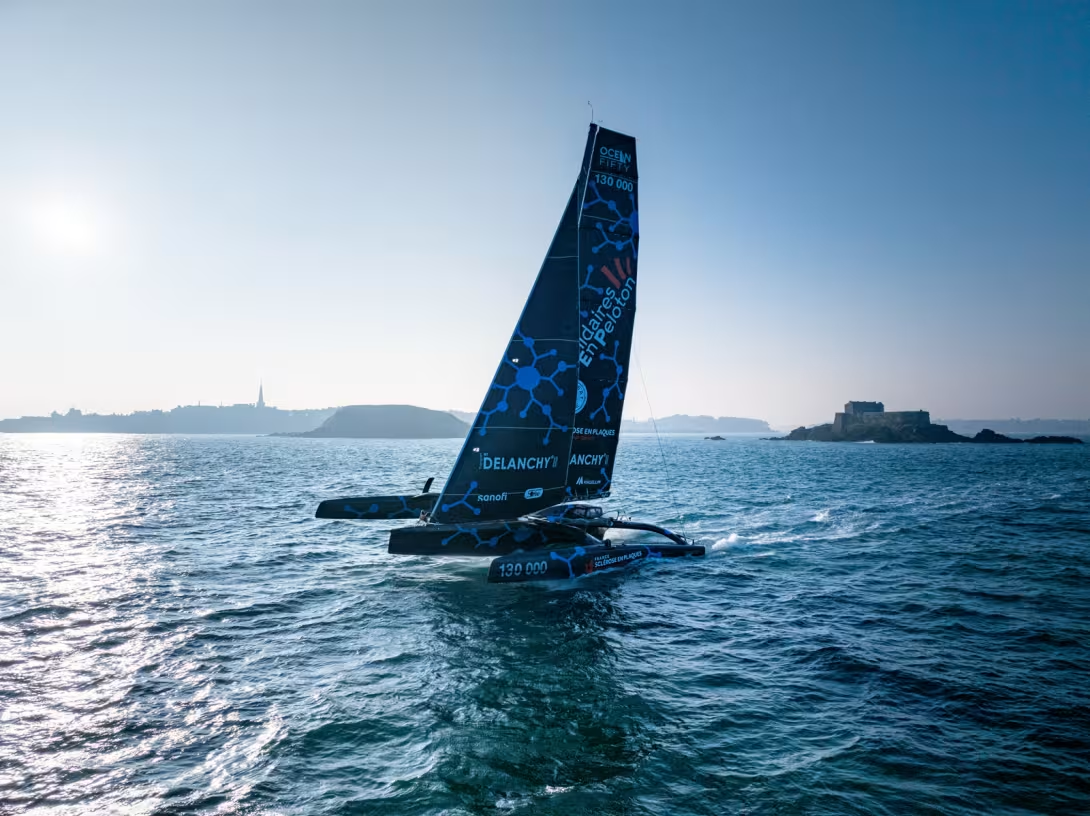
The four of us set sail with the help of Lolo in the team’s RIB. The light over Saint-Malo on that beautiful autumn day was magnificent, and I took advantage of the fact that the wind hadn’t yet picked up too much to send up a drone and take some initial pictures. With about ten knots of breeze, under mainsail and J1, we are already gliding along at 15 knots on a perfectly flat sea, and I was enjoying filming the multihull. But as soon as we passed the ancient fort of Petit Bé, the wind increased and the boat sped up at an incredible rate. Tucked under the cap in the central hull, I found it difficult to concentrate as the acceleration was so violent: Solidaires en Peloton was flying at over 30 knots.
Thibaut, who has always had a flair for showmanship, didn’t hesitate to pull the helm a little to let the trimaran rise very high on one hull. As we set about switching from J1 to J2, I took advantage of the boat bearing away sharply to catch my drone, which was running out of steam. I could then begin to take an interest in the layout of the multihull.
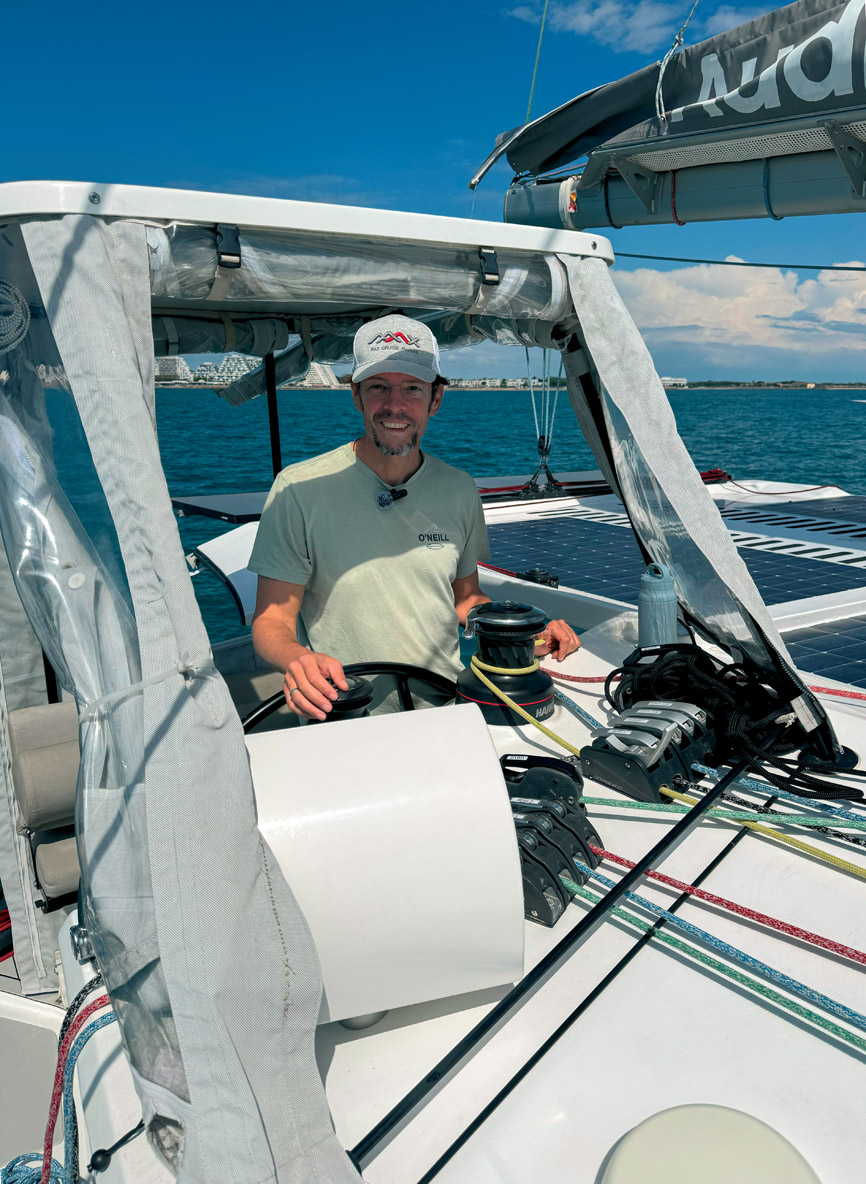
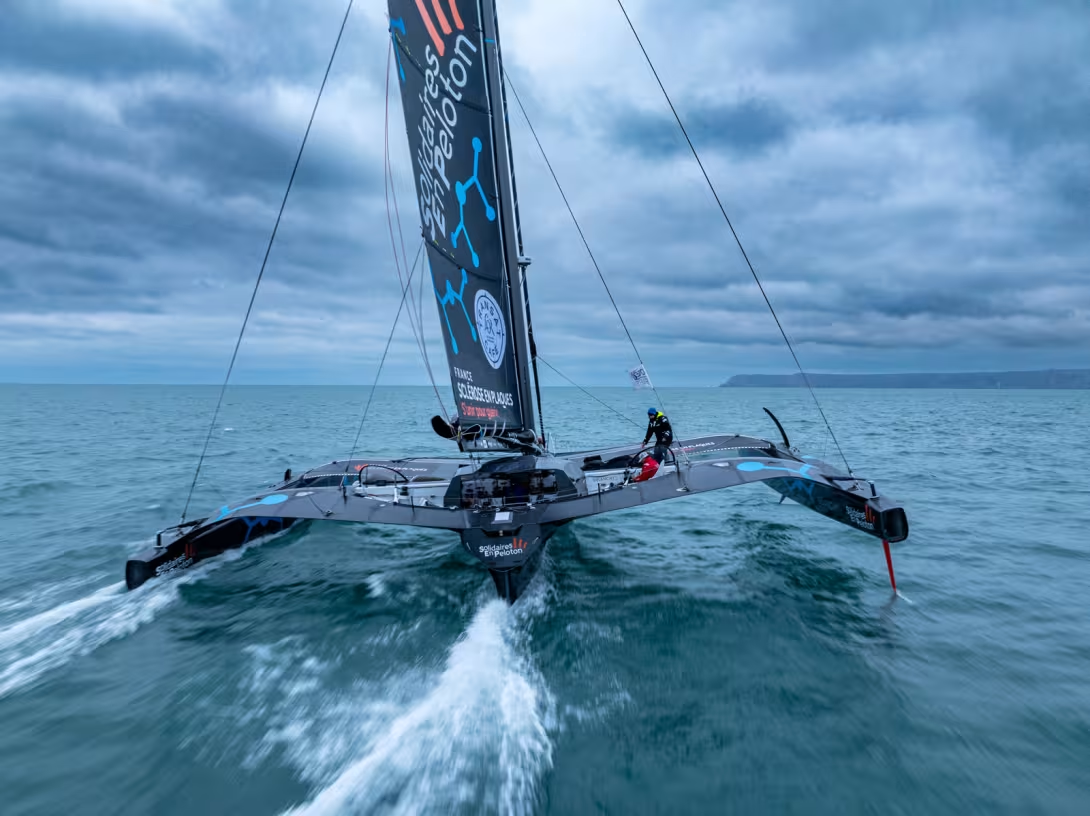
My first observation was that the trimaran, which is “only” 50 feet long and doesn’t look that big when moored quietly at a pontoon, became an absolute powerhouse when under way. As wide as it is long but weighing only 4 tons, it is incredibly stiff and powerful. The maneuvering cockpit, well sheltered under a canopy that Thibaut and his team enlarged during the last refit, gathers together all the sail handling maneuvers around three winches and a coffee grinder. A large computer screen and a few electronic repeaters allow the crew to monitor the “constants” in real time – very important on this type of vessel, which is prone to capsizing. Between 110 and 80° to the true wind, the most challenging sector for a multihull, the trimaran’s speed can reach 1.8 times the true wind speed, so you can imagine the impact this can have on the apparent wind and the need to anticipate, or else put the balance of the boat at serious risk. In fact, Thibaut never moves around on board without constantly holding the mainsheet traveler line in his hand, his “life insurance,” he tells me with a big smile.
Gabrielle and I ventured out onto the windward float, clinging to the trampoline. The trimaran sometimes rises so high that the daggerboard in the central hull comes completely out of the water, but the absence of waves gives a certain feeling of safety, meaning I could take advantage of this relative calm to photograph the trimaran from every angle.
I then attempted the adventure of climbing down into the central hull to review some video footage: the first obstacle is a manhole that requires a slim build to pass through... The atmosphere is spartan: a bunk allows one crew member to more or less lie down. Further forward, a gimbaled Jetboil stove provides the means to cook. The two large cylindrical portholes (which also serve as escape hatches) offer an unobstructed view of the floats. Thibaut tells me that he hardly ever goes down into the hull and that, thanks to the enlarged maneuvering cockpit, he is able to sleep outside.
The northeast wind continued to freshen to 25 knots and Thibaut took in the first reef. The maneuver looked easy but is actually quite physical. I can’t even imagine doing it at night in a squall with 15-foot waves...
Once the operation was complete, Thibaut called out to me, “Go on Brieuc, take the helm!” I climbed up to the windward helm station, which is offset on the aft connecting arm. From there, I had a perfect view of the bows and the telltales on the headsails, while large repeaters allowed me to see the speed and wind angle. We arrived downwind of Cap de Diélette and the Flamanville nuclear power plant. The sea was perfectly flat, gusts of wind were blowing off the cliffs at 30 knots, and I found myself alone at the helm of this war machine while Thibaut laconically says, “Right, I’ll leave you to it, I’m going to take shelter with the others in the nest.”
After a brief moment of apprehension, I began to get a feel for the trimaran, which is ultimately as responsive as a small beach cat. Steering is easy, with one hand on the helm and the other on the line for the mainsheet car. A plexiglass panel provides me with some protection from the spray, and I can begin to concentrate on the parameters. We were sailing at 70 degrees to the true wind, at about 30 knots. In the gusts, I luffed up to avoid lifting too much, meaning the C-shaped foil on the leeward side would tend to make the trimaran pitch up a little, which calms things down. Quickly, when the wind dropped, I picked up by bearing away slightly below the proper course - the speed and apparent wind instantly picked up and the trimaran quickly returned to its target speed. With a little practice, I ended up with a fairly straight course, without climbing too high, at a speed that was just incredible for a multihull of this size... I frequently saw 34 knots on the log, and I won’t hide the fact that I was completely euphoric.
Approaching Cap de La Hague, we entered the Alderney Race, and although the tides weren’t that big, the place certainly lived up to its reputation by blocking our path with an area where the sea was completely chaotic and choppy... I’m glad that Thibaut took the helm for this part of the passage. We trimmed the trimaran’s sails to make upwind at a 55° angle to the true wind, which allowed the boat to continue sailing close-hauled at wind speed with incredible VMG.
We finally made it through the turbulent area quite easily and tacked a long way out into the English Channel to catch a small shift to the left that would allow us to make Le Havre in two tacks. I couldn’t resist the offer to take the helm again - unlike many multihulls, tacking an Ocean Fifty is no punishment!
The atmosphere was typical of the eastern English Channel in October: even though the weather was glorious when we crossed the Bay of Granville a few hours earlier, the green sea was now turning the same shade of gray as the sky; the ceiling was low, squalls were coming one after another, but fortunately, the ambient temperature remained mild because, with an apparent wind of nearly 40 knots, we could quickly end up frozen! I attempted a tack, but I didn’t push the helm fast or hard enough - the multihull ended up in irons. The crew eased the backstay, I reversed the rudders because the trimaran was by now moving backwards, and things quickly returned to normal, once again with apparent ease... I imagine that the same stunt, with a little more wind and sea, could quickly cause material damage. After a few hours clinging to the tiller, I handed the helm back to Thibaut, because the high-speed sea spray was making me look like a lagomorph (I avoid mentioning the name unlucky for sailors) suffering from myxomatosis!
We continued sailing on port tack, in a softening wind and calmer seas, and once again, in these conditions, the trimaran proved to be extremely fast. We reached Le Havre and its now famous Paul Vatine basin in 9 hours, having averaged almost 19 knots, with more than half the trip completed on a close reach! Thank you, Thibaut, for sharing this uncompromising voyage with me!
Thibaut Vauchel-Camus Objective: Route du Rhum 2026
At 47 years of age, Thibaut is an iconic figure in offshore racing in general, and in the Ocean Fifty class in particular. He started sailing in a Hobie 16 in Guadeloupe before joining the Pôle France Tornado. After winning everything in Formula 18 alongside Jérémie Lagarrigue, he turned his attention to offshore racing, a discipline in which he has established himself as a lasting force. He is also the president of the Ocean Fifty Class. His goal is now clear: to win the 2026 Route du Rhum.
Honors
• 2023: 1st Trophée des Multicoques Baie de Saint-Brieuc (Ocean Fifty)
• 2018 & 2020: Winner Drheam Cup (Multi50)
• 2019: 2nd Transat Jacques Vabre (Multi50)
• 2018: 3rd Route du Rhum (Multi50)
• 2016: Winner of The Transat Bakerly (Class40)
• 2015 & 2016: French Class40 Champion
• 2016: Winner Flying Phantom Series
• 2014: 2nd Route du Rhum (Class40)
• 2005-2013: French F18 Champion (6 times!)

The Ocean Fifty Class Innovation, Cost Management, and Project Sustainability
Created in 2021 as an evolution of the Multi50 class, the Ocean Fifty class brings together 50-foot ocean-going trimarans dedicated to high-level offshore racing. Fast, powerful, and spectacular, these multihulls are now one of the most dynamic classes on the offshore scene. Governed by strict class rules, the Ocean Fifty class is based on a deliberate balance between technological innovation, cost management, and project sustainability. The class deliberately limits the number of boats entered in order to preserve the sporting competitiveness and economic viability of the teams, while promoting the optimization and refit of existing boats.
The sporting program combines close-quarters inshore regattas (Ocean Fifty Series) and major offshore races, including transatlantic races, offering sailors and teams a complete arena in which to express themselves. Accessible, understandable, and resolutely forward-looking, the Ocean Fifty class stands out as a natural link between monohull classes and the most extreme ocean-going multihulls.
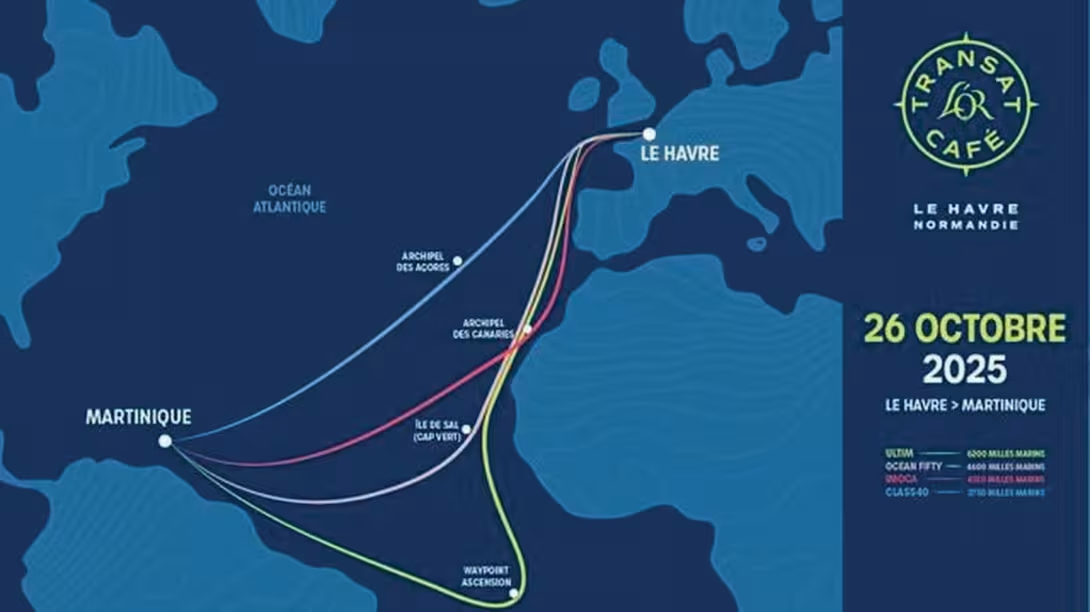
Transat Café L’Or 2025: A Very Tense Edition for the Ocean Fiftys
The 2025 edition of the Transat Café L’Or confirmed the very high level of competitiveness of the Ocean Fifty class. In order to avoid the center of a low-pressure system forecast over the English Channel and the Bay of Biscay, the start of the trimarans was brought forward by 24 hours. Despite this decision, the fleet encountered very gusty and disorderly conditions on the first night, unfortunately leading to three capsizes, reminding us of the violence of this initial phase.
Once this delicate stage was over, the race turned into a real battle of speed and strategy out in the Atlantic. Tactical choices, the ability to maintain high average speeds over time, and the reliability of the trimarans made the difference in a fleet where the gaps remained extremely small until the finish, with the top four finishers arriving less than 45 minutes apart after 12 days’ racing.
| Ranking | Ocean Fifty | Skippers | Elapsed Time |
| 1 | Viabilis Oceans | Baptiste Hulin / Thomas Rouxel | 12 d 05 h 24 min 30 s |
| 2 | Wewise | Pierre Quiroga / Gaston Morvan | + 17 min 32 s |
| 3 | Le Rire Médecin | Lamotte Luke Berry / Antoine Joubert | + 27 min 42 s |
| 4 | Solidaires en Peloton | Thibaut Vauchel-Camus / Damien Seguin | + 44 min 23 s |
| 5 | Edenred 5 | Emmanuel Le Roch / Basile Bourgnon | + 4 h 41 min 39 s |
Solidaires en Peloton An Ocean Fifty in a Few Figures
Thibaut Vauchel-Camus acquired this trimaran in 2023. It is Quentin Vlamynck’s former Arkema, aboard which the two won the Transat
Jacques Vabre in 2023.
Builder: Lalou Multi
Architect: Romaric Neyhousser
Launched: 2020
Length: 50’ (15.24 m)
Beam: 49’10” (15.2 m)
Upwind sail area: 1,938 sq ft (180 m2)
Downwind sail area: 2,906 sq ft (270 m2)