
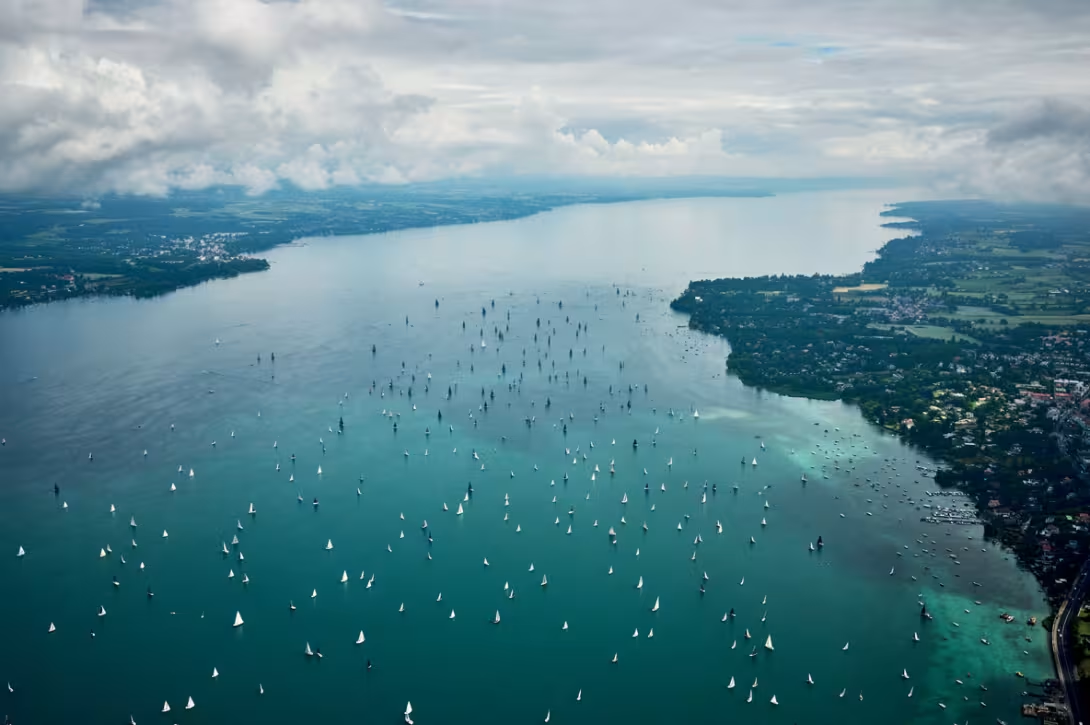
Switzerland doesn’t have the sea, yet there are countless prestigious racing sailors who know its subtle bodies of water by heart... The top event for these freshwater crews, who are more than capable of holding their own against the most successful ocean racers, is the Bol d’Or Mirabaud, which takes place every June on Lake Geneva. Since 1939, the Société Nautique de Genève has set the tempo for the world’s biggest inland regatta. Its unpredictable scenario is sure to keep the most demanding racing fans on the edge of their seats. Between violent winds (images of the 2019 edition’s big squall have been seen around the world) and overwhelming calms, choosing the right boat to win is no easy task. How do you cover the spectrum of such a wide range of conditions?
This is the breeding ground for an almost limitless desire for innovation, which has led generations of owners to design the most high-performance multihulls of their time.
From the D35 to the TF35
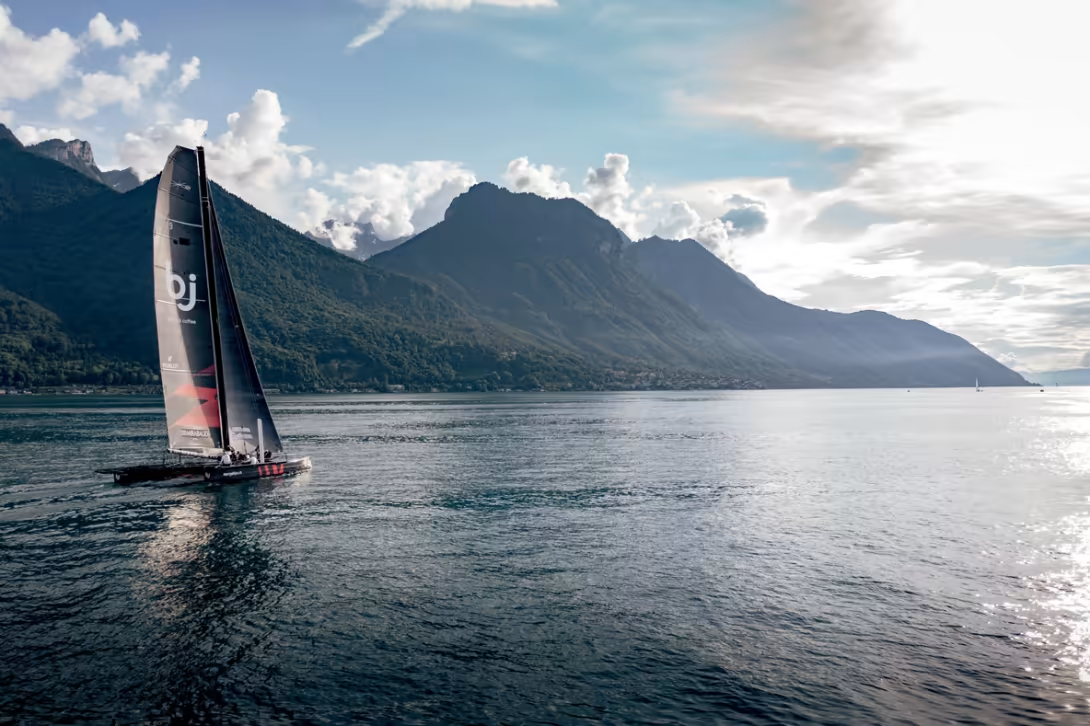
Since the 2021 edition, the Bol d’Or Mirabaud has been the scene of a new and unprecedented confrontation. On one side, the only D35 in the race, with Christian Wahl at the helm, and on the other, the brand-new TF35s, of which there are now six. The queen of the lake for a good fifteen years, the D35s bowed out in 2020, when some of their owners decided to ship them off to Hungary, some 600 miles east, to Lake Balaton, with the aim of replacing them with a very specific foiler. The TF35 was born. This multihull was intended to establish its supremacy on Lake Geneva by flying even in light airs. A daring gamble. The machine is capable of taking off downwind in just 6 knots of breeze, and features an automatic altitude regulation system, making it a formidable craft, capable of opening up phenomenal gaps in just a few minutes on its foils. But it won’t fly in less than six knots of wind. However, during this 2023 edition, peak winds of 7 knots were recorded, no more. So there was nothing to write home about, and for the second year running, the TF35s dragged their foils. All of them... except for one crew with much panache: these doldrums warriors took the daring gamble of swapping their pair of foils for daggerboards for the first time in a race. Initially designed as a hybrid, the TF35 can be fitted with C daggerboards - provided the necessary work is carried out a few days in advance. A few practice tests and a handful of clever calculations were initially enough to convince almost the entire fleet that it wasn’t worth the risk. In fact, mathematically, a few tens of minutes of flight time could be enough to make up the lost ground on the older generation of Archimedean catamarans - M2s, D35s and the like.
Quite a gamble
Jérôme Clerc, multihull specialist and head of the Realteam stable, was the one who changed his mind. The crew came very close to pulling off the coup of the century, keeping the race alive from start to finish. Faced with a very light airs forecast, Jérôme and his boys decided to go all in. “Following an average result in the Genève-Rolle-Genève [the prelude to the Bol d’Or, which takes place a week earlier. -Ed.}, we thought we’d take a risk,” commented Jérôme, who ended up in fourth place overall and First in his class. “So we opted to replace our foils with C-shaped daggerboards, as required by our class rules.” The foils vs daggerboards match was about to begin!
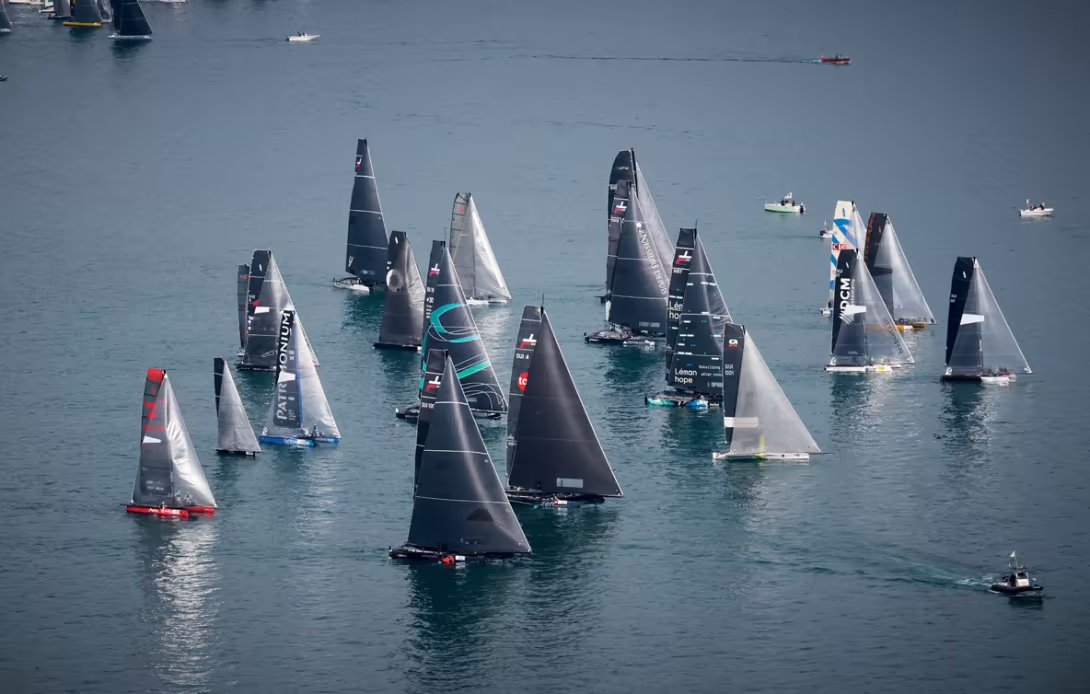
When the starting gun was fired at 10 o’clock, the 420 boats on the line found the lake as flat as a millpond. It was only after what seemed like an age, that the first rays of sunlight allowed the slightest thermal breezes to pick up. Naturally, the Archimedean catamarans were the first to start off, but the foilers stayed close, ready to make up in leaps and bounds for the difference granted to the older generation catamarans. Christian Wahl’s D35 was first on the scene, while the 20-year-old M2s led the way for a while, before Realteam took control after leaving Petit-lac. Thanks to a series of strategic decisions, the daggerboard TF35 proved to be a dominant performer, capable of competing with the best-performing boats in light airs. After eight hours of racing, she rounded the halfway mark at Le Bouveret in the lead. The Archimedean TF35 is followed by two M2s, while the first foiler, Alinghi Red Bull Racing, was by then in 4th place, more than 27 minutes behind the frontrunner.
Masterstroke
Aboard his D35, Christian Wahl - the most successful sailor in the event’s history - was more than 40 minutes behind at Le Bouveret, and his chances of a comeback were ever dwindling. But the “Wizard of the Lake” refused to give up and believed in his chances right to the end. His experience of the race played in his favor: “It was a very difficult race, which was finally decided off Coppet,” said Wahl, “We were three boats separated by ten meters, with Realteam Sailing and Patrimonium. We managed to slip in under Realteam Sailing and build up a slight advantage, which we then held to the finish line.”
Inch by inch, the D35 nibbled away at the lead. The race was intense, historically long, and the heat overwhelming. The multihulls spent most of the night on the water. Another race began. Night sailing on Lake Geneva is reserved for specialists capable of detecting and locating the impressive array of night-time breezes offered by the Franco-Swiss stretch of water. Lower, faster, the D35 first covered the M2s before placing her attack on Jérôme Clerc’s Realteam. “We were sailing in control of our opponent,” explained Clerc, “But we saw the D35 slip downwind of us, and there was nothing we could do.” In the final miles of the race, Realteam was helplessly defeated by the D35 and two M2s, Swiss Medical Network and Patrimonium.
What strategies for the TF35s?
In 2021, when the TF35s took part in the Bol d’Or Mirabaud for the first time, their performance put everyone in agreement. A light northerly flow at the end of the race enabled them to open up a considerable gap to the Archimedean multihulls.
Ylliam - Comptoir Immobilier won after an epic battle of nocturnal foiling gybes. In 2022, the Bol experienced a hellish squall before encountering even trickier conditions in 2023. Enough to be a warning sign for the TF35 teams who swear by foiling? Jérôme Clerc may have been one of those who believed in the superiority of flight, but he was mischievous enough to think outside the box. Little testing or training has been carried out to optimize the TF35 in Archimedean mode. For Clerc, there’s still a lot to be done: “I’m convinced that this boat can progress in Archimedean mode, but to do so we’ll have to sail more and optimize certain technical aspects”. While the crews have now mastered all aspects of their machines in flying mode, they don’t have the luxury of hindsight when it comes to using their daggerboards. “For example, we need to improve our sails. They’re designed to perform with 25 knots of constant apparent wind, not to glide in windspeeds below 10 knots,” explained the Realteam skipper.
The sail plan should certainly be one of the key points to focus on for optimizing this young class. Indeed, Alinghi Red Bull Racing - which fielded a young crew for the event - was equipped with a large gennaker, unlike the rest of the flying fleet. This larger gennaker enabled them to compensate for some of the drag generated by the foils. Alinghi Red Bull Racing’s youngsters finished a commendable 5th. What would have been the outcome of the race if Jérôme Clerc had chosen to use his large gennaker? The skipper confesses to having left it ashore for lack of hindsight.
Once again, the generation clash turned in favor of daggerboard catamarans. It’s worth noting, however, that the TF35s improved on last year’s performance. Realteam took 4th place thanks to its chosen option, while Alinghi Red Bull Racing climbed to 5th place with its foils, while last year Ernesto Bertarelli’s team topped the TF35 rankings with 7th place overall.