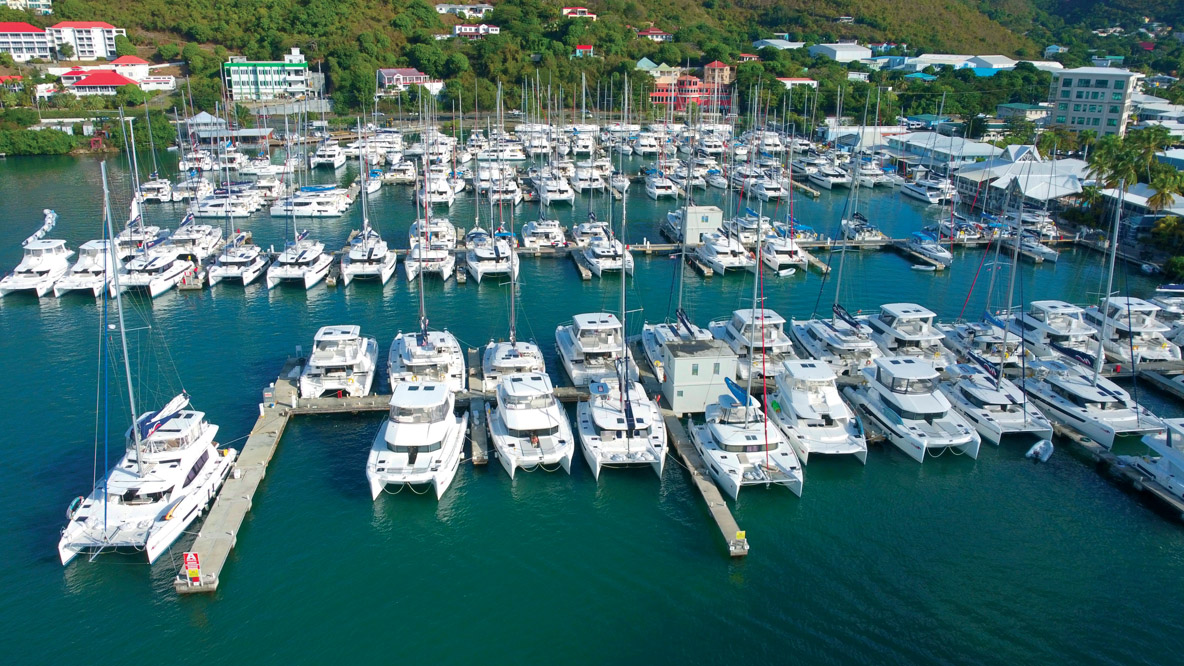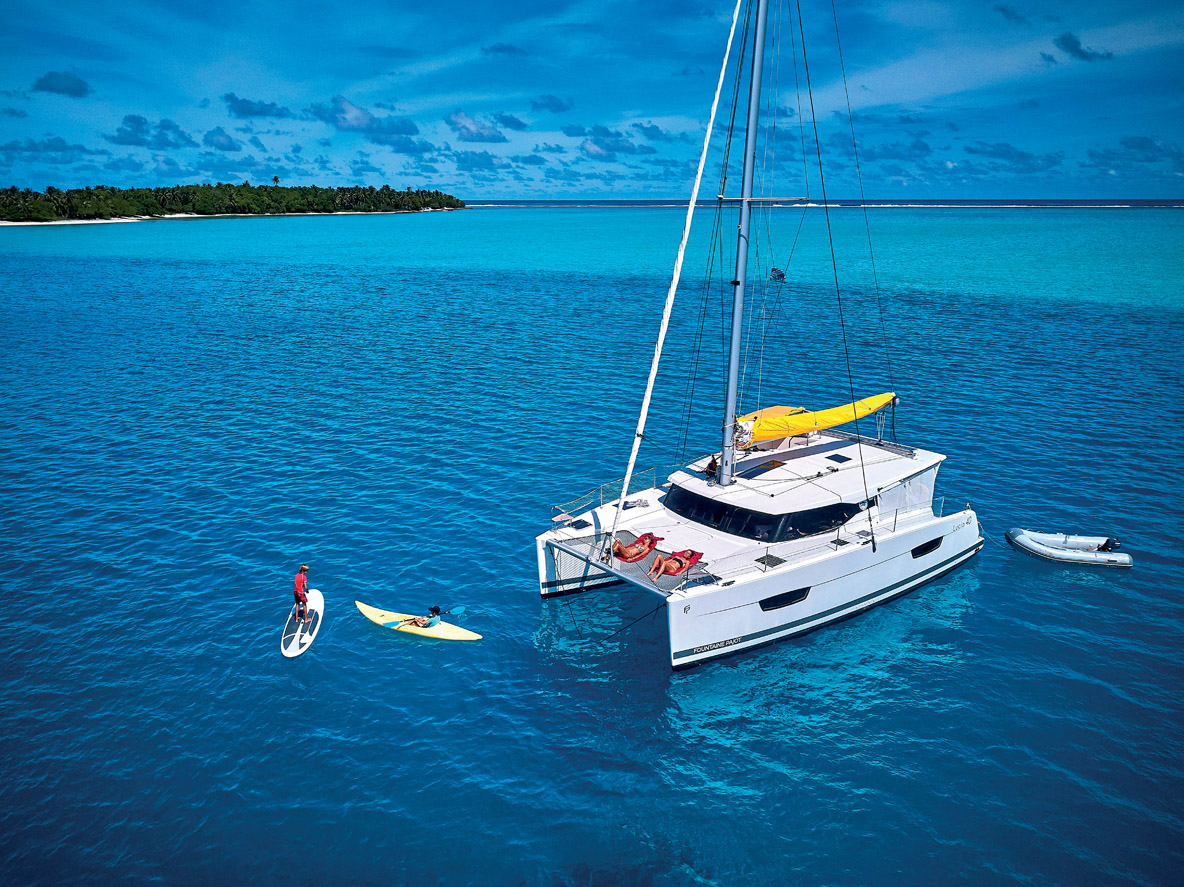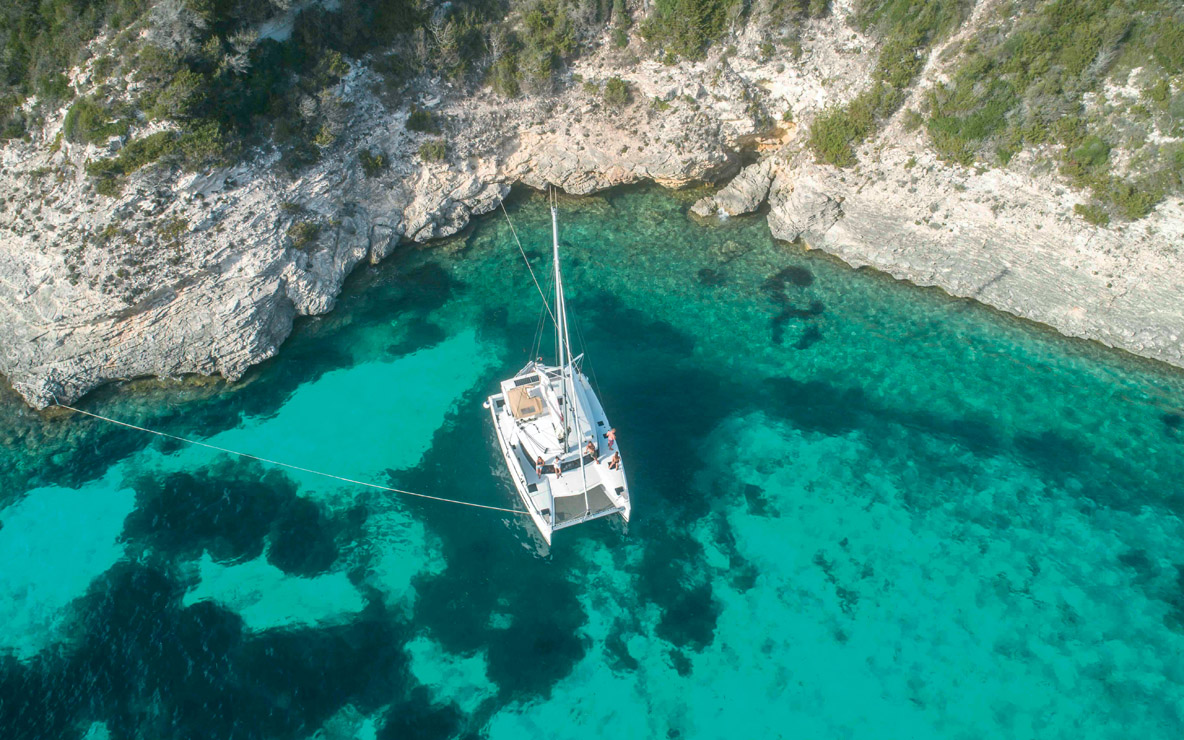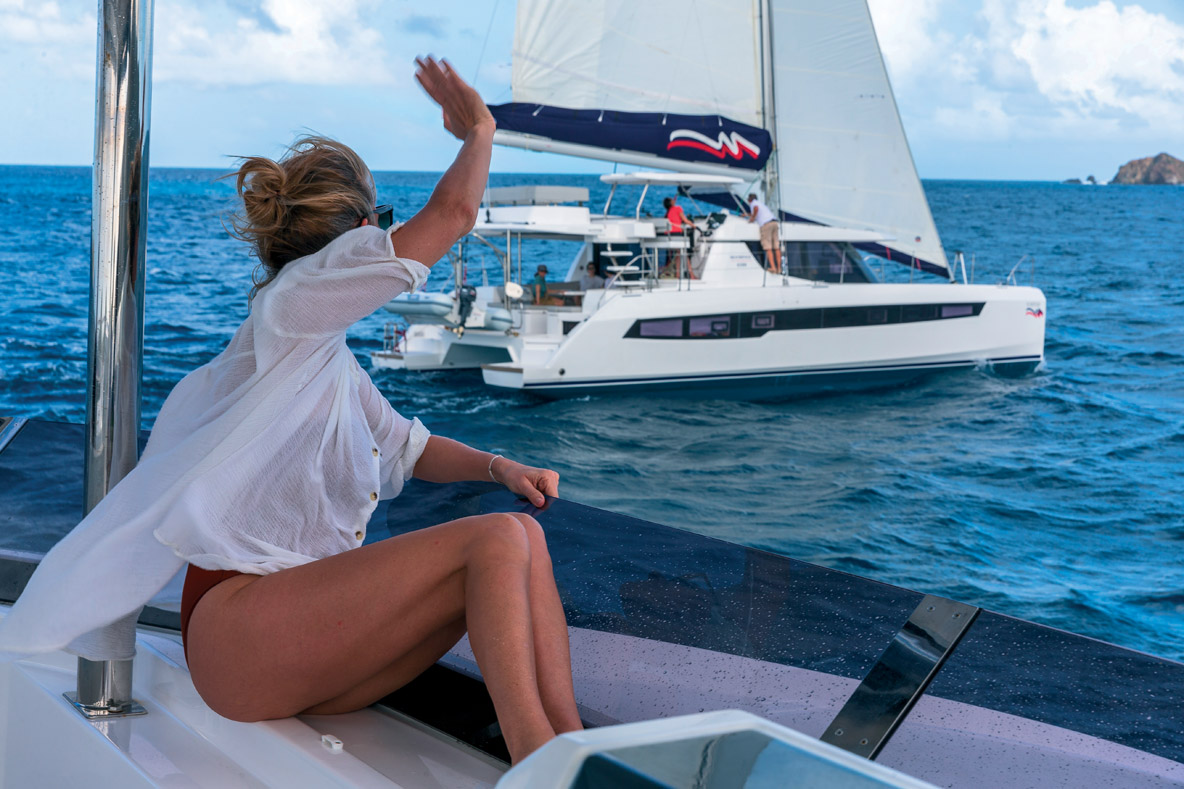

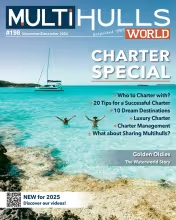
In the wake of the spectacular growth in yachting in the last quarter of the 20th century, the charter market flourished. Specialist companies sprang up; some remained very local, while others had wider, even global ambitions. Among these yacht charter pioneers, there were two giants: The Moorings and Sunsail. They had long been fierce competitors but are now sister companies within the Travelopia group.
These two companies, founded in 1969 and 1974 respectively, have made a major contribution to the democratization of yachting by offering the opportunity to charter a yacht for one or two weeks a year in some of the most beautiful places on earth. In fact, it was by turning everything on its head (in other words, by putting the destination before the yacht) that former journalist and sailing enthusiast Loïc Bonnet launched Dream Yacht Charter in 2000. He used to say, ‘It doesn’t matter what the bottle is, as long as you get drunk’, - and he was probably right, because a little over 20 years of growth and many takeovers later, he is the world leader in the sector. Dream Yacht Worldwide (“Charter” has recently been consigned to oblivion) has 900 boats, while Sunsail/The Moorings has 700. Over the years, the fleet has evolved: it now comprises a majority of catamarans, with powercats gradually becoming more important. The problem is that the capital required to assemble such a fleet is immeasurable. Especially if you want to offer your customers the latest multihulls, so that they can benefit from the best equipment and the highest standards of modern comfort, without forgetting that catamarans and trimarans have to be as robust and reliable as possible to ensure customer satisfaction and a maximum operating rate.
It’s Just a Question of Time…
For their part, sailors have their own particular problems. Unless they are fabulously wealthy or retired, working multihull cruisers will rarely spend more than 4 or 5 weeks a year on the water, even if they are able to spend the whole of their vacations afloat. Buying a catamaran or trimaran is certainly an appealing proposition and technically can be quite interesting. It can be convenient to always have a multihull available with your own gear on board. But when your vacation period is limited, it takes a considerable amount of time to get the boat up and running again and then to winterize it. What’s more, in the space of a few seasons, you’ll quickly have covered all the destinations that can be reached in one- or two-weeks’ sailing from your home port - even if you can change ports. The marina, insurance and maintenance bills fall 12 months out of 12, when you’re only really enjoying your multihull for 3 or 4 weeks of the year. That’s where charter management comes in, as it offers a solution to these two problems. By entrusting your multihull to a specialist company, management leasing allows you to finance it while you wait to use it more intensively. The formula is far from new: it was invented by Jean Larroux in 1971 - the man had just joined Charlie and Ginny Carry, the couple who had founded The Moorings in the BVIs two years earlier. Please note: contrary to what you sometimes hear in the media, lease management is not an “investment with x% return per annum.” Apart from exceptional cases, the Owner does not earn money with charter-management. Instead, he or she avoids losing money and enjoys a catamaran or trimaran in perfect condition for a certain number of weeks a year, anywhere in the world.
With the original ‘variable’ contract, an owner entrusted the management of his multihull to a specialized company, which rented it out during the periods when he was not sailing. The aim is to maximize the use of the craft, usually in order to generate more income. The charter company is responsible for managing all the technical and operational aspects. It manages bookings, maintenance and cleaning, and ensures that the multihull is ready for each client. In return, the company takes a commission on the income generated by the rentals. This is potentially a more profitable option for the buyer, but it is also riskier. The owner pays all the costs (port, insurance, maintenance, etc.) and in return receives between 60 and 65% of the turnover. But all the financing can be hard to bear out of season, when the bank continues to deduct the leasing charges, the marina, winter storage and maintenance, yet no rental income is coming in. On the other hand, during the summer months, if the multihull is left entirely at the charterer company’s disposal and is well used, it can be very profitable. But in this case, you are depriving yourself of using the boat during the best season, when most of the turnover is generated. This is a formula offered by local operators who only have a local offer.
One Multihull, Dozens of Destinations
Charter companies with a global presence, on the other hand, offer guaranteed income contracts. These do not vary according to the rental activity, and everything is included (berthing, maintenance, insurance, etc.). In practical terms, the owner contributes between 20% and 50% of the purchase value of the multihull. The balance is financed by leasing from a financial institution. The owner can sail the catamaran for a certain number of weeks per year. They can also choose to sail on identical units in other bases of the charter company, which allows them to discover new destinations. Finally, it’s also possible, via a points system, to rent different units from the one initially chosen, so that you can adapt perfectly to the program of the moment, whether you’re a couple, a family or a whole group of friends. For the duration of the contract, the charter company undertakes to maintain the multihull, insure it, pay port charges and pay a monthly rent to the owner.
All these contracts include 12 weeks’ use per year for the owner, divided between high season, low season and half of that in the “last minute”, i.e. with one- or two-weeks’ notice. The average price for a week’s charter of a Leopard 45 with 4 cabins and 4 bathrooms, for example, is $16,100. The advantage in terms of use is therefore considerable, even if it does not appear directly on the financial balance sheet. If you don’t use your multihull or a sister-ship during the term of the contract, it would be better to buy the same second-hand catamaran in five years’ time, because that’s what the charter management comes down to if you don’t sail. In the best-case scenario, the income will cover depreciation and costs, but no more. At the end of the contract, you have two options: either you keep the multihull for your own use, or you have it resold by the leasing company and possibly start a new contract. Although the resale value is not guaranteed at the time of signing, (and this is the only unknown factor), established charter companies are in the best position to estimate it as accurately as possible. By renewing a fifth of their fleet every year, they manage the resale of between 150 and 200 boats every year, all over the world. Few brokers handle this volume of business. And here again, multihulls have the advantage. While the resale value of a monohull after five years of intensive use is estimated at between 50 and 55% of its initial price, for a standard catamaran it is more likely to be between 55 and 60%, or even 65% for the most sought-after models, such as a 45-foot Owner’s Version, for example. That represents a non-negligible difference of up to 10% on boats costing between $ 500,000 and $ 1 million.
Some Nice Surprises… Thanks to Inflation
What’s more, although the resale value is not guaranteed, the economic climate of recent years has meant that some owners have been able to pick up some bargains. Between the inflation in new boat prices, which has automatically pushed up second-hand prices, and the rise in the euro/dollar exchange rate, some owners have had some pleasant surprises. Anyone who bought a 50-foot catamaran in Europe and in euros 5 years ago and then resold it in the Caribbean in dollars this year has made more than $ 100,000 on the estimate they were given in 2019. In a short timeframe such as this five-year contract, you can either end up worrying about the outcome or being euphoric. In reality, over the long term, everything tends to sort itself out, especially in today’s global market. And yes, the concept works so well that customers keep coming back for more. “It’s when things go wrong that customers recognize the seriousness of the charter companies,” confides Guillaume Caffin at Sunsail, “The partnership with the owners is sacred! The income really is guaranteed.
There’s no reason to opt out. The insurance is solid, including for hurricane risk.” The memory of Hurricane Irma in 2017 is still fresh in Guillaume’s mind. “We suffered 180 total losses. The clients were able to sail on other bases and the owners continued to receive their rentals until the insurance reimbursed them for their catamaran, which was valued at the date of the hurricane. Well, they ALL bought another boat!” More often than not, “By the second contract, they are much less concerned about the choice of boat and prioritize the best package”.
Choosing Between Full Ownership and Weekly Charter: The Best of Both Worlds
If all the fleets of the major charter companies are now almost exclusively made up of leased units, it’s because leasing offers the best of both worlds, between full ownership and weekly rental. It’s not a miracle solution, because the depreciation of your multihull over the period and the total leasing costs are not fully covered by the sum of the rentals received. But if your schedule allows you to sail between 3 and 12 weeks a year, then the cost of your week on the water will be incomparably lower than that of a traditional charter. It will also be much lower than that of a fully- owned multihull, with fewer worries and maintenance costs, and an almost infinite choice of cruising destinations! And while sailing multihulls have become the majority among charter fleets, powercats are also making their presence felt. Sunsail/The Moorings, for example, already has around a hundred units under charter management. Sail or power, the choice is yours!
Your experiences happy owners!
Eric & Isabelle D. – A 40’ Catamaran
“We used to own an Océanis 36 CC based in the Mediterranean, but we wanted to switch to a package where we would see more countries. Not always sailing in the same place is the most important thing for us. We now own a catamaran, and we can take an equivalent model from any base. The second advantage is that we don’t have to look after the boat at all. Because when you’re an owner, when it’s windy, you worry about the multihull, you have to organize the refit, repair anything that’s broken, have the wintering done, and maintain the engines. When you don’t have a lot of time, it’s a big constraint. If we rent out our catamaran, we don’t have to worry about berths or maintenance: everything is already included, and that’s already a holiday! What’s more, when we arrive, we benefit from the charter company’s service: the sheets and towels are already on the bunks, the water and fuel tanks are filled, a technician takes us around the catamaran to check that everything is in working order. We are reminded of how everything works if necessary, and then we set off. The other aspect is safety. When you’re sailing as a family, with an inexperienced crew, in an unfamiliar sailing area, you have a 24-hour number that will be there to help you if you run into the slightest problem. Finally, financially it’s very attractive too. We couldn’t buy and maintain the catamaran we have today without a charter/management program. You only need to sail her for at least 3 weeks a year for it to be worthwhile. This is our fourth contract with The Moorings. When a hurricane destroyed the boat in Tortola, they managed everything remarkably quickly, even though we were very worried. And then during Covid, our multihull was in the Seychelles, a hermetically sealed country for over twelve months, and we continued to receive the rents like they had promised. The contract was honored.”
Bruno & Véronique B. – A 50’ Catamaran
“Because we work, financially we were looking to gradually acquire a boat. We’re now on our third, so we’ve got a really nice catamaran that we can use for our vacations at any of the bases. The advantage of having a catamaran is that you don’t have to look after it or pay for a weekly charter every time. And we can book at bases in the West Indies in winter and in Europe in summer. You contribute or finance half the price of the multihull and the rest is financed by the charter/management service. After five years, the catamaran may have lost some of its value, but it corresponds to our 50% contribution. And we’ve already sailed her for a certain number of weeks, 4 to 6 in our case. Since 2006, on all three contracts, both the final buyback value and the guaranteed rental payments over the five years have been respected. Even during Covid, when the boat was not chartered for a year and a half.
You have to experience it to really believe it, because on paper the concept may seem a little magical. They explain it to you at first, but inside you’re thinking: where’s the scam? There must be something hidden, written somewhere in the small print. But in the end, there isn’t, because the charter company also benefits. The boat costs $1 million, a week’s charter costs $14,000 and they pay us $5,900 a month. So, if they rent it out properly, they make a lot of money, without having to make any capital investments. But in the end, it’s a win-win situation, with everyone happy. When you go on vacation, you book, you take the airplane, you arrive to a multihull that’s cleaned, ready and functional, and you set off the next morning. And when you come back, on the other hand, you can leave the catamaran just three hours before catching your flight. We don’t have a lot of time off and we like everything to be as efficient as possible. Having no maintenance time or costs over 5 years is an enormous advantage!”
- Transparent, early financing plan
- No worries about a marina, insurance and maintenance
- Flexibility of use wherever the charter company has bases
- Protection of the value of a well-maintained and regularly used multihull
To be honest, there are very few - certainly far fewer than the advantages!
- A multihull used for 30 weeks a year is bound to show wear and tear: it won’t be new after 5 years...
- In the event of a shutdown or serious operating difficulties (pandemic, particularly devastating cyclone), the risk of non-payment or even bankruptcy for some charter companies cannot be ruled out 100%.