
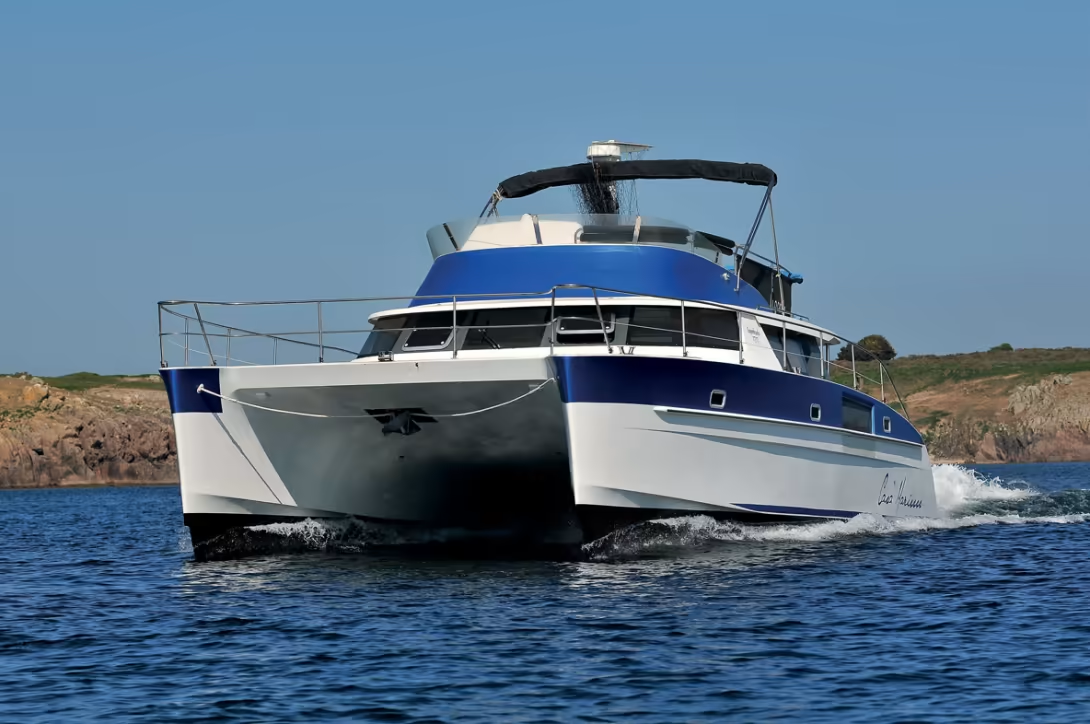

Jean-François Desmars is a true sailor, first a hardened racer aboard 470s and then J/80s. He next tried his hand at a Lagoon 43 PC, followed by a Lagoon 440. Neither of these two catamarans really matched his program. At the time (nearly 20 years ago), he was still seeking sporty rides, so a fairly radical Petter 50 satisfied his taste for “fast blue water sailing”. For some fifteen seasons, Jean-François sailed single-handed or with a crew to the UK or Norway - the great North Atlantic being his cruising playground every summer. But it came time to reduce sail: “Having spent many nights at the helm and maneuvering a rather advanced catamaran, fatigue and age set me thinking about more reasonable sailing,” says Jean-François.
The objective: less than a liter per mile
The choice between monohull and multihull was quickly settled. “All the comparisons converged in favor of the latter: more space and more conviviality, less weight and lower fuel consumption,” notes the sailor. As for the choice between sail and motor, it was logically the appeal of ease of use that favored a boat without a rig... so, go for a powercat! A venerable 18-year-old Cumberland 44 became Casa Marissss (the 4th of her name). This model is an owner’s version equipped with two 285 HP Volvo KAMD300s.
Let’s talk about fuel consumption: “A 45-foot production powercat equipped with twin 300 HP engines already consumes 80 liters (21 US gallons)/hour at 17 knots, and for a less roomy monohull, it’s even more. Getting a 15-ton boat up on the plane is excessively energy-consuming. By being more reasonable, we can appreciate that, if we want to go to sea responsibly, the first step is to significantly moderate our cruising speed.”
To validate this step, the lessons we can learn from sailing are invaluable: “A very good recreational sailboat (mono or multi) rarely goes along at average speeds of more than 8 knots, 10 for exceptional units, and sometimes tacking, which lengthens the distance to the goal. Transposing these figures to our second-hand power catamaran, we opted for a target speed of 8 knots, a value very close to the Cumberland’s hull speed.”
The new life of a powercat
Jean-François launched a vast program to optimize and improve his powercat, with the aim of significantly reducing fuel consumption. For the time being (see below), the biggest parts of the project, such as sugarscoop extensions and bulbous bows, have not yet been completed. “I decided to start with the most accessible elements: weight and propulsion,” he explained.
A weight-saving cure - by almost two and a half tons!
We started with the anchor chain, which was made lighter (10 mm instead of 12) in a reinforced specification (Force 7). A drastic tidy-up removed all superfluous weight (unnecessary tools, spare parts, etc.), - in total, some 500 kg/1,100 lbs removed. The second crucial point was liquid mass: “I installed a 110 l (29 US gal)/h watermaker and sailed with 100 l (26 US gal) reserve instead of the original 800 l (210 US gal),” explains Jean-François, “For fuel, it’s even simpler: my boat doesn’t consume much, so I carry little fuel: 400 l (105 US gal) instead of 1,600 (420 US gal), except for exceptional trips. It’s not every day you get to save almost two and a half tons on a boat!”
Propulsion down to the smallest details
It would have been possible to change the motors for more basic and less powerful ones, but beyond the cost, the administrative complexity of getting everything re-certified for the boat’s registration discouraged Jean-François. “These Volvo KAMD300s are very good engines, even if they are very sophisticated (compressor, turbos, electronic management). What’s more, these engines are new, completely rebuilt, so I decided to keep them. The power curve suggested good results at very moderate revs, before the turbos were triggered, below 1,500 rpm. But to go a step further, I remembered that impeccable hull preparation favors gliding through the water, and also my positive experience with folding propellers on my previous catamaran. I could sail downwind on a single engine set at 7 knots, opposite propeller folded, taking advantage of the acceleration generated by wind and waves.” So why not folding propellers on a powercat? Dominique Montésinos (a regular contributor to our magazine, whose new wood/epoxy dinghy, the Tender Cat, we’ll be unveiling in detail shortly) did it before me on his Leopard 47 PC,” continues Jean-François. For my part, I opted for 4-blade Flexofolds. A final area for optimization: rationalizing propeller pitch. A right-hand pitch turns the stern to the right and the bow to the left. With two engines, the crab effect is accentuated, so you have to compensate with the helm, causing a certain amount of drag. The decision was therefore taken to mount the starboard propeller with a left-hand pitch to reduce the drag induced by the helm corrections.
The results under way
At the end of two seasons of coastal cruising, a large part of the initial objective has been achieved (low fuel consumption to significantly increase range while maintaining speeds comparable to those of a very good sailing catamaran).
Here are a few concrete examples:
- Downwind, in winds of force 3 to 5 on a single engine at 1,400 rpm, set for a speed of 6 knots, opposite propeller folded, we can reach an average of 7 to 8 knots while consuming 5 l (1.32 US gal)/h. Range with 1,600 l (420 US gal) of diesel then exceeds 2,000 nautical miles.
- The virtuous curve of economy on a single engine turns the other way above 6 knots, and it’s preferable to use both engines to make faster progress. In these conditions, fuel consumption is 9 l (2.38 US gal)/h at an average speed of 8.5 knots. - If you need a higher speed to reach a goal or get around a weather situation, at 14 knots you consume 55 l (14.5 US gal)/h for both engines, instead of 66 l (17.4)/h at 13 knots in the original configuration. It should be noted in passing that consumption is 10 times higher than at 7 knots, while the speed is only doubled.
Additional development avenues being considered:
- Sugarscoop extensions and bulbous bows
- Partially dry exhausts and underwater outlets in line with the hull axis
- Fresh air intake from the flybridge into the engine compartment (25°C/77°F in summer instead of 50°C/122°F)
- Lighter flybridge, or even partial or total elimination of this superstructure
- Electronic reprogramming of the engines for an expected 20% gain in torque and fuel consumption.

Philippe Echelle’s expert opinion: “An inspiring level of sobriety”
Having done hundreds of sailboat tests and many dozens of motor multihull tests, I admit to a preference for wind propulsion and a love affair with speed sailing. However, I admit to having a real sympathy for certain powercats. I’ve discovered the pleasure of sticking to a schedule, whatever the weather, and enjoying the view from the helm in my slippers, even in the worst weather. I also found a certain satisfaction in doing without reefing and those nocturnal gesticulations. I’m happy to embrace this other vision of boating, on the very personal condition that it brings me closer to the specifications of my beloved yachts: a smooth, steady glide, perfect trim and a low noise level that doesn’t cut me off from the natural environment in which I’m evolving. With Jean-François’ Cumberland, I was able to confirm the joy of boating for two days in good company. Our senatorial pace brought the very contemporary satisfaction of low energy consumption. For me, one of the pleasures of recreational boating is the experience of autonomy. And dividing the fuel consumption of a generously powered multihull by a factor of ten is a great way of nurturing this feeling, while opening the door to controlled ocean adventures in an inspiring level of sobriety.
Second-hand :What are the best deals for a refit?
The second-hand market for powercats is starting to expand, as new production has been steadily increasing over the past decade. The dazzling success of Sino-American builder Aquila Catamarans is a measure of this incredible potential. But there’s also justification for refitting older models, which are rarer and, above all, do not (yet) constitute large series. These include Privilège’s first Euphorie models (40 and 44) built in the late 1980s, followed by Fountaine Pajot’s powercats. In the early 2000s, the Fountaine Pajot range appeared - Highland 35, Maryland 37, Summerland 40, Cumberland 44, Queensland 55 - and the first Leopard PC, the 46, built in 12 examples. These vintages also include compact models such as the TomCat 25, ArrowCat 30, PDQ 34 and Glacier Bay 3470, followed by the Leopard 47 PC - a classic with 59 examples built, now 15 years old - the Lagoon 43 PC, Aventura 430, Africat Marine 420, Manta 44 and Flash Cat 43. Numerous custom and small series powercats are also available in the USA, Australia and New Zealand.
EvD
Cumberland 47 LC: What Multihulls World had to say at the time
Introduced in 2001, the Cumberland 44 received its first update in 2010, becoming the 46. But just 10 years ago, in 2013, the Cumberland 47 LC, for Long Cruise, was released, already an evolutionary step in the story. Here’s what Emmanuel van Deth had to say about it in your favorite magazine.
The ocean is right in front of your bow
Further optimized and ever more comfortable, the Cumberland 47 LC retains its exceptional seakeeping qualities, coupled with almost unrivalled autonomy. By moving up from the 44 to the 46, then to the 47 LC, the Cumberland abandons the overly restrictive term “Trawler” to become a “MotorYacht”. Two words that demonstrate the shipyard’s belief in the luxury of motor catamarans, and the fact that it is now targeting single-hulled boaters with some very convincing arguments: fuel consumption reduced by 40 to 50%, reduced roll in beam seas as well as at anchor, and finally, a separation of functions with a nacelle featuring vast, user-friendly interior and exterior surfaces, and hulls that offer real cabins where privacy is not an empty word. While the price is higher for the same length, the comfort of the 47 LC is equivalent to that of a 60 to 65-foot monohull.
Speed or range: the choice is yours
Heading into a short chop, the 47 LC reaches 23 knots with the largest engine option - twin 300 HP Volvos. Obviously, at over 3,500 rpm, fuel consumption hovers around 100 liters (26 US gallons)/hour, offering some 500 miles of range. If you lower the revs to reach cruising speed, i.e. 15 knots, fuel consumption is already halved. And when you return to trawler mode, just under 7 knots, you’re down to one liter per mile, for an exceptional range of 2,400 miles. That’s because the capacity of the fuel tanks has been increased to 2 x 1,200 liters (2 x 317 US gal). Enough to cross an ocean! The distance can be further optimized by judicious use of the two engines: in windy conditions and with following seas, only one engine is run, the leeward one, to take the strain off the helm.
Terrace with a view!
The helm position on the flybridge is very comfortable and attractive: perched 4 meters (13’) above the surface, visibility is optimal at 360°. With its bench seating, table, sun-lounging area and mini galley (optional), the flybridge is a genuine terrace with a breathtaking view covering almost 20 m² (215 square feet). The boat’s behavior in the short head-on sea we experienced was exemplary. Any movement is surprisingly smooth and cushioned. The very high bridgedeck clearance minimizes any slamming effect in heavy seas. Outside, there’s no shortage of space for lounging, starting with the pulpit benches nestli ng in the bows, the aft cockpit, well-equipped with a table - you can seat six using four chairs - and a small galley, not to mention the two sugarscoops.
Dynamic interior design
Inside, the shipyard has maintained a classic layout. There’s a vast, generously glazed central area, with generous headroom at 1.97 m (6’6”), a central helm station with chart table, a U-shaped galley to port and a saloon area opposite. The view outside is perfect. This is certainly the ideal location for piloting the 47 LC in poor weather or at night. In the hulls, there are two possibilities: the Quatuor version offers four cabins. Those located aft are the most generous, with a king-size bed measuring 2 meters by 1.6 (79” x 63”), while those forward are more traditional, with a 1.4-metre-wide mattress (55”). It’s worth noting that the cocoons protecting the engines save 4 decibels at high revs. The Maestro version reserves the entire port hull for the owner, with a proper bathroom and a desk.
Conclusion
The two major strengths of the Cumberland 47 LC are undoubtedly its seakindliness and the possibility of making very long passages, including crossing the Atlantic, at a much-reduced speed. The shipyard’s aim is to establish the motor catamaran as a competitor to the motor cruiser. The Cumberland 47 LC thus represents a real alternative for anyone who loves long voyages and are perhaps getting weary sail handling.
Technical specifications
Architects: Michel Joubert and Bernard Nivelt
Builder: Fountaine Pajot
Length: 44’ (13.4 m)
Beam: 21’6” (6.55 m)
Draft: 3’11” (1.2 m)
Light displacement: 30,865 lbs (14 t)
Engines: 2 x 285 HP on our test version / up to 2 x 560 HP as an option
Max speed: 20/25 knots
Fuel: 210/315 US gal (800/1,200 l) for the Cumberland 47 LC
Water: 185 US gal (700 l)
Price when launched: €713,000 for the twin 285 HP version
Approximate used price in 2023: €350,000
The Cumberland 44/46 and 47 LC are based on the same molds and the same design, with different evolutions concerning sugarscoops, choice of engines, tank capacity and layout.
