

New ecological challenges are prompting industries to reduce their energy consumption and, if possible, ensure that energy’s “clean” origin. At the same time, rising energy prices and the predicted scarcity of many materials are forcing rapid changes in production models. The boatbuilding industry is no exception to these inevitable changes, and it’s quite clear that yachting has no choice but to be at the forefront of respect for the environment. Sailing on one of the planet’s last untouched spaces imposes a certain forever green exemplary behavior.
Although the use of leisure craft for a 20-year period accounts for 80% of polluting emissions, construction accounts for the rest...
Controlling energy expenditure and, above all, the selection of materials are therefore important areas to consider. One thing is certain: in the long term, it will no longer be possible to use resins derived from fossil-fuel technologies, or materials that cannot be recycled and/or take several hundred years to decompose. Today’s fleet of fiberglass/foam/resin composite boats is not recyclable (unless we choose to renovate and adapt these boats so they can continue to sail), and destroying them represents a considerable expenditure of energy, not to mention the pollution generated. Consequently, it seems essential to improve the assimilation of our multihulls through a virtuous recyclable production process, using natural resources that are supplied to us in a short space of time (in the order of one or two generations).
Standards to reduce both energy consumption and environmental impact
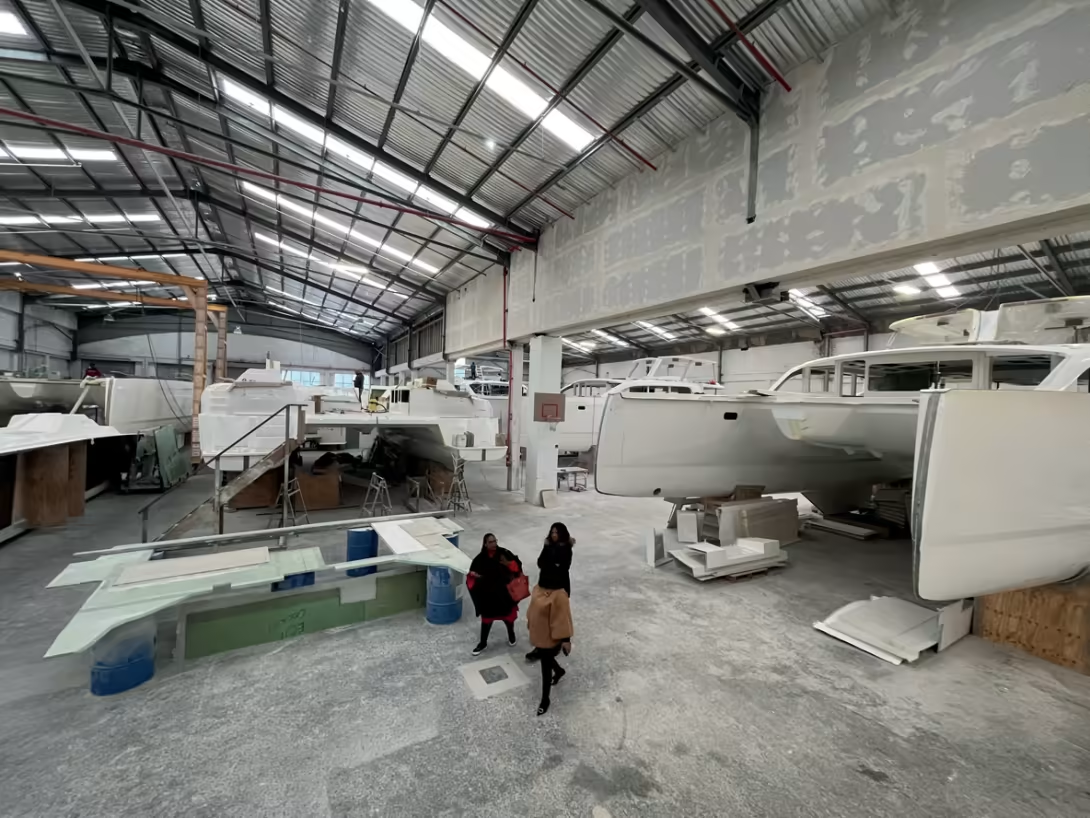
Multihulls are bulky products, heavy to move around and requiring a great deal of space and energy to manufacture. The impact of large builders producing hundreds of boats is obviously greater than that of small shipyards with their few annual launches.
Take the example of the Groupe Bénéteau shipyard in Bordeaux, where Lagoon catamarans of 50 feet and over are built, and where consumption amounts to 6 million kWh of electricity and 10 million kWh of gas per year. Add to this the consumption of Lagoon’s other catamaran production units, and it’s easy to see why the world’s leading yacht builder has embarked on a proactive CSR program, B-Sustainable on the horizon for 2030. The ISO 14001 standard (governing environmental impact) was introduced by the Group 15 years ago, followed by ISO 50001 (governing energy consumption) 6 years ago. The latter is a great help in measuring energy consumption: the basic energy performance index (kWh divided by temperature multiplied by the number of hours worked) is the benchmark and serves as a reference for adopting more economical gestures, modernizing equipment or reducing energy losses by improving building insulation, for example. Simple day-to-day measures, such as using a small door rather than the big gate, or organizing teams in such a way as to bear in mind that ten craftsmen will need as much energy as a hundred, can have an impact on the energy bill at the end of the year. The three main levers for action are extraction/ventilation, winter heating, and air compression for infusion. These common-sense resolutions, which require everyone’s support, can produce impressive results. “In seven years, we’ve achieved energy savings of 35%,” explains Eric Greaud, who is responsible for applying these standards for the Bénéteau Group. There are many ways to take action, all of which considerably reduce energy consumption. To meet the requirements of the 14001 Standard, procedures will be reviewed, requiring a certain sense of innovation. To limit the impact of emissions, many more parts are produced by infusion or injection. Within the Group, the proportion of parts manufactured in closed molds has risen from 35% in 2013 to 62% and should reach 70% by 2025. Water also represents a major challenge. The first boatwash for washing multihulls at the end of the production cycle has been inaugurated, reducing water consumption by a factor of five.
For their part, Fountaine-Pajot have set up the Odysséa 24 plan, the industrial aspect of which aims to improve production procedures over the entire life cycle of catamarans in order to reduce the environmental impact of their manufacture and use. Recycling waste, reducing energy consumption by investing in plant energy efficiency and promoting local production are among the first initiatives for building cleaner. Secondly, the company intends to rethink the way it designs and produces, limiting waste by optimizing the cutting of materials to reduce waste and using renewable energy to run its workshops. Finally, in addition to offering green powertrains, the plan’s final thrust is to use bio-sourced and recyclable materials in manufacturing by 2024, thanks in particular to the ODSeaLab platform dedicated to forever green innovations.
Small and large shipyards: different challenges when it comes to innovation for sustainability
2024 may sound like it’s a long way away for starting to produce multihulls using materials with a short reproduction cycle, or less polluting, or recyclable, or... all three at the same time! But, as in the case of green drivetrains, smaller production yards, or those newly created with the aim of minimizing their ecological footprint, have for some years now been produced with more environmentally neutral technologies. Such is the case at Windelo, where they use basalt fiber and PET foam for the hulls and structures of its catamarans. The drawback is that this fiber is three times more expensive than fiberglass. As for PET foam (recycled plastic bottles), it requires 30% greater density to achieve the same strength. A mix of materials is therefore used to keep weight and performance in line. For Vaan Yachts, the production of a catamaran in which most of the materials used are recycled - aluminum obtained 60% from road signs, insulating glass wool and PET linings - or environmentally-friendly - bio-sourced wood for the fittings and cork for the deck - all assembled locally in the Netherlands, is even the main raison d’être of this young brand, which makes the protection of our resources one of its main arguments. This pioneering strategy is undoubtedly a step in the right direction, but these brands offer top-of-the-range units at a base price around 30% higher than mass-produced multihulls. With just a few units produced per year, they can offer highly innovative solutions to an ecologically demanding clientele who are prepared to pay the price of change.
For medium-sized shipyards, the risk is already greater, as their reputation is already well established on conventional bases, which are more difficult to challenge. Nevertheless, NEEL-TRIMARANS has also introduced new materials. On the 43, while the hulls and deck are made from classic and largely reliable materials - sandwich foam/glass quadriaxial/polyester and vinylester and carbon reinforcements - many non-structural parts in the fittings, such as counter-moldings, are made from a sandwich incorporating a 300 gsm glass/linen fabric and a cork core. Like Windelo, the 52 is built in a composite sandwich using PVC and PET foams for the core, thereby taking things a step further.
At Outremer, after having built Roland Jourdain’s 5X partially in flax fiber, they are still hesitant to offer this type of innovation. Despite 9,000 miles on the log, a second-place finish in the 2022 Route du Rhum and little after-sales service issues, the shipyard feels that it doesn’t yet have enough experience of this technology to be able to design a reliable, robust catamaran that will perform well over time. These are arguments that have built Outremer’s reputation, and on which it would not be permissible to take the slightest risk without the certainty of success. In the case of larger production yards, a long-term strategy is being implemented, with well-defined stages. And with hundreds of employees, there’s no room for error. Fountaine-Pajot, with their ODSeaLab program mentioned above, plan to manufacture catamarans in the future using bio-sourced and recyclable materials that are just as high-performance as current models. Brands can’t bring themselves to turn back the clock on performance, whether in terms of speed, stiffness, lightness, strength, comfort or even economy. The aim is to move towards more virtuous cycles, but only if they can offer equivalent or even higher-quality products at attractive prices. On this point, Bruno Belmont, Product Development Manager for the Bénéteau Group, confides that it’s not easy to set the bar: “We’ve defined a roadmap that aims to use, little by little, more natural fibers and biosourced resins. We are carrying out extensive tests with Arkema’s Elium® resin. The advantage of these thermoplastic resins is that they stiffen or soften according to temperature, and we can then separate the resin from the fiber at the end of the boat’s life and reuse it to manufacture other products. The need for raw materials is therefore minimized, as is waste. This requires us to adapt our know-how, as the use of quadriaxial fibers is no longer possible. We’ve therefore worked on a new weight/stiffness compromise using longitudinal fibers.”
“Sailboats built with this 100% recyclable resin will serve as a full-scale test of our industrial processes, with a view to applying it to our production boats in the future”, explains Erwan Faoucher, the Group’s Innovation Director. For the time being, on mass-produced catamarans, hemp and flax fibers are being introduced on small parts such as hatch covers, lockers, cockpit tables, and so on, but not yet on structural parts such as hulls, bulkheads and coachroofs. There’s clearly a long way to go before we reach the stage of a mature, environmentally friendly product, but initiatives are being taken within the group to move towards this goal.
What about the peripherals?
The materials that comprise a multihull don’t stop at composites. There’s also fabrics and woods... An Iroko deck from FSC-certified Congolese forests looks very similar to Burmese teak, which is now banned from sale. Cork is also proving to be an ecologically responsible product, thanks to its longevity (an important asset in the fight against excessive consumption): in fact, it made an appearance on the sugarscoop of an Excess 12 at the International Multihull Show in La Grande-Motte, France. It’s a locally produced solution that avoids long distribution networks, as it comes from bark grown on the shores of the western Mediterranean and is processed in France, not far from the factories. Cork oak bark is harvested every nine years and renews itself naturally without the need to fell the tree. A single tree provides 10 to 12 harvests, making cork a sustainable development material par excellence. Following technical validation and customer feedback, the next step will be to roll out these innovations across all Groupe Bénéteau brands.
At Vaan Yachts, PET linings take the form of very light and aesthetically pleasing rigid panels. Cork has been used since the creation of the brand. It covers not only the deck, but also the tables and outdoor seating, with a particularly attractive, uncluttered design. The challenge of the forever green transformation is to maintain a strong level of attraction so that potential customers willingly embrace these changes: leisure boating remains a luxury sector, but ecological goodwill can’t be allowed to take a back seat due to a lack of quality or aesthetics.
Sustainable boating is in fact a sum of innovations in all aspects of boat design, manufacture, use and recycling. Green technology, which is widely showcased at boat show booths, now makes it possible to envisage the feasibility of this ambitious challenge. Because no, it’s not too late. We salute the vision and risk-taking of certain players and are delighted to see the major brands following suit, albeit with understandable caution. The boating industry’s energy transition is a complex one, but multihulls appear to be well placed to erase their carbon footprint. Let’s hope that you, our customers, yachtsmen, experienced sailors or first-time buyers, will embark on this exciting adventure with enthusiasm!