
Electric motorization is no longer a futuristic project, but a reality, with dozens of brands of motors and batteries coming onto the market, just as they did in the early days of the automobile, almost 150 years ago. Often totally unknown brands from all over the world. It’s a safe bet that within 5 to 10 years, 75% of these brands will have disappeared or merged. So it’s not easy to make a choice and commit without knowing whether the after-sales service will still be guaranteed in 6 months, a year or two years.
The electric motor, a 200-year-old invention!
Promoted by governments for environmental reasons, the electric motor is far from new. Although the earliest examples date back to 1821 and 1822 in England, the first real electric motor capable of performing a task was developed by the American Thomas Davenport in 1834. This was followed by improvements such as Nikola Tesla’s invention of an AC induction motor in 1887. The first electric motor suitable for use in automobiles dates back to 1892, developed by Westinghouse engineers. However, it wasn’t until the invention of the rechargeable lead-acid battery by Gaston Planté in 1850 that the technology took off, notably with the famous “Jamais contente” (Never content) by Belgian Camille Jénatzy, which in 1899 was the first electric car to exceed 60 mph (100 km/h). Even more impressively, in 1900, electric cars accounted for 38% of the American automotive market, before the combustion engine, which was more economical and offered greater range, took over.
The electric motor is therefore relatively simple technology, that’s been very well mastered and, above all, widely proven over decades. However, to operate, an electric motor needs energy, stored in batteries. What the motor is capable of will therefore depend in part on the size of these batteries, their technology and how many you use.
As a result, there’s a lot more to electric propulsion than just the motor. In fact, the motor itself is only a small part of the whole. What’s more important, when you buy an electric outboard, is the batteries and the battery management system. It’s the latter that regulates the distribution of energy and ensures greater range. Last but not least, there’s the recharging system, which varies in speed from one technology to another.
What kind of battery?
The first kind of battery, invented in 1850 by Gaston Planté, was the lead-acid battery, a technology that is still widely used today. Next came nickel-cadmium batteries, now banned, then Nickel-Metal Hydride batteries, which have been superseded by lithium-ion technology.
Finally, the new generation of all-solid-state batteries, which increase energy density and stability while simplifying thermal management, is starting to appear on the market, as are salt batteries, that are almost entirely recyclable, thus partly solving the ecological problem. To date, lithium-ion technology has dominated the market for powering electric motors.
Theoretical power, efficiency, peak power and useable power
To sell their electric motors, manufacturers generally indicate the maximum power. However, in the majority of cases, this is the peak power, i.e. the maximum power the motor can deliver, but over a short period of time (around 30 seconds). Typically, this power is available at the moment of acceleration, but quickly falls back to offer a lower stabilized power. So, if you’re thinking of buying an electric motor, you need to pay close attention to this point, and find out about continuous power, which is the real usable power.
In fact, the power of an electric motor also depends on its efficiency, i.e. the ratio between the amount of electricity supplied as input by the batteries and the amount of mechanical energy transmitted to the motor’s output. Part of the energy distributed by the batteries is lost through friction or heat. So it’s important to use a motor with the lowest possible energy loss. To find out the efficiency, simply divide the actual output power by the input power, or theoretical output, in other words, the power supplied by the batteries.
Similarly, to calculate the «useful» energy of an electric boat, divide the output power at the propeller (speed x torque) by the input power, i.e. the power supplied by the batteries. The result will differ from the theoretical power, especially if we’re talking about peak power, but it will give a true indication of the power available to your boat. It’s a complex calculation, and one that manufacturers don’t usually provide...
Finally, contrary to popular belief, the power of an electric motor can be expressed not only in kW, but also in HP, one horsepower being equal to 736 Watts.
How to choose an electric outboard?
The offer on the market is now quite vast and, above all, diverse, with motors from 0.25 to 300 HP. So, the first thing to do is to define your use, or at least the power you need. Quite close in the world of big power, the offer is more disparate in the world of small motors, with different solutions, particularly when it comes to batteries.
The right power
Contrary to popular belief, electric power can be expressed in horsepower. If this is not the case, use a converter. You can also make a quick assessment, knowing that a motor producing 1000 Watts is equivalent to 1.35 HP gas engine, a 2-kW motor will offer the equivalent of 2.7 HP, 3 kW corresponds to 4 HP, 5 kW corresponds to 6.8 HP and 8 kW corresponds to 10.8 HP. For slightly larger engines, 50 kW is equivalent to 68 HP, while 150 kW delivers 204 HP.
Also pay attention to the way power is expressed, as peak or continuous. Most motor manufacturers advertise peak power, i.e. the power that will be available for 30 seconds... You need to know the continuous power, which is much more reliable and generally lower, but it’s the power that will really be delivered by your motor during use.
While the number of small electric outboards on the market is very large, in the case of main propulsion, the outboard offer is more limited, with only a handful of players offering power ratings in excess of 80 HP. These include in particular Torqeedo, Evoy and Vision Marine. These three brands offer marketed models, meaning that we are no longer in the prototype phase.
Fixed or removable batteries?
When it comes to dinghy motors, the choice today is between the classic solution of having a battery in the dinghy, or motors with an integrated battery, as in the case of the Temo. The last solution is the removable battery, a technology chosen by ePropulsion and Mercury with its Avator range.
When it comes to larger engines, we’re talking about a battery pack to deliver the necessary power, and above all to deliver it consistently over several hours. A battery pack means a substantial initial investment, as well as additional weight and volume to be accommodated in the catamaran’s hulls. It also goes without saying that this installation must be carried out by a certified professional.
What kind of recharging?
Not all electric propulsion systems offer the same type of recharging. When making your choice, ask yourself where you’re going to recharge your batteries.
In the case of a dinghy motor with a separate battery, you’ll need to recharge the battery regularly, either by having a charger on board, which is rarely the case, or by taking the battery with you to recharge it at home or, lastly, by using the main boat’s charger to charge the dinghy’s battery.
Alternatively, you can opt for a model with a removable battery, such as the Mercury Avator, or with a built-in battery that’s easy to recharge, such as the Temo 450.
When it comes to a main motorization system for more powerful electric outboard, you’ll need a recharging system. Several solutions are available.
The first, and also the least ecological, is the generator, which consumes fuel to produce electricity.
Another solution, but one that somewhat limits the possibilities in terms of distance, is to recharge at the port by connecting the charger to the dock. This is efficient but does not guarantee a great range. What’s more, it can take a long time unless you have a supercharger and a brand of outboard that accepts this mode of charging. This brings us to the most frequently used system: solar power. This keeps the batteries charged while respecting the environment. Hydrogenerators, wind turbines and even combinations of these systems can also be used.
What about safety?
Relatively simple in appearance, an electric outboard, especially when installed with a battery bank, requires an important safety system.
First and foremost, it must be perfectly insulated from the water, of course, with IP67 protection. In addition, water detectors must be installed to cut off all on-board electricity and isolate the batteries in the event of a problem.
An electric outboard must also be able to modulate its temperature, both in terms of the motor and the battery. To achieve this, manufacturers normally use a dual liquid-cooling system, traditionally water-cooled for the motor, while the batteries are cooled by a glycol circuit and a heat exchanger. Optimum battery operating temperature is between 20 and 25°C (68 to 77°F). These are very important factors to check with the manufacturer before purchase.
Go for the big players!
Once the power and technology have been established, it’s time to choose the product that’s right for you. As mentioned above, dozens of brands, some of them unknown, now offer electric motors of all kinds, and it’s much the same for batteries.
To be sure of your purchase, both in terms of quality and after-sales service, it’s best to opt for established brands. Here’s a small, non-exhaustive selection of the main players on the market.
Torqeedo
This German company has been on the market since 2005, and has virtually become the industry benchmark. They offer a range of outboard motors up to 80 HP, and has an entire ecosystem including BMW batteries, enabling the motors to be installed in any environment.
ePropulsion
Originally from China and founded in 2013, ePropulsion has become one of the specialists in tender motors with power ratings of up to 9.9 HP. Very easy to use, ePropulsion motors also feature a removable battery on certain models.
Mercury
This is one of the latest players to enter the market, but it’s making the most of its power and aims to become the market leader. The range, called Avator, currently boasts a 750 W motor, the 7.5e, but should introduce a 2500 and a 3000 watt by the end of the year. The Avator stands out for its many removable parts, starting with the battery.
Purewatercraft
Created in 2011, Purecraft’s partners include General Motors, a guarantee of seriousness. The engine offers a unique profile, halfway between an inboard and outboard model. The brand currently offers a 50 HP equivalent model.
Temo
Founded in 2018, this French brand offers highly innovative products, since motor and battery are integrated into a long tube that attaches to the transom. The whole unit is light, handy and easy to stow on board. Two models are currently available, a 450 W and a 1000 W.
Evoy
The Norwegian motor manufacturer debuted in 2018 and offers a range of outboards from 120 to 300 HP, and even 400 HP in 2024. Requiring a conventional installation with a battery pack manufactured in Austria, the Evoy offers exactly the same sensations as a combustion engine, minus the noise.
Vision Marine
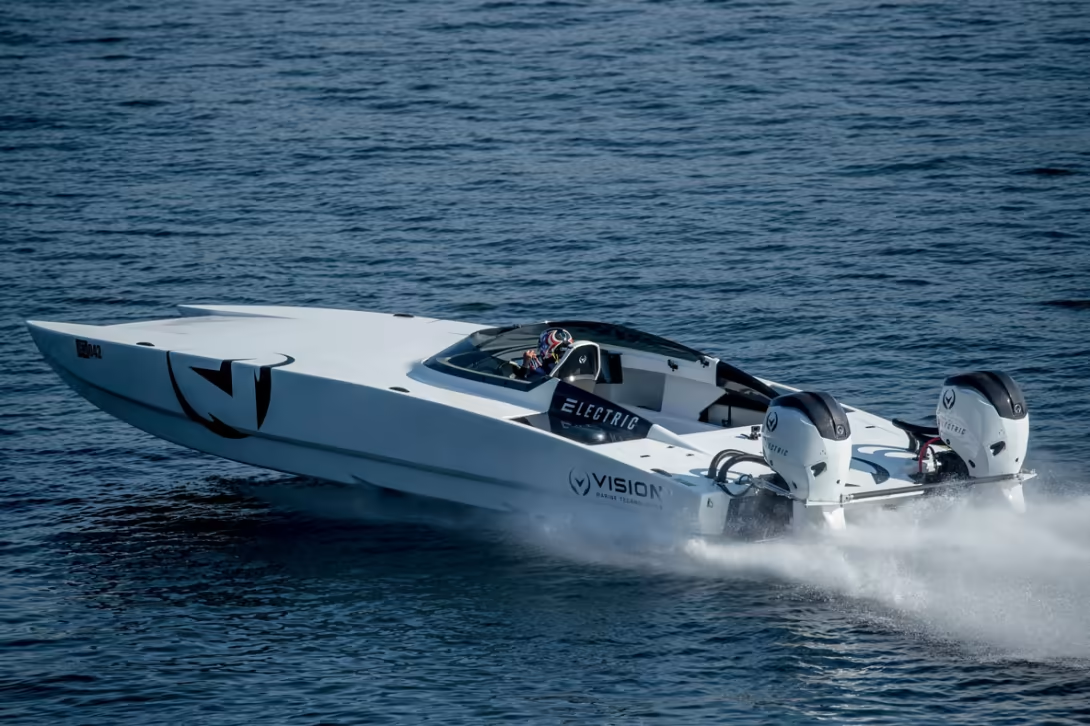
Active in the marine industry for 25 years, Vision Marine launched its first electric outboard in 2022, the E-Motion 180. The manufacturer also caused a stir by signing an agreement with the Beneteau Group to supply electric outboard. On the water, the E-Motion 180 offers the very best in electric motors, with high torque, rapid acceleration and good range.
Advantages of electric propulsion
No polluting emissions
The first advantage of electric propulsion is the absence of exhaust fumes, and therefore of pollution. A real plus for nature, but also for the users.
Quiet sailing
An electric outboard motor is very quiet, and what you hear is mainly the noise of the gears in the lower unit, but this is a problem that seems easy to solve.
Increasingly green energy
The other good thing about electric power is that it’s increasingly being produced in an environmentally friendly way, even though there’s still a long way to go. In particular, you can use it with solar panels, an effective solution for auxiliary propulsion.
A lightweight motor for transport
Because of its simplicity, an electric outboard is generally lighter than its internal combustion counterpart, which means it’s easier to transport, but also lighter on the transom.
Instantly available torque
Unlike an internal combustion engine, the torque of an electric motor is instantly available, which means that the time to plane is quicker and acceleration can be impressive.
Greater reliability and reduced maintenance
Even if we haven’t yet had much experience (except at Torqeedo) with electric outboards, the technology itself is well known and reliable. What’s more, an electric motor has around 5 times fewer parts than an internal combustion engine. The result is greater reliability and far less maintenance than a regular engine.
The disadvantages of electric propulsion
Battery weight and volume
The first disadvantage is the need to carry a battery pack. This takes up a lot of space on the boat, adds a lot of weight and represents a major investment, given that the cost of the batteries is much higher than that of the motor. Technology is rapidly evolving to reduce this disadvantage, but today it’s a fact of life.
Limited Range
Another problem is that the range is still limited. However, this is improving. Studies have shown that the average yachtsman travels 17 nautical miles in a day, and today there are electric engines capable of going 25 or 30 miles at decent speeds.
Recharging Time
Recharging time is also an obstacle. Unless you can use a supercharger, as is the case with cars, electric motors need several hours to recharge. This also points to the problem of infrastructure, which is virtually non-existent in our marinas. In practice, whether you use a conventional socket and have to wait for hours, or you have the boat on a trailer and can recharge it at home or on superchargers if the boat accepts this technology. The last solution, for small boats, is the removable battery that recharges easily.
Recycling to be improved
Finally, and this is a serious matter, batteries are currently very difficult to recycle, and there are very few structures in this field. This means that, in a few years, we’ll be left with mountains of batteries that we won’t know what to do with. Similarly, battery manufacture, with its current technology, is not really environmentally friendly, and requires the use of rare metals, which are also in short supply in nature. Things will change in the years to come, notably with sodium (salt) batteries, but today we’re still a long way off.
Multihulls World tests
Vision Marine E-Motion 180 E

In addition to the motor, Vision Marine markets a complete system, including not only the motor, but also the battery, the management interface and all the safety systems that go with it.
An essential element of the system, the battery pack can be modulated according to the boat’s needs. Vision Marine uses only lithium batteries, which are more expensive but far more efficient.
We tested the E-Motion 180 E on a Four Winns H2e equipped with two 35 kWh batteries, giving a total of 70 kWh, which can be increased to 80 kWh. This battery pack gives the boat a range of 30 nautical miles (or an hour and a quarter) at 22 knots, and up to 30 hours at 4 knots.
To recharge it, the system includes a 6-kW charger that operates over a range of 86 to 264 volts, meaning it is compatible with electrical systems worldwide. A full recharge takes 8 to 10 hours.
The motor also benefits from a comprehensive safety system and an easy-to-use management interface.
Peak power: 250 HP
Continuous power: 180 HP
Range at 4 knots: 21 hours / 106 NM
Range at 22 knots: 1h15m / 30 NM
Autonomy at 34 knots: 40 mins / 24 NM
Battery: Lithium
Charger: 6 kW
Evoy 300+
Power: 225 kW (306 HP)
Torque: 550 Nm
Weight: 270 kg (595 lbs)
Battery: Lithium-ion
Range: 37 NM at 25 knots
Mercury Avator 7.5e
The Avator is all about ease of use. It features a removable battery, a quick-connect mounting system and intuitive controls. A luminous color display indicates battery level and range. The lithium-ion battery was developed in partnership with Mastervolt and designed exclusively for marine use. The 48-volt, 1 kWh battery is drop-resistant and waterproof to IP67.
According to recent tests with a 172 kg (380 lbs) Veer X13 boat, the Avator 7.5e can run for 60 minutes or 4.3 NM at full constant power, with a fully charged 1 kWh battery. It can operate for 2.8 hours or 8.6 NM at 75% power, 6.2 hours or 14 NM at 50% power, and 19.4 hours or 29 NM at 25% power.
Peak power: 1000 Watts
Propeller power: 750 Watts
Voltage: 48 V
Battery: 4 kWh Lithium-Ion
Total weight: (without battery) 19.5 kg (43 lbs)
Battery weight: 7.1 kg (15.6 lbs)
Motor support weight: 2.5 kg (5.5 lbs)
Shaft length: 15, 20, 25 inches
Propeller: 12.7 x 7 inches