
We love sailing and independent Arctic adventures. Greenland in particular fascinates us. After more than 15 expeditions, the high-latitude environment has become familiar. We have each completed two coastal sailing trips here.
For us, the true meaning of a sports catamaran trek, apart from safety and agility is being in maximum contact with the elements. The boat has no cabin for shelter and the living space, the trampoline, is only 20 cm above the water. These contingencies place us permanently close to the sea, the wind, the cold, and the humidity. This may seem a little extreme to some, but for us, it is a deliberate choice: to be in harmony with the environment. At a time when these landscapes are accessible from the deck of a cruise ship, or soon thanks to 3D glasses, we take the opposite view, the opposite trajectory.
We named our expedition “Uummaa”, after the Inuit term that designates “vibration”, “life force”, or even the “heartbeat” we feel when in contact with the elements. We love the sound of this word, which evokes both the delight of being privileged witnesses to the beauty of our planet, and the human strength that emerges in these isolated regions.
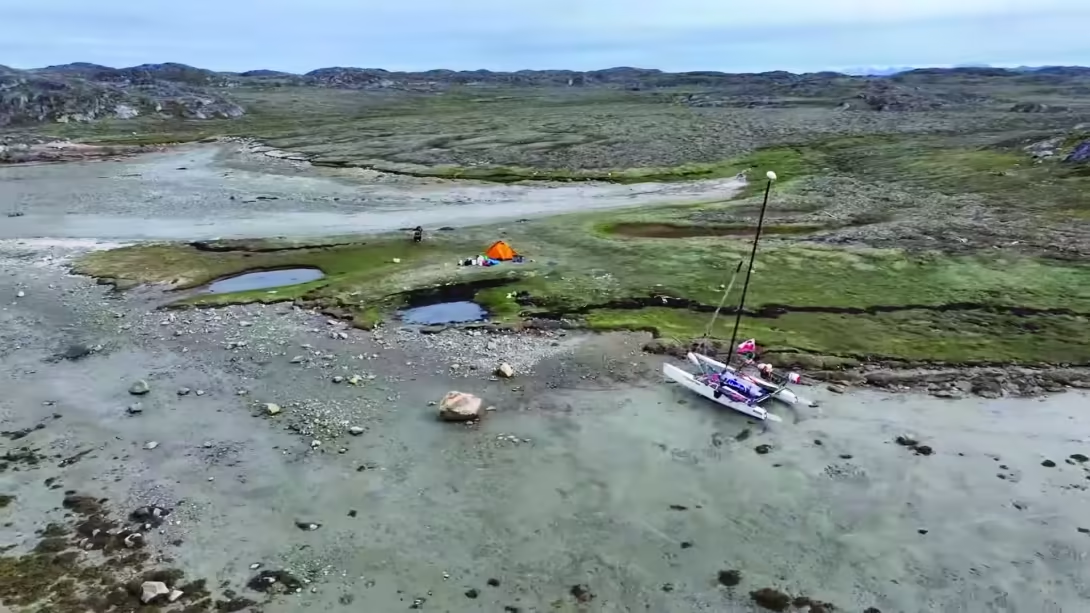
In the summer of 2022, an aborted Northwest passage forced us to improvise a change of course: direction the Baltic Sea for a 15-day Hobie Cat trip in the Stockholm archipelago. This experience was a revelation. It confirmed the advantages of a coastal trek on a sports catamaran: safety, agility, freedom and, above all, contact! Despite the vulnerability of its plastic hulls, paradoxically and thanks to its shallow draft and our extreme sailing trip, this type of catamaran allowed us to navigate in safety. In a region where many areas remain uncharted, navigating visually among the reefs and icebergs is safer. The shallow draft makes it possible to seek wild shelter in the isolated coves inaccessible to keelboats, by covering the final meters by paddling. The catamaran’s lightness allowed us to pull onto the shore and easily unload our numerous bags, and, a significant advantage, to bivouac or explore with peace of mind! In short, to fully enjoy the nomadic experience. Still with two people and after unloading our bags, we could barely pull it a meter or two over sand or small rocks. Beyond that, we took the risk of damaging the hulls.
Legs of 1 to 4 days’ sailing
We were excited by the idea of sailing along the country’s west coast. Its considerable advantages allowed us to achieve the balance we sought in our expedition: sometimes being in the great outdoors, sometimes in contact with the Greenlanders.
The villages are ideally spaced, offering one-to-four-day stages of wild navigation. The presence of at least one supermarket assured us of regular supplies, thus avoiding food overload. 4G coverage within 10 km (6 mi) allowed us to check the weather forecast regularly and communicate easily.
Our original itinerary should have seen us start from Nanortalik, in southern Greenland. In the end, we were afraid that it would be too long and that we wouldn’t have enough time to reach Disko Bay. It was also simpler for us to start in Nuuk, the capital, where we were welcomed by Greenlandic friends.
Against the cold and the wet, 12 pairs of gloves each!
In Greenland, summer temperatures can exceed 20°C (68°F) with the sun and without wind, but on average they are around 7°C (45°F). During long hours of static navigation, in the wind and the cold, not to mention entire days spent in the rain, the temperatures seem significantly lower! We were equipped with a first layer, then a Thermophill Heavy insulating mid-layer and on top, our windproof and watertight Gemino Navigator drysuits from Ursuit. The best! Our extremities were problematic... The challenge was to find a compromise between agility, dexterity, protection and insulation.
For our feet, we opted for neoprene diving booties. If their lightness and flexibility made it easier to launch or get back to shore, they remained charged with the humidity of the sea spray all day. In static conditions, the cold sets in quickly.
For our hands, it’s even more complicated. Staying warm means staying dry which, to say the least, is difficult to do when we need to take our hands out of the gloves or mittens very often: to make a navigation point on the smartphone, grab an end or carry out a maneuver... In short, there was constantly water in our gloves which meant they were never dry. We opted for quantity and variety, easy to find locally: thin, thick neoprene, wool mittens and overmitts, under-gloves and waterproof rubber fisherman’s gloves with or without a sleeve... The strategy was to have 3 or 4 pairs in the daily bundle and change them regularly. We had a good ten each in total!
Managing our on-board safety
With a sea at two degrees max, falling into the water without a drysuit or with an unzipped wetsuit is a catastrophe and the sanction would be immediate. The absolute rule is to go on board in a closed drysuit (which Greenlandic fishermen never do because they do not have one!). Paradoxically, for practical reasons, we regularly sail without neoprene gloves, knowing that our hands would freeze (we did the test!) in less than a minute, which could be problematic for getting back on board...
Then, we are asked the question of the lifeline. We installed it but ultimately chose not to use it. Already bundled up in our survival suits, it would hinder our movements. In the event of a capsize, we risked getting stuck in the water...
The living space made up of the trampoline is well enclosed by the wings, and when we sit there, it seems difficult to fall into the sea. The risk exists when we have to go to the “bathroom” or do something at the bows.
We quickly felt relatively comfortable compared to the risk of capsizing: the boat is sufficiently well-ballasted with all our bags that it listed very little. On the other hand, the rigging was under stress and we constantly kept an eye on it. A thought for those who urged us to do a loaded rollover test before leaving [our editor-in-chief, who met up with the crew ahead of the expedition, was one of those behind this idea… - Ed.] But no, we didn’t do it!
We also quickly gained confidence in the watertightness of the hulls. The boat did not have a life raft. One of the floats was perfectly watertight, the other took two to five liters per day (½ to 1½ US gal.) We coped with this by monitoring the boat’s angle. With a little practice, depending on the flotation level of the hulls, we could tell to the nearest millimeter whether we had taken on water and pump, when necessary, which was, every two or three days if we hadn’t had the opportunity to empty the water through the plugs. We actually ended up with small holes of up to 3 cm (1¼”) after rubbing on rocks. We had brought all the repair equipment necessary to remedy this... provided we noticed it!
Overall, we were especially careful not to expose ourselves to strong winds (more than 15 knots), which did not prevent us from occasionally experiencing stronger winds than we would have preferred.
Between long sails and stopovers with the locals
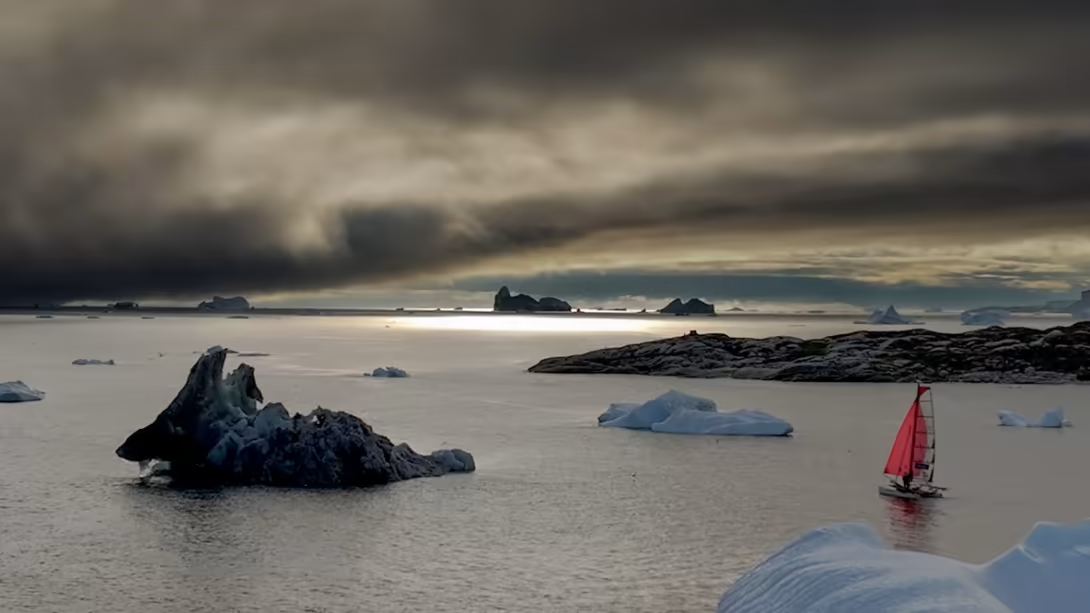
Days can range from five hours to 24 hours of navigation. From May 1 until August 12, in these latitudes close to the Arctic Circle, (66°33’49” N) there is no night. The setting sun lasted beyond midnight in scarlet glows that don’t make you want to stop. We often finished very late. The time to moor the boat, bring all the bags to shore, prepare the bivouac (still in a tent on land) and have dinner, meant we frequently went to bed around 2 a.m. or 3 a.m., a time when the purple rising sun was appearing again on the horizon. To reach the next village or bivouac spot, sometimes we took advantage of the wind and pushed until 7 a.m. or even 9 a.m. We quickly got out of step, but that’s what holidays are all about as well! At sea, we tried to rest in turns. Despite our dry suits, the body cools down quickly in immobility and the damp cold catches up with us starting in the extremities, preventing us from sleeping for more than an hour, when we managed to fall asleep!
It was the weather that set the pace for our northbound progress. We sometimes stayed several days at a bivouac site or in a village waiting for a favorable weather window (between 4 and 12 knots of wind). As a precaution, in these isolated regions, we do not leave if the forecast gusts exceed 15 knots. If we are stuck at a bivouac point for several days, it is a perfect opportunity for us to go hiking, always a very exciting adventure in this environment without any human trace.
But one of the objectives of this expedition was to meet the Greenlanders. When we arrived at a village, we wanted to make contact with and be accommodated with locals. Landing by beach catamaran made it easy to break the ice... and it rarely took us more than an hour to find a host family. Greenland is a positively immense territory: it is also a large village of 56,000 inhabitants. Everyone knows someone in the next village: the announcement of our approach and our arrival on Facebook in a community’s group sometimes opened the doors for us before even reaching a pontoon! In exchange for hospitality, we cooked French dishes using local ingredients. If we tasted whale, our hosts discovered savory pancakes! Staying for a few days allowed us to share the lives of our hosts and participate in that of the community: weddings, birthdays, guitar and singing evenings, renovation work, schools, kindergarten. Relationships developed very easily, with great simplicity and spontaneity, whether you speak Greenlandic or not!
2024: Heading even further north!
We unstepped the mast and prepared the boat for winter in Saqqaq, the last village north of Disko Bay. As the crow flies, we made 650 km (400 mi) to the north of Nuuk, well inside the Arctic Circle. In 2024, we want to continue the adventure as far north as possible. There is a somewhat touchy cape to pass (wind and waves to be encountered) and afterward, the navigation should be calmer given the multitude of protective islands. As long as we don’t come across too much ice…
Hobie Cat Tiger custom A catamaran prepared for the trip
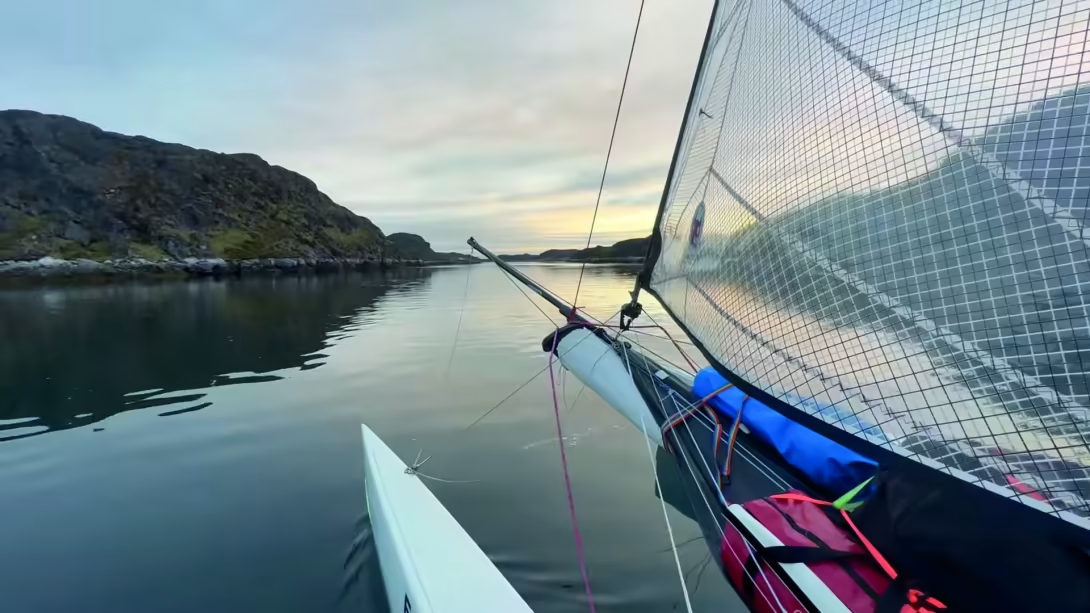
For the choice of boat, our research focused on an 18-foot catamaran. We found that it offered the ideal compromise between a living platform with an acceptable 2m² (20-square foot) surface area and a manageable overall weight (more than 350 kg/775 lbs loaded), as we need to be able to move it easily.
Accustomed to organizing expeditions, we know how time-consuming preparing a boat can be and did not want to spend too much time on it. Therefore, we looked for a catamaran that had already been prepared for an adventure raid. We found it in northwest Iceland in Isafjordúr where an 18-foot Hobie Cat Tiger had already been prepared for a round trip voyage between Iceland and the east coast of Greenland. The boat is equipped with wings (for hiking out), a real plus in terms of comfort (dry seated and raised position) and absolutely essential for storing all our bags. It also had some interesting customizations like the front trampoline (a few precious square centimeters of additional storage!) and pump-out compartments. The existing hook system was removed in favor of a braided halyard. We left with a set of new sails: a mainsail with 2 reefing points, a furling jib and a spinnaker. And finally, the heavily stressed hulls were reinforced over their entire length with one-centimeter-thick (½”) keel shoes made by our friend Sébastien Roubinet. Essential protection which proved to be very effective…
Equipment What did we carry on board?
We took two 10-liter (2½ gal) containers of water, a more than sufficient reserve given the profusion of rivers and the possibility of stocking up in the villages. We had two paddles, two sleeping bags, overbags and mattresses for nights on the trampoline, a tent, a stove, a drone, a GoPro... supplies for the current stage, tools and repair materials...not forgetting Dom’s ukulele, essential to bring tropical sunshine to these lands and tease the Greenlandic guitarists! To communicate, we each had a waterproof smartphone, a VHF, and a Garmin beacon in our jackets, plus a PLB stationed on the boat.
Tough times: The full story!
Apart from the omnipresent management of the cold in our extremities, which was sometimes tiring, we had 4 or 5 delicate moments which made the expedition so special.
Rodeo in Qaquk Sound
For the first days of the expedition, we were playful and decided to take a very narrow inland channel, on the other side of Nuuk Bay, as our starting point. This canal connects to the sea 50 miles (80 km) further north. We knew that this labyrinth was shallow (sometimes less than 3 feet/1 m), rarely trafficked (at least not at low tide!) and crossed by strong currents. Under the accelerating effect of the tide, we were caught in a succession of rapids and the catamaran quickly became completely unmaneuverable despite our energetic (if not desperate) paddle strokes. Even when we covered a few hundred meters, stern-first but in the right direction, without being able to restore the natural direction of our movement and miraculously avoided the rocks that dotted the sound despite our efforts, we felt helpless and were guaranteed shortness of breath.
Crossing the Fjord of Eternity
At the mouth of the Fjord of Eternity, north of Maniitsoq, a katabatic wind of 25 knots picked up within 2 minutes, surprising us as we paddled in full calm. We should have reefed immediately but persisted, mainsail up, hoping to quickly get out of this very uncomfortable situation. This cavalcade in the high wind and the sudden fury of a choppy sea certainly seemed like an eternity!
Caught in a pothole at the mouth of the Nordre Fjord
Happy but tired from having covered 56 miles (90 km) in a single day with spinnaker and power currents, around 2 a.m. we finally reached the north shore of the mouth of the powerful Nordre Fjord. We had spotted potential bivouac sites behind a string of islands. We then found ourselves sucked into micro-zones of currents where the waters become hysterically anarchic and raised waves in all directions. These areas, known to fishermen, are quite anxiety- provoking because they cause a suction effect which slows down or even stalls the boat. We had to release the reef and paddle furiously to get out of this infernal pothole which did not fail to provoke a fit of nervous laughter. Throughout our trip, we frequently battled with the currents. One day, it took us 4 hours to go 300 meters (1,000 feet), tacking into the wind and paddling against the current to get out of a sound that led to our bivouac spot.
Finally, tide management is the true headache. There are 4 meters (13 feet) of tidal range and a 1-meter (3-foot) difference between daytime and nighttime tides. Putting the boat on dry land at high tide is risky because you are never sure you will be able to leave. The boat must, therefore, be moved back once unloaded; and moored about 20 meters (65 feet) from the shore to keep it afloat whatever the tide level. A stage we are sometimes tempted to rush through when we are so tired. One night we found ourselves sheltering in a pirate paradise cove but the entrance to it was blocked by a large rock at low tide. We woke up late the next morning. As the morning tide is 1 meter less, and it takes 4 hours to strike camp and get ready to sail, we missed the noon slot and had to wait until midnight the following day to get out!

