“We’ve still got a long way to go to reduce our environmental footprint”
Windelo’s young co-founder and COO (aged just 30) approaches the challenges of an eco-responsible boatyard with a blend of enthusiasm and thoughtful hindsight. His observation is crystal clear: while the course to be followed is well set, the difficulties encountered are not negligible. Innovative construction and use are of course the keys to making boating eco-responsible, but there’s still a long way to go before we can significantly reduce our environmental footprint. To sail green, we need to raise awareness among both users and suppliers.
Image
Image
1
/
1
Publié le
26/06/2024
Par
Nicolas Massines
Numéro :
SP22
Parution :
Aug.
/
Sep.
2024
Gautier Kauffmann: Quite simply, it stems from a number of observations. I came across shoals of plastic while on a passage to Menorca, I’d seen my grandfather sell his house on the Atlantic coast because there was nothing left to fish, and more recently, one of our employees who took up sailing had to cancel her trip because of a pollution alert.
MW: How did this commitment fit in with the creation of Windelo?
GK : Initially, what my father [Olivier Kauffmann, Windelo’s other co-founder. Ed.] and I wanted was to offer high- performance, seaworthy and innovative catamarans. But in 2018, we decided we couldn’t launch a new shipyard without doing everything we could to protect the marine environment. We were well aware that no one would buy a catamaran for a million euros just because it was eco-responsible; our idea was to design a very good multihull and make its green character a bonus. This vision has proved to be the way forward, because some of our customers come to Windelo because the eco-responsibility argument counts for a lot for them. I believe that people in the market for a 50-foot-plus recreational catamaran can afford to invest slightly more in a model that makes more sense, and for which the esteem value will be higher.
MW: What’s the current state of ecological transition in the marine industry today?
GK: We’re still in the early stages... but Windelo is well under way, and things are beginning to get moving in other shipyards too. On the whole, our Western society is starting to turn the tide... but we need to do it a lot faster and a lot harder!
MW: What difficulties are you facing?
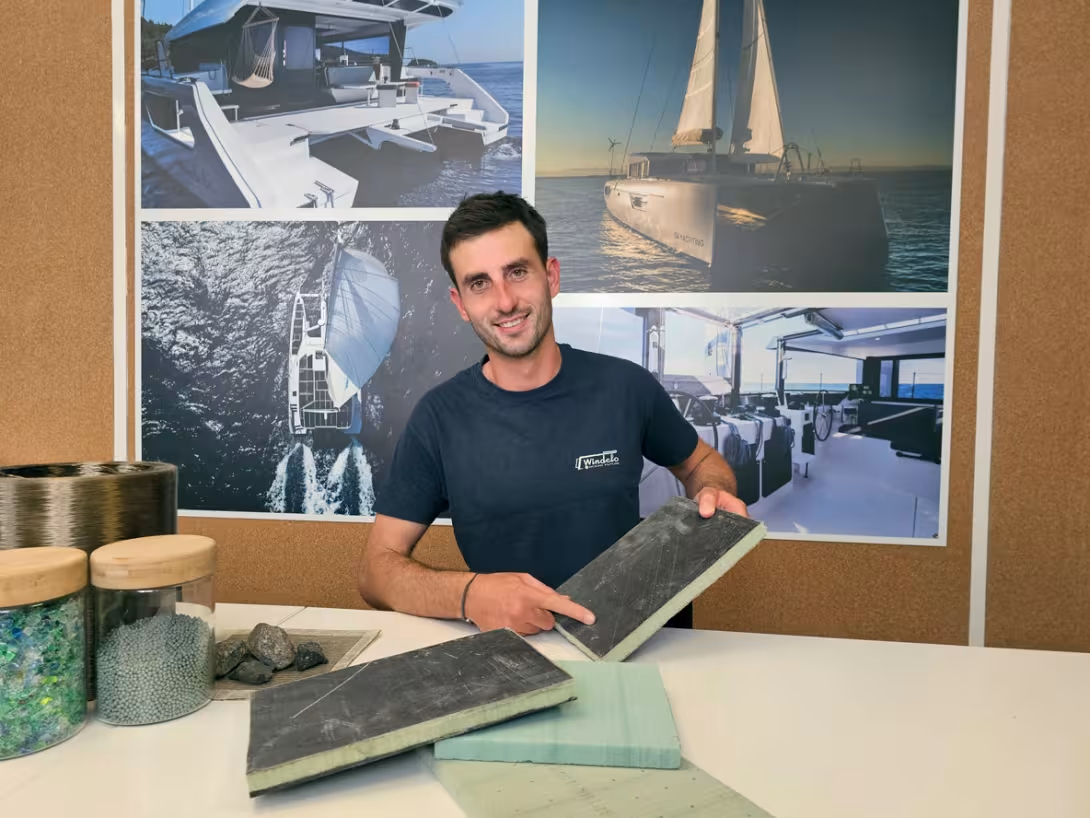
GK: We’re involved in an ongoing challenge, which requires a great deal of R&D and investment in innovation to find eco-responsible alternatives and make them even better. We’re having great success with structural materials, halving our carbon footprint, but in other areas such as upholstery and interior fittings, we’re still not there yet.
MW: Does success depend on financing and research?
GK: Yes, it requires research, resources and, of course, innovation. And this is where Windelo stands out: innovation is a must if we are to become eco-responsible. It’s costly, time-consuming and technical. It’s all about our choice of construction, structures and materials. However, certain suppliers are also called upon to play the game: we can take the example of a mast manufacturer who would use 100% recycled aluminum, but this applies to sails, interior fittings and all the components of a multihull. Our expertise also extends to the propulsion system, but here too, we rely on equipment manufacturers for the development of motors, batteries and hydro-generation performance. So it’s the entire industry that needs to move together towards eco-responsibility, so that one day we can offer a boat with a zero carbon footprint that can also be recycled. We’re obviously interacting with a number of manufacturers on this subject.
MW: Are customers looking to reduce their environmental impact?
GK: Absolutely, yes. And actually, I prefer to break down that impact: when you do life-cycle analyses, you have construction, use and deconstruction. So these are the three subjects that interest our customers. Today, at Windelo, we’re further ahead and stronger on the construction side, notably via eco-composites and usage, as our catamarans are self-sufficient in green energy and electric propulsion. On the other hand, when it comes to dismantling, it’s the whole industry that needs to get its act together, even though technically, the basalt we use has recycling properties thanks to its chemical composition, which is much better than fiberglass. Basalt can be heated for recycling without any significant deterioration in mechanical performance, unlike glass. In fact, we expect our catamarans to last at least 50 years.
MW: Do you already have feedback from any long and demanding sailing?
GK: Yes, our catamarans sail and are built to swallow up the miles. The first Windelo 50 made a beautiful Atlantic circuit: 20,000 nautical miles passing close to Greenland and Iceland, in other words they saw some big seas... but at the end of the trip, this multihull came back with zero structural issues. The construction phase involved 2 years of R&D with the Mines d’Alès laboratory [one of France’s top engineering schools – Ed.] testing the material’s characteristics and its ageing cycle. Moreover, we are extremely closely governed by CE certification requirements with regard to material resistance and sampling.
MW: You’ve gotten into the US market - is the ecological argument as strong there as in Europe?
GK: We’ve been active on the American market for 3 years now, but since the end of 2023 we’ve been represented by Just Catamarans. In February, Windelo attended a US boat show for the first time, taking a slot at Miami. The United States is nation of Tesla, and the market is so vast that we even have prospects who are insensitive to eco-responsibility, but who like our Windelo... while others come to see us because they drive an electric car.
MW: What is your next target market?
GK: We already have an international clientele outside Europe who buy our multihulls directly, but strategically we’re going to strengthen the Eastern Mediterranean and Australia.
MW: What personalities or companies inspire you in terms of ecology?
GK: There are plenty, but outside the marine sector, Tesla is a pretty inspiring model in its capacity for innovation and the implementation of specific infrastructures. We’ve had customer feedback telling us that it’s good to have a little Tesla in the boating world!
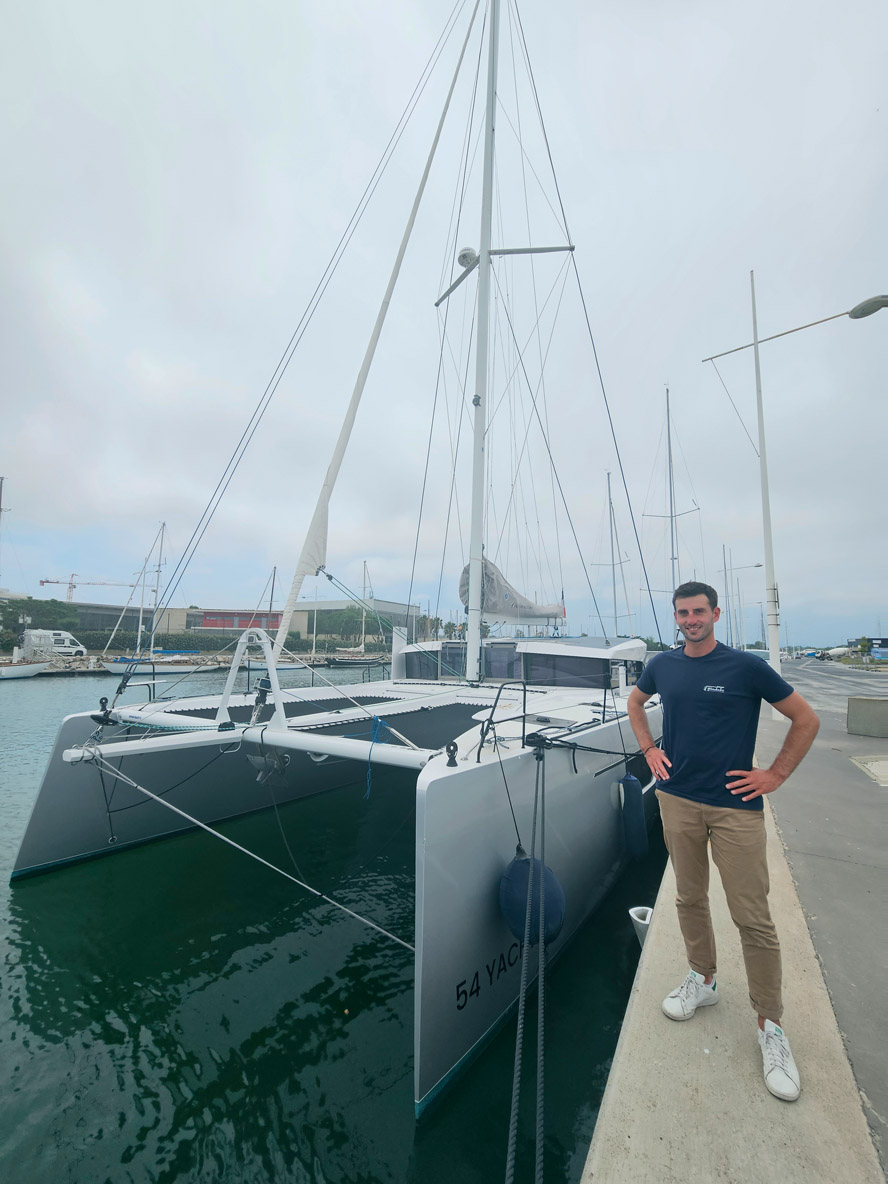
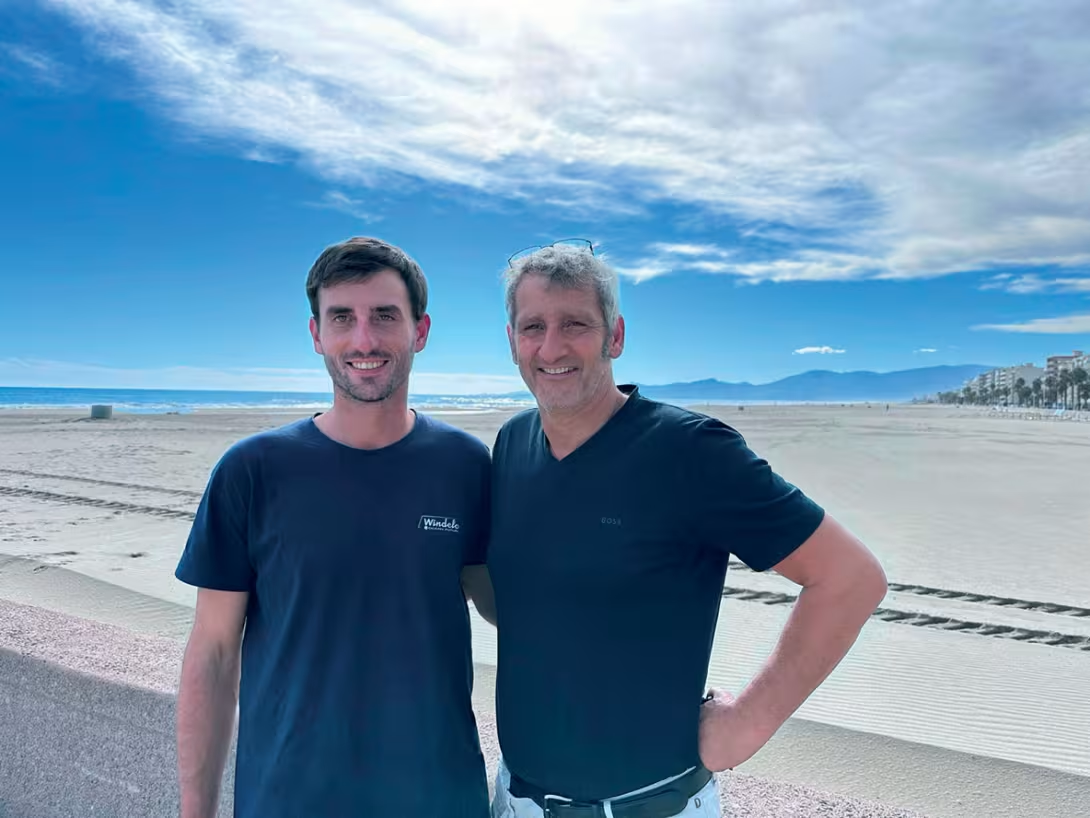
Gautier Kauffmann in Canet-en-Roussillon in front of a New Windelo 54 Yachting moored outside the yard.