Before stepping aboard our multihulls, let’s first take a look at what’s happening ashore. While many major industrial players are turning to hydrogen production, it’s not just to make electric mobility viable and meet ambitious greenhouse gas reduction targets. It’s also to support and optimize the development of green energy production - particularly solar and wind-generated power. With respective increases of 24% and 17% in electricity production in 2023, these two energy sources now account for almost 15% of the global mix. One of the forthcoming challenges is to manage production levels, which are bound to fluctuate: surplus electricity not consumed directly could be used to produce hydrogen by electrolysis. This will make it possible to store clean energy rather than waste it.
The different ways of producing hydrogen
Hydrogen atoms (H) form a very light gas, with the chemical formula H2. Highly flammable, it is odorless, colorless, non-toxic and non-corrosive. In its natural state, it is generally combined with other atoms: in particular, it is found in water (H2O), petroleum (HC hydrocarbons) and natural gas (CH4 composition). Chemical processes are used to separate hydrogen from the elements with which it is associated.
These different methods are distinguished by color codes - which still vary from country to country, pending global consensus.
- Green hydrogen is produced by electrolysis of water using electricity generated solely from renewable energies.
- Gray hydrogen is produced by thermochemical processes using fossil fuels (coal or natural gas) as raw materials.
- Blue hydrogen is produced in the same way as grey hydrogen, except that the CO2 emitted during manufacture is captured for reuse or is stored.
- Yellow hydrogen, more specific to France, is produced by electrolysis like green hydrogen, but the electricity comes mainly from nuclear power.
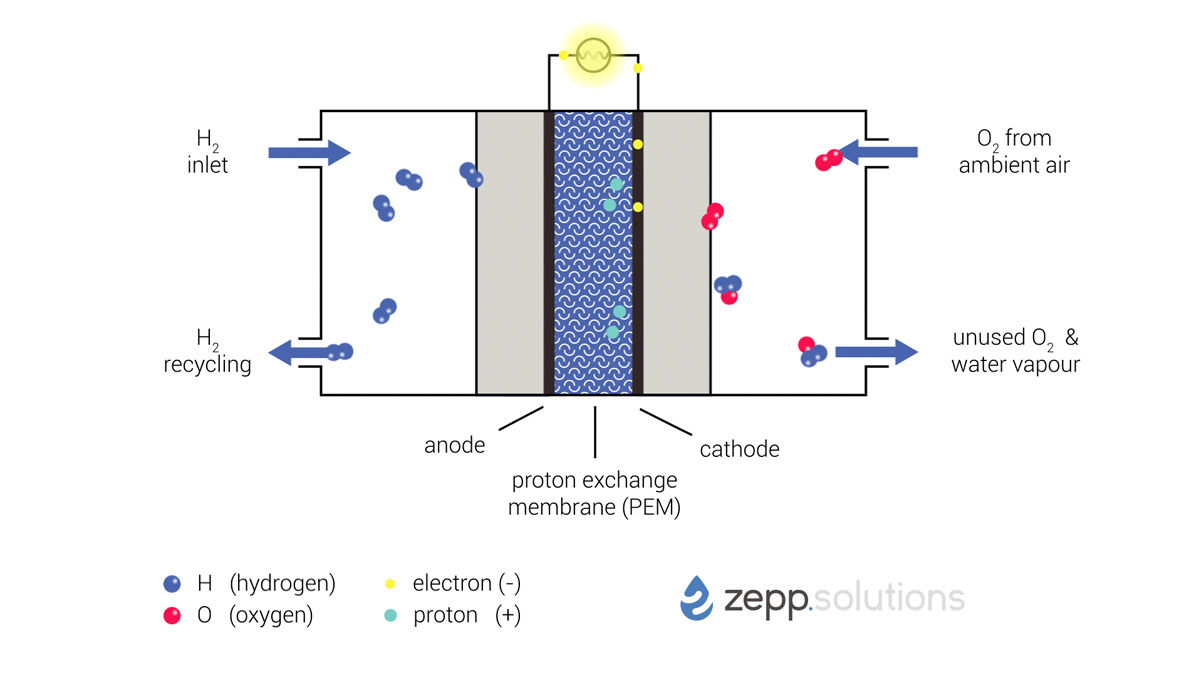
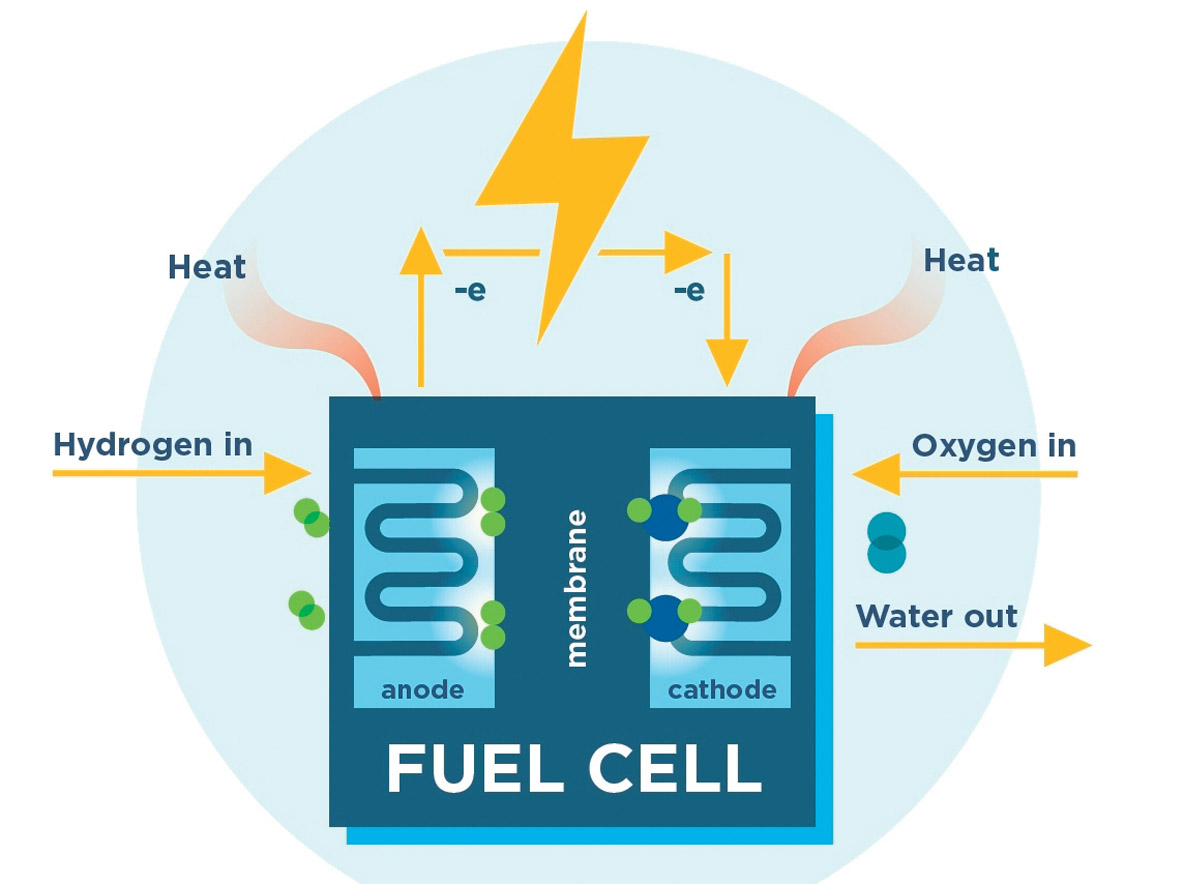
Worldwide hydrogen consumption today stands at around 100 million metric tons, representing less than 2% of global energy consumption. Hydrogen is considered an “energy carrier” because, once produced, it can be stored, transported and used. The energy contained in this gas can be recovered in two ways: by burning it or using a fuel cell. It is also used as an input in certain industrial processes. Thanks to the advent of new technologies (in particular hydrogen fuel cells), hydrogen offers a wide range of uses, from energy storage to providing power for buildings and vehicles.
A bet that’s far from being won in advance
Today, 95% of hydrogen is produced from fossil fuels (oil, natural gas and coal). This is the least expensive solution. Water electrolysis currently accounts for just 4% of hydrogen production, and less than 1% is produced from green electricity (solar, wind and tidal power), which emits very little CO2. The result is a virtuous cycle that uses oil only in the materials that make up the equipment itself. An installation such as a solar farm or electrolysis mill can therefore produce “renewable or decarbonized” hydrogen. This is one of the key solutions for achieving carbon neutrality, not only by replacing fossil hydrogen used as an input in the chemical and fertilizer industries, but also by introducing new uses in agriculture and mobility. Cars, trucks... we’re slowly getting closer to multihulls!
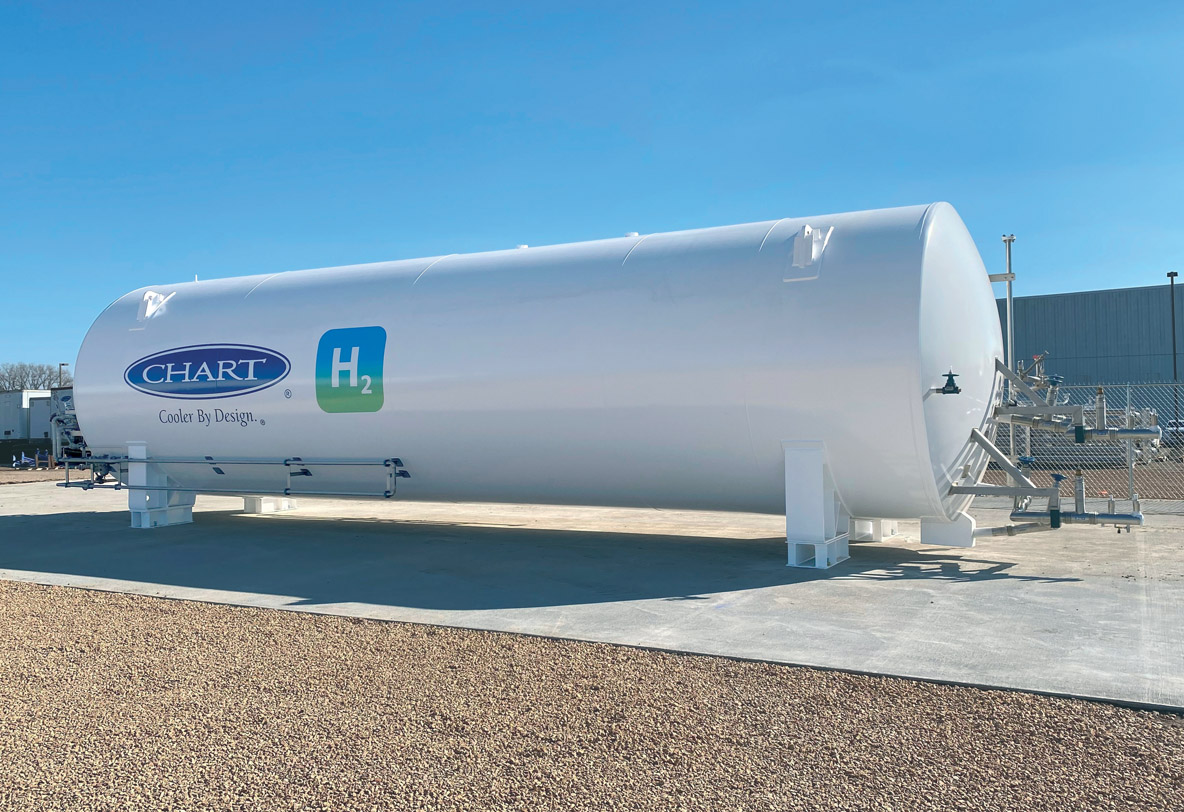
But it’s not all that simple. Hydrogen-powered cars have made considerable progress but are still very expensive. As for the manufacture and distribution of hydrogen, this remains a problem. The temptation is great to use “dirty” hydrogen, which gets us nowhere, while “clean” hydrogen is energy-intensive. Today, it takes 1 liter (2.1 US pints) of water and 5 kWh of electricity to produce 1,000 l (35 cubic feet) of hydrogen gas at atmospheric pressure. This gas must then be compressed to 700 bar (10,150 psi) for automotive use. The fuel cell then converts this hydrogen into electricity (efficiency is around 60%). In the end, only 1.53 kWh of the initial 5 kWh of electricity remain – that makes it expensive storage. In addition, transporting hydrogen remains problematic due to its very low density of 0.09 kg/m3 (0.0056 lb/cu ft). To obtain the energy equivalent of a gasoline truck, you’d need 22 identical trucks of hydrogen pressurized to 200 bar (2,900 psi). The only viable solution is therefore to produce hydrogen in situ. This is what many stations in Europe do, but they don’t necessarily produce hydrogen using renewable energies! Those that do, like the Uno-X stations in Norway and Denmark, sell a kilo (2.2 lbs) of hydrogen for around €10. So, for the time being, hydrogen is not yet aimed at private customers. However, the hydrogen-powered car would be coherent as part of an industrial complex, with heavy-duty rail and sea transport - provided the appropriate infrastructure is in place.
The quest for green hydrogen on board
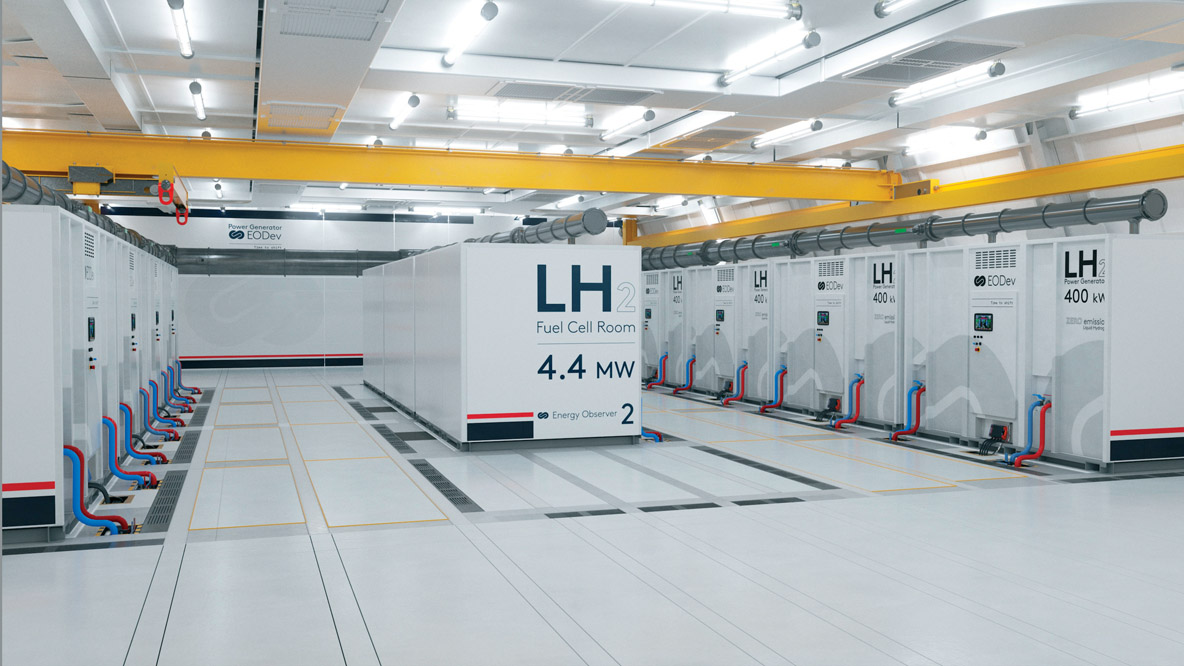
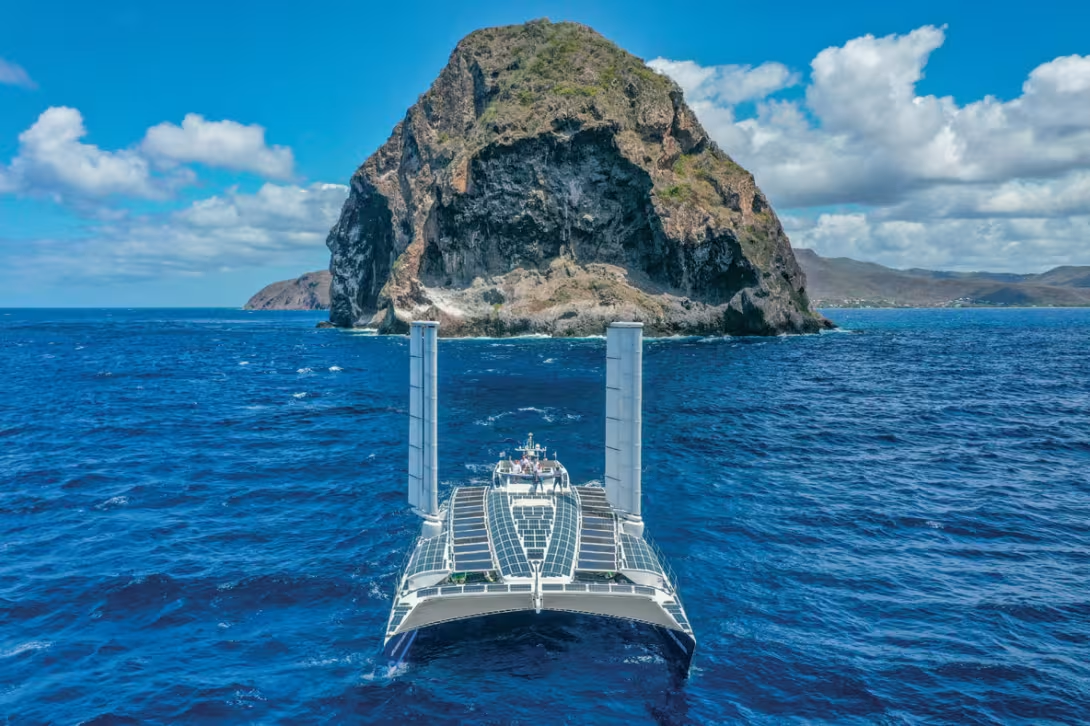
Now that the complexities of hydrogen production have been revealed, we can finally (re)climb aboard our multihulls, where we have unlimited seawater and sources of energy (sometimes even surplus energy). This is precisely what we need to produce hydrogen. The only catch is that we need lots and lots of electricity to produce hydrogen. Not easy on a sailboat, but possible, as Victorien Erussard is proving aboard Energy Observer. The French entrepreneur has worked with the CEA (France’s Atomic Energy Commission) to achieve this. On board this 30-meter (100-foot) catamaran (formerly TAG Heuer, then Enza), an electrolyzer runs on the energy supplied by the 150 m² (160 sq ft) of solar panels, two wind turbines and prop shafts in hydrogeneration mode. “The eight 332-liter (87-US gal) tanks can store a total of 63 kg (139 lbs) of hydrogen, equivalent in energy to 230 liters (60 US gal) of diesel fuel. This volume represents a total net stored energy of 1 MWh,” explains the Energy Observer team. Hydrogen acts as a long-term range extender, while batteries provide immediate short-term energy. The Energy Observer installation also makes it possible to quantify the mass advantage of hydrogen over batteries: “While the batteries weigh 1,400 kg (3,100 lbs) for 112 kWh, the hydrogen storage and fuel cell weigh a total of 1,700 kg (3,750 lbs) for 1,000 kWh. On a per-kilogram basis, 1 kWh therefore weighs 12.5 kg when stored in batteries, and only 1.7 kg when stored as hydrogen. In other words, for the same weight, hydrogen storage contains 7.35 times more energy than battery storage, a considerable asset when it comes to mobility, whether we’re talking sea, land or even air.”
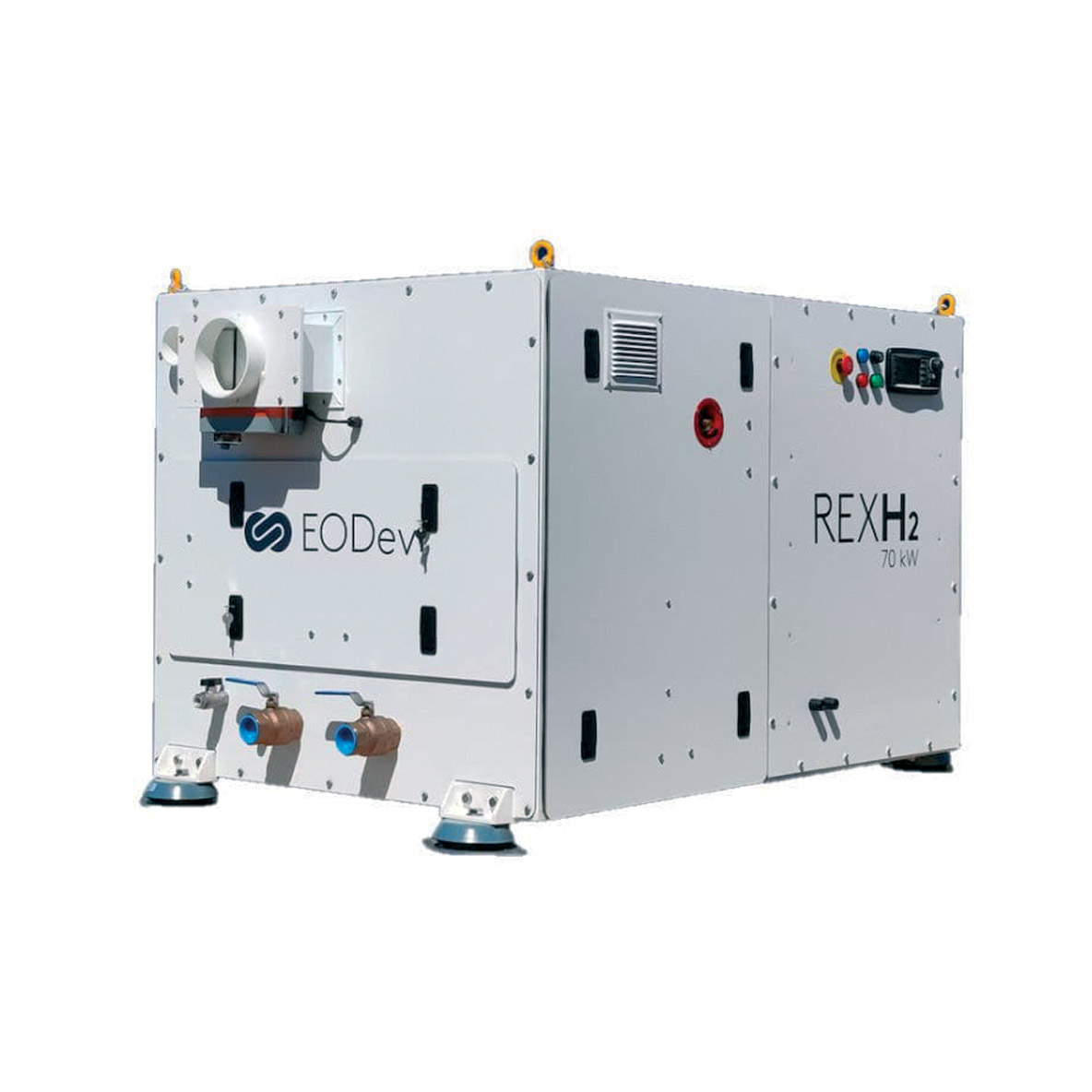
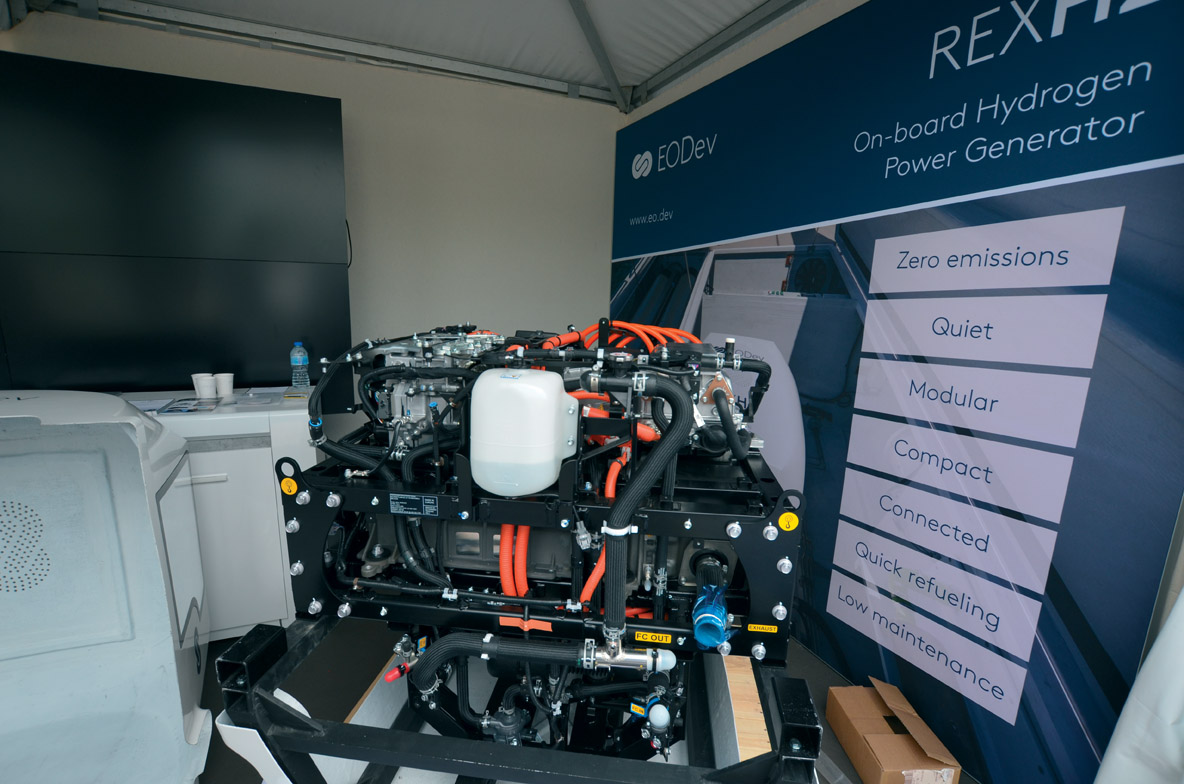
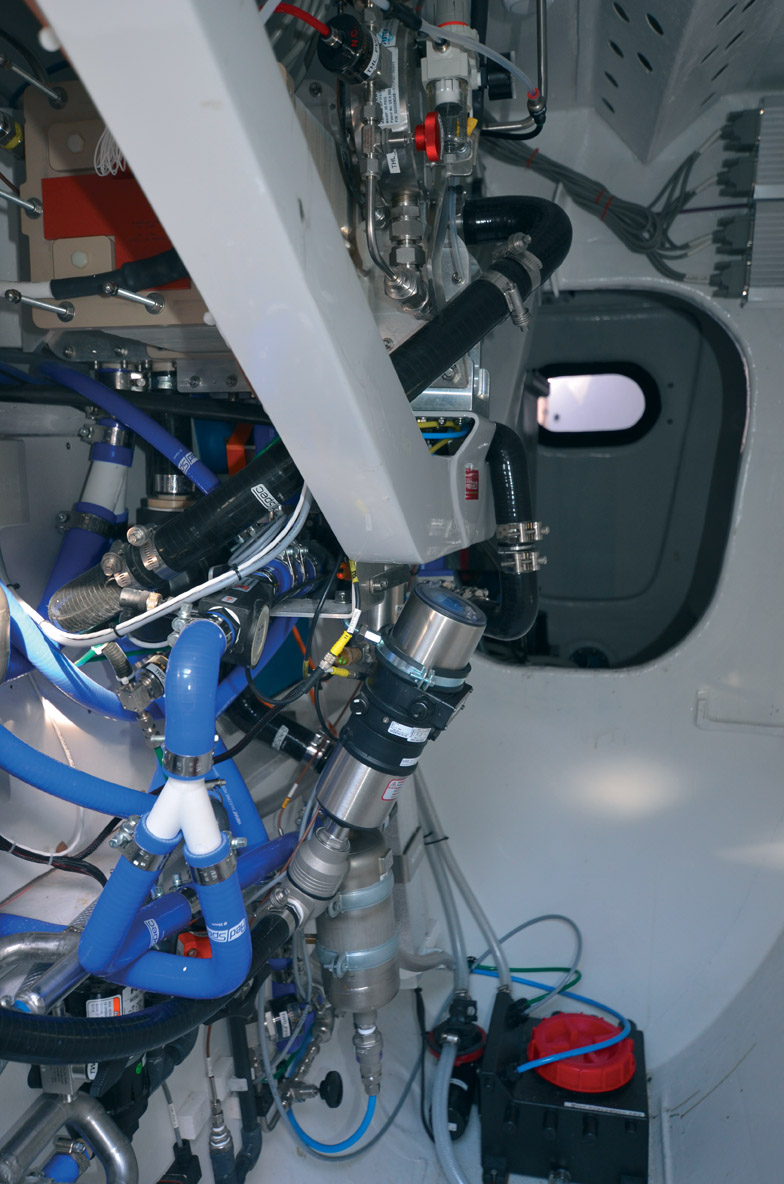
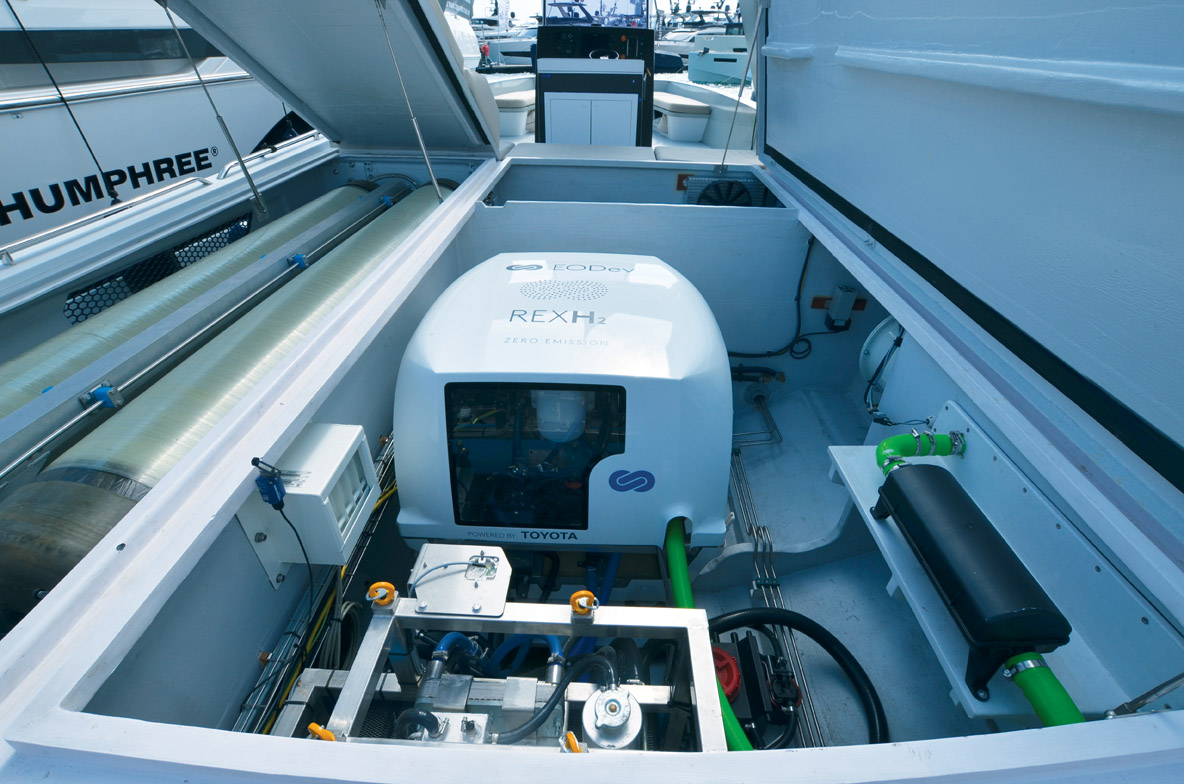
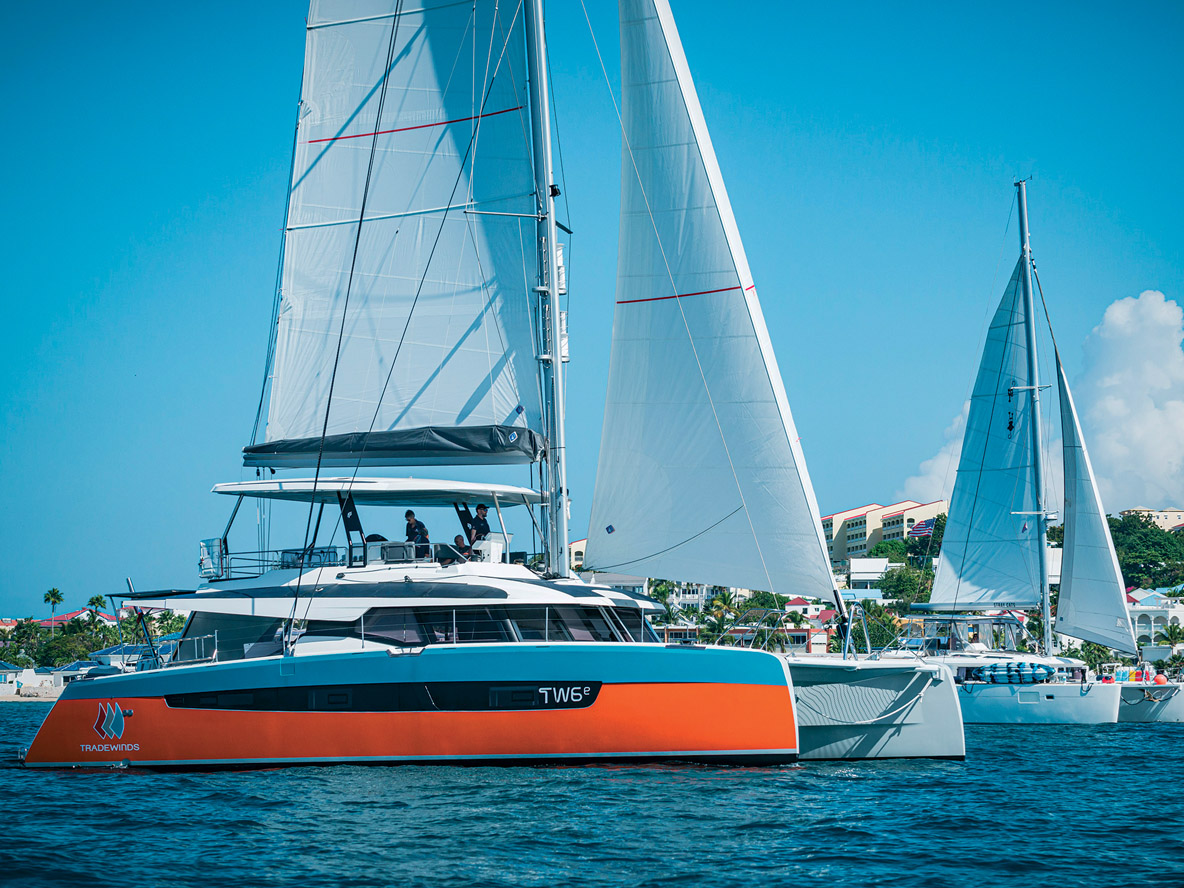
According to architect Marc Van Peteghem, Energy Observer’s Oceanwings are capable of delivering an average speed of fifteen knots on the high-performance platform. At this speed, which is well above what our mass-produced cruising catamarans - including the largest - can maintain, hydroelectric production is very high (around 4 kWp, or potentially 100 kW of production over 24 hours). This energy is used to power the hydrogen production cycle. When there isn’t enough wind, or when, at the start of its voyage, Energy Observer was not yet equipped with its wings, the only solution was to produce hydrogen when the catamaran was alongside and connected to shore power. The lengthy development work carried out during the long passages of this experimental multihull since 2017 has led to the creation of EODev; this company, in partnership with Toyota, has developed REXH2, the first fuel cell designed for the individual mobility market - and therefore boating, by extension. A first prototype of an electrically-powered boat was produced in 2021 with the company Hynova, to validate the concept and pursue research. In 2023, Fountaine Pajot installed one aboard a Samana 59 for charter company Tradewinds. This year, Sunreef Yachts also used the famous REXH2 fuel cell aboard an 80 ECO zero-emissions yacht.
The quest for green hydrogen ashore
These two luxury cruising catamarans are capable of averaging 10 knots under sail in a good breeze, but not the 15 knots of the Energy Observer. In these conditions, it becomes difficult to produce hydrogen while sailing. So, we’ll be relying on land-based supplies. But as we saw above, supplying hydrogen ashore isn’t easy. What’s already very complex for cars is even more so for boats! Tradewinds would like to produce green hydrogen from solar and wind energy at its charter fleet bases. Setting up a network of hydrogen filling stations, like Tesla’s Superchargers, is obviously the right solution. For the time being, however, the cost of a station that manages to produce “renewable” hydrogen, like the stations in the Uno-X network, is in the region of one million euros. That’s a hefty price compared with an ultra-fast charging station (350 kW) that can be installed for €50,000. Not to mention the budget required to hook up to a simple shore power outlet...
In this context, why launch “hydrogen-powered” multihulls if they can’t be easily recharged? Mathieu Fountaine, Managing Director of the shipyard which built the Samana 59 prototype, replies: “Hydrogen won’t really be operational for another ten years, but we need to start getting used to this technology if we want to give it every chance of working well one day.”
The development of this technology will undoubtedly depend on the development of local infrastructures for the production and refueling of green hydrogen, but also on technological developments in the yachts themselves and onboard equipment. Making boats lighter, taking advantage of foils and consuming less fuel are just some of the avenues open to us!
Samana 59 Smart Electric REXH2 : Hydrogen working its way on board!
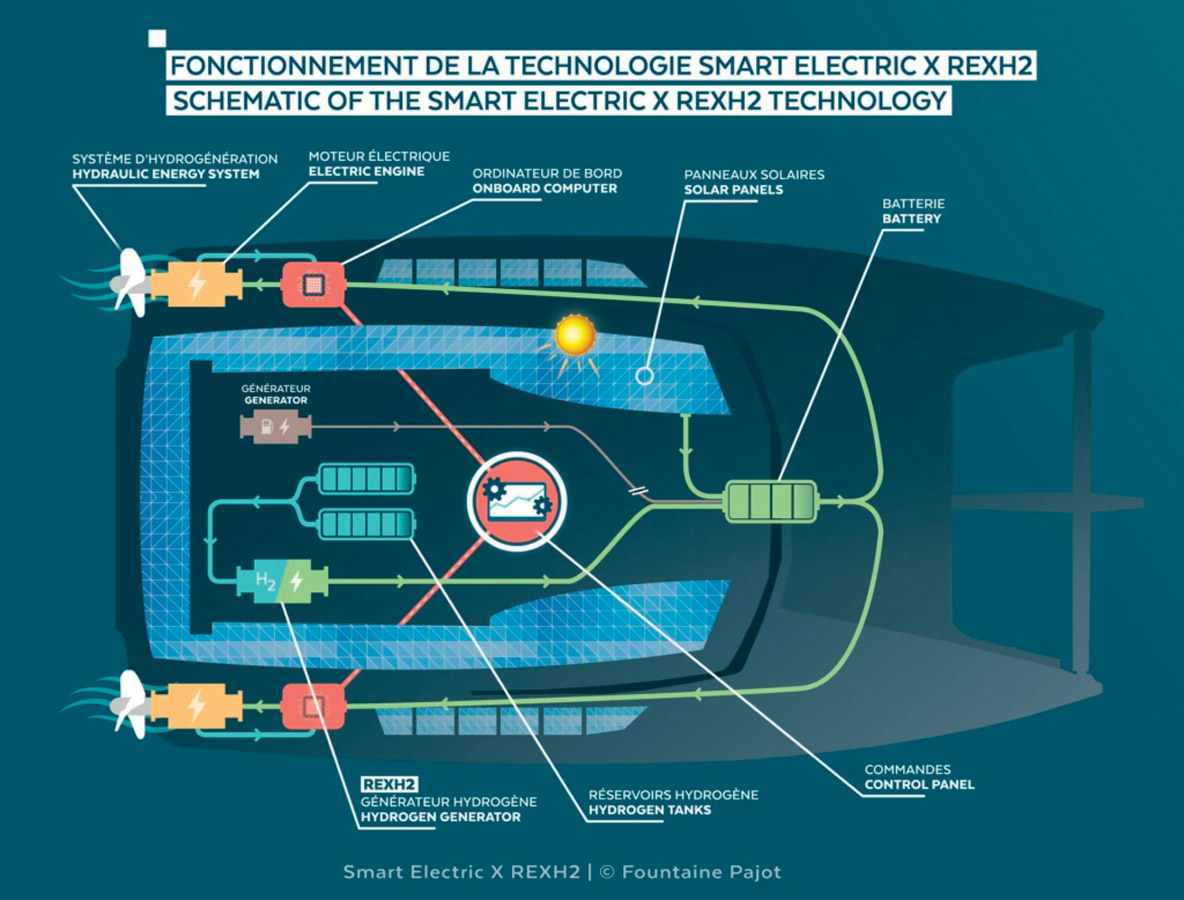
Using a standard Samana 59 as a base, the Fountaine Pajot and EODev teams have developed and installed an electro-hydrogen generator with a nominal power of 70 kW. Boosted by 450 square feet (42 m²) of solar panels, the 650 lb (300 kg) generator installed in the starboard engine compartment powers a 64 kWh LiFePO4 (lithium iron phosphate) battery - comparable to the one used in a top-of-the-range electric car, it weighs 775 lbs (350 kg). The actual motors offer 50 kW each. The 33 lbs (15 kg) of hydrogen is stored at just over 5,000 psi (350 bar) in special carbon tanks - each tube weighs just 66 lbs (30 kg)! Self-sufficiency in electro-hydrogen mode is 40 hours at anchor and 10 hours under way at a speed of 5 knots. Of course, energy from the solar panels, combined with hydrogeneration when navigating under sail, all increase considerably these “raw” values. In the event of problems, a small generator and 185 US gal (700 liters) of fuel are also on board.
In standard use, this catamaran should be self- sufficient, and notably, capable of emitting no carbon emissions, for one week. This corresponds to about half the autonomy of the standard model, though that would be fitted with twin 110 HP motors, a pair of 15 kW generators and carrying 370 US gallons (1,400 liters) of diesel. Note that the laden displacement of the Samana 59 Smart Electric REXh2 is barely more than that of the standard catamaran. The large catamaran is now in the Caribbean, operated in charter by Tradewinds. It is indeed Magnus Lewin, managing director of this company specializing in cabin charter, who has acquired this avant-garde Samana. Note that Tradewinds have just ordered ten Fountaine Pajot electric catamarans, as has the world’s leading charter company, Dream Yacht Worldwide.
Sunreef 80 ECO Hydrogen : One step closer to forever green
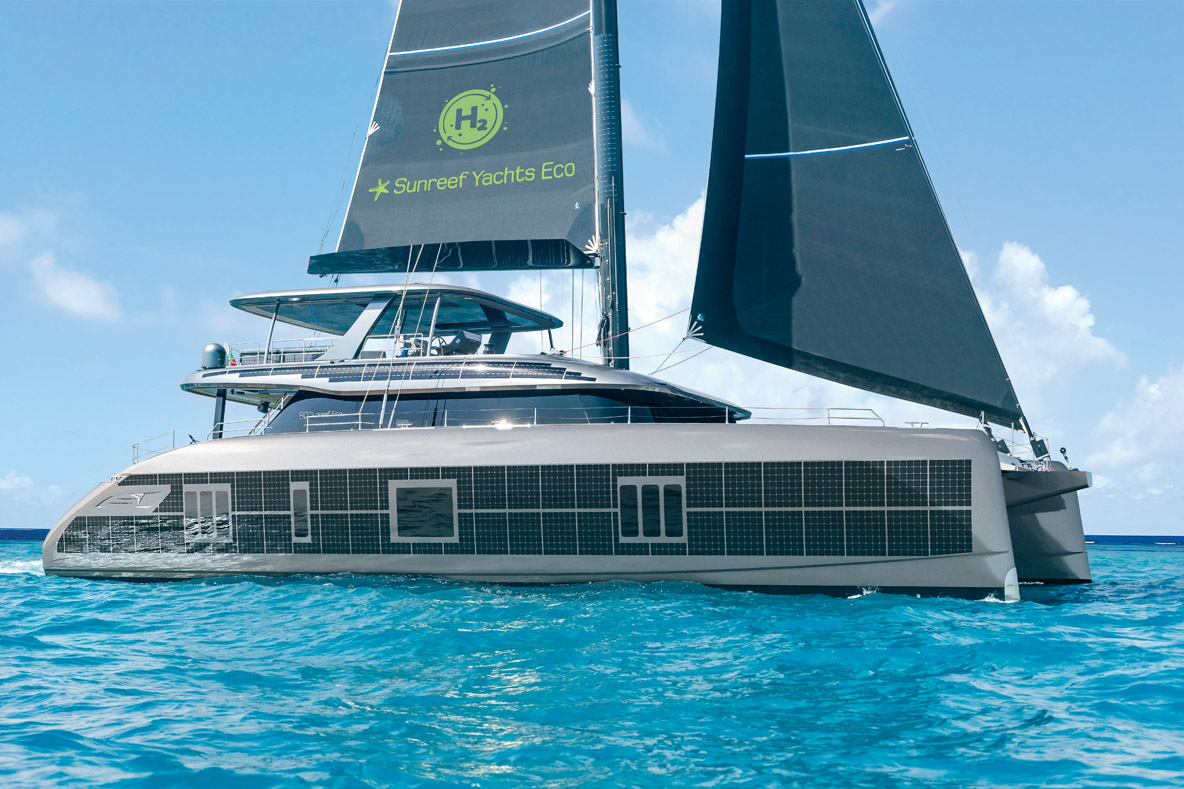
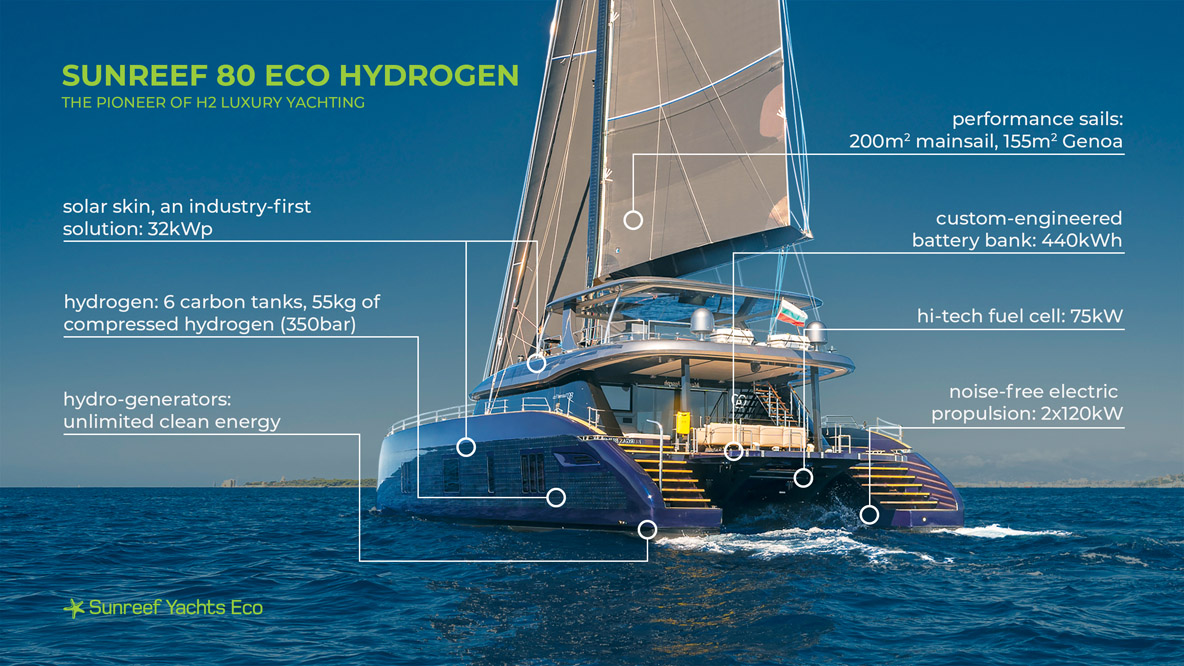
The Polish brand is heavily involved in the energy transition, with the ECO range now accounting for half of all sales... The builder has decided to take the next step by integrating the REXH2 fuel cell offered by EODev. This makes the Sunreef 80 ECO a genuine showcase for the green solutions developed and validated by the manufacturer. The 440-kWh custom-built lithium battery bank is already fed by 32 kWp of photovoltaic cells. The 75-kW fuel cell draws its fuel from six carbon tanks - containing a total of 55 kg (121 lbs) of hydrogen compressed to 350 bar (5,075 psi).
Nicolas Lapp, Development Director, tells us that the 80 has been certified as a commercial vessel. However, obtaining that famous label from the Royal Institution of Naval Architects (RINA) was no simple matter, as the inspectors, having no previous experience with fuel cell technology, had to carry out numerous specific risk analysis procedures. Fortunately, the buyer was an industrial player in the hydrogen sector - so he was content to wait without batting an eyelid for many months before delivery, so that his multiyacht could be subjected to a battery of tests, which lasted several months.
Note that the manufacturer has unveiled an even more demanding technological project for its R&D department: the 90-foot Sunreef Zero Cat should be capable, like Energy Observer, of producing its own hydrogen on board.