

August 27th - Day 1 - Ibiza
The weather in the Balearics is so miserable that air traffic is completely out of kilter: my flight is delayed by a good two hours and the journey over Mallorca is punctuated by severe turbulence. On land, the wind blew at more than 70 knots and there were downpours in the south of the island... Further south, in Ibiza, the conditions were a little better. At anchor just a stone’s throw from Talamanca beach, Brieuc was celebrating his birthday - and instead of blowing out his candles, he was leaning on the engine against the gusts. With no room in the harbor and a ban on disembarking, we ended up at the Eivissa Marine fuel dock before anchoring further east at the Platja de ses Figueretes. There was total protection from the north, but it was now the tramontana wind that had replaced the storms... Apart from the fact that Alfred and Marc, the two journalists who were due to join us on board, were also delayed, the weather forecast seemed to be conspiring against our objective of heading north. In the meantime, I was getting my bearings aboard the LEEN 56. The water was 84°F (29°C), which was ideal for a swim. A very calm evening allowed us to (finally) celebrate Brieuc’s birthday ashore.

August 28th - Day 2 - Ibiza / Ricarlos
The previous day’s forecast was proved right: to the north of the Balearics, there were 50 knot gusts and 16-foot (5-meter) waves. Nobody wanted to go there - not even Brieuc, who had seen it all before. So we decided to sail around the area in question, taking the long way round to the west and reaching the Spanish mainland as quickly as possible. It looked as though we’d be dropping anchor near Barcelona rather than Port-Leucate as originally planned. After a hearty snack prepared in the galley, we set sail for the two spectacular islands of Vedranell and Vedra, to the south-west of Ibiza. Piloting from the flybridge is a real pleasure. The engine was brought up to 2,000 rpm, and frankly, you can’t hear it that much, even in the saloon. I joined Brieuc in the engine room, where it is noisy and hot! The sea is already choppy, and the 55-mile crossing doesn’t look like being easy. At the start, a heavy head-on chop didn’t bother us too much: the LEEN 56’s slender hulls coped perfectly with these testing waters. Then the wind shifted to the south-west and so did the waves, and it became downright uncomfortable because the rolling was rather pronounced. This is not unique to the LEEN 56 - it’s just that the sea, with its 8-foot (2.5 m) waves, was now really quite rough. Venturing onto the flybridge became complicated, so this is where the interior helm station really comes into its own. Around midnight, we arrived in Moraira. There was only one boat at anchor, its mast dancing to the rhythm of the surf. We decided to push on a little to the south-west, just off Ricarlos beach. This stretch of water is perfectly sheltered by Cape Blanco, an imposing rocky headland, which ensured a perfectly calm night (albeit quite short!).
August 29th – Day 3 Ricarlos / Valence
The calm seas at daybreak tempted us all to go for a swim. We’d love to stay here for a while and climb Cape Blanco, but we’ve got a long way to go! So the LEEN 56 headed north-east around the series of headlands leading to Denia. The panorama offered by the golden rocks is sublime. We then headed north, then north-north-east. Everyone was starting to get their bearings. In his Owner’s suite, Alfred could use his desk. Brieuc never left the sofa at the helm station. Marc is busy rinsing the salt water from his mattress, pillow and bed linen: the day before, he stayed in the saloon and forgot to close one of the deck hatches in his cabin... As for me, I’m settling in at the big table in the nacelle. For lunch, we drop anchor at Cullera, where a small cape protects us from the north- westerly chop. We didn’t stay very long, though, as the wind came in from the east-south-east at a good twenty knots. It was our skipper’s turn to experience the joys of a flooded cabin - this time it was the hull porthole that was left open! This misadventure didn’t stop Brieuc from getting in touch with the local NEEL/LEEN Trimarans distributor, and a berth was reserved for us at the Valence marina, as was the restaurant ashore.
August 30th - Day 4 - Valencia / La Rapita
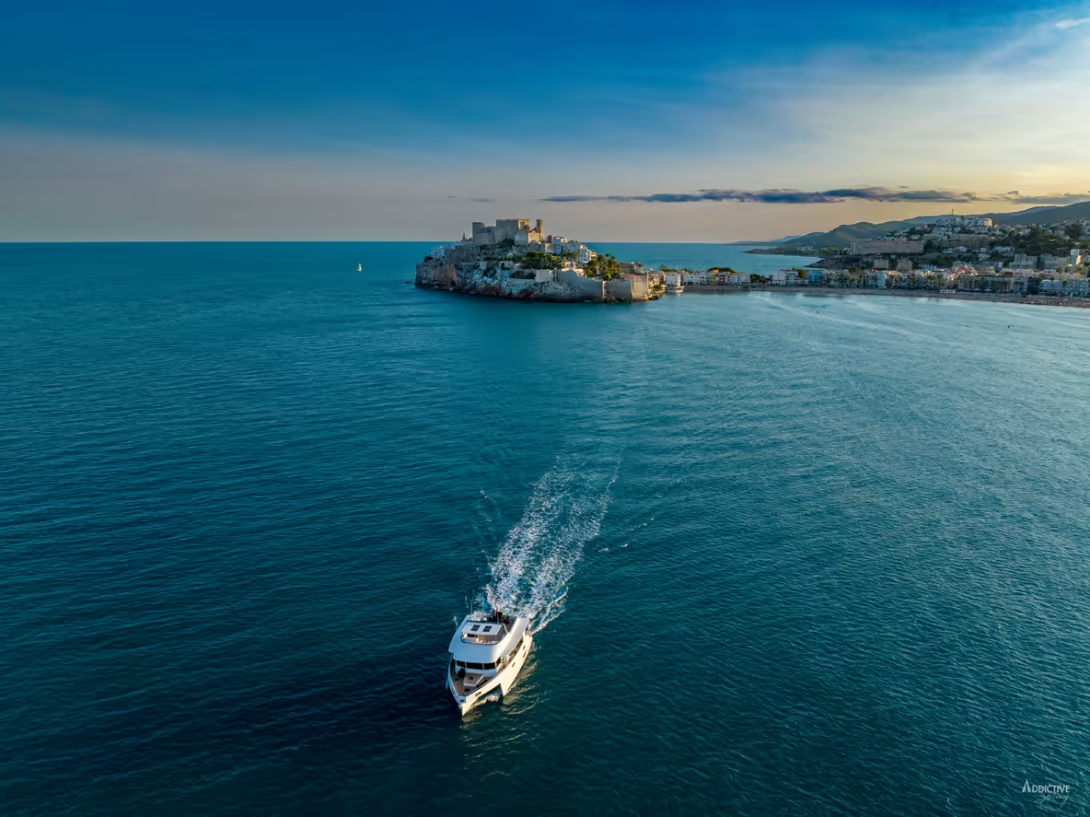
We would have to cover 80 miles during the day if we wanted to reach the Ebro delta and its perfectly protected anchorages at a reasonable hour. Even at 9 knots, it would still take almost 9 hours without a stop. In the end, this wasn’t really a problem, as the only place it would have been a shame to miss was the walled town of Peniscola. In the rather concrete world of seaside resorts on this part of the Spanish coast, this city rising out of the sea is extraordinary. With a strong easterly wind, anchoring was not advisable. But if the weather is fine, you can anchor in the southern extension of the harbor or just north of the citadel. Like us, make the most of the times when the sun is low over the horizon - sunrise and sunset here are feasts for the eyes... We almost reluctantly resumed our journey northwards. As night fell, we entered the immense southern lagoon of the Ebro delta. Only two other boats were at anchor, in absolute calm. To the north, another lagoon also provided perfect all-weather protection. There are oyster beds and a picturesque restaurant on stilts at Mirador Badía.
but this is no longer the case since the port was built.
August 31st – Day 5 – La Rapita / Castelldefels
We cleared the anchorage at dawn; I was at the helm and tried to negotiate the sandy spit. The depth sounder was showing 4/5 meters (12/16 feet) and I didn’t exceed 5 knots.
Luckily for me, as the bottom of the hull suddenly caressed the seabed! As the propeller, at the stern, is the lowest point and is not protected by a skeg, Brieuc opted to clear it in reverse using the electric motors - it worked perfectly. As a result, we took a rounder trajectory, especially as the bottom near the river was reported to be uneven. Our skipper checked the weather one last time. It had calmed down in the Gulf of Lion, and he set out the program for our last day: he would drop us off at Port Ginesta, 15 km from Barcelona, refuel and continue his solo route to Port Leucate.
Off Tarragona, we slalomed between mighty cargo ships at anchor. To make the most of lunch, we switched off the main engine and just relied on the two electric motors. Our speed was limited to 5 knots, but there was no sound or vibration to disturb us. When it came time to maneuver to moor up at the fuel dock, the auxiliary motors once again proved their worth. Brieuc made do with an extra €300 worth of diesel, or 182.7 liters (48.25 US gal) - enough to cover just over 90 miles at 9 knots. Who said that multipowers were fuel hogs?
LEEN 56 A UFO (Unidentified FLOATING Object) in the multihull universe
In the spring of 2021, the release of the LEEN 56 did not leave anyone indifferent. Let’s be honest, most nautical specialists were quick to criticize the design of this first mass-market motor trimaran. We didn’t agree, as you’ll see when you (re-)read our review. But what didn’t we like so much? The floats, which are much shorter at the bow than the central hull, and above all the very high hull sides. Personally, I’m convinced that an effort at decoration, such as a colored gelcoat all over the upper part of the topsides, would really transform the look - a bit like what was done with the famous Muscadet sailboat in 1963. Note that these very flat shapes are due to the panel manufacturing process. The LEEN 56 and 72 are not built in conventional molds. The shipyard, quite logically, did not expect - and it is still the case for these two models - large production volumes. Hence this choice.
Too few of our colleagues have tested this motor trimaran, and that’s a real shame... The LEEN 56 has come up with some very relevant solutions in terms of fuel economy and safety, with its double propulsion system. The ‘Portuguese’ bridge layout (the side decks are protected by the superstructures) works well, especially when combined with the 30 m² (323-square foot) flybridge. Inside, the nacelle opens onto the cockpit, and the owner’s cabin is on the same level, with a saloon and an ingenious gangway door.
As for the LEEN 51 announced last September, it’s a game-changer, since this new model will be produced using molds - and at the same time a more familiar design. On the sales front, this new direction seems to be working, with 10 units already on pre-order.
TECHNICAL DESCRIPTION
Naval architect: Bernard Nivelt
Architect and interior design: Pierre Frutschi
Overall length: 56’ (17.1 m)
Beam: 27’1” (8.25 m)
Draft: 5’7” (1.7 m)
Light displacement: 65,000 lbs (29.5 t)
Max laden displacement: 84,200 lbs (38.2 t)
Engine: 305 HP Cummins QSB6.7
Engines: 2 x 22 kW
Fuel: 925 US gal (3,500 l)
Water: 217 Us gal (825 l)
