
Getting ready to go
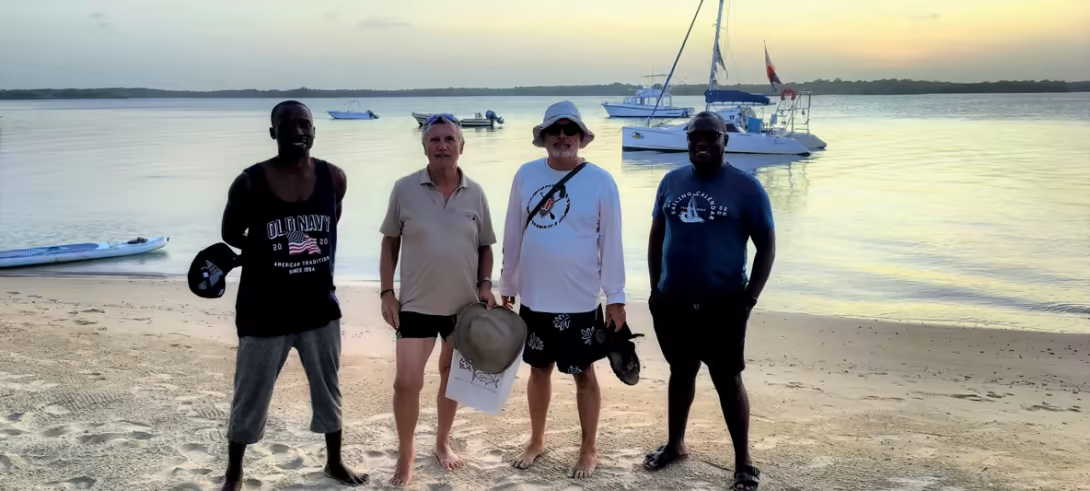
“Failing to plan is planning to fail”: this cannot be emphasized enough. The planning for this cruise up to Lamu began immediately after our last trip in early March 2022. This would be my 4th sail to Lamu, the second on my own boat, a modified 1996 Richard Woods Elf 26 catamaran. I had been watching the weather patterns for several months and Fritz had already started the weather routing. We were initially planning to leave on January 19, but a cyclone down near Madagascar was causing all the air to move down those sides to the massive low thus causing extraordinary wind and waves in northern Kenya. The cyclone passed and Fritz had determined that 1300hrs on Wednesday February 1 would be the ideal departure time. We were joined as crew by Amir whom I had met a few weeks previously, and by my full-time deckhand Emmanuel “Manu” would join as well: this would be his 3rd sail up to Lamu. The day before departure, Fritz and I went to Malindi so we could clear out with Kenyan Customs and get our transire that would allow travel to Lamu and to also do our provisioning. I also used this day to notify the Kenyan Regional Maritime Rescue Coordination Centre (RMRCC) via email (RMRCC@kma.go.ke). I would phone them the next day to notify them of our departure, and I regularly kept in touch with them as we proceeded on our cruise across Ungwana Bay: they are a real pleasure to deal with and will call you on the mobile phone if you miss your check-in deadline.
Day 1 - From Watamu to Ras Ngomeni
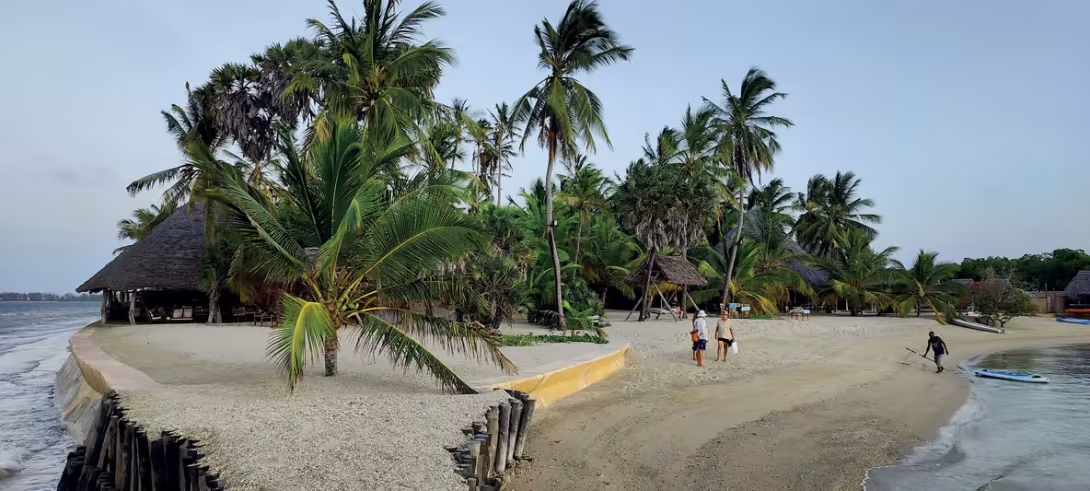
After a good night’s sleep, we loaded up the boat. We were met at Ocean Sports Resort in Watamu, Kenya, where we moor our catamaran in the Kaskazi season (from December to April) by Amir who had taken a bodaboda (local motorcycle taxi) in from the neighboring town of Malindi. We departed right on time at 12.55 pm. We zigzagged back and forth so as to get on the proper course to Lamu. Fritz even managed to get “Otto” the autopilot to work for the first time in 7 years! We had a great sail but just after dark, Otto started misbehaving and steering us in circles. We later found that he was hungry for power and the ship’s batteries couldn’t satisfy his needs: with at least 5 phones, 2 tablets and 2 additional battery packs on board, you can imagine the draw, especially if several of the gadgets are running Navionics. By this point we were not making any headways as we sailed into Ungwana Bay (also known as Formosa), which gets fierce at night. With no safe harbor for over 50 nm, I made the decision to turn back towards Ras Ngomeni, the home of Italy’s space program and the site of the San Marco Space Platform. We anchored at our favorite spot for the night just before midnight.
Day 2—From Ras Ngomeni to Lamu
We were up at 5.20 am in order to get ready for a sunrise departure. We soon discovered that we were caught in a fishermen’s net which had wrapped itself around us. They were quite accommodating about it and assisted us in the untangling process. As they rowed off in their dugout canoe, they told Manu that they were hungry, so we gave them an unopened 2 kg (4½ lb) pack of rice. When going on a long voyage I normally have a few packs of cigarettes, even though I don’t smoke, and a case of bottled water to give out to fishermen that we encounter along the way (onboard, our drinking water is pumped from a 20-liter (5 gal) bottle of spring water). We set our course for Tenewe on the north shore of Ungwana Bay and were able to get the autopilot working great (well as long as there was plenty of sunshine and no battery drain.) We sailed past Kinyika, a bird and turtle haven, and sailed into Lamu just before sunset and in fact joined the “parade” of dhows doing their sunset circuit. However, the motor wouldn’t start. It started racing and then died. We had to be towed in by Hassan, London art dealer and good friend Nicholas’ boatman who had come out to greet us. Anchored for the night at Fisheries near the Floating Bar Lamu, an anchorage which we shared with a number of enormous dhows. Hassan collected the “fearless crew” and took us all to dinner at Nicholas’ Lamu hilltop “Factory” where we enjoyed hot showers and toilets that didn’t move. We were pleased to note that we used Just 2 jerry cans of fuel all the way from Watamu which compared to 4 last year (over 140 liters/ 37 US gallons).
Day 3 - Lamu
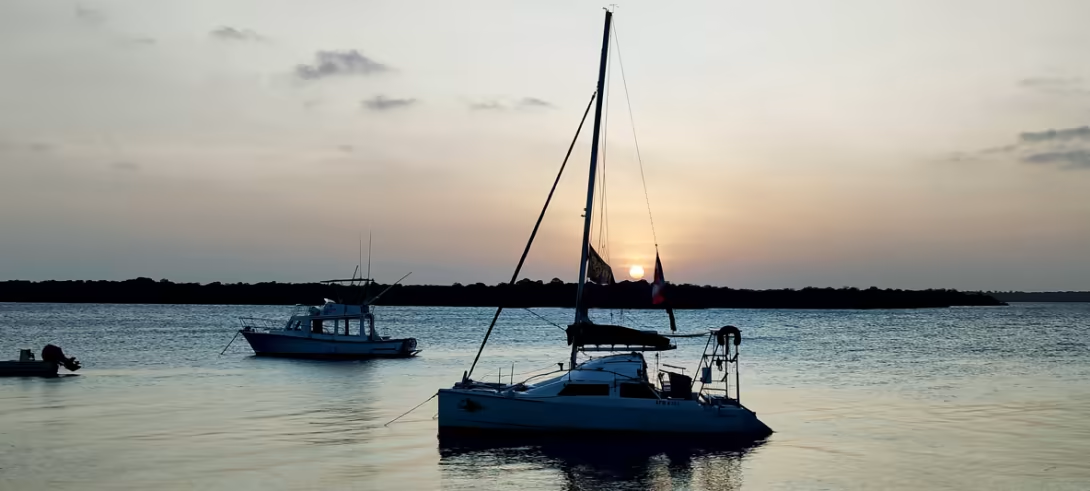
We had a leisurely sleep in and after breakfast, both Amir (a mechanic by training) and when Manu looked at the motor it was then he realized that the kill switch had disconnected! Hassan came for us in Nicholas’ Boston Whaler, and we went on a tour of Lamu town walking past the donkey hospital (Donkeys are the main form of transport on Lamu, where automobiles are banned.) Fritz and I dealt with clearing in and printing out forms, customs, and registering with the Kenya Port Authority. Indeed, we still needed to complete clearance formalities, even though we were sailing within Kenya, but they’ve been dealing with old colonial legacy since long before sailing yachts started appearing on Kenyan shores. We then trekked up the hill past the market to check in with the Coast Guard which was up at the Police Station. Several times per year, we host virtual sundowners from the deck of my boat for my Rotary eClub here in Kenya. We invite Rotarians from all over the world to share stories of their clubs and projects and enjoy a tipple while we watch the sunset. This time it was in Lamu and we were joined by several members of the Rotary Club of Lamu (the “Sailors” they call themselves!) We anchored in front of The Majlis Resort on Manda Island and watched the procession of 10 Mozambican-style dhows. As usual, the Lamu sunset behind the sand dunes of Shela did not disappoint.
Day 4 – Lamu Floating Bar
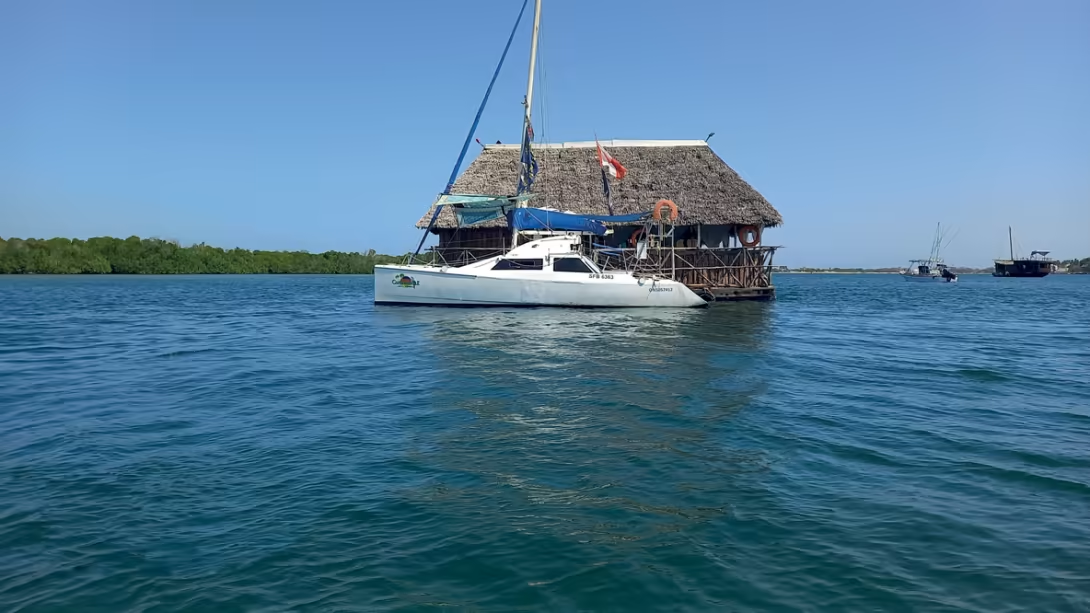
The highlight of the next day (and one of my unfulfilled bucket-list items from last year) was sailing over a couple of hundred meters to and mooring alongside Floating Bar Lamu. As we were facing some challenges in docking, the staff suggested we anchor. I told them that if I couldn’t dock, we wouldn’t be coming for lunch. It seems that the entire staff though came out to assist with our docking and tying us up alongside. Usually, the food in such places fails to stack up against the atmosphere but the mbuzi (goat) and fresh samaki (fish) were every bit as good as the venue. I can’t wait to sail back there again! While there, we met some German cruisers who had just sailed up from Kilifi (Kenya) who were not anchored too far from us. We went for another sunset sail (I never get tired of them, especially in Lamu!) with friends Nicholas, his wife Miriam, her nephew Brian, and Hassan.
Day 5 - Manda
We sailed by the Old Town on the way to Manda Bay Airport where we anchored for a few hours while waiting for our fifth and final crew member, Muema, who was with us on our last adventure but couldn’t join us from the start of the voyage. We then made for Manda Island up through the narrow Mkanda Channel to Manda Bay Resort. As we were just coming off of low tide and encountering a strong current and winds, we quickly ran into the shore. The canal, which is only about 3 miles long and was built by the US Navy in the late ‘90s to service their military base on Pate Island but took less than an hour even against wind and current and running aground. The tide was rising so we were good in our shallow draft catamaran. The number of dhows coming at us from Manda Bay reminded me of rush hour on Toronto’s Highway 401! We were relieved to be out the canal and noticed the new Lamu Port, South Sudan, Ethiopia Transport Corridor (“LAPSSET”) Port to port, but soon encountered a strong current in Manda Bay as well as strong waves. I didn’t really want to anchor at Manda Bay Resort which bills itself as Africa’s leading private island resort, since they said they were busy and wanted KES 6,000 (€38 / $42) per person per dinner! I wanted to sail past them and anchor at Manda Toto but it was too rough, so we anchored up the mangroves several hundred meters away from the resort. We had drinks (expensive!) but worth it and made use of their showers. Afterwards we walked along the beach heading towards Manda Toto and an abandoned resort that I had found on my last sailing trip to Manda Bay about 4 years before. While we enjoyed sundowners, Amir went on a ride and, even if he wasn’t a guest, was allowed to go see the 1500-year-old baobabs and the 9th Century Takwa Ruins. Apparently, Manda is the only island with baobab as the slaves en route to Persia and Arabia ate their seeds and made juice out of the fruit. As we enjoyed the starry night, we saw a drone hovering in the sky over the LAPPSET port on the way to the US military base on Pate Island.
Jour 6 – Manda
channel again and besides, we came to explore! We were up at around 6.30 am, we left Manda Bay Resort, around 7:30-ish and sailed into the ocean about 8.00 am. However, it seemed that we had crossed a reef as Navionics shows “Mwamba” instead of reef. Lucky for us it was high tide, and we were sailing in a shallow draft catamaran. The next time we will use the well-marked and buoyed commercial shipping channel. It took us about 4 or so hours to cover the 16 nm around Manda Island. This time, we anchored over at the World-famous Peponi Hotel. One of the reasons that we like to anchor there is that our loved ones can see us at anchor on the hotel’s webcam. Muema and I went to get water with a few mitungi (jerrycans) from the water boat at Shela and then came back to the catamaran to collect Fritz and head over to Lamu Town to clear out at KRA and check in with Kenya Ports Authority. We later had lunch at Stopover Guest House on the Shela oceanfront. My wife Cassandra and I had stayed there a number of years back with my daughter Stasia. I remember longing then for the day when I would own a sailboat again and be anchored out there. Later we took Nicholas, his wife Miriam and friends for a final sunset sail around the south shore of Manda Island, past the Majlis Resort, past Fort Shela, out into the ocean and back up the channel to anchor once again in front of the Peponi Hotel. Nicholas invited us to supper at Pizza “O” (ex-Osteria) where I ordered (as did several others) the tasty chicken Milanese. After supper we walked over to Peponi for drinks and to use their land-based toilet. We walked back over to Nicholas’ Boston Whaler for a final lift over to CassandravillE. But when we got there, we realized that we had anchored very close to shore at low tide. However, when we woke up the next morning, we were way out in the channel.
Day 7 and 8 – Manda – Watamu
We were awake at 5am and had a quick breakfast prepared by Manu (as he always does) and were underway by 5.55 am. It was still dark, but we followed the fishermen expressway out the channel into the ocean. We were soon using the beautiful and huge red and white spinnaker which Fritz had given to me from his sailboat as a birthday gift. We quickly caught a 20 kg (45 lb) yellowfin tuna which Manu and Muema reeled in by hand under full spinnaker as we did not want to stop. It was then a swift run down Ungwana Bay as the winds and waves continued to build. We later put in 1 reef and then another. As they say, there are no atheists at sea so there was a lot of praying! The winds and seas calmed by midnight as we arrived in Watamu having chosen an offshore route directly from Lamu rather than heading closer to shore (and fishing nets!) Since it was low tide so we anchored outside the reef until 2 am when we could cross the mlango (literally “gate” but in local parlance refers to the channel, ergo “gate” through the reef). We were up by 7.30 am and then went ashore for breakfast at Ocean Sports before heading to my home. What a trip! I can’t wait to go back!
Notes for next time:
- We will take 2 days to sail up with the first night at anchor in Ngomeni, and moor stern to at the jetty in Shela perhaps. We will probably go to Mike’s Camp in Kiwayu (that I had sailed to in 2020.). - Better charging system for phones, and bigger battery just for autopilot.

Weather check
Lamu is located in the southern hemisphere, but just below the equator - GPS position 02°16’18” S, 40°54’07” E. The climate is therefore warm all year round, with a cooler, drier season from June to September and a hotter, wetter season from November to April. The rainy season lasts from April through mid-July, with a total rainfall of 700 mm (27 in). For the rest of the year, rainfall is low - reaching 920 mm (36 in) over the year - and even non-existent in January and February. Warmest month: August, with an average minimum temperature of 23.4°C (74°F) and an average maximum temperature of 29°C (84°F). Warmest month: April, with an average minimum temperature of 25.6°C (78°F) and an average maximum temperature of 33.1°C (92°F). Sea temperatures range from 25.5°C (78°F) in August and September to 29°C (84°F) in April. Annual sunshine totals 3,200 hours. From April to October, winds are generally southerly at 12 to 16 knots. From November to March, winds shift to the east at 10 to 15 knots.
Top 5 things to visit and to do in Lamu
• The Lamu Seafront. For the hustle and bustle and the donkeys and the vibe! • Peponi Lodge (Shela). For the atmosphere, the views, the characters, the fantastic selection of drinks. • The Floating Bar & Restaurant. It was well worth the schlep all the way to Lamu just for this place. I loved being able to moor alongside. The food, the service (although slow) and the views were beyond amazing. • Sunset Sailing. There is no sunset like a Lamu sunset: that says it all. We joined the sunset procession of dhows 3 or 4 times while were there. If I lived in Lamu, I would probably do it every night and I’d never get tired of it. • Manda Bay Lodge. Just wow. Despite not being formal guests, we just sailed up and were literally welcomed with open arms. What more can be said?
