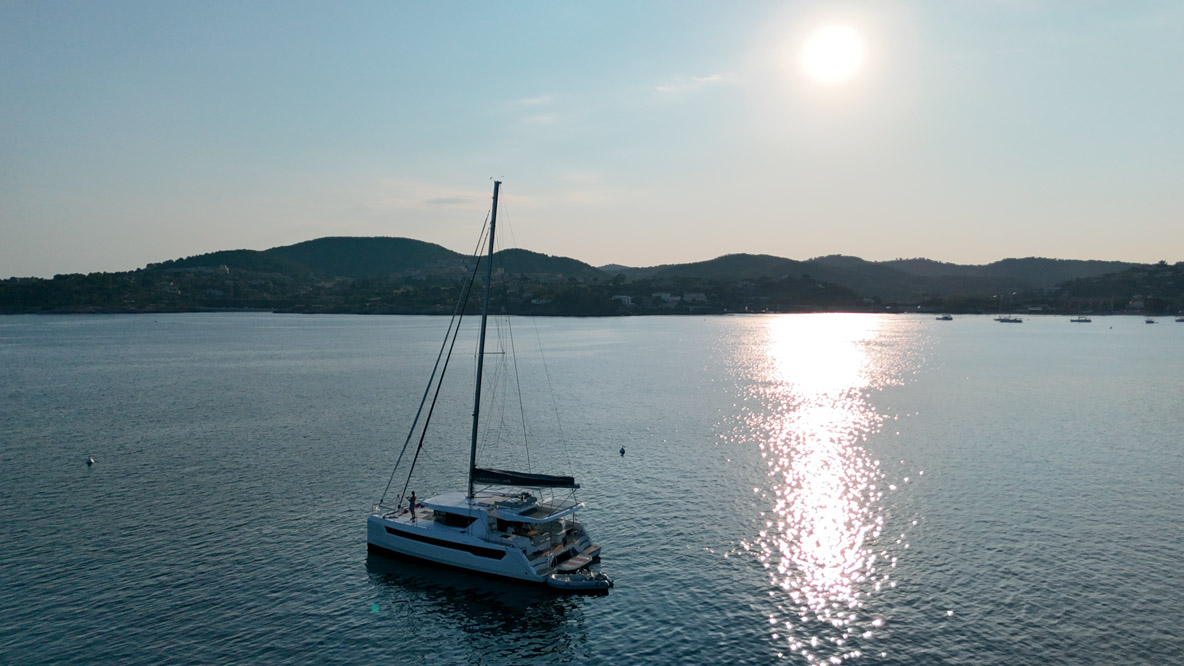
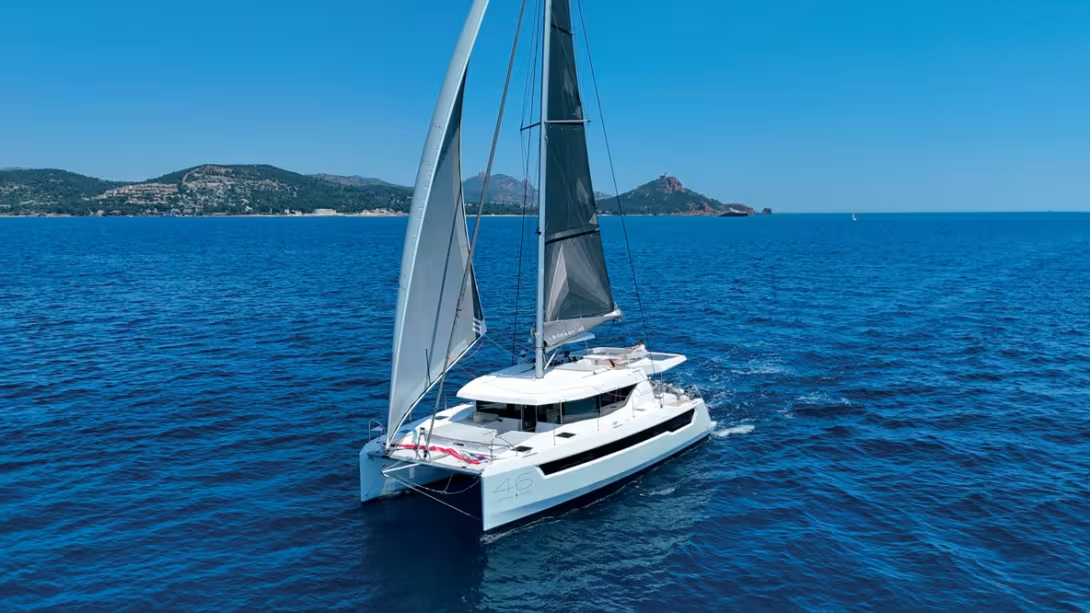
Conditions : 4 to 8 knots of wind, calm sea
Three years ago, when we launched this Forever Green Special Issue, we were generally satisfied with the theoretical data provided by equipment manufacturers. Then we were able to test the first electric catamarans for a few hours, which was a much better thing. Last year, we collected the first testimonials from owners who had completed ocean passages. Could we find out more? Yes, by spending 24 hours on board to learn everything there is to know about electric propulsion and better understand how it works in typically “current” use. We contacted the Leopard Catamarans team: their base in Saint-Raphaël is home to a Leopard 46 Electric Drive. For the sake of consistency, we also had the use of a Highfield tender powered by an electric outboard.
Reassuring Range
When we cast off in the late afternoon, the batteries were at 100% as we’d been hooked up to the shorepower until 4pm. Useful information: when connected to shorepower, the battery bank recharges in four hours. As our plan was to enjoy complete freedom, the option of plugging back in during our unpretentious mini-cruise was obviously out of the question.
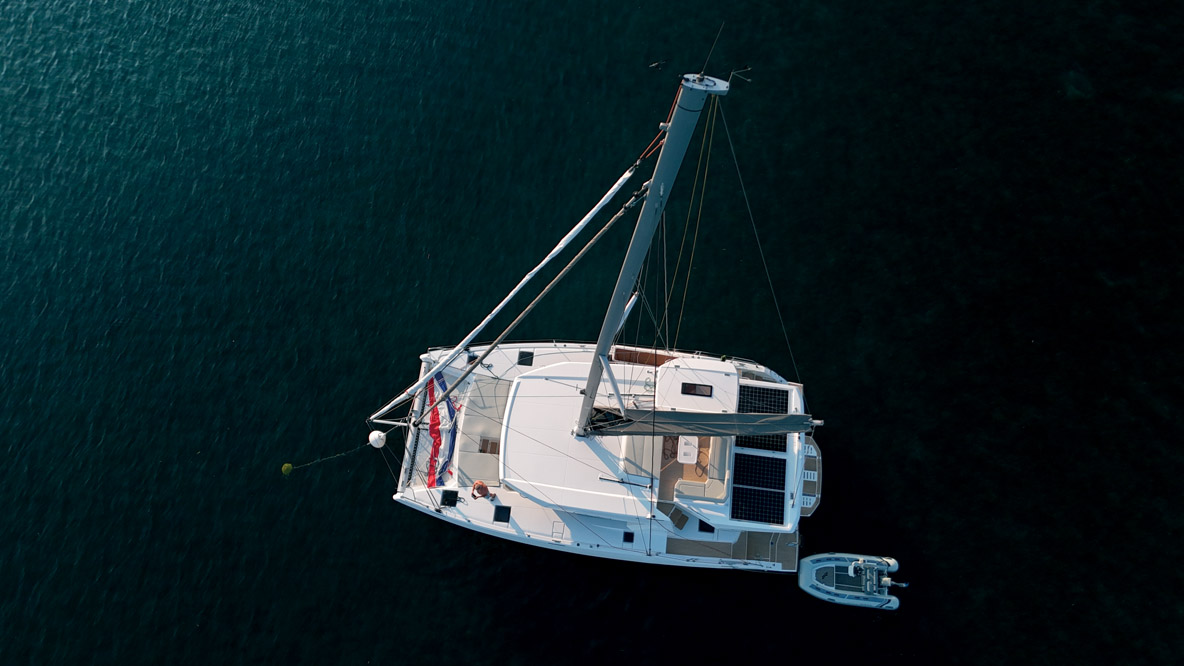
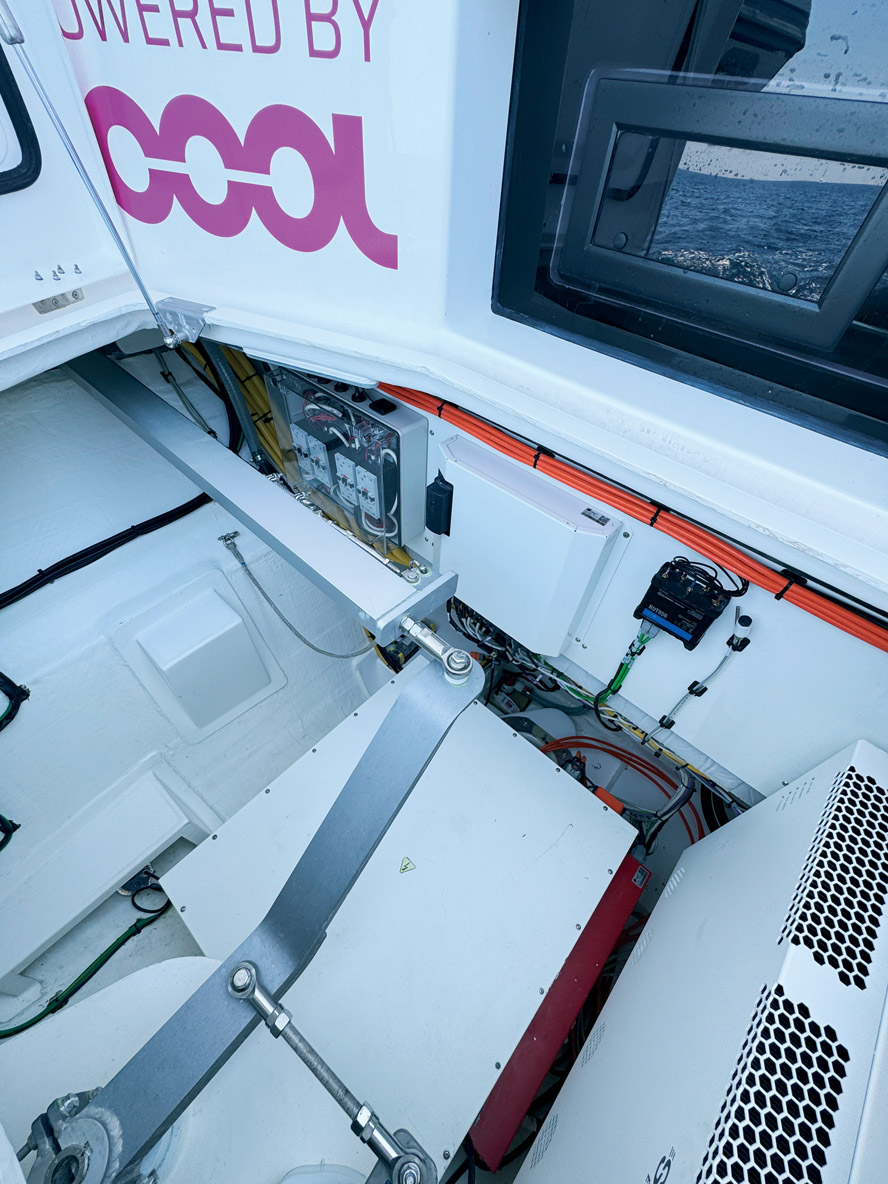
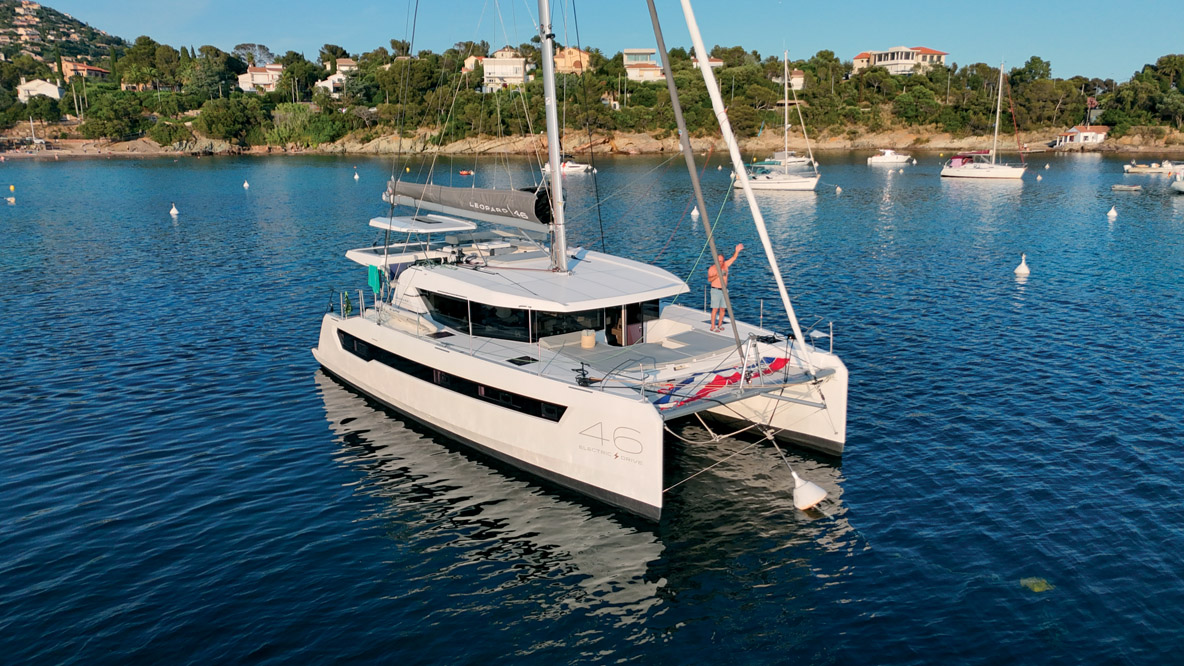
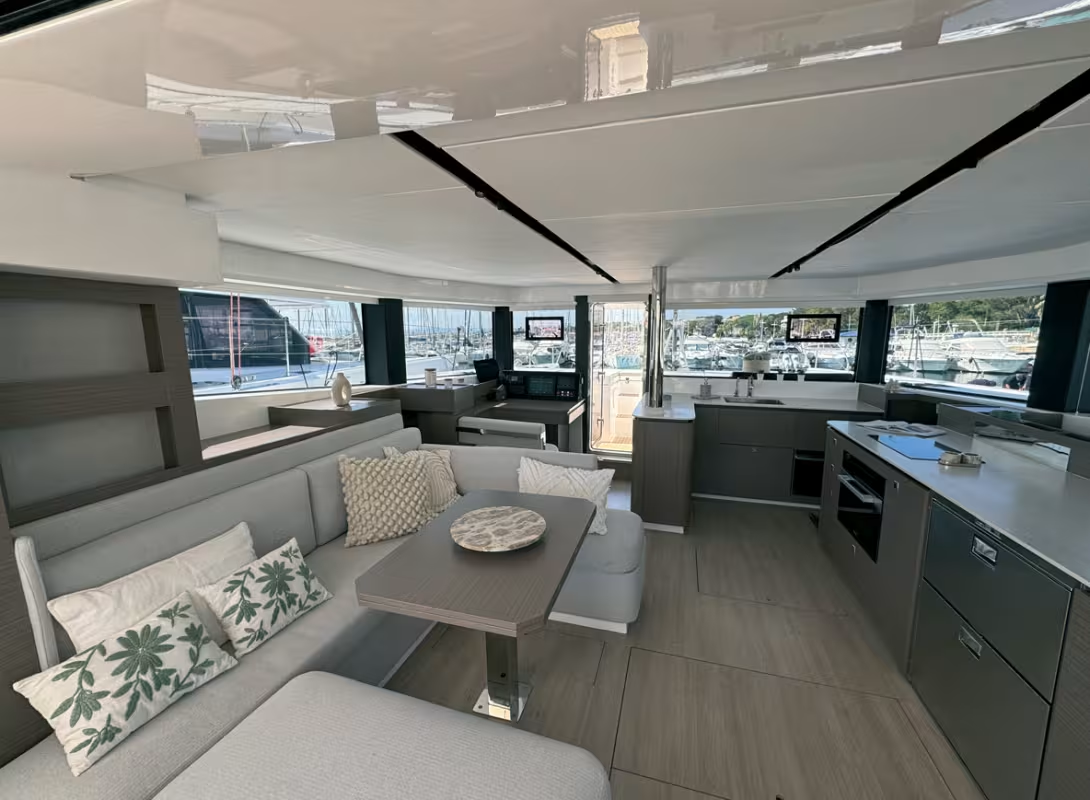
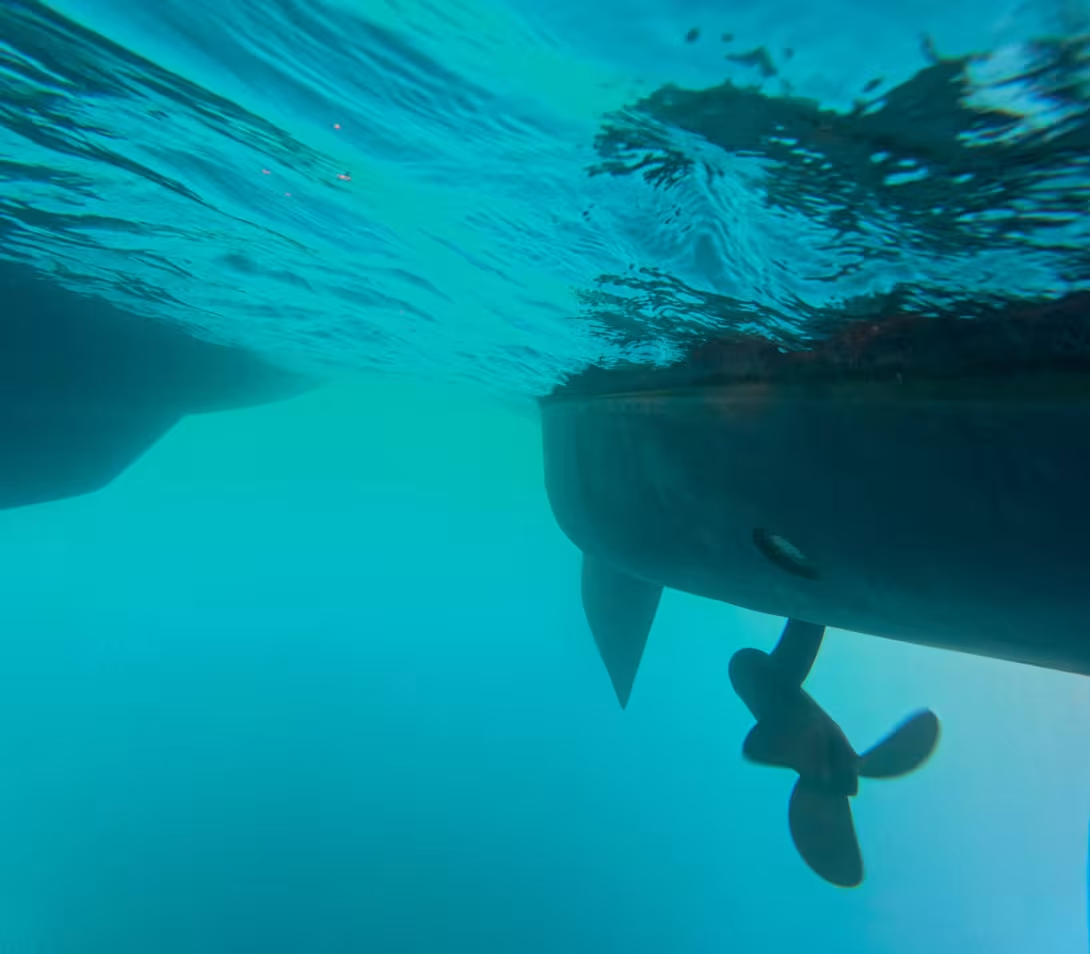
The Leopard 46 Electric Drive we had was equipped with a system designed by Joool – it’s exactly the same as the one fitted by Fountaine Pajot. Each hull is equipped with a 25-kW motor/pod and a 27-kWh battery. The builder also offers 21, 32, and 38 kWh options. The catamaran is equipped with four 400 Wp solar panels, a 4 x 210 Ah AGM service battery bank in 12 V (in our opinion, this bank would benefit from being upgraded to lithium) and a powerful 24-kW generator. On paper, the figures speak for themselves: if you want to sail at full speed (8.5 knots), the generator will start up in less than an hour and maintain a maximum speed of 7.5 knots. By barely touching the throttle, you can “motor” for 550 miles at 7 knots, and 920 miles at 6 knots. These figures are comparable to those of a “fully internal combustion” unit, if that’s any consolation... but our goal, in this Forever Green Special Edition, is rather not to touch the 180 US gallons (690 liters) of diesel we’re carrying...
A word about the powerful generator: it is still very useful on board, as one hour of runtime recharges the battery bank to 45%, or provides two hours of engine power at 6 knots, or four hours at 4.5 knots. But here’s the thing: the generator, soundproofed as it is, is still noisy and even makes maneuvering in port kind of tricky when it’s running
In Slow-life Mode...
Once the plug is pulled, we obviously switched to another mode, the autonomy mode that interests us here. Leaving the slip was smooth and quiet. There’s no need to push the levers hard down to ensure rapid power: you can feel that the electric motors have high torque. The so-called throttle levers seemed pretty small and sensitive to me, but you do get used to them.
We were in front of the islet of Lion de Terre, which lies across the southern entrance to the port of Santa Lucia. So should we turn to port, towards the islands of Iles de Lérins or to starboard towards the Gulf of St Tropez? We decided that port was the way to aim, and to head for Cannes. We set a speed of 500 rpm, which gave us 4.9 knots, consuming 3 kWh per motor. On board, the instruments were on, the two refrigerators were running, as were the AC inverter, a remote screen, a computer, and a few cellphones charging. Our average daytime domestic consumption was just under 1 kWh. Our total electrical consumption was therefore 7 kWh. We could therefore last a little over 7 hours with our 54 kWh batteries and travel a little less than 40 miles. These figures corroborate those of the shipyard, who claims 8 hours of full electric autonomy at 4.5 knots and 4 hours at 6 knots. We were beginning to get used to the slow life... Gilles, our skipper, hoisted the mainsail from the helm while Arnaud and Pierre-Yves prepared the gennaker - we had actually managed to find a small thermal breeze.
At 5:20 pm, the motors were shut down, but the sailing maneuvers still required 4 minutes’ use of the 1,200 W electric winch. With the wind struggling to reach 5 knots, our sails filled and pulled us along at 2.5 knots. We started the hydrogeneration system: the propellers each produce 50 W, but the noise isn’t that pleasant. So we decided to try the opposite approach: at 5:40 pm, we set both motors to 2 x 400 W, or 300 rpm. Our speed settled at 3.6 knots. This means that we gained a little over one knot with minimal energy expenditure. Here again, we are very close to the manufacturer’s data, which indicates a gain of 1.5 to 2 knots with 2 x 1 kW of engine thrust. 5:41 pm: with the sun now much nearer the horizon than its zenith, I was surprised to see that the solar panels were still producing 600 W. The yard has also provided for the possible installation of recessed panels on the coachroof
An Economical Night
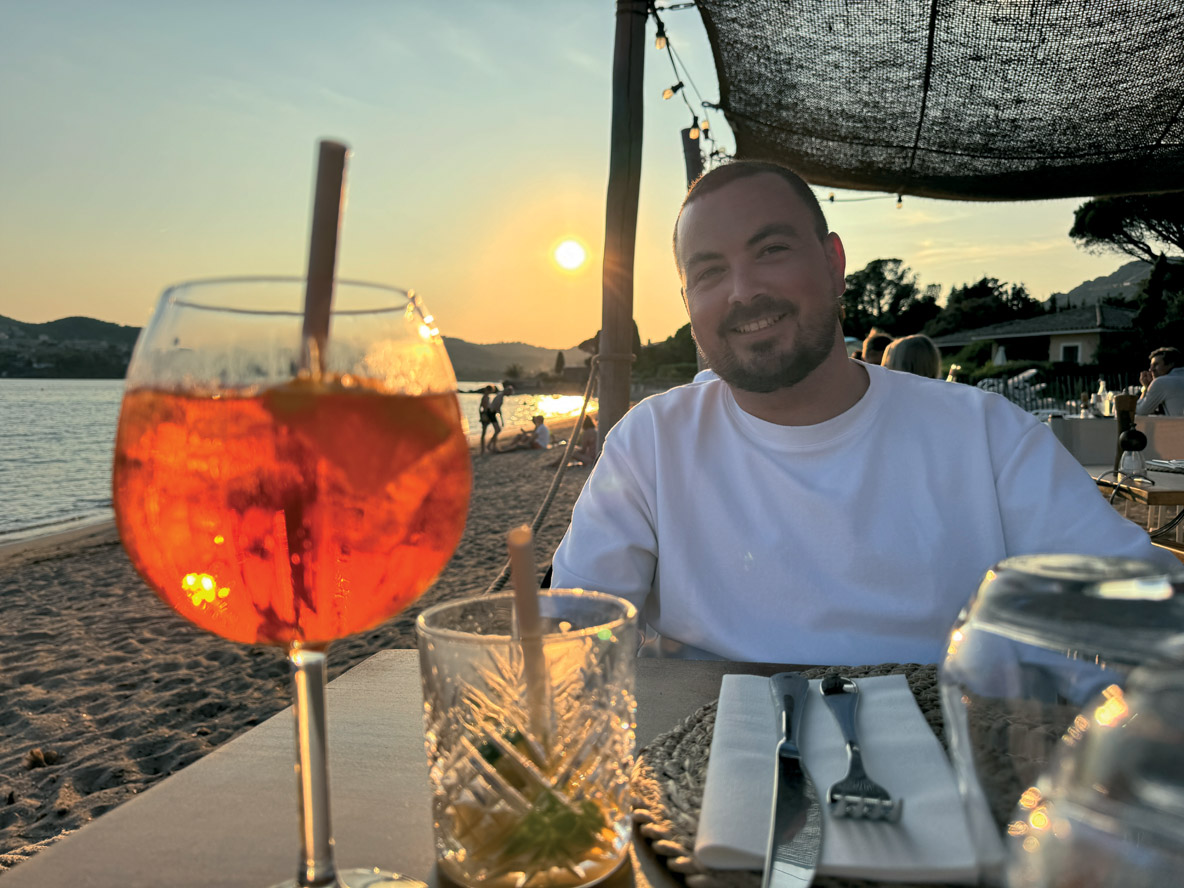
Just to the north, Agay harbor was looking very inviting. We called to reserve a mooring ball, but it was already too late, and no one answered, so we left a message. Pierre-Yves, meanwhile, booked us a restaurant where we could have our “feet in the sand.” At 6:05 pm, the gennaker was furled and the mainsail lowered. We pushed the motors to just 400 rpm and settled in at 4 knots. Our propulsion consumption was 1.4 kWh. At 6:23 pm, we pushed the throttles a little to reach 5 knots - the power required was 2 x 2.5 kW at 500 rpm.
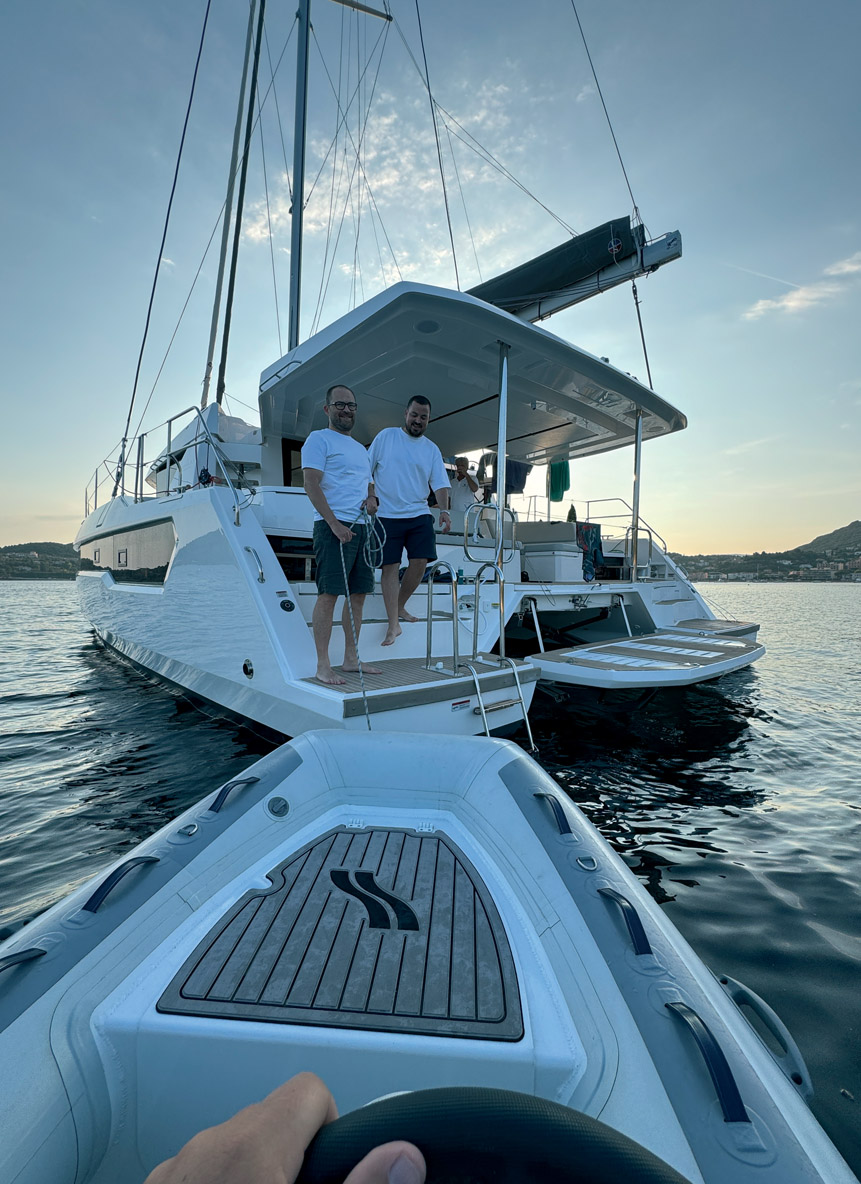
6:30 pm: we picked up a mooring ball. It was hard to resist the call of the water at 74°F (23°C)... The aft platform was submerged (the motor is almost equivalent to that of the winch, ie. 1 kW, which took a minute to launch our dinghy, a Highfield 340 E-Propulsion equipped with a 6 kW Navy 6.0 Evo motor. I had planned to give you a full review of this dinghy, but during transport (by road), one of the three propeller blades broke, which was a shame. The 650 feet (200 m) separating us from the shore still allowed us to appreciate the ergonomics of the suspended helm station, the stability, and the comfort. The round trip only resulted in a 2% reduction in charge for the 8.35 kWh ePropulsion E163 battery.
Back on board, the dinghy and platform were put back in place, the catamaran’s lights were turned on, as was the anchor light. Pierre-Yves put on some music, not too loud as our neighbors in the anchorage were fairly close, while Gilles switched on the underwater spotlights for a few minutes. He explained that in this area, lighting is limited to one hour so as not to disturb the wildlife. Shortly before midnight, I made my way to the owner’s hull (thank you guys) while the rest of the crew set about a lively game of cards. I woke up fairly early in the morning and glanced at my phone – it was out of battery! The inverter actually switches off if one of the two motor systems isn’t running. This wouldn’t be a problem if the system wasn’t accompanied by relatively noisy ventilation. So Gilles had switched everything off, depriving us of AC power... In fact, the 12 V reading lights area actually equipped with USB-C outlets, but you had to know that, of course! In the event, it was Amel, who works in technical support, who explained this to us when we got back to the dock...
Optimal Sunshine
In short, to get power back, I turned on the starboard system (the fan is close to the berth I was assigned, so it was the least noisy option for the rest of the crew members who were still sound asleep. The morning data shown on the screens was interesting: the port battery was at 85% charge and the starboard battery was at 92%. The Leopard was now only consuming 500 Wh (the refrigerators had remained tightly closed) while the power delivered by the solar panels was already reaching 750 W - so we were in the black! I switched the inverter back on so I could use my phone, my laptop, the coffee machine, the kettle, hot water... 230 V is great, after all!
My crew finally got up, with two out of three phones at 0% battery. Gilles explained that on board this electric Leopard, as skipper, he not only pays attention to the weather, the schedule, and his crew, but also to energy management.
Gilles went back down to the platform and the dinghy to make another run ashore – a quarter of a nautical mile (500 meters). The dinghy battery dropped 2% of its charge, so we decided to recharge it, which took 20 minutes.
The Miracle of Hydrogeneration
Noon: one last swim and we cast off our mooring line. On June 18, almost at the summer solstice and with the sun close to its zenith, the panels were charging between 1 and 1.2 kW, gaining 200 W for the batteries.
At 12:20 pm, the motors were driving the propellers at 350 rpm, taking us out of the bay at just over 3 knots.
At 12:30 pm, the thermal breeze was beginning to pick up, and we had 6 knots of true wind. The mainsail and gennaker are hoisted and unfurled, the motors were shut down, the propellers locked off, and we were making way at 4 knots. In this configuration, we could regularly hear a slightly annoying beeping sound - a detail that should be corrected quickly. The wind deigned to pick up to 8 knots: now we started to lengthen our wake and easily exceeded 5 knots. I started the hydrogeneration system: we were recharging at 1 kW and, curiously, we gained 0.1 of a knot of speed. When the sun reached its zenith, we were then at 1.2 kW of charge from the panels, so 2.2 kW in total against 1.0 kW of expenditure, ie. a charge of 1.2 kW in the batteries. The only downside is that the hydrogeneration is still noisy, although this becomes more tolerable as boatspeed increases. According to the equipment manufacturer’s data, we could expect 3 kW at 8 knots and even 5 kW at 10 knots. Note that this is all theoretical: the sea state, any slight list, and turbulence can significantly alter these figures.
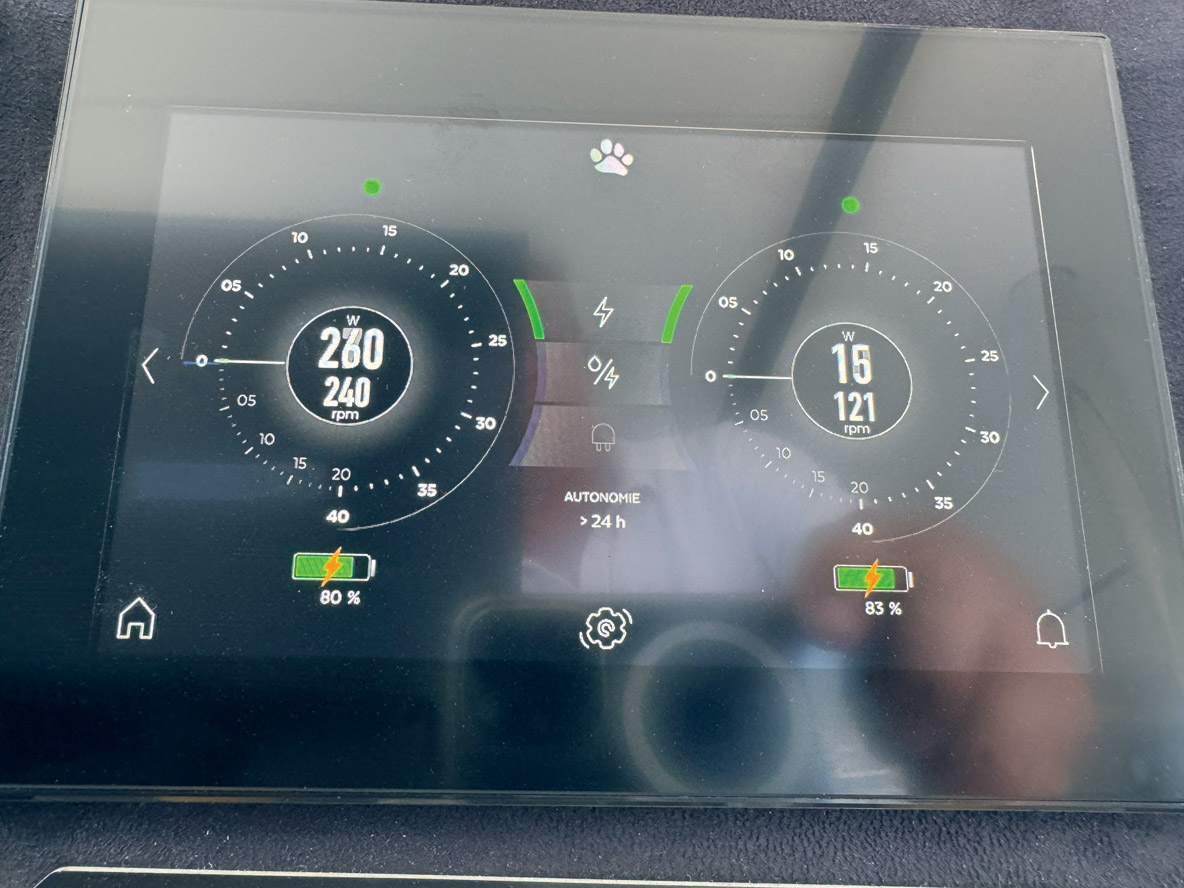
We continued sailing off the Gulf of Fréjus before returning to our slip. It was 4 pm: just 24 hours after our departure, the Leopard could be plugged back in to the shorepower... but unless we wanted to turn on the air conditioning, there was really no need to do so, as our batteries were at 80% on the port side and 83% on the starboard side. So we didn’t need to start the generator - mission accomplished!
Ability to sail without fuel emissions
Real self-sufficiency at anchor
The service battery bank could be upgraded to lithium
Still high additional cost
Technical Specifications
Architect: Simonis & Voogd
Length overall: 47’6” (14.48 m)
Beam: 24’1” (7.35 m)
Draft: 5’5” (1.65 m)
Sail area: 1,554 sq ft (144.4 m²)
Displacement: 37,940 lbs (17.2 t)
Motors: 2 x 25 kW
Generator: 24 kW
Drivetrain batteries: 2 x 27 kWh
Service batteries: 4 x 210 Ah AGM
Hydrogeneration with two motors (estimates)
• 1.5 kW at 6 knots
• 4 kW at 8 knots
• 7 kW at 10 knots
Solar panels: 4 x 400 Wp
Max observed load: 1.2 kW
Min observed consumption at anchor: 16 Ah in 48V, or 768 Wh
Max observed consumption at anchor: 30 Ah in 48V, or 1,440 Wh
Fuel: 182 US gal (690 l)
Water: 185 US gal (700 l)
CE Certification: Category A
Price: € 1,082,500 ex-tax
www.leopardcatamarans.com