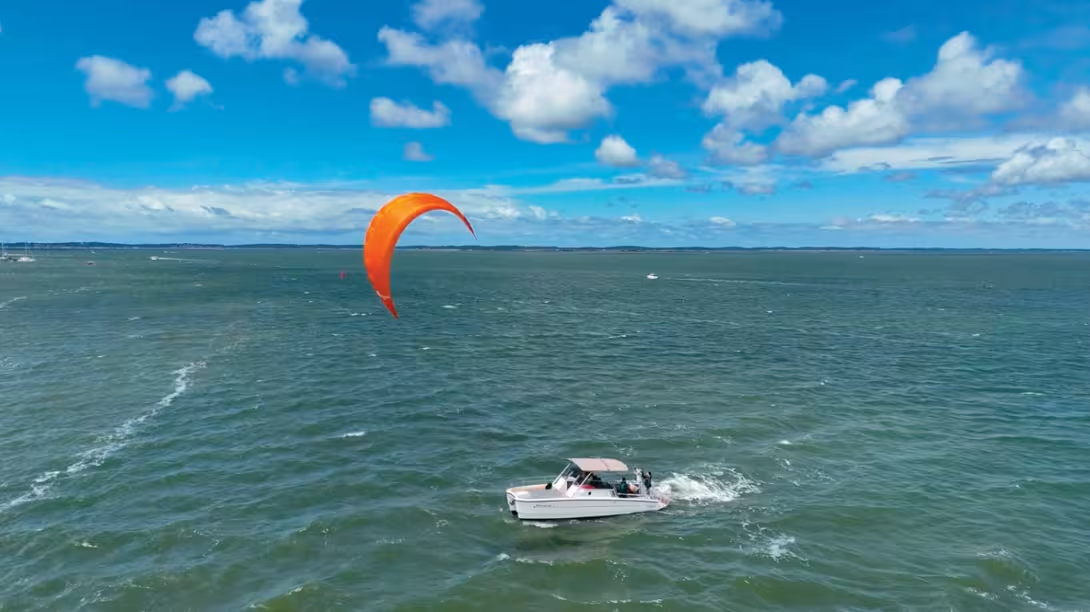

Conditions: westerly wind 12 to 18 knots, light chop
The idea of being able to take on board a traction kite to remain maneuverable led to the creation of the LibertyKite® some ten years ago by Beyond The Sea, a company specializing in towing large commercial and fishing vessels.
Since then, some of the biggest names in sailing, such as Charles Caudrelier - recent winner of the Arkea Ultim Challenge - Armel Le Cléac’h, Tom Laperche, Alex Thomson and many other sailors have carried a LibertyKite® on board for their maritime expeditions. It goes without saying that with such skippers, the product has already been validated, but this kite deserved to be tested under yachting conditions.
The self-stabilizing wing, which requires no permanent adjustments to keep it within its flight window, can be used to sail on any type of water and on any type of boat, provided it has two pulling points and sufficient space to launch it.
As the Pinball Boat hybrid catamaran lends itself perfectly to these conditions, the two teams met at Quai Goslar in Arcachon on France’s Atlantic coast for this “test flight”. Conditions offered a well-established 12-knot wind and a choppy but clear stretch of water. Flight is accessible from 10 knots of apparent wind, so particular attention must be paid to drift and sea state.
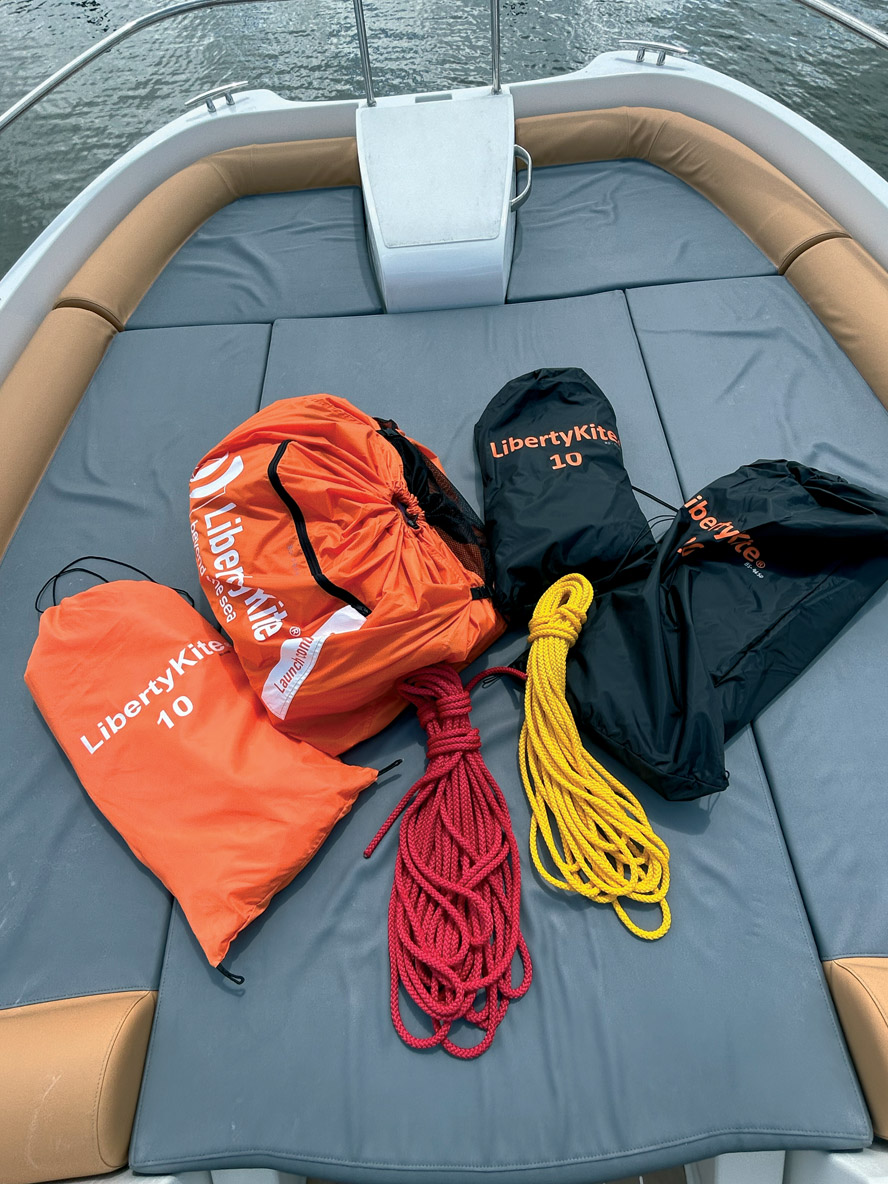
On the Pinball’s 65-square foot (6 m²) foredeck are the bags containing the three available wings. Space requirements are minimal. A block, two sheets and two cleats: that’s all the 215-square foot (20 m²) LibertyKite® that we’ll be flying today needs. It should be noted that the French companies Cousin Trestec® and Porcher Industries® collaborate respectively in the manufacture of the fabrics and the ropes.
Preparation is simplicity itself
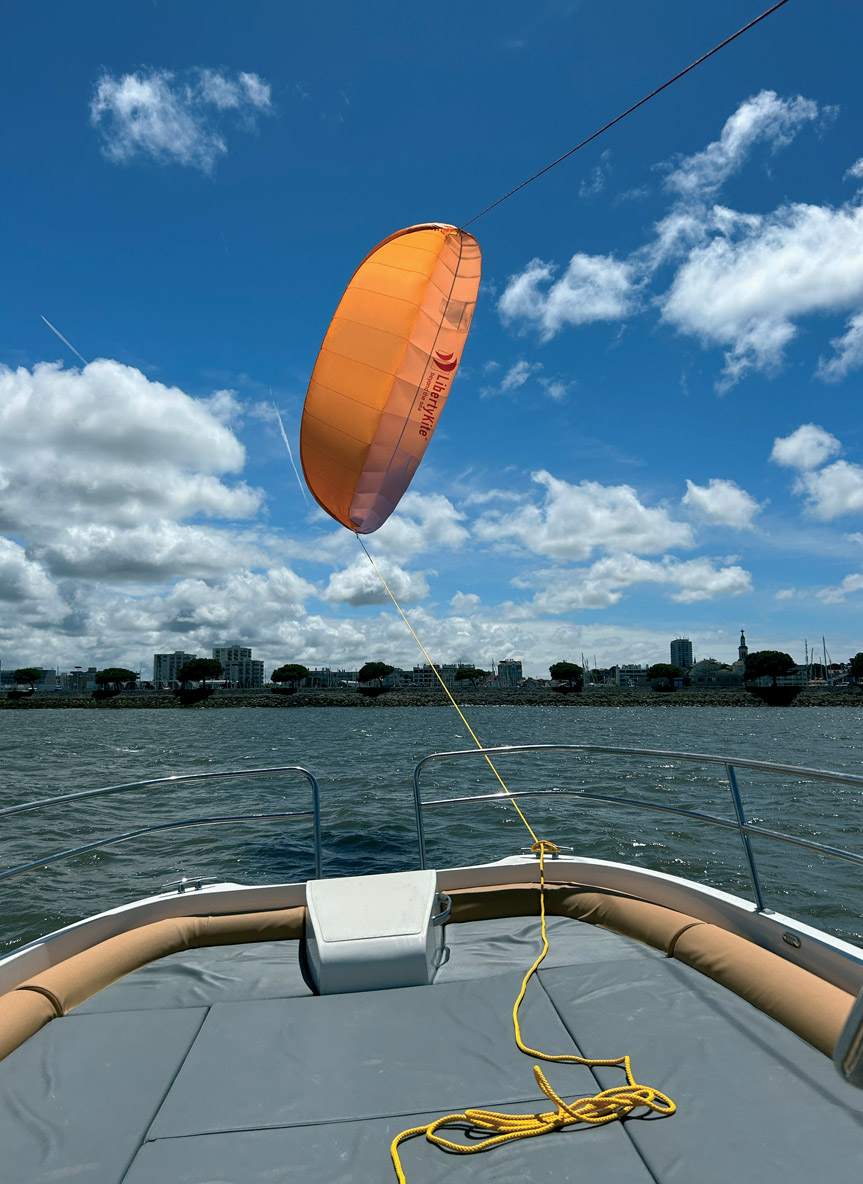
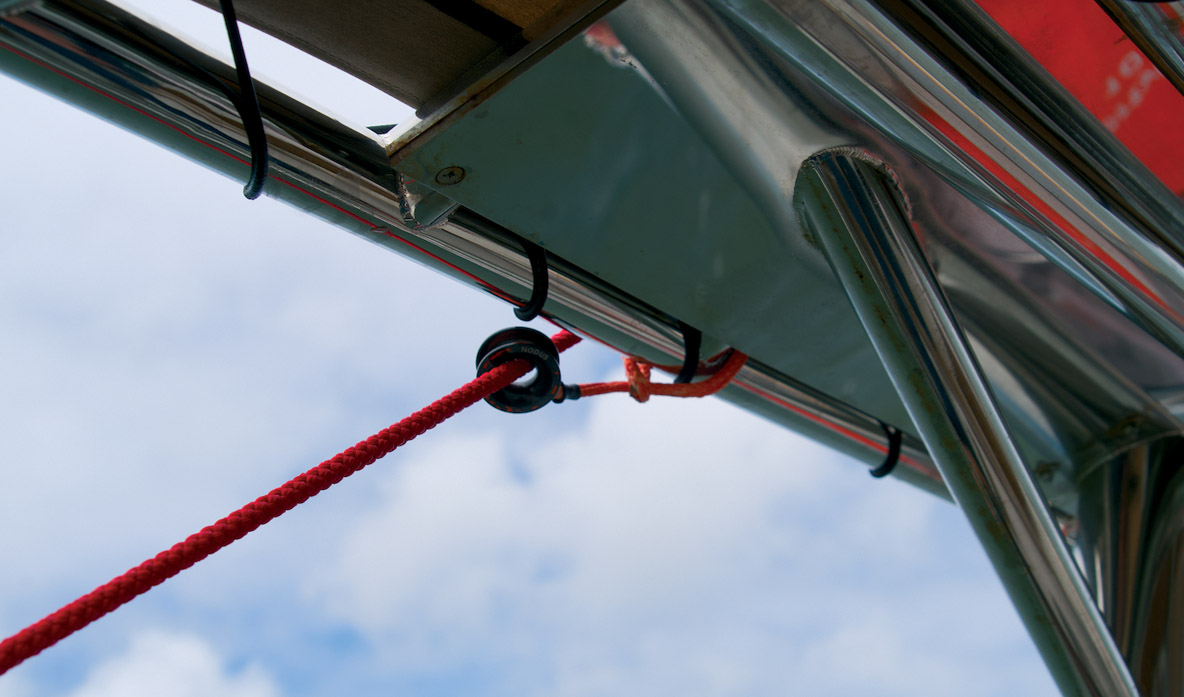
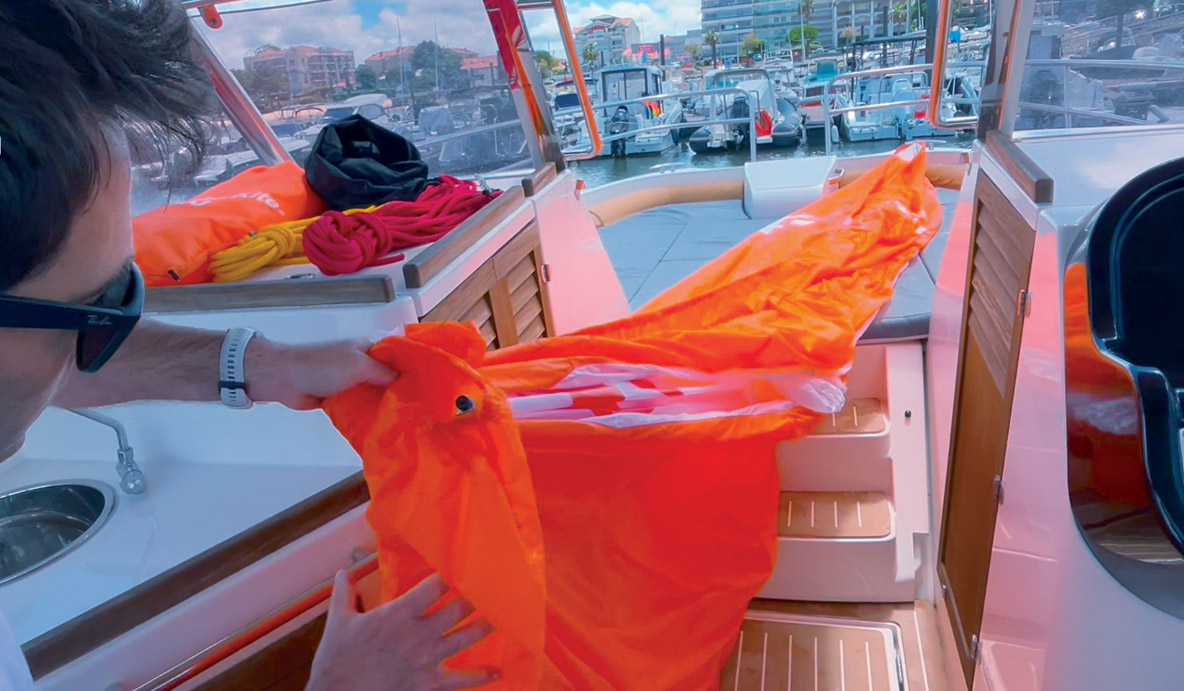
The 9-meter-long (30’), 2.97-meter- wide (10’) powercat silently slips aways from the pontoon thanks to propellers in the port and starboard nozzles - a smart move for the safety of swimmers - powered by a 23-kWh lithium battery located in the bow. Throttle levers are used to position the catamaran silently to windward of the Cercle de Voile d’Arcachon sailing school - a notable landmark with a green roof. Preparation is a breeze. Thanks to the PinBall’s stainless-steel T-top, the aft pulling point is set up like a barber-hauler with the block attached to the hoop. The sheet is secured on the aft cleat, then passes through the block to be attached to the wing with a sheetbend. At the bow, the sheet is cleated off fairly short and connected to the wing with a distance of about one meter between the two points, as opposed to 3 or 4 meters at the stern.
The launch is the first phase of flight.
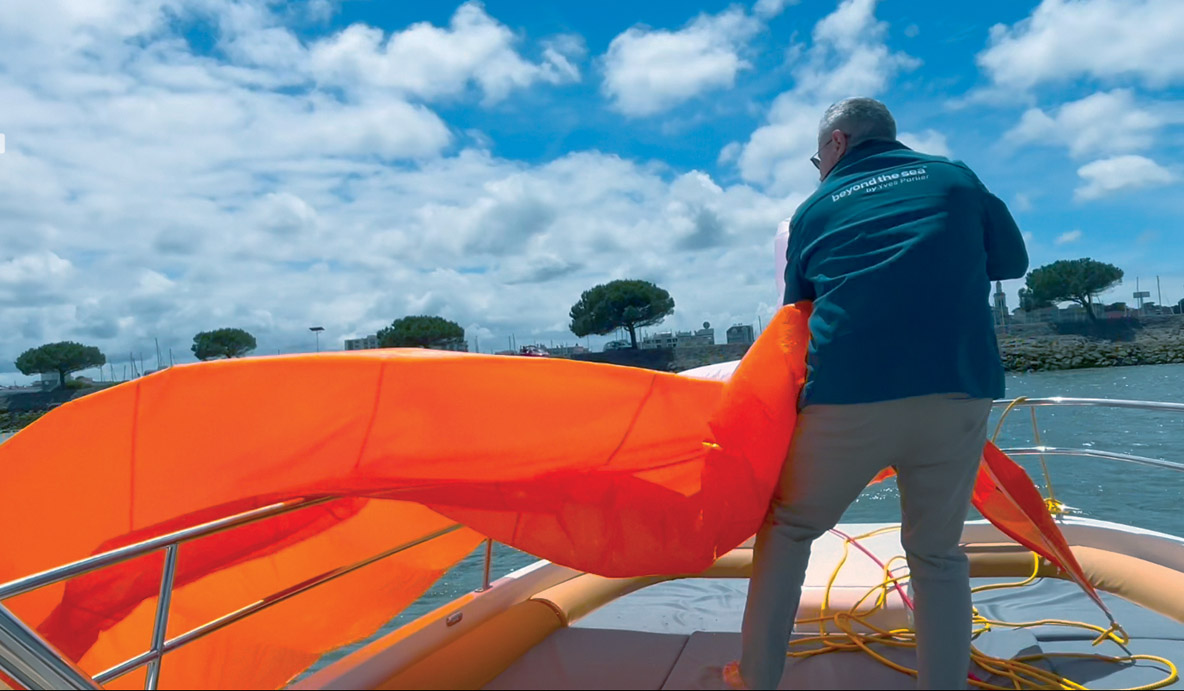
The wing is inflated through a compartment located along the leading edge and covering about a third of the total surface area, without forgetting to close the air inlet pockets beforehand. Inflation continues from the front to the rear ear in around ten seconds. Once the LibertyKite® is airborne and stabilized, the lines are gradually eased to gain altitude and position at a 45° angle to the water. The kite then begins to describe regular S shapes. It’s smooth, seamless and quiet!
Now it’s time for the second phase: trimming.
Bear in mind that if the pulling points are too far aft, the wing will luff, and if they are too far forward, the wing will surge. The company stresses the importance of keeping lines parallel, with pulling points perpendicular to the apparent wind. Use, even for the uninitiated, is relatively straightforward. Much more so than with a conventional kitewing, even if flying one is not similar to conventional sailing.
The Pinball’s electric propulsion barely disturbs us - the powercat, with its shallow draught of 50 centimeters (20 inches) and Z Drive lower leg, doesn’t have a sufficient anti-leeway effect to correct the heading at the helm, and thus keep the catamaran in a correct position with respect to the apparent wind. Small “electrical” corrections are therefore necessary. But some powercats with skeg keels and rudders can do without such adjustments!
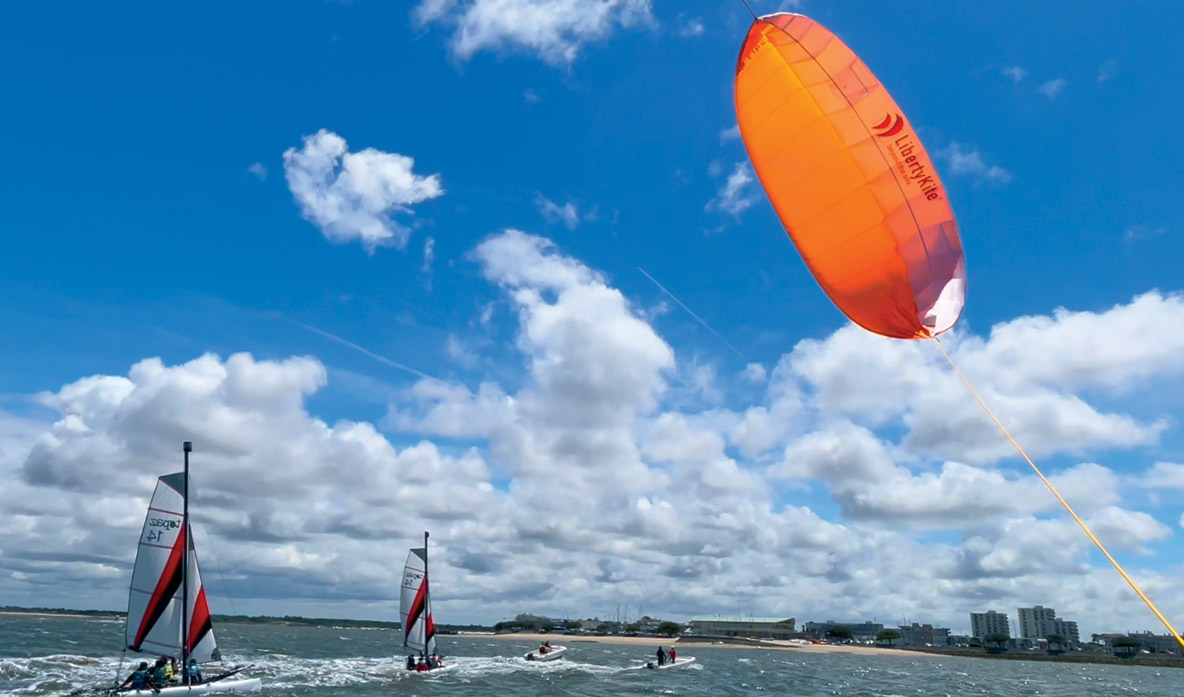
There’s also an unexpected argument in favor of the LibertyKite®: whether you’re setting it up or flying it, the colorful kite has the same effect on children as a regular kite. The wonder of a kite moving with the wind is timeless. The young sailors we met during their sailing lessons on small, lightweight catamarans made no secret of their delight at sharing the water with a powercat towed by a large kite. From the deck of the Pinball, we could hear them exclaim: “Kite! Kite!” Slow sailing is good! An observation shared by Pascal Duclos, CEO of Pinball: “The Libertykite® allows us to save battery power and I just keep control with the electric motors, so it’s a bit of the best of all worlds and it makes a wonderful image!”
It’s difficult with a falling tide to give accurate speed readings, especially as we’re tacking quite short. But the range is between 2 and 3 knots on the course, depending on the angle, with the wind now averaging 14 knots. Note that the Pinball weighs over 4 tons in ready to sail condition, with 6 adults on board.
Unquestionably safe to use
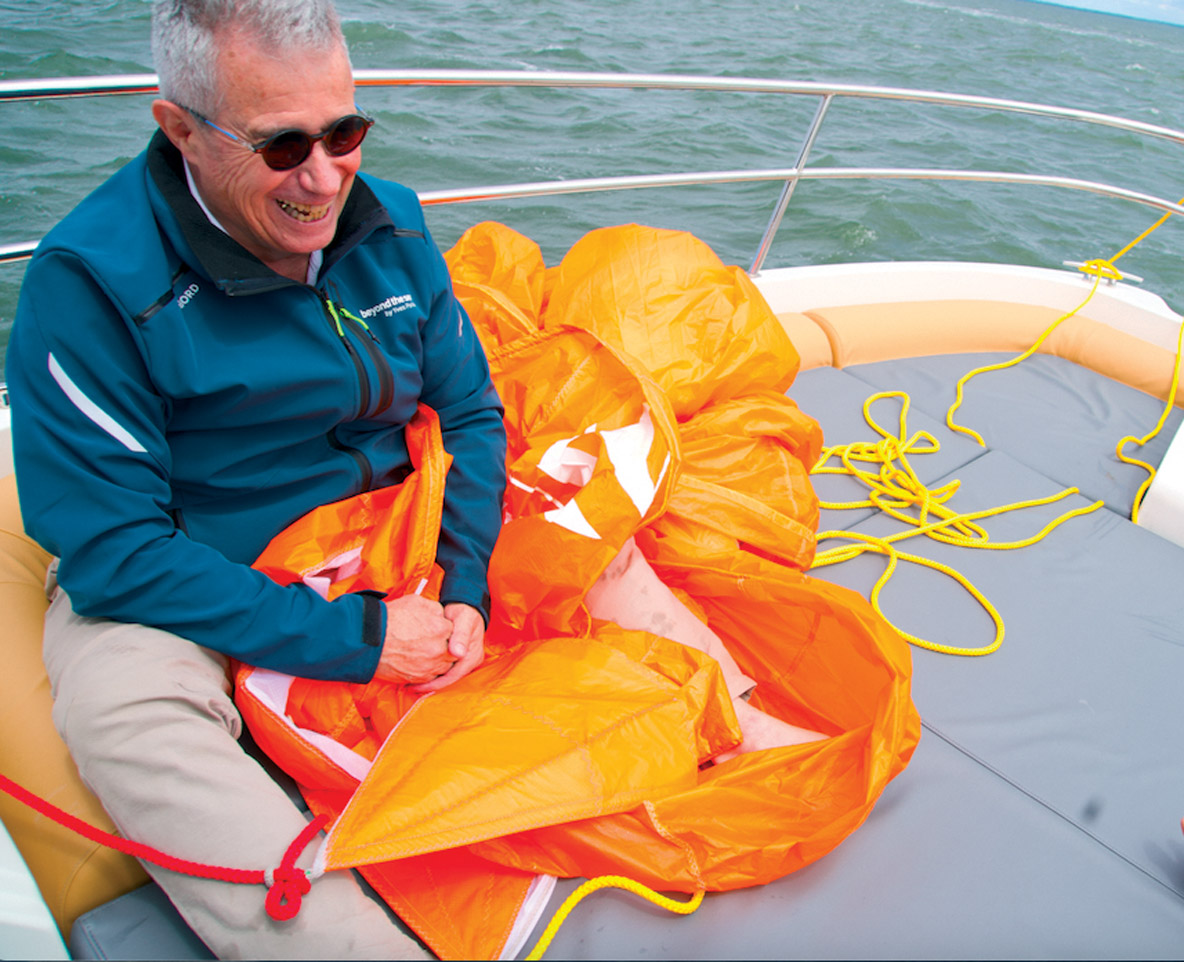
The third and final stage of the flight involves retrieving the LibertyKite®. Rather like a classic spinnaker, you simply release one of the two lines and retrieve the other. With a bit of bundling, the kite is brought in without touching the water... After folding, it’s ready to be relaunched. Hoisting, setting and retrieving the kite are carried out on different tacks three times during our trials, always with the same precision, simplicity and efficiency - there’s a reason why the LibertyKite® has been used as an emergency sail on so many racing boats... But you don’t have to be a great sailor to play at being towed, to give a different flavor to a day that would otherwise be spent under engine power, by involving the crew in rediscovering something as old as Methuselah: using the wind to move forward. What’s more, it’s indisputably safe to use, which is important if you’ve got children on board.
But the fundamental aspect of this traction kite is decarbonization. A credible alternative to 100% internal combustion boating, the kite could well become the standard on board small craft as well as large cargo ships. To this end, Beyond the Sea offers kites of up to 120 and soon 240 m² (1,290 and 2,580 square feet) and continues to optimize its automated SeaKite and develop intermediate products.
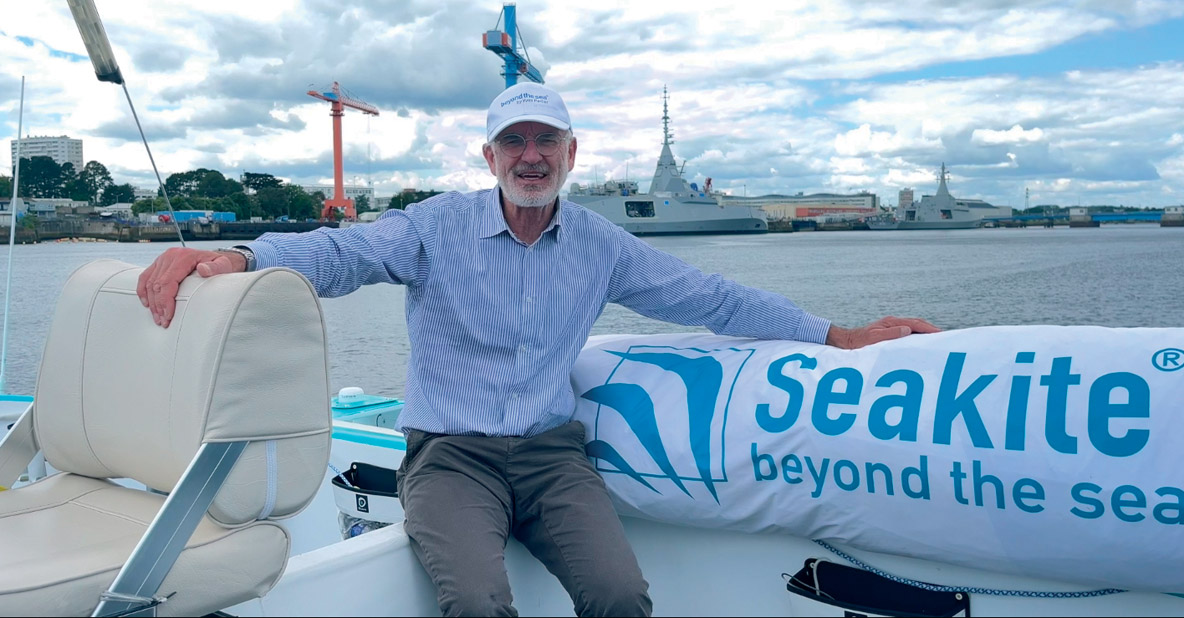
Yves Parlier: “We’re facing a colossal environmental challenge”
We managed to contact Yves Parlier, just a few hours before he was due to set sail on his transpacific voyage from Japan to Canada, and he agreed to share a few words with us:
“We’re facing a colossal environmental challenge. We absolutely have to move away from fossil fuels, which pollute and emit greenhouse gases, causing acidification of the oceans. To achieve this, we need to use renewable energies. My career and my passion have led me to a lifelong interest in wind propulsion on racing boats, and in 2007 I decided to devote myself to motorboat propulsion, to reintroduce sailors to the use of wind to reduce their consumption of fossil fuels, but also to reduce boat power. Wind is one of the ways in which this can be achieved. We’ve been using the wind to get around for 50,000 years. The oil era wiped out sailing ships after the Second World War, and now they’re back. There are sailing freighters again, and with the kite we’re going to help existing boats use the wind instead, because these ships weren’t designed to be fitted with a mast and sail. Our kites are adapted to pull this type of boat. We’ve seen the Libertykite®, which is totally manual, and now we’ve developed the Seakite for decarbonization, which is a much more efficient, fully automated system. This intelligent sail makes it possible to get somewhere faster while reducing the angle of the throttle. The Seakite is in fact designed to be flown with engines on, and lower overall consumption while maintaining a decent average speed.”
Wing prices in € ex-tax
LibertyKite 20 m² (215 sq ft): 2,330
LibertyKite 40 m² (430 sq ft): 7,950
LibertyKite 80 m² (860 sq ft): 14,150
Prices for accessories in € ex-tax
Friction ring: 33.50
Ball bearing opening block: 45.85
Stainless steel deck cleat: 20.85
Comfort handle: 67.00
Karver winch: 1,572.00
Winch Karver : 1 572,00
Pinball Boat E-Hybrid Technical specifications
Designer: Stéphane Chaurial
Length overall: 29’6” (9 m)
Hull length: 27’4” (8.33 m)
Beam: 9’9” (2.97 m)
Draft: 27” (0.69 m)
Air draft: 10’8” (3.25 m)
Unladen displacement: 8,375 lbs (3.8 t)
Passenger capacity: 15
Cabins: 1
Berths: 2
Fuel: 105 US gal (400 l)
Water: 35 US gal (135 l)
Max diesel power: 350 HP
Max electrical power: 2 x 8 kW or 12 kW
Battery capacity: 23 kWh at 48 V
CE category: C
Price: € 237,000 ex-tax