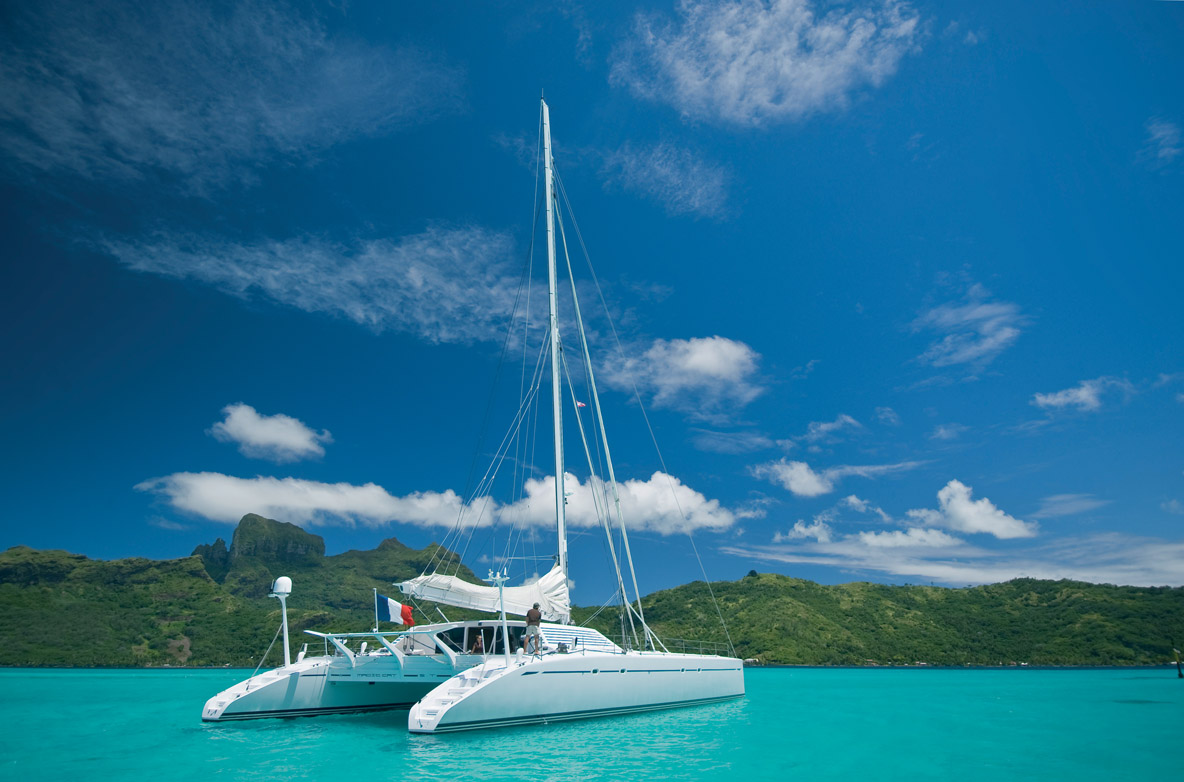

At first glance, cruising may seem to be an activity and a way of life far removed from luxury and comfort, and this is more often than not the case, unless you’re aboard a luxury superyacht. In this case, the atmosphere bears no relation to that of a traditional bareboat charter, where you are the de facto skipper, with all the necessary skills and personal and organizational commitment. Instead, on a luxury charter, all you have to do is let yourself be cocooned by all the activities on board - diving in the islands of the Indian Ocean, discovering the colorful, sun-drenched markets of Turkey, strolling along the fine sandy beaches of the Caribbean or enjoying the sunset on Santorini in the Aegean Sea, the catalog seems endless!
Access to the world’s most beautiful coastlines from the terrace of a palatial yacht, with ad hoc catering and service on offer... However, that’s a bit of an oversimplification, as the rates for these “offers” have little in common with those for bareboat charter. A yacht with at least four or five en-suite double cabins, including a master suite, is generally 80 to 130 feet (25 to 40 meters) long. Charter rates for such units usually exceed € 100,000 per week, to which must be added provisioning, port and fuel costs. On monohull superyachts of this standing, that consume a lot of fuel, the bill can be very high. But there is a way to make the dream (a little) more accessible: the multihull superyacht, or multiyacht, of course!
Multiyacht: Multiple Advantages!
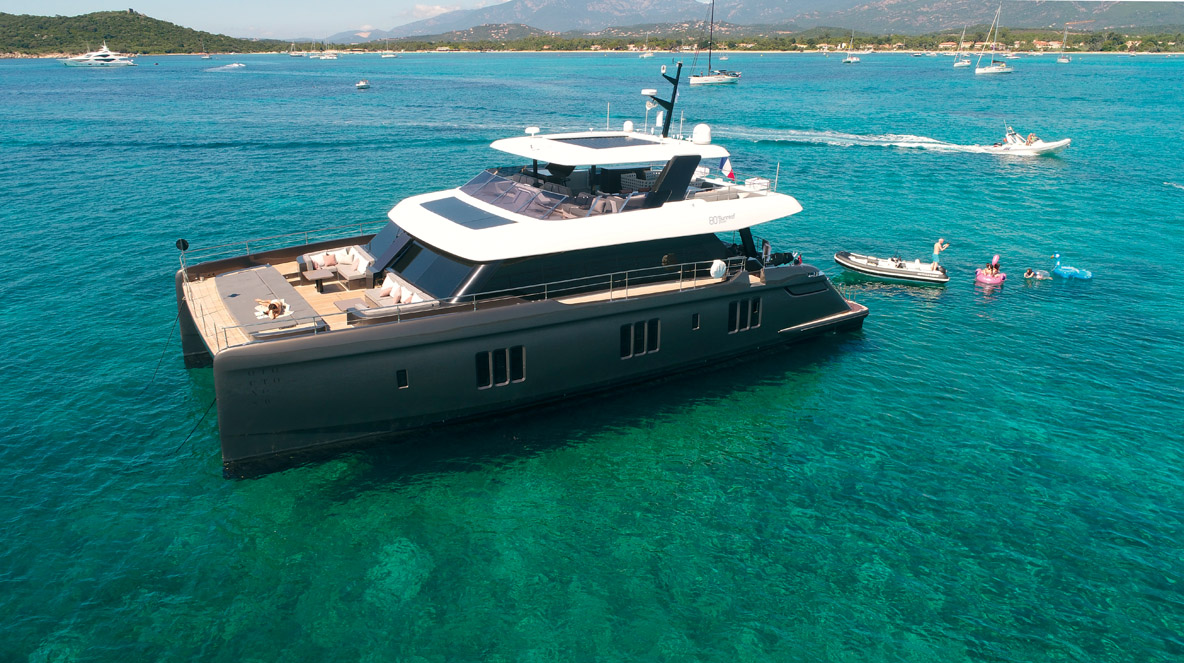
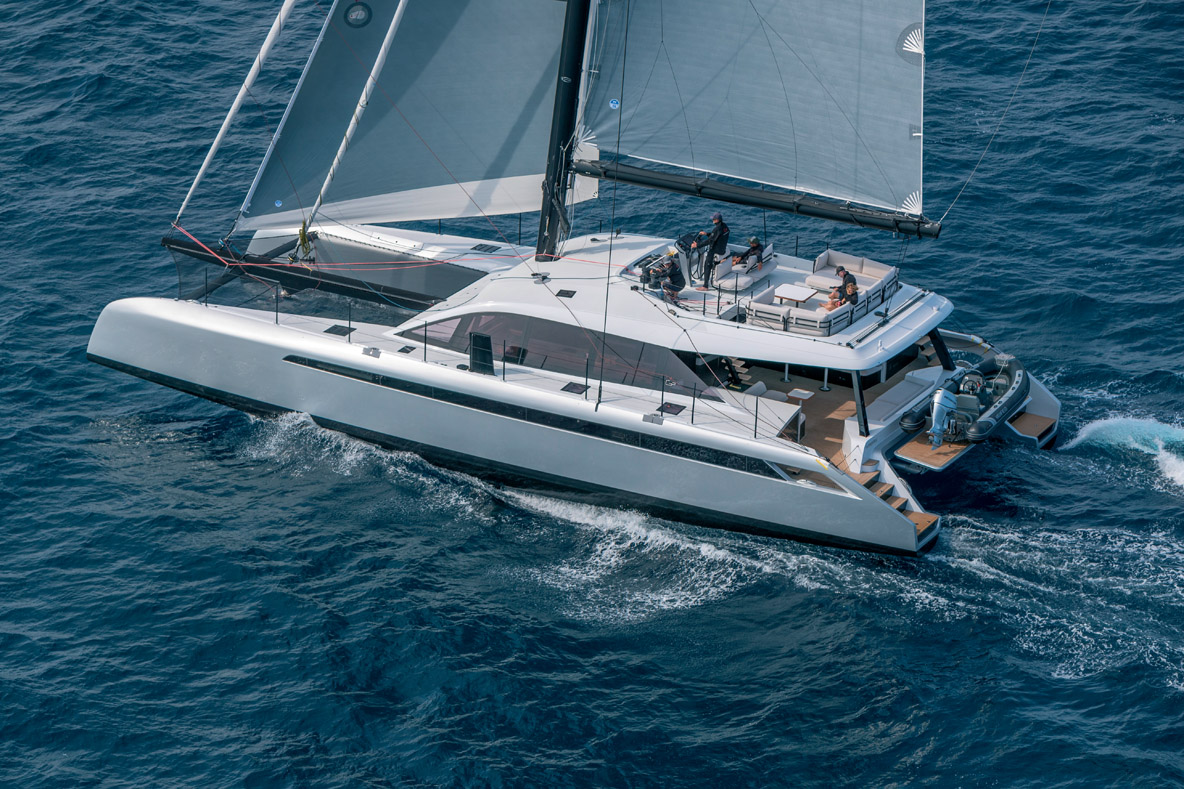
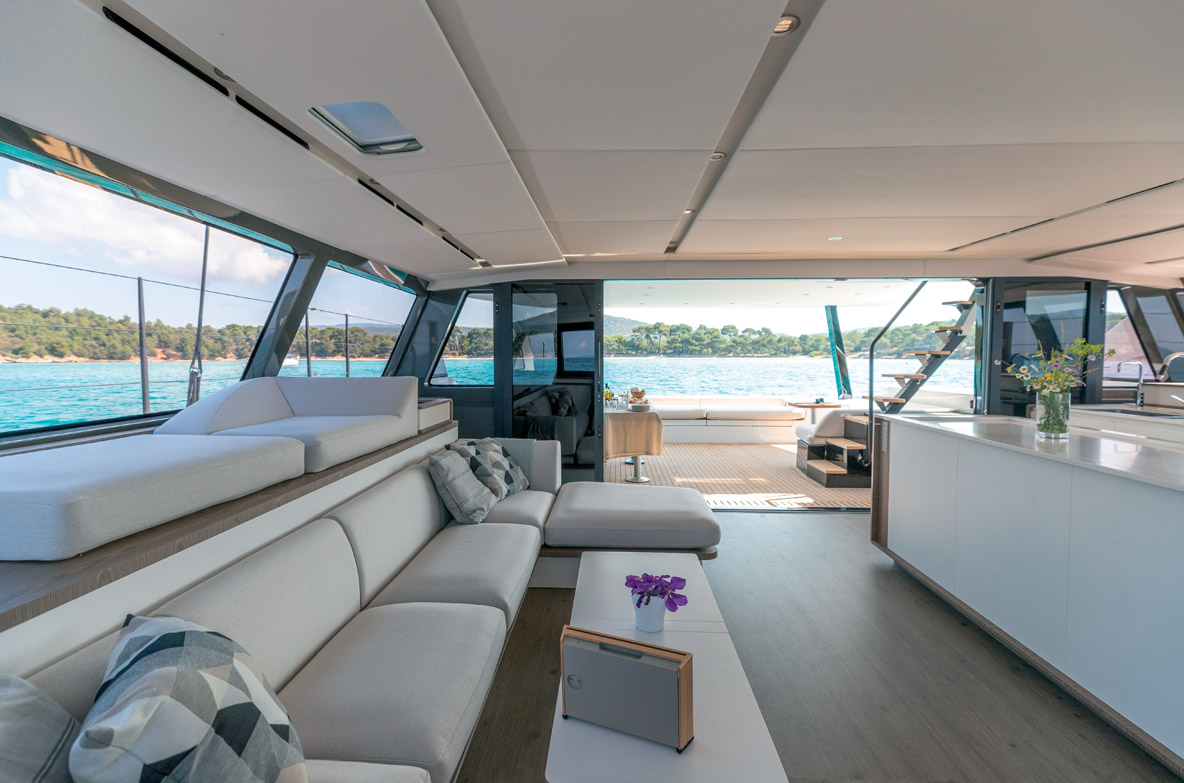
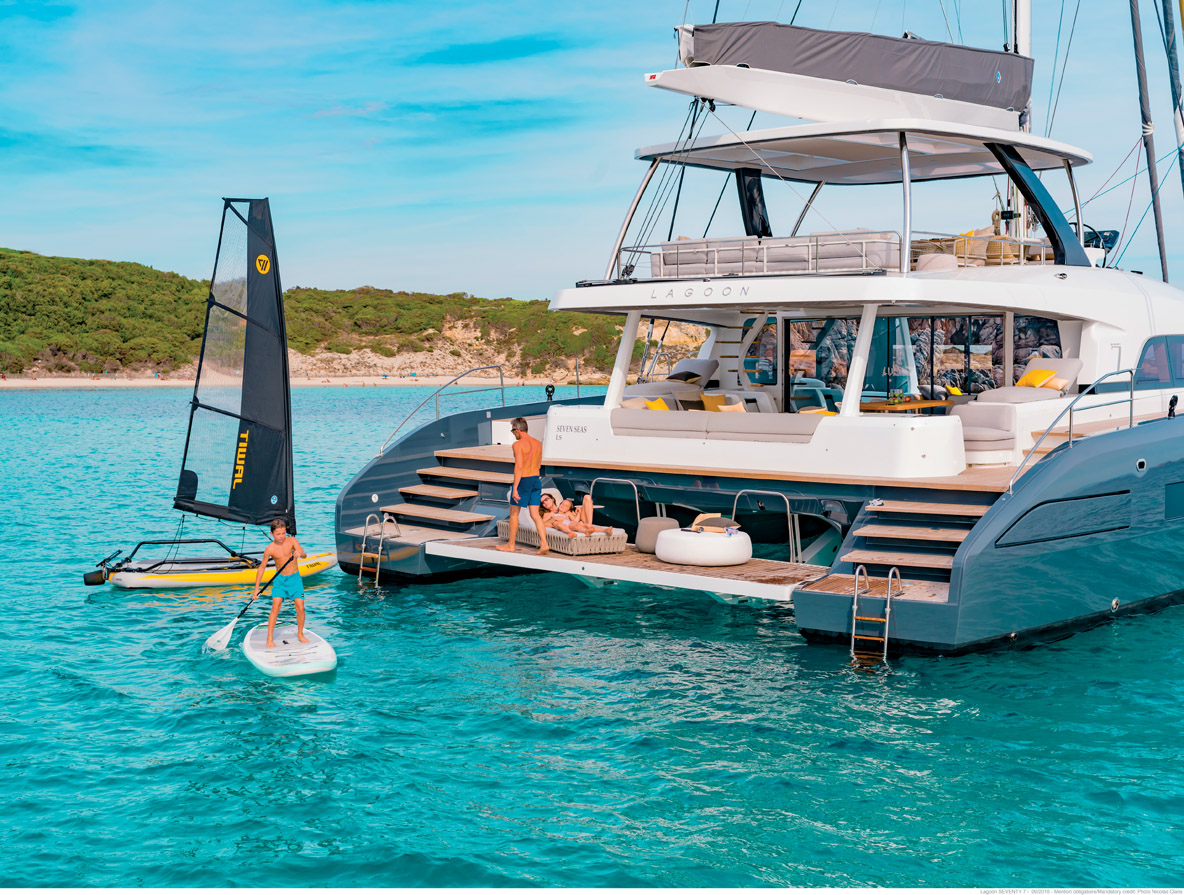
The intrinsic qualities of a multiyacht are numerous when it comes to cruising. XXL hydraulic water-access platform, huge exterior spaces - foredeck, aft cockpit and flybridge, huge multifunction interior saloon with panoramic views, cabin insulation, and natural stability give these super catamarans (trimarans do exist but remain few and far between) intrinsic advantages that enable them to compete with much larger monohulls. The volume offered by the cabins or suites, with their private bathrooms, king-size beds, desk and, of course, dressing room, is worthy of that of a luxurious apartment or even a villa. Compared to a monohull, crew quarters are also more spacious, partitioned and/or separated, and include a professional galley and fitted-out forepeaks. These volumes allow the crew to be at ease, while preserving the privacy of the charter guests, an essential condition for quality service throughout the season. In short, an 80-foot (24-meter) multiyacht offers the same easy features as a 115-foot (35-meter) monohull yacht. This is an obvious advantage when it comes to the administrative aspects of the vessel: once over 24 meters in length, a vessel has to be commercially classified according to fairly draconian standards, which increases the complexity and the operating budget. Last but not least, the low drag generated by a multihull reduces fuel consumption quite remarkably. It’s no longer unusual to see a motor multiyacht making do with 50 to 80 liters/hour (13 to 21 US gal/hour), while its much longer and more powerful monohull alter ego will burn over 300 liters/hour (80 US gal/hour). The difference is substantial by the end of the week and can easily reduce the overall charter cost by 15%, but we’ll come back to that later.
An Unstoppable Rise…
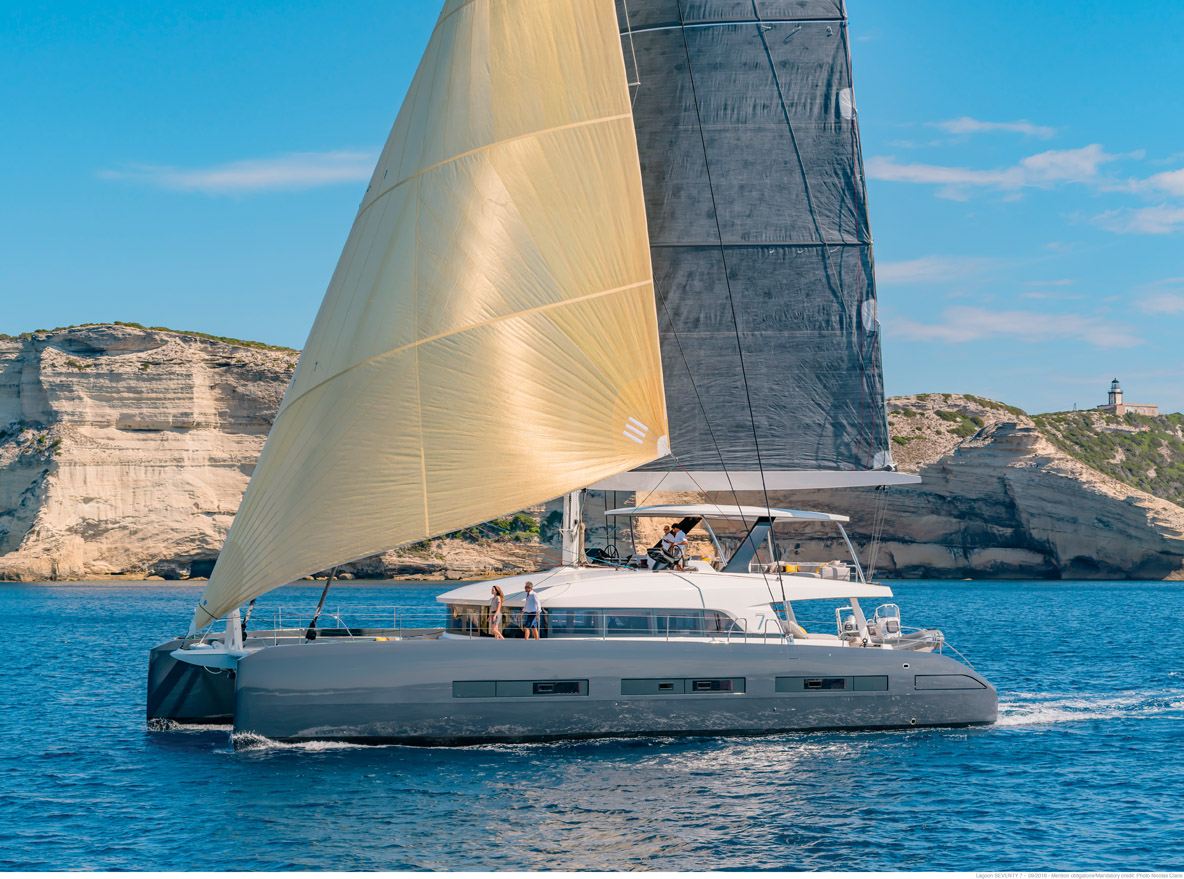
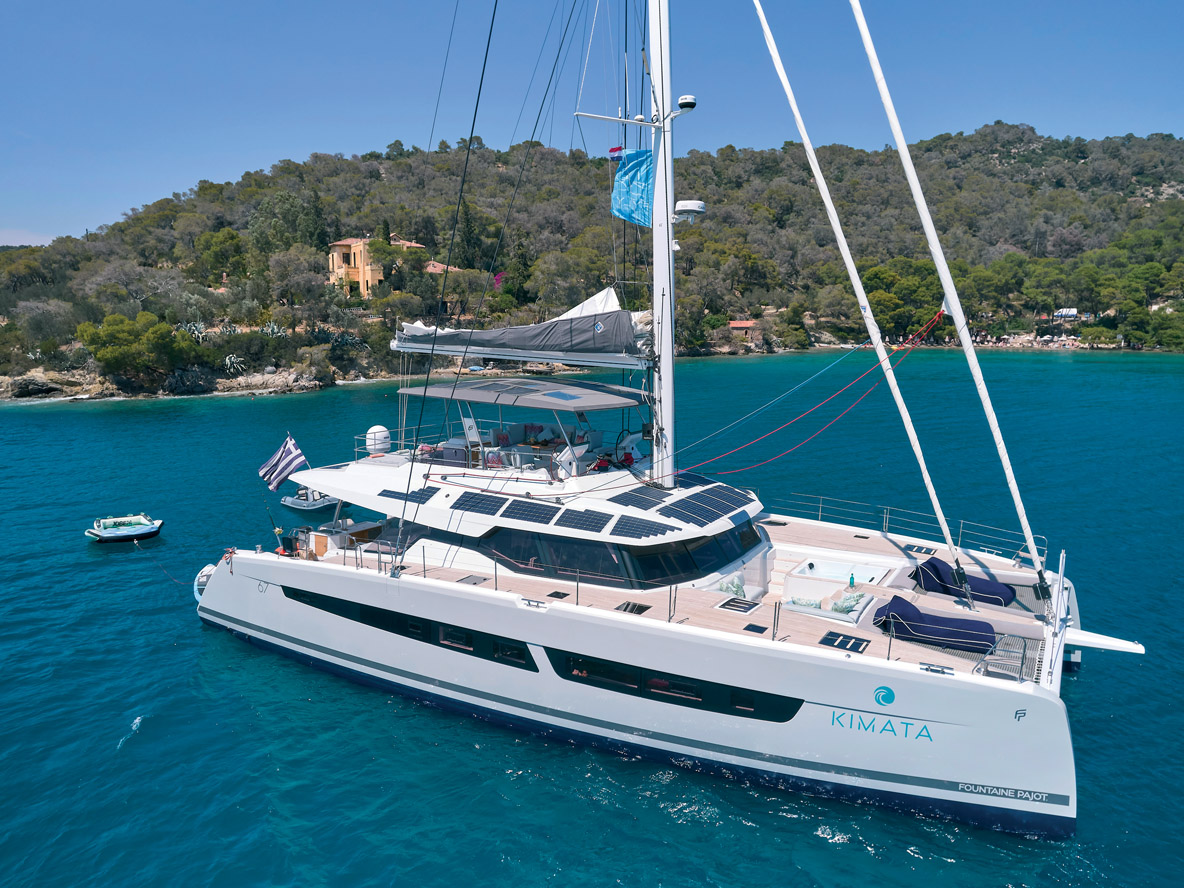
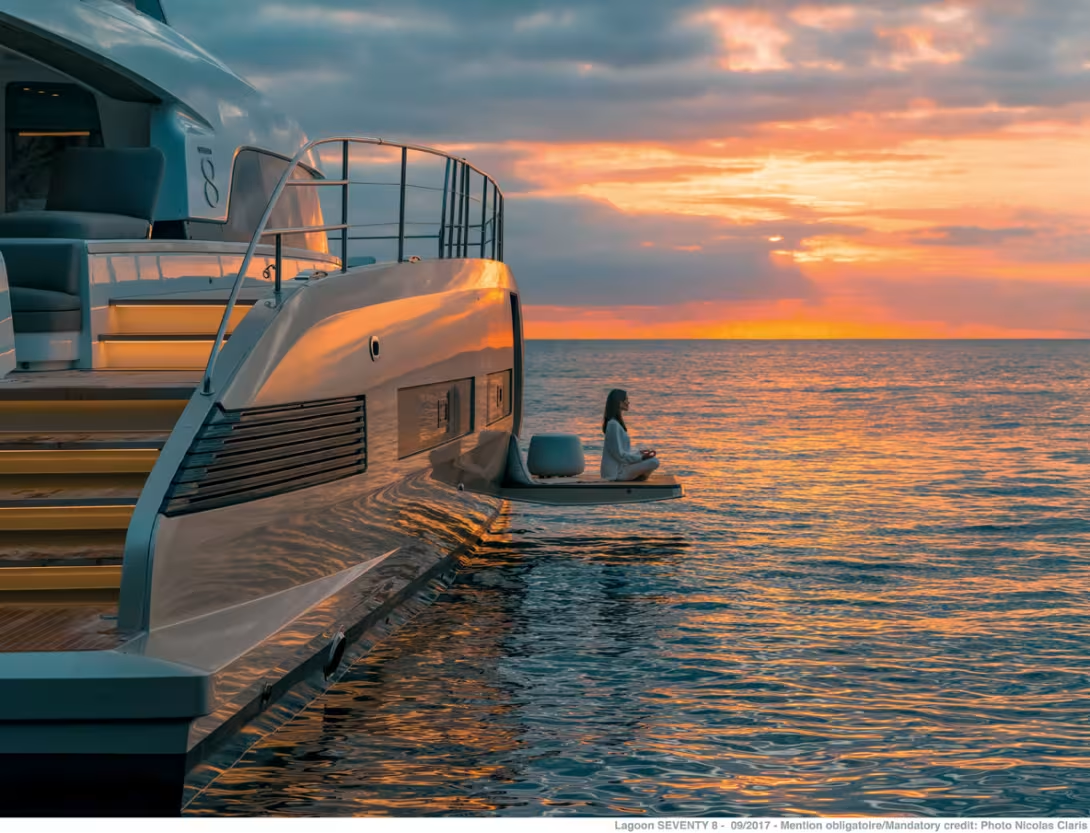
Over the past two decades, market share in the luxury catamaran sector has risen irresistibly. The advantageous features described above have not escaped the attention of a number of superyacht players. Initially, the first multiyachts were one-off units like Magic Cat in 1996, followed by Douce France two years later. Blue Coast Yachts then made a name for itself, launching three very luxurious catamarans in the 92-, 95- and 100-foot classes: Rafoly (now Black Swan), Cartouche and Allures. Then Francis Lapp entered the yachting world through Sunreef Travels, a travel agency specializing in yacht charters in the Indian Ocean. The entrepreneur quickly realized that customer demand for large luxury catamarans was not being met, so he decided to build them. The year was 2000: less than three years later, the first 74’, christened CHE, was launched, and Sunreef Yachts was born. Since then, the brand, which has built over a hundred sailing and motor catamarans from 60 to 150 feet, has succeeded in establishing the catamaran formula within the superyacht range. Many of these models are available for luxury charter. The Yapluka brand, with Nahema IV, is another example. Privilège Marine, with its first 745 Lady Alliaura, launched the concept of small, customizable series production runs. It is precisely this niche that was to be taken up and expanded by the world leaders in production catamarans, starting with Lagoon with the Seventy 7 sail and Seventy 8 power, followed by the Sixty 5 and Sixty 7. Fountaine Pajot followed suit with the Alegria and Power 67, then the Thíra and Power 80.
Why DepriveYourself of Sensations?
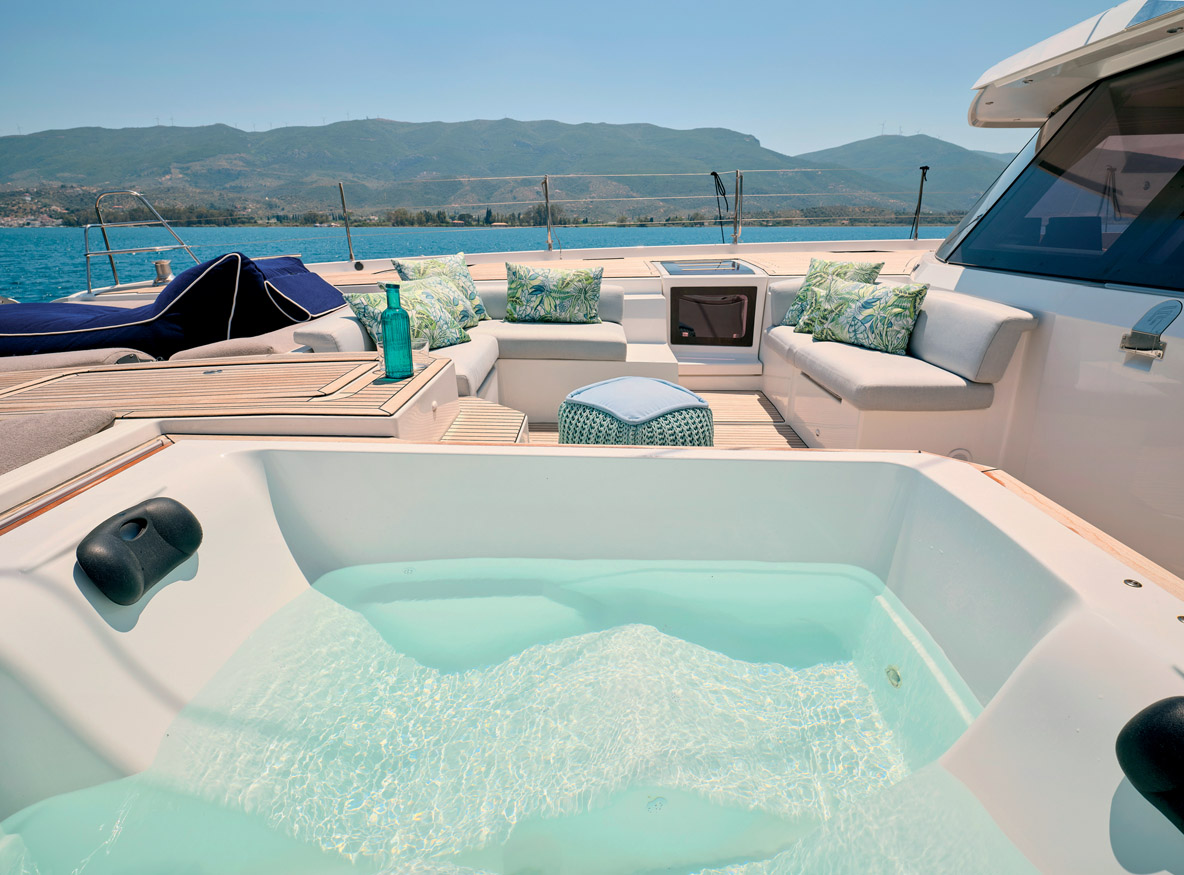
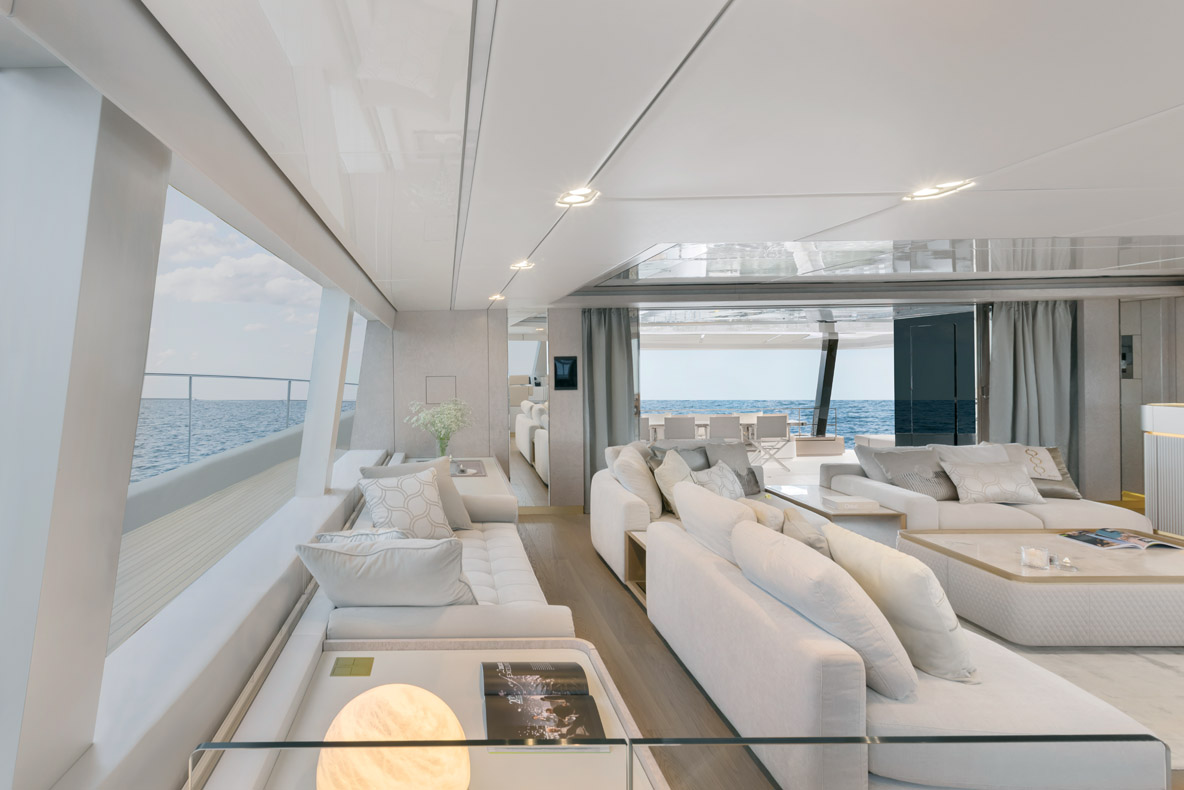
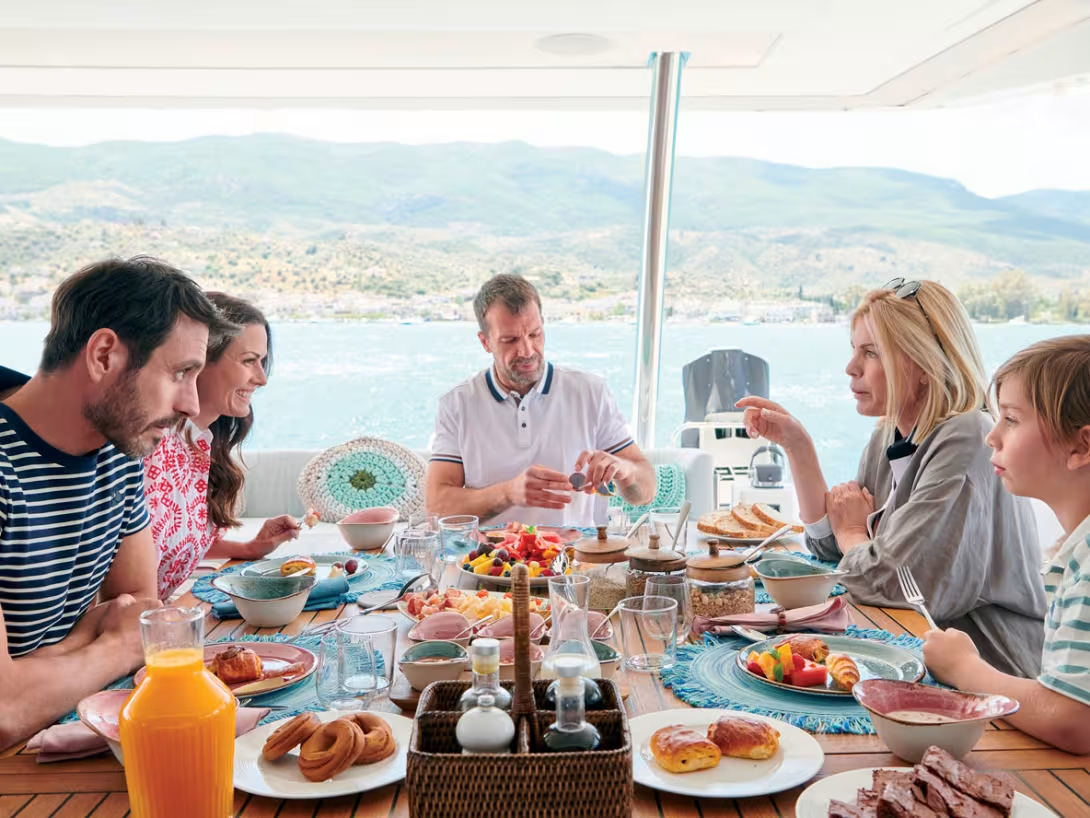
Aboard these models, the luxurious way the equipment has been dealt with is increasingly reminiscent of the world of superyachts. Precious woods, porcelain and crystal, thick wool carpets, state-of-the-art multimedia and sound systems, high-tech communications and office equipment, hull-side balconies, Jacuzzis in front of the mast or on the flybridge: these are all luxury features that are becoming a must aboard these palatial charter yachts.
This luxury and the adrenalin of speed are not necessarily incompatible. In this very specific sector with Magic Cat having paved the way, the American brand Gunboat has made its mark: its catamarans combining technology, luxury and performance are not reserved exclusively for owners, as a brand-new 72 is now available for charter. In Brittany, the Concarneau-based shipyard JFA is also a key player in the deployment of multiyachts. They built the 85-foot Rose of Jericho, which became Azizam, then an imposing 110-footer, Mousetrap, before launching the semi-custom Long Island series - among them, the 85-foot Winquest is available for charter.
250 Multiyachts Available to Charter!
Today, of the five hundred or so 60 to 150-foot multihulls plying the world’s oceans, roughly half are available for charter - but not necessarily all year round. The need for a dedicated crew of three to five sailors, with at least one year-round captain, motivates the owner to mitigate the heavy maintenance costs by making the boat as profitable as possible; in this context, chartering proves to be an important and welcome source of income. There are many charter agencies, some of which specialize in this sector. The same multiyacht can often be represented by several intermediaries.
Sunreef Yachts Charter, a pioneering agency in the market, offers no fewer than 144 catamarans in its catalog, including 9 powerboats, 5 of them over 100 feet, and 2 Eco full electrics built by the Polish shipyard. Among high-end yachting agencies, the monohull to multihull mutation is blatantly obvious. A look at the catalogs of MYBA agencies (a worldwide association of brokerage agencies guaranteeing quality of service) reveals that the multiyacht offer has indeed become predominant, especially for sailing yachts. Charter World boasts some one hundred multiyachts, including Douce France, which sails the Indian Ocean, the 41-meter (135-foot) catamaran Royal Falcon, the JFA Windcrest and the 85-foot HH Crazy Love. The split between monohulls and multihulls differs from segment to segment. Among the major institutional yachting agencies, such as Camper&Nicholsons, there are only three or four multihulls over 25 meters (80 feet) among a hundred or so yachts on offer, and only one at Fraser Yachts - Hemisphère, a 44-meter (145-foot) catamaran built by Pendennis. Between 18 and 24 meters (60 and 80 feet), however, the situation has completely changed: multihulls are well and truly making their mark. Of the 46 yachts offered by Ocean Independence, around ten are multihulls - including one trimaran and two powercats. Luxury Charter Group already boasts 16 motor multiyachts, but it’s in the sailing yachts that the new distribution is most obvious. Of the 79 sailing yachts listed on Bernard Gallay’s website, 29 are catamarans. Blue Water Yachting has 16 catamarans and only 4 monohulls! Many agencies, such as CSO Yachts, now offer more multihulls than monohulls... Even those historically stamped as motoryacht agencies, such as Princess Yacht Charter, offer some twenty multiyachts - including 16 sailboats and a Silent 60.
A Five-star Hotel on the Water
The various high-end catamarans on offer cover a wide range of possibilities in terms of both destinations and pleasures to be had. As we have seen, the units range from the luxurious to the fast, and can accommodate from four to twelve guests, depending on their size. All these offers are just a click or a phone call away: one of the characteristics of luxury charter is that the service offered by the broker is not simply that of an intermediary. It’s up to them to take your wishes and desires into account and personalize your cruise by planning a customized itinerary and points of interest. This starts with the choice of multiyacht with the equipment and accommodation that suit you, as well as the number of staff and qualifications for the service you require. The major luxury charter agencies mentioned above offer multiyachts for charter, but there are also more regional agencies such as FX Yachting in Greece, which present Alegria 67s and Thíra 80s that are highly optimized to cover the Aegean Sea. Simpson Marine, based in Hong Kong, is ideally situated for cruising in Asia and the Indian Ocean. In America, charter companies are not to be outdone - at Northrop&Johnson, four agencies cover US waters. Here you’ll find the Gunboat 72 we mentioned earlier - sailing in the Caribbean. On the cruising side, Worth Avenue Yacht in Florida offers a 70-foot Sunreef with three decks.
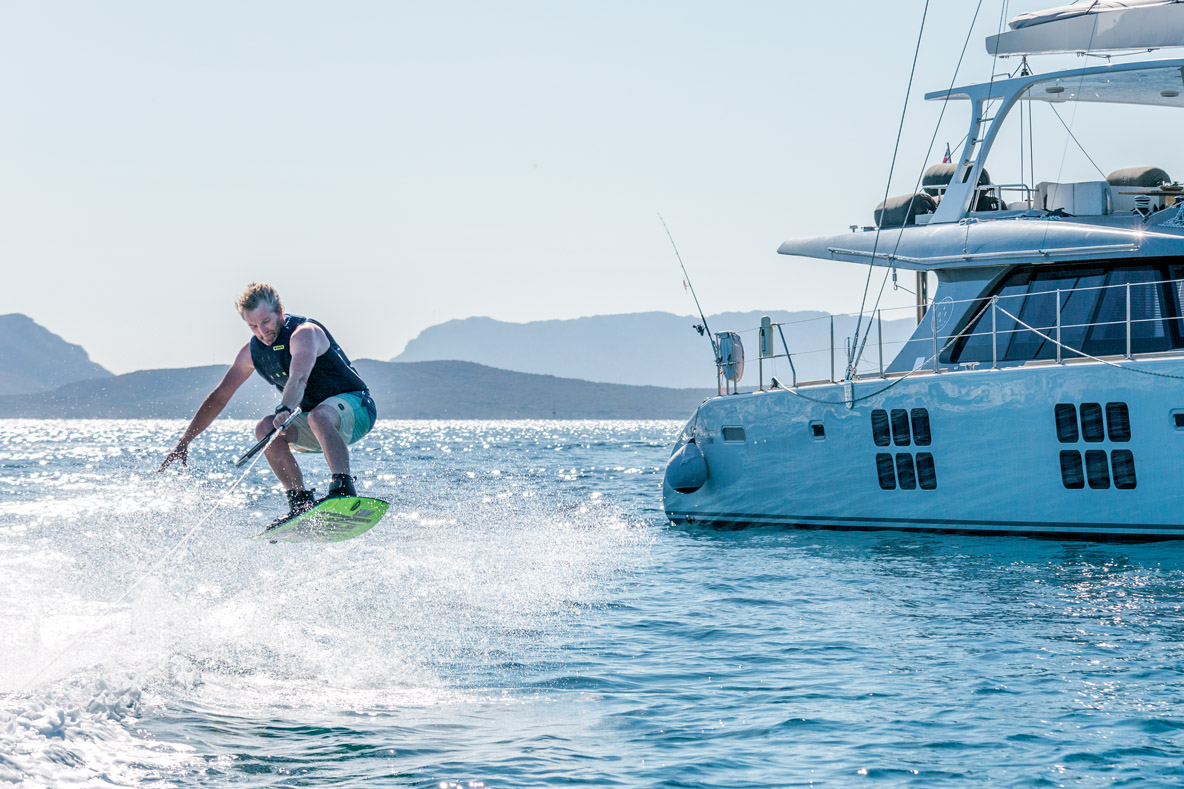
Let’s talk big bucks now: if you want the best of the best for 12 guests with as many crew members, you’ll have to shell out no less than $ 260,000 to spend seven days and the same number of nights aboard Hémisphère, but at this price, the main tender is none other than a 54-foot sport fisher... For as many guests but with “just” seven people for service Douce France is $ 95,000 per week. For 6 to 8 passengers, most catamarans between 60 and 80 feet charge between $ 35,000 and $ 50,000 per week, but the most recent and exclusive ones like the Sunreef 80 can go up to $ 90,000. Each multiyacht has its own customized equipment. Some, for example, have a dedicated generator for a compressor to refill scuba tanks, while others, like the McConaghy 75, offer an inflatable SmartKat for a spot of sailing while the mothership is at anchor. The lists are often quite exhaustive... and evolving, as the toys change according to what’s new at the time - electric foil boards, underwater scooters and so on. Rates include charter with crew and all equipment, but food, beverages, fuel and other consumables, as well as communications and shipping costs, are extra. A contractual advance provisioning allowance (APA) is required for victualing. This is generally set at 25% to 30% of the charter price. At the end of the charter, the captain will settle the accounts and refund the difference, or invoice the extra amount consumed. While the cost of meals may vary according to guests’ requirements (fine wines, caviar, etc.), fuel costs, as mentioned above, are much lower on multihulls than on motor monohulls. As a result, costs are usually less than 20% of the initial price - or even less with full electric yachts - whereas they can reach 35% or more for a large monohull motor yacht. Finally, tips for the crew are left to the customer’s discretion. The cost of such a week’s charter can represent a substantial sum for most yachtsmen - it should be noted that low-season rates can be more attractive, with discounts of between 30% and 40%. If this is still too much, some 50-foot catamarans offer services very similar to those of multiyachts. Blue Ocean Sailing, for example, presents a Sunreef 50: for between € 15,000 and € 26,000, you can have access to luxury on the water.
The Owner’s Perspective