


Getting to grips
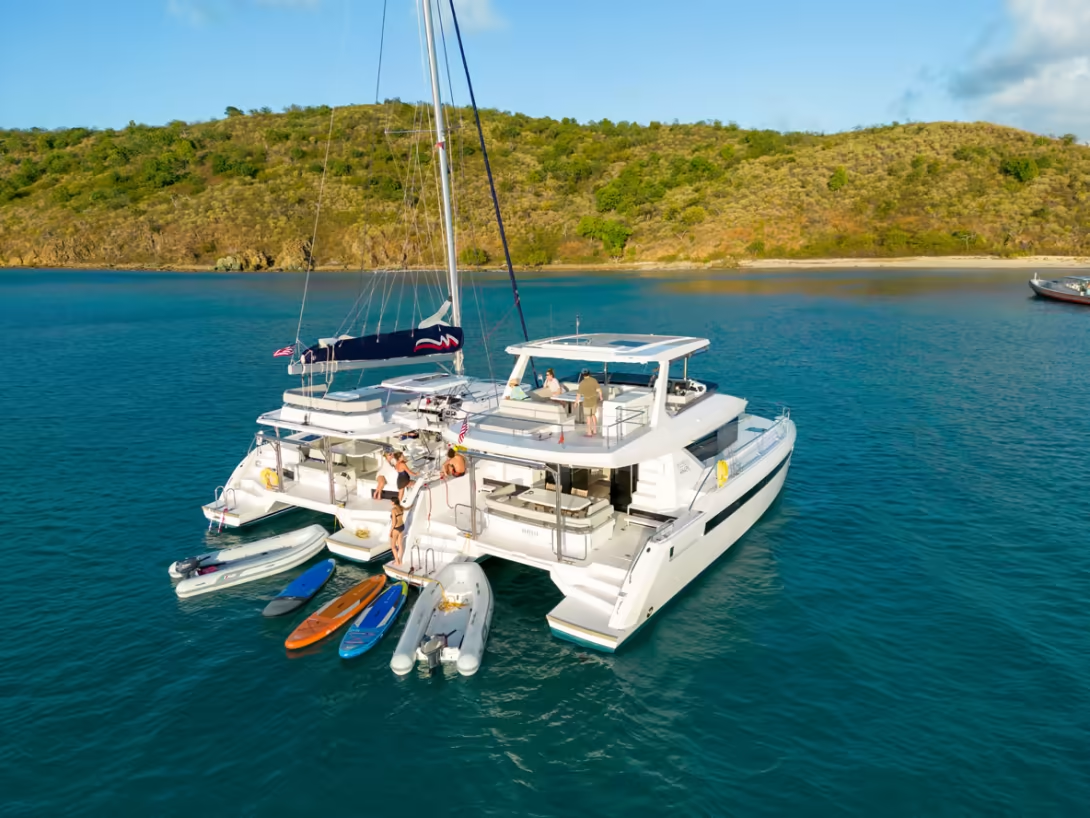
Sail or power, there are always two engines for maneuvering... Aboard the Moorings 4500 (the charter version of the Leopard 45) we had at our disposal, the 45 HP motors were always more than sufficient for maneuvering, turning on the spot or heading straight into strong winds. The throttle levers seem a little rustic, as are the screens, but we never missed not having a bow thruster. It’s worth noting that the bows and deck are so high up that it’s not easy to pick up a mooring without the help of the dinghy. From the elevated cockpit, there’s a good view of the water. The Leopard 46 PC differs from its sailing sibling in that its engines are far more powerful - our Moorings 464 PC version is powered by twin 320 HP motors - that’s seven times more power available! Thanks to the electromagnetic throttles, management of the 640 HP remains smooth and easy. We also liked the interface, which controls almost everything from the navigation screens. However, at boatspeeds under 4 knots, trajectory control is very approximate due to the small surface area of the rudders, which is where the autopilot comes in handy and why the bow thruster is indispensable. The 46 PC offers two control stations: one on the flybridge and one inside the nacelle, where it’s well sheltered. Once under way, apart from furling the lines and stowing the fenders, there’s nothing left to do but enjoy going along on the 46 PC. Aboard the Leopard 45, on the other hand, you hoist the mainsail, unfurl the jib, trim the sails, tack, and so on. For some, it’s a chore... for others, it’s the pleasure of sailing. It’s worth noting, however, that setting the sails prohibits going up any long creeks you might be tempted to do under power. And if you’re tempted by an anchorage 10/15 miles away with only an hour of daylight left, that’s fine on the powercat, but not on the sailboat.
Cruising program
The Leopard 45, with its 185 US gallons (700 liters) of fuel, has 70 hours of cruising speed, or a range of 525 miles. But as this catamaran is capable of sailing, it has an ocean-going range. This is not the case with the Leopard 46 PC: even at 8 knots with one engine, it will not exceed 2,000 miles. At full load with both engines at 8 knots, we’ll be happy with 1,500 miles. On the other hand, with an air draught of less than 20 feet (6 meters), including antennas, the powercat can sail up rivers and waterways unhindered by bridges. Its draft of 37” (94 cm) enables it to venture as close to the shoreline as possible, which is particularly interesting in shoal draft waters such as the lagoons of the Bahamas. The Leopard 45 is logically more limited in such approaches, with an air draught of over 69 feet (21 m) and a draft of 5’3” (1.6 m). The pleasure of being aboard the Leopard 46 PC is that you can almost ignore the weather - almost because, in reality, you’re avoiding any head-on seas. Conversely, aboard the sailboat, you set your course according to the wind and wave forecasts. But in the end, the weather dictates the anchorages for both sailing catamarans and powercats!
Comfort at sea
The 46 PC’s nacelle sits 4½” (11 cm) lower than that of the 45. In certain conditions with short head seas, the underside of the bridgedeck can slap the waves. Overall, the powercat performs well in choppy conditions. When the waves are beam-on, the flybridge can become a little uncomfortable - a good reason to take up the watch from inside. On the other hand, when conditions are manageable, the area is perfect for enjoying the scenery. You can stretch out in the sun or shade, and even protect yourself from the wind thanks to the PVC enclosures (though these are a pain to put up and take down). The Leopard 45 also has a (small) flybridge, but it’s very exposed to the wind and very close to the boom. This area is rarely used at sea. Aboard both catamarans, engine soundproofing is fairly good. Of course, in the nacelle, the aft cockpit and aft cabins, it’s far from church-like silence, but many areas remain very well protected. Moving around is easy everywhere, inside and on deck. The Leopard 45, despite its lower hulls, is more seaworthy and at ease in rough seas. The steadying effect under sail is a real pleasure, limiting any roll. The average speeds we recorded with 20 to 25 knots of wind were 7 knots close-hauled and 9 on other points of sail. On the other hand, motoring into the wind, you suffer from pitching accentuated by the rig.
Comfort at anchor
Overall, the layout of our two catamarans is quite similar, with a large living area in the nacelle with an XXL opening onto the cockpit as well as a forward door. The 3 or 4 cabins (and as many bathrooms) are distributed throughout the hulls, with no particular surprises in store.
There are a few differences, however: the galley is on the port side, aft, on the powercat, whereas it is forward and to starboard on our sailing catamaran. There’s an interior helm station for the 46 PC... but no chart table, which is a shame, because a small desk in the nacelle is always appreciated. We can install a computer on the 46 PC’s saloon table, of course, but we’d really like 110/220V outlets! The powercat is back in the lead when it comes to dealing with on-board noise. The fresh water pump and accumulator remain very discreet. Not at all the case aboard the 45, where the slightest few ounces of water awakens at least one hull...
Externally, the Powercat retains the advantage with its solid foredeck and XXL flybridge. And yet, for its size, the 45 Sail fares rather well: a crew of eight won’t be stepping on each other’s toes.
Consumption
It’s relatively easy to calculate a range of fuel consumption for a coastal cruising yacht: count on five hours of operation for each engine per day at cruising speed (2,400 rpm) for comfortable living and cruising, and only one hour in sport mode - which is what we were in - or 18½ to 92 US gal (70 to 350 l). We therefore report a fuel consumption of just 20½ US gal (77 l). Note that the generator consumed only 6.6 US gal (25 l) of diesel in a week.
Moving on to the Leopard 46 PC... it’s much more difficult to predict fuel consumption, since it starts at 2.6 US gal (10 l)/h at 7.5 knots (the same values as for the Leopard 45 at this speed) and rises to 7.9 US gal (30 l)/h at 9 knots, 15.8 US gal (60 l)/h at 15 knots, and even close to 26 US gal (100 l)/h when you hit 20 knots! The fuel you consume is therefore intrinsically linked to your cruising speed. In our case, we averaged 10 knots, but spent a good hour at full throttle for the photo session. Total consumption was 23 US gal (844 l), including 34 US gal (129 l) for the generator alone - which was overstretched thanks to a burnt-out inverter as soon as we left port.
All in all, a big advantage for the sailboat, but remember that the powercat can do just as well...

Launch year: 2017
Number of units built: 288
Overall length: 45’ (13.72 m)
Waterline length: 42’11” (13.07 m)
Beam: 24’2” (7.36 m)
Draft: 4’11” (1.5 m)
Air draft: 70’ (21.34 m)
Bridgedeck clearance: 2’9” (0.83 m)
Displacement: 36,156 lbs (16.4 t)
Load capacity: 10,141 lbs (4.6 t)
Sail area: 1,344 sq ft (124.9 m²)
Engines: 2 x 55 HP Yanmar
Standard propellers: 3 blades 17” x 14” (432 x 356 mm)
Fuel: 185 US gal (700 l)
Water: 206 US gal (780 l)
Black water: 45 US gal (170 l)
Launch year: 2021
Number of units built: 126
Overall length: 46’4” (14.13 m)
Waterline length: 46’2” (14.06 m)
Beam: 24’1” (7.34 m)
Draft: 3’1” (0.94 m)
Air draft: 18’6” (5.64 m)
Bridgedeck clearance: 2’6” (0.75 m)
Displacement: 36,945 lbs (16.8 t)
Load capacity: 10,679 lbs (4.8 t)
Engines: 2 x 250/320/370 HP Yanmar
Max speed: 23.5 knots with 2 x 370 HP
Fuel: 475 US gal (1,800 l)
Water: 185 US gal (700 l)
Black water: 42 US gal (160 l)