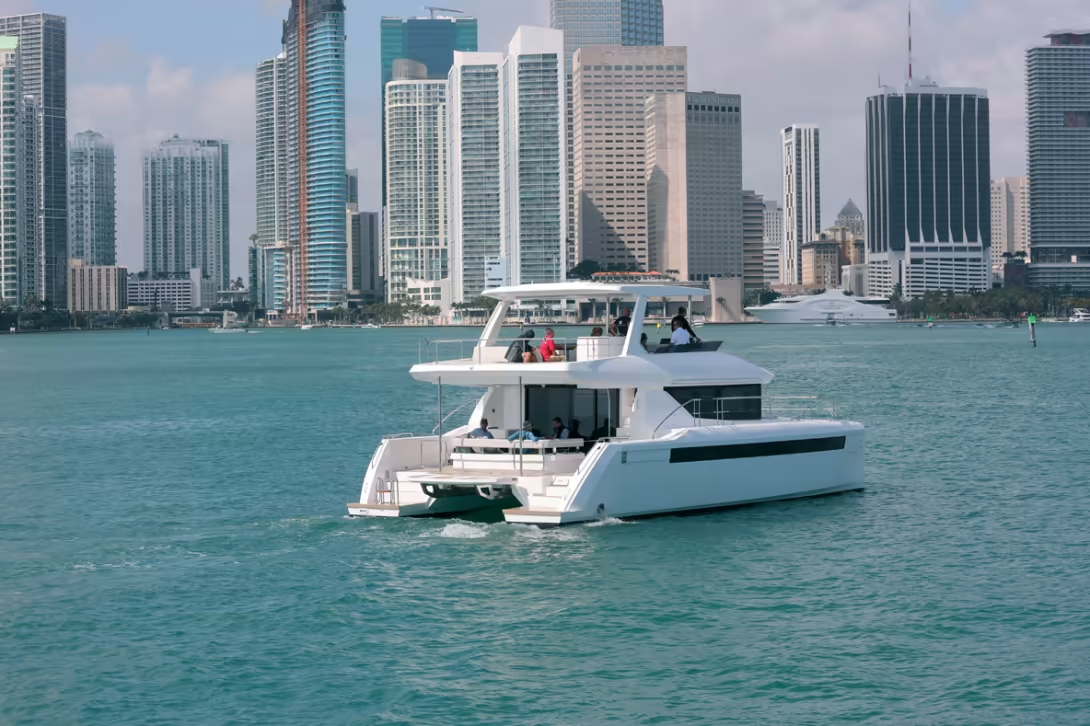
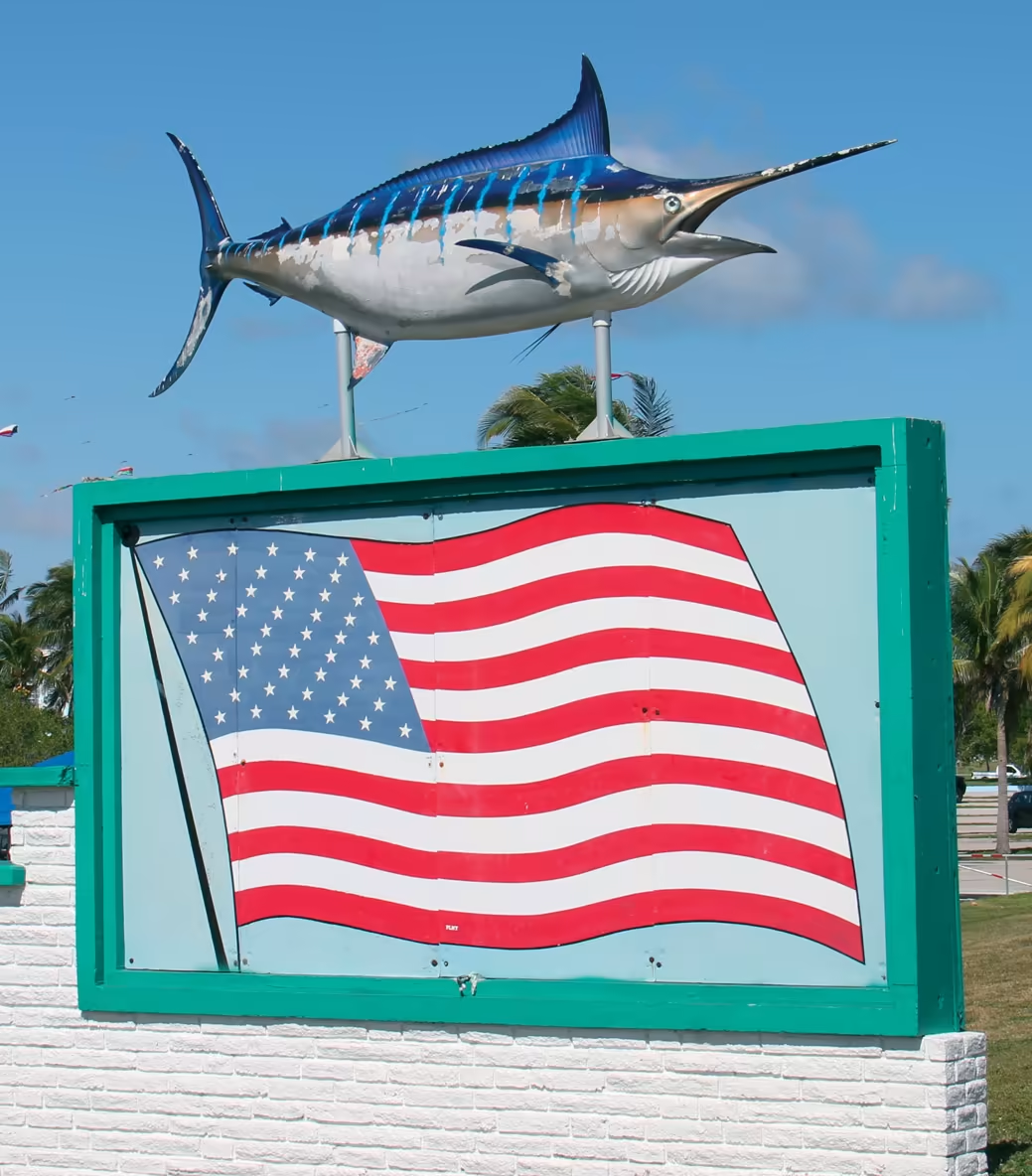

For many non-Americans, Florida remains a dream destination where skyscrapers, turquoise waters, beaches and coconut palms combine to create a tropical, modern atmosphere. It’s an image that’s cleverly cultivated but is actually quite close to reality. In the very south of the United States, Florida, and Miami in particular, already gives a taste of the Caribbean. Add a healthy dose of South America too - mastering a few words of Spanish can really come in handy. The third most populous state in the USA, with over 21 million citizens, Florida derives most of its revenue from tourism, including boating. A feature that comes as no surprise if you look at a map, since it’s also the only state bordering by both the Atlantic Ocean and the Gulf of Mexico.
Florida, the land of boating
The location of the “Sunshine State”, as the Americans call it, has also enabled the development of a true ecosystem around pleasure boating. With 2,170 kilometers / 1,348 miles of coast (comprising 5,450 mi/ 13,600 km of actual shoreline), about 30,000 lakes, some of them very large, and 1,700 rivers, Florida is brimming with possibilities. Add to that the famous Everglades, that giant swamp... In the end, you could almost say that Florida is half water!
In fact, the state boasts over 1,000 marinas, i.e. approximately one marina for every 10,000 people - not a bad infrastructure, given that by 2022, over one million pleasure boats were registered in Florida. It has to be said that all forms of pleasure boating can be enjoyed here, from canoeing to deep-sea fishing, not forgetting water sports and, of course, sailing. Multihulls have been quick to make the coast their own, especially as many of the marinas are “multi-friendly” and there are also plenty of mooring balls. These marinas are almost always full, since many Americans from the northern states and Canadians leave their boats here year-round, attracted by the much milder winter climate...
Perfect conditions for multihulls
Another reason for Florida’s boating popularity is, of course, the conditions, starting with large, relatively sheltered stretches of water for safe sailing. For starters, there’s the Intracoastal Waterway, a strip of water protected by islets that allows you to sail along much of the east coast of the United States. To the south, there are vast stretches of water that are well protected by the Florida Keys, and the area between Tampa and Sarasota is again sheltered by a string of islands.
Added to this are very pleasant temperatures most of the year, rarely dipping below 18° Celsius (65° F), but regularly climbing above 35°C (95° F) in summer. Be warned, however, that we’re not yet north of the Tropic of Cancer: 0°C (32°F) has been recorded in Miami, and snow is sometimes observed in the north of the state... In concrete terms, South Florida enjoys 3,150 hours of sunshine a year, or 262 days, which isn’t bad considering that even cloudy days are pleasant.
Wind conditions are also fairly stable (apart from hurricanes), averaging 8 knots in summer and 12 knots in winter, making for perfect conditions for setting sail.
An ideal location
Another advantage of Miami is that it boasts one of the world’s largest airports, making it easy to get to from the rest of the U.S., Canada or virtually any other country in the world. It’s also where the famous Route 1 ends, which runs along the entire east coast of the United States; the highway network is very well developed - even if it is often saturated. Miami is therefore a good base from which to explore the region, or even to head for the Caribbean.
In fact, there are several charter bases, either from Miami or from Key West, for exploring the surrounding area (see below).
The only downside is that you need to be vigilant during hurricane season, as the city is regularly hit by these extreme weather phenomena.

Miami International Boat Show An event not to be missed!
Originally, the event actually comprised two different shows, the Miami Boat Show and the Miami Yacht Show, with two different organizers. The event has also changed location several times at the whim of construction work or protests. Over the past two years, the organizers have agreed to create a single, larger show, mainly grouped between the stadium and the Marriott Biscayne Bay. In addition to the downtown part, which brings together four sites side by side, there’s the famous Convention Center on Miami Beach, an enormous indoor exhibition space for small craft, engine manufacturers and equipment suppliers. As for the Yacht Haven Grande site, it welcomes superyachts for a feast for the eyes. This formula also includes sailing and motoring.
As far as multihulls are concerned, the best place to find sailing units is undoubtedly Museum Park Marina, at the bottom of the stadium, which also boasts a number of motorized models. Other powercats can be found at Herald Plaza, while fishing catamarans are more likely to be found in the Convention Center.
A formula that works rather well, as the figures attest. The Miami Boat Show attracts over 100,000 visitors, more than 1,000 brands are present, over 1,000 boats are on display, and the expected economic spin-offs are close to $1.5 million. To achieve all this, the show has put in place a gigantic organization, with the creation of several marinas, land and sea shuttles, and a superb drone show on Friday evening.
As for the brands, all the major players in the market will be present, with strong European representation, starting with Catana/Bali, Excess, Fountaine Pajot, Lagoon, Nautitech, Outremer and Sunreef, to name but a few. There will also be plenty of boats from South Africa, such as Leopard and Balance, as well as Iliad powercats from Australia. China is also represented with HH. The Americans, of course, are not to be outdone, with boats such as Aquila, Four Winns, HammerCat, Invincible and Worldcat.
Multihulls are no exception. This year, we should see the world premiere of the Illiad 53F, the flybridge version of the 53S. The HH shipyard will also be making headlines with the American presentation of the HH44, a very modern hybrid catamaran. The Nautitech 48 Open (reviewed in this issue) will orchestrate a much-anticipated world premiere, while Outremer will exhibit the brand’s latest model, the 52. For powercat enthusiasts, the Aquila 47 Molokai, presented in Fort Lauderdale, and the Four Winns TH36 will once again be the stars of the show.
The six different sites
THINGS TO DO : Must-sees around Miami
Haulover SandBar
Haulover is a unique place in Miami, and for several reasons. For sport fishing enthusiasts, the marina is one of the main starting points. Haulover is also famous for its naturist beach, but also for its famous sandbar in the intracoastal, just a few hundred yards from Haulover Beach marina. This is where dozens, if not hundreds, of yachtsmen regularly gather to spend the day on the sandbar, where the water is no more than 2 feet deep. People come here to party, drink and listen to music before heading back to the marina.
Haulover Inlet
Haulover Inlet, north of Miami, is a channel connecting the intracoastal to the ocean. Cut into a sandbar between Bal Harbour and Haulover Park, the channel has to contend with the shifting position of the sandbars, the current and the arrival of ocean waves of varying shapes, which on certain days make for a rather agitated passage. The pass has been made famous by a number of YouTube channels, which regularly film the agility or inexperience of certain captains.
Miami Beach’s Art Deco district
This is one of the most famous Art Deco districts in the world. Stretching along Ocean Drive Boulevard and Collins Avenue, this well- preserved district boasts a wide variety of buildings with Deco architecture and colors. The best way to visit is to leave the boat at Miami Beach Marina and walk around to get a feel for the atmosphere. In the evening, Ocean Drive transforms into a party spot with cocktails and music.
Key Biscayne
Accessible from the Rickenbacker Causeway and William M Powell Bridge, Key Biscayne comes after Victoria Key, the two islands that form the beginning of the Florida Keys. A veritable paradise on Miami’s doorstep, Key Biscayne offers a central urbanized area, while the southern tip is a natural park. The west coast offers a sheltered anchorage, while the east coast boasts one of the region’s most beautiful beaches. There’s also the Cape Florida lighthouse, a beautiful structure offering a unique view of the coast and Miami.
Miami International Boat Show guide
February 14 to 18, 2024
Wednesday 14 10:00 am - 6:00 pm
Thursday 15 10:00 am - 6:00 pm
Friday 16 10:00 am - 7:00 pm
Saturday 17 10:00 am - 7:00 pm
Sunday 18 10:00 am - 5:00 pm
www.miamiboatshow.com
1 day (Preview - Wednesday) $64
2 days (Preview - Wednesday - Sunday) $98
2 days $75
Superyacht 1 day (Preview - Wednesday - Sunday) $160
Superyacht 1 day $135
Herald Plaza VIP 1 day $350
Convention Center VIP 1 day $350
All sites - VIP 1 day $550
Children (6 to 12 years) 1 day $16.50
Under 12 Free
Military and veterans (American) Free
Cruising: Where to sail from Miami?
The Caribbean
From Miami, the Caribbean is an ideal destination with a huge playground, all a question of time and nautical experience. While the Bahamas are very close by, the Dominican Republic, Antigua and Martinique, to name just a few islands, take much longer to reach.
Food and drink
BBQ cuisine
Alligator
The sweet potato
Key lime pie
Orange juice
Cuban coffee
Marinas: Multihulls World selection
Crandon Marina
Located at the entrance to Key Biscayne, the marina opens onto Key Biscayne Bay and is very close to the ocean. The marina can accommodate units up to 80 feet in length and features all modern conveniences. Rates are currently $2.33 per foot per day for units up to 49 feet.
There are few places for multihulls, but this is possible for short periods. You can also take advantage of the moorings right in front of the marina, which is ideal for a catamaran or trimaran. Crandon Marina is the ideal starting point for the Florida Keys.
Position : 25° 43’ 27’’ N 80° 9’ 20’’
Miami Beach Marina
Located on the protected part of South Beach, this marina has 400 berths and can accommodate vessels up to 250 feet. It offers a few berths for multihulls and is just a few minutes’ walk from Miami Beach’s Art Deco district, Ocean Drive and all the hustle and bustle of the area.
Dinner Key Marina
Located in the Coconut Grove district, Dinner Key is a beautiful marina. Well protected by several uninhabited sandbanks, the marina features 587 berths and can accommodate units up to 135 feet. It also has a few berths for multihulls and 250 moorings for boats up to 50 feet. It overlooks Key Biscayne Bay and is located in a busy shopping and dining area.
Overnight rates are $5 per foot in the marina and $27 for a mooring.
Matheson Hammock Marina
Located south of Miami and overlooking Key Biscayne Bay, this marina, nestled in lush natural surroundings, is a true haven of peace. The marina can accommodate boats up to 50 feet in length, including multihulls. Once moored, you can take advantage of the small, well-protected beach or a hammock for a siesta under a coconut tree. A perfect escape from the hustle and bustle of the city.
Pelican Harbor Marina
Located a little further north, between downtown and Miami Beach, Pelican Harbor Marina isn’t very big, but it has moorings that can accommodate multihulls for a night or longer. The marina has everything you need for a pleasant stay and, thanks to its location, is very well protected. Finally, being very close to the city and Miami Beach, it offers easy access to everything the city has to offer.