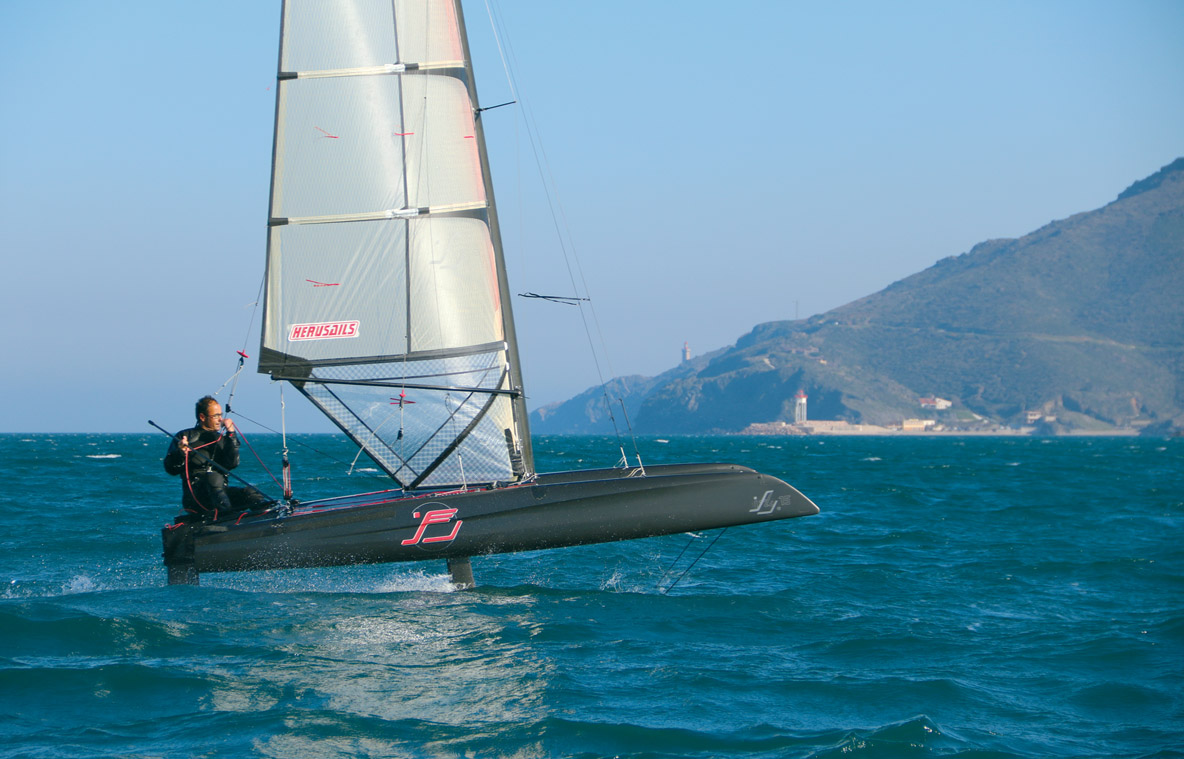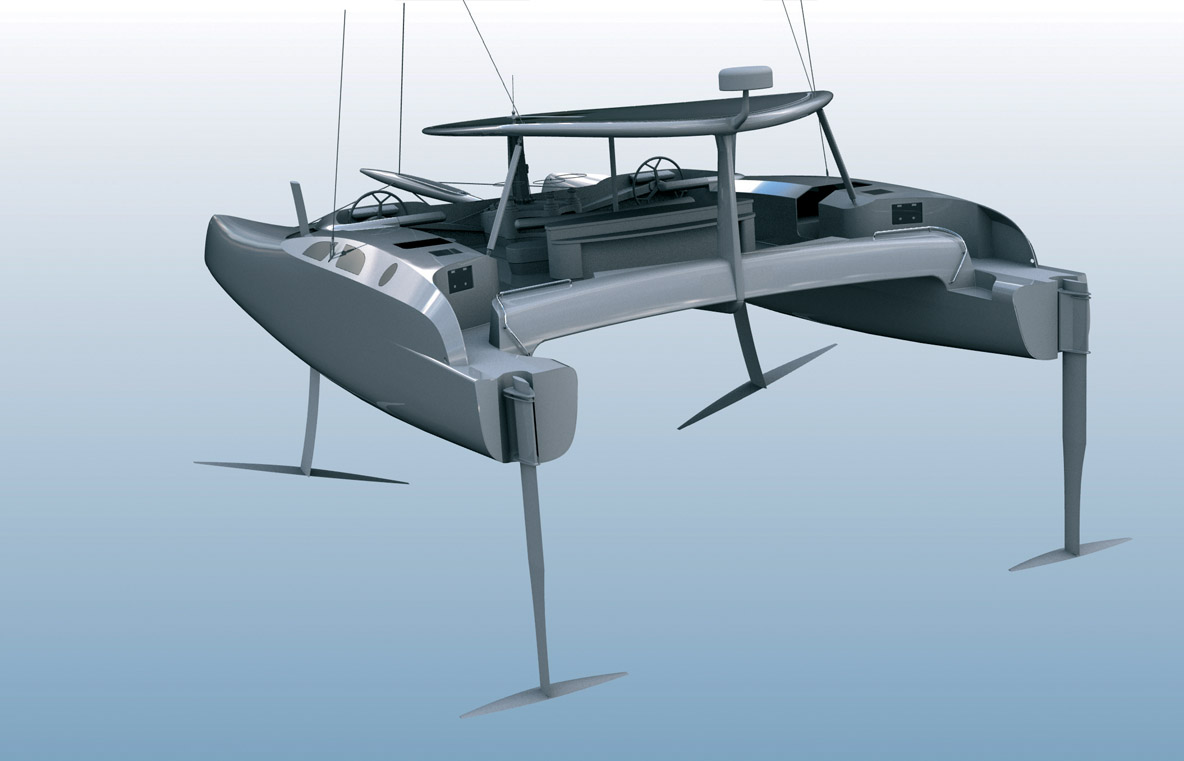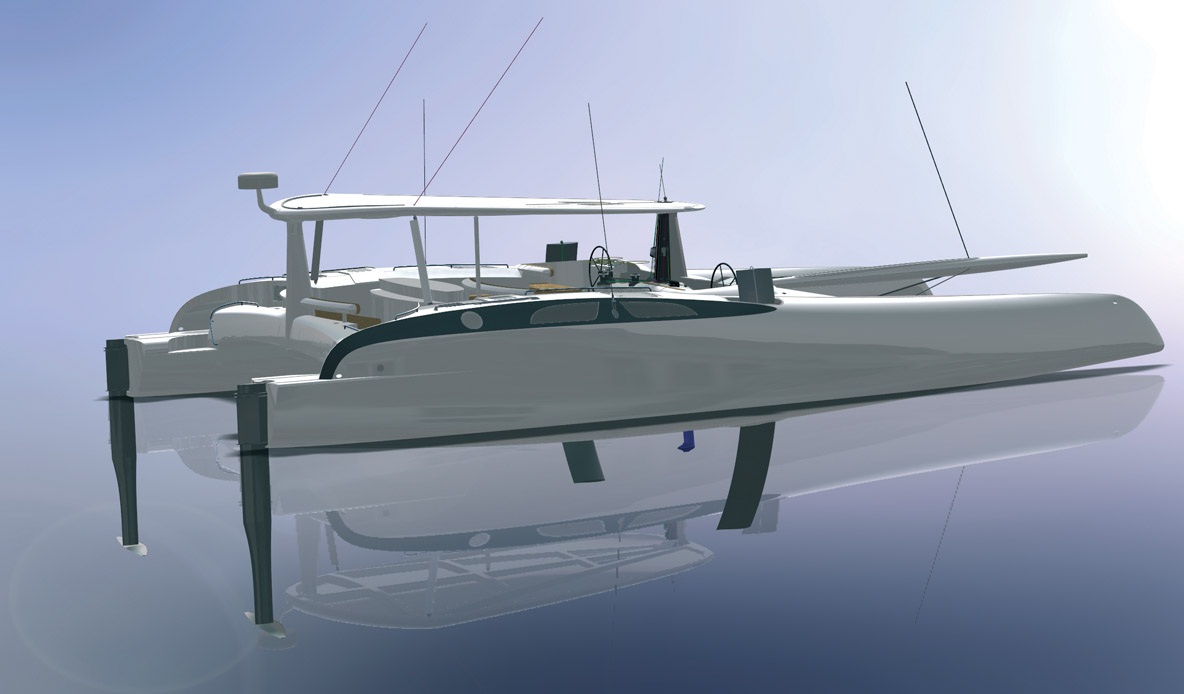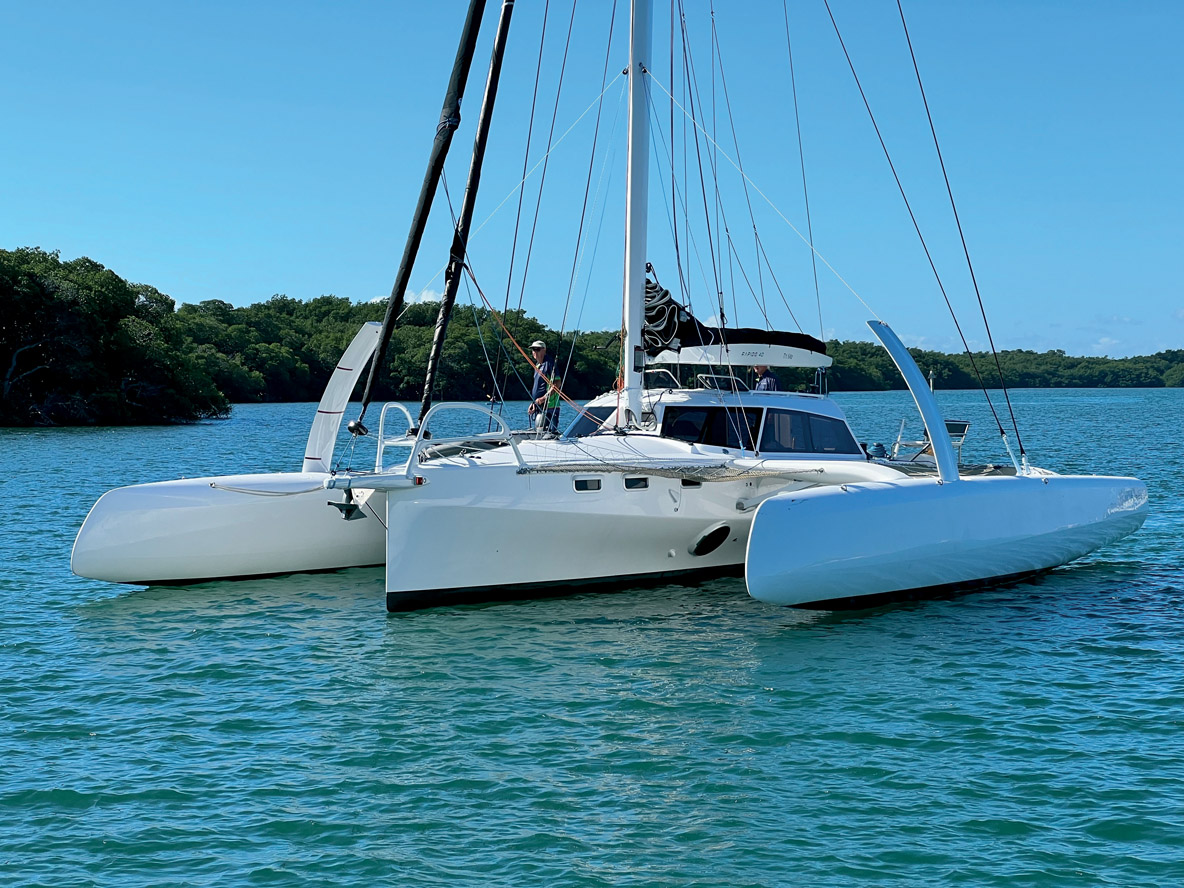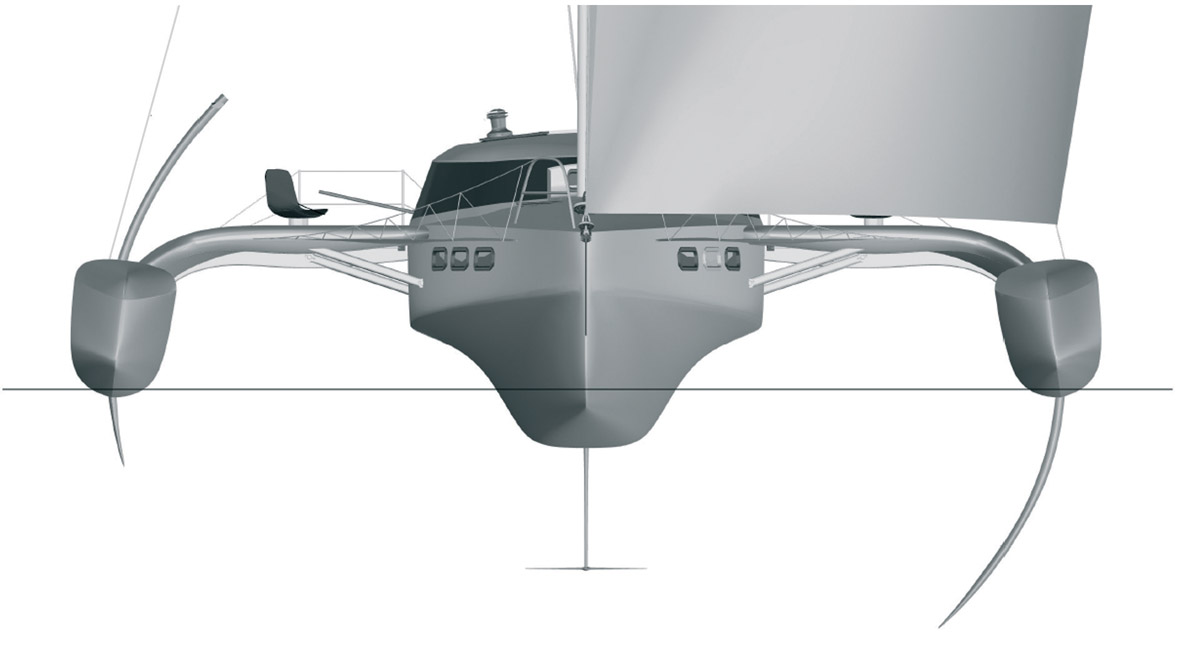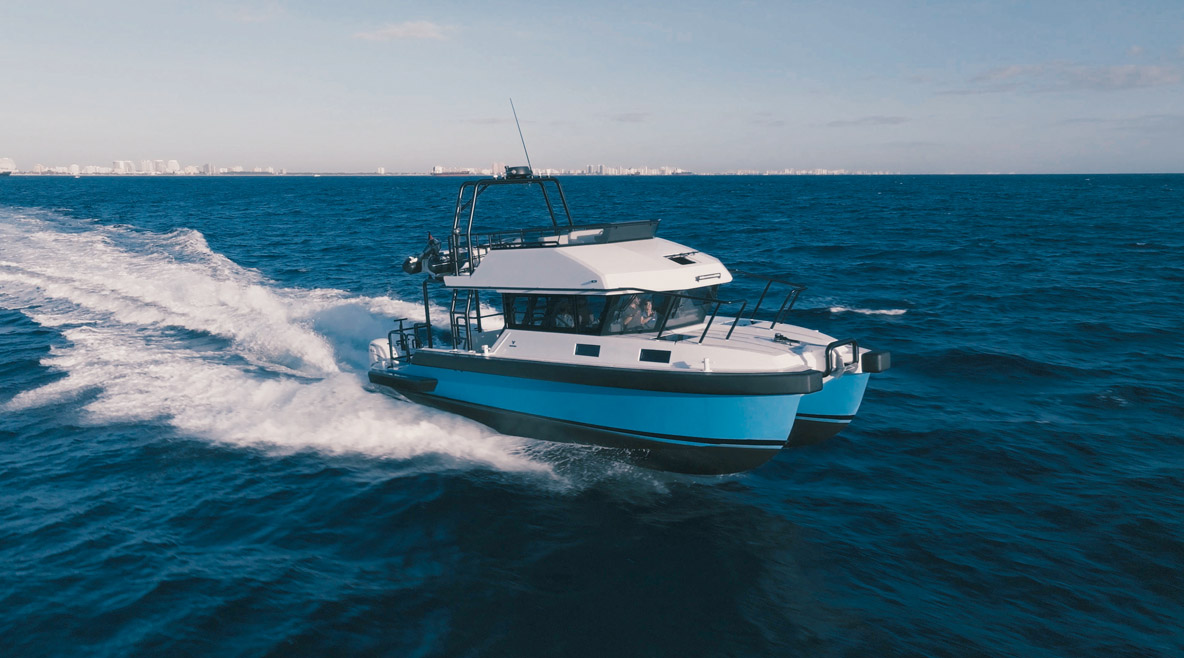

It’s been a little over 10 years since foils were introduced on large numbers of racing sailboats, both monohulls and multihulls. In the recreational boating sector, these appendages are no less impractical to integrate on a single hull as they are on two or three. In fact, foils come in many shapes and sizes, and can be found on all kinds of multihulls, including powercats and cruisers. This technical revolution is becoming increasingly accessible and is set to change the way we sail.
A Brief History of Foils Around the World
Contrary to popular belief, foils are not a recent invention. However, their adoption on sailboats and multihulls has been (very) gradual and has only recently become popular. The idea of using underwater blades to lift a boat was developed by an Englishman, Thomas W. Moyet, in 1861, then in 1869 by a French mechanical engineer, Emmanuel D. Farcot. The latter filed patents in which he added lateral load-bearing planes to a boat, whose inclination could be adjusted according to speed. The effect was to lift the boat slightly off the water, thus validating the hydrofoiling principle. The principle was improved in 1878 by London-based John Stanfield and Josiah Clark, while in 1881 Horatio F. Phillips, another Englishman, but an aviation pioneer, created the transverse foiling system for fast ships.
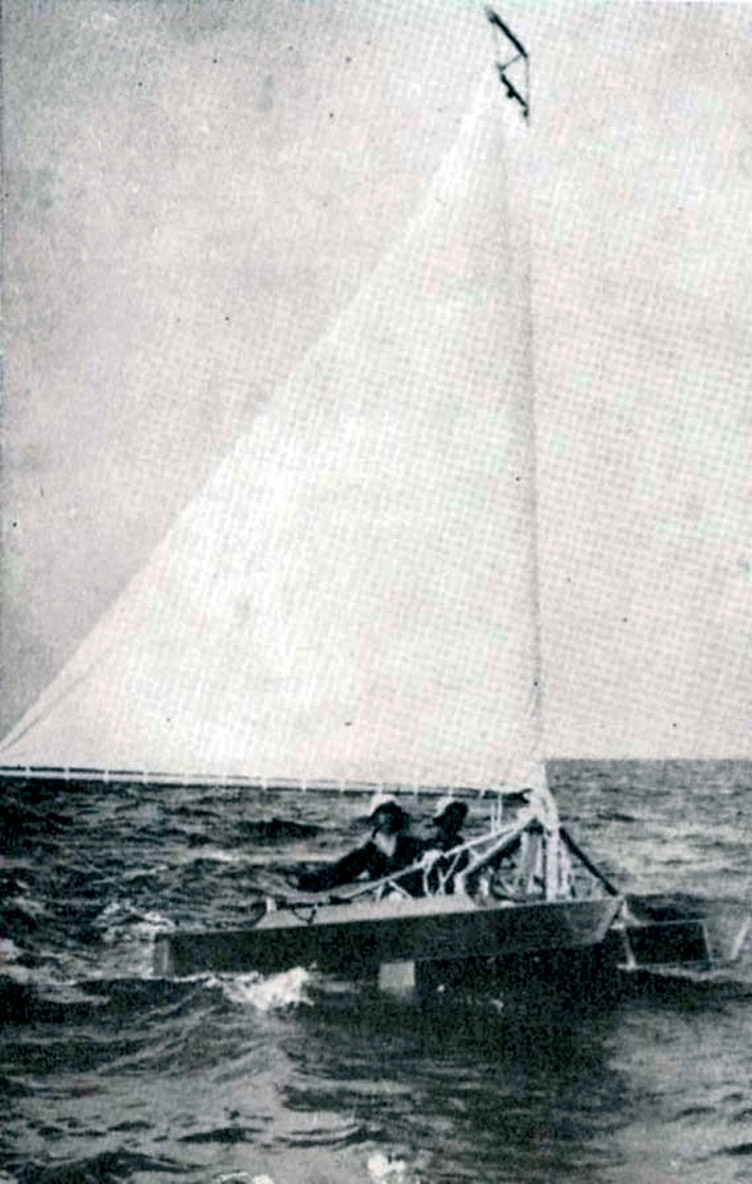
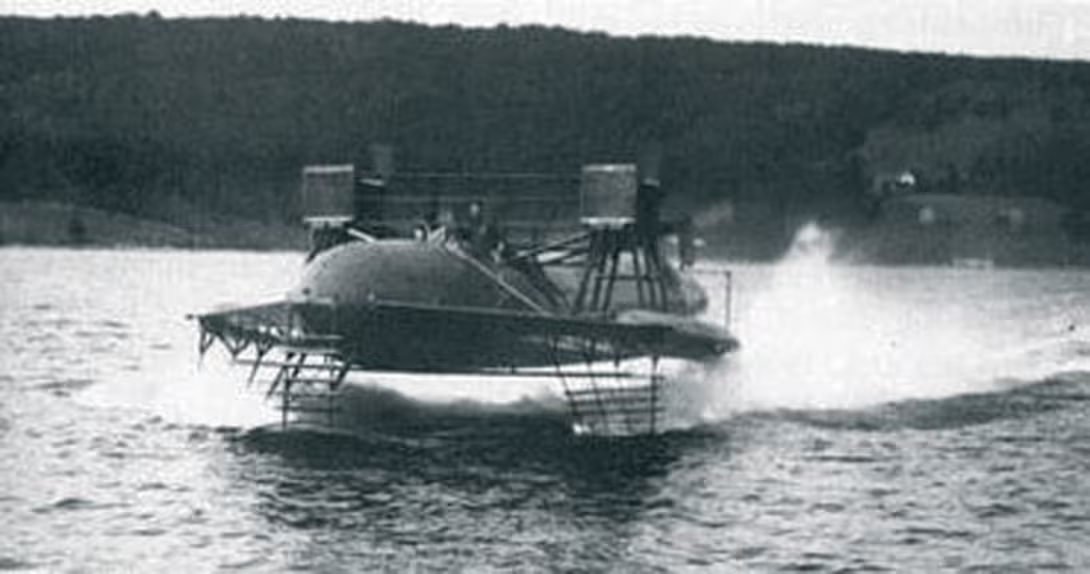
A prototype foiler was built in 1985 by Count Charles de Lambert, a French adventurer and aircraft pilot. This was a catamaran whose two floats were joined by plates underneath. Towed by a horse on the bank, the multihull quickly rose above the water, validating the foiling principle. The inventor continued to improve his invention, going so far as to design a catamaran with five lateral foils and a motor to reach speeds of 40 km/h (25 mph) while skimming the surface of the water. In 1887, American inventor William M. Meacham took up the same idea in Chicago.
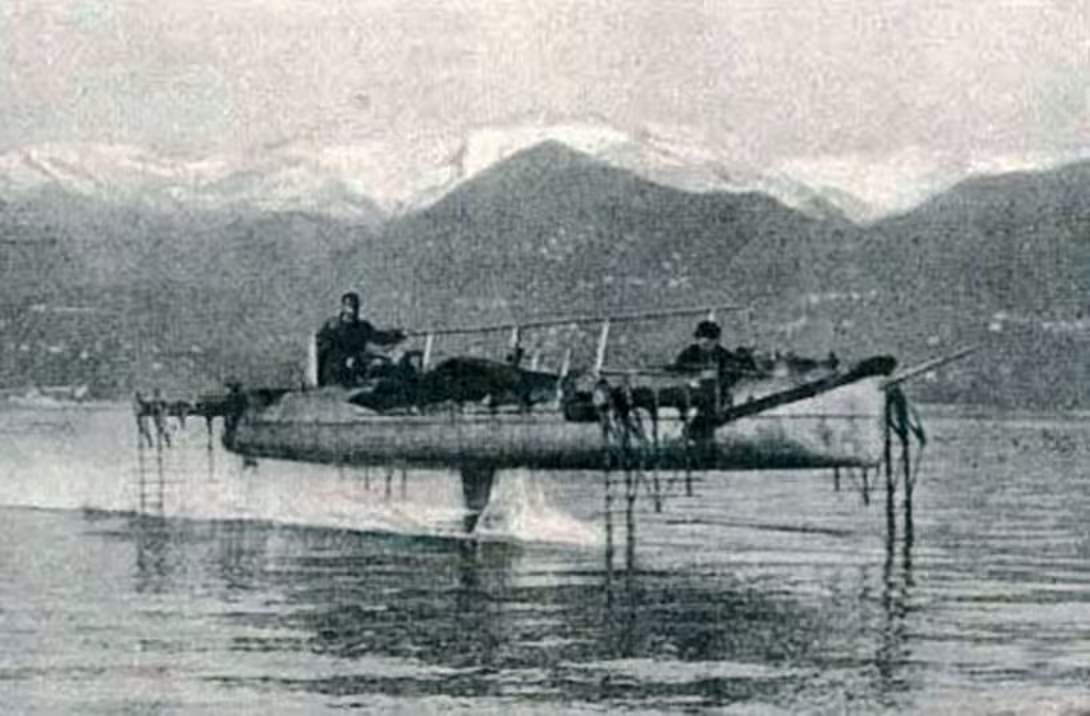
In 1906, Italian engineer and inventor Enrico Forlanini carried out the first trials of the Idroplano, a 10-meter-long (33-foot) catamaran weighing just 1.62 tons and equipped with foils. Powered by a 70 HP engine, it reached 27 knots. He followed this up in 1911 with another 10-meter catamaran, this time powered by a 100 HP Fiat engine, which covered 18 nautical miles at an average speed of 40.5 knots.
Scottish-born Canadian American Alexander Graham Bell (inventor of the telephone) bought Forlanini’s patent and, together with his assistant Frederick W. Baldwin, improved the system, building several hydrofoil prototypes, and even set a world record with a speed of 71 knots. In 1907, the first truly flying powerboat was launched by American electrical engineer Peter Cooper Hewitt.
1938: The First Sailing Catamaran with Foils
Initially geared towards powerboats, the foiling system made its appearance on sailboats in 1938 with the Catafoil, a sailing catamaran with foils built by Englishmen Robert Rowe Gilruth and Bill Carl, taking their inspiration from the pioneers of aviation. In 1950, American scientist J. Gordon Baker’s Towboat II was launched. It was catboat-rigged and is considered by many to be the first true hydrofoiling sailboat. In 1969, English sailor-inventor James Grogono modified a Tornado to add foils. This innovation enabled him to break the world speed record six times on water (over 500 m / 1,640 feet) in Class B, with a top speed of 28.4 knots.
The 1960s and 1970s saw the development of numerous hydrofoil prototypes, including the ingenious Hydrofolie, a trimaran with adjustable foils designed by French architect Xavier Joubert.
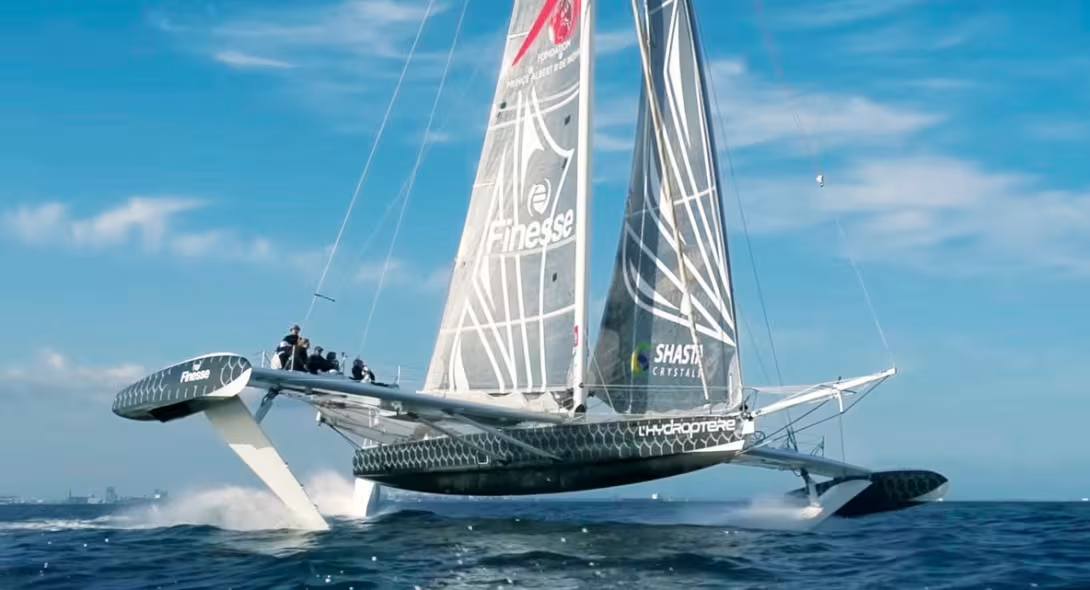
However, hydrofoil multihulls really came into their own with the French sailor Eric Tabarly and his trimaran Paul Ricard, who broke the Atlantic crossing record in 1980. Continuing Tabarly’s work, Frenchman Alain Thébault developed the Hydroptère, which in 2009 became the first multihull to exceed 50 knots.
Since the 2000s, foils have been appearing on (or rather under) racing sailboats - particularly multihulls. These increasingly reliable, high-performance multihulls are beating all ocean racing records, from Atlantic crossings to round-the-world races.
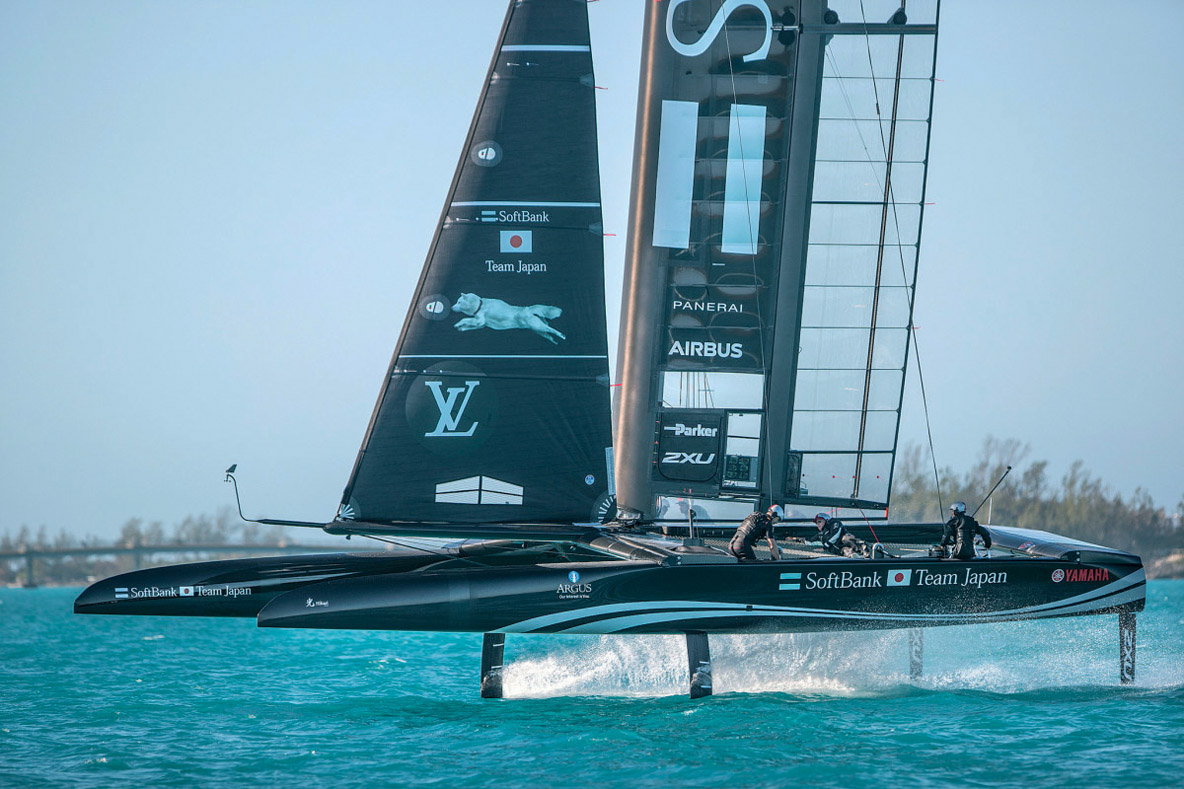
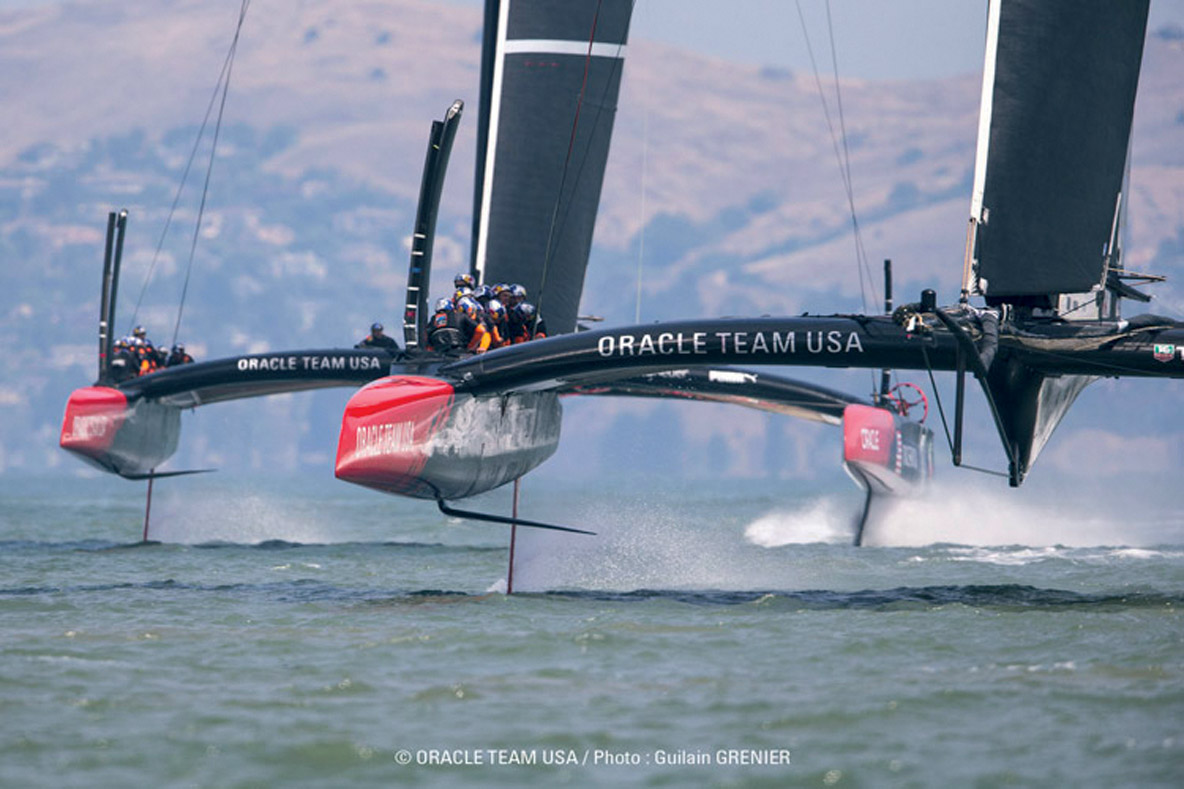
In 2013, the America’s Cup also switches to catamarans, with the famous AC72 hydrofoils. Capable of reaching 45 knots with their retractable foils and wing mast, these racing machines are revolutionizing racing, and competition on the water in general.
In 2016, it was the turn of the Imoca class to adopt foils, resolutely increasing boat speed, while the Ultim class, 32-meter (105-foot) foiling trimarans, were created in 2020.
What About Leisure Boating?
While foiling technology has certainly proven its worth in the world of competition, lifting foils are no longer reserved for this field. Foils can now be found on many power boats, on sailboats - and of course on our multihulls.
The purpose of the foil is no longer necessarily to fly, but rather to provide lift and cushioning. This makes it possible to optimize performance, consumption (for powercats) and comfort. With advances in automation and composite materials, the next generations of cruising multihulls could incorporate semi- automatic foils adapted to speed and sea conditions.
Sports and Cruising Multihulls
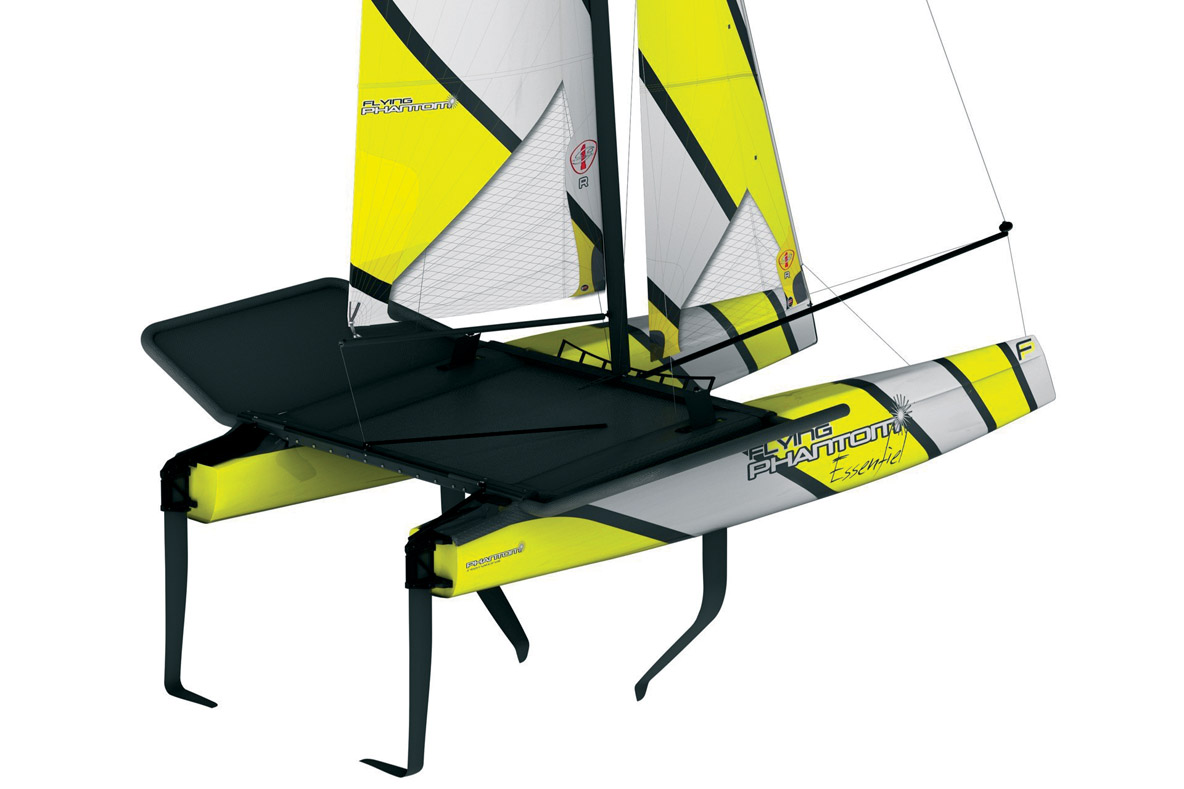
From the very first experiments, the multihull has represented an ideal platform for foils thanks to its lightness (no ballast) and the possibility of easily stabilizing the rectangular platform. It is therefore no surprise that this type of boat is particularly well suited to the use of foils, starting with the Nacra 17 and its C-foils, the Nacra F20 Cabin, the Flying Phantom Essentiel, the iFly 15, the Whisper Foiling Catamaran and the impressive TF 35 inspired by the AC50 – to name but a few.
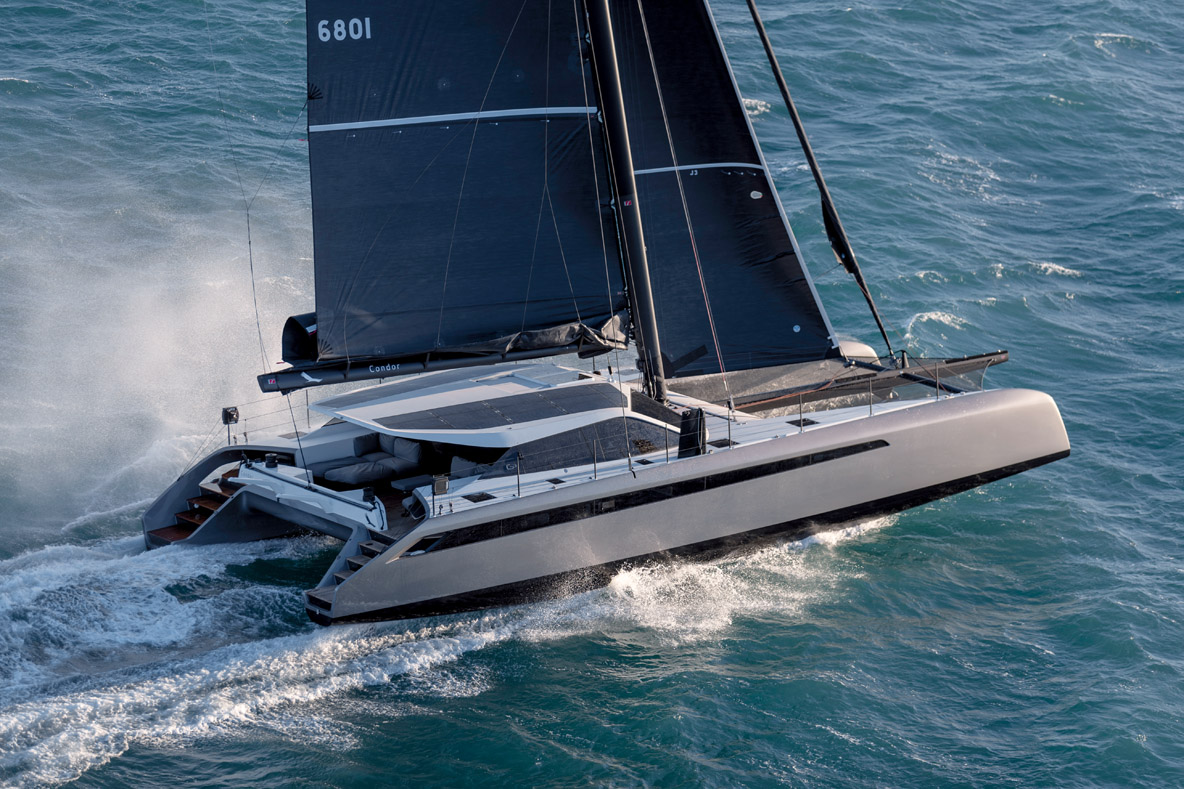
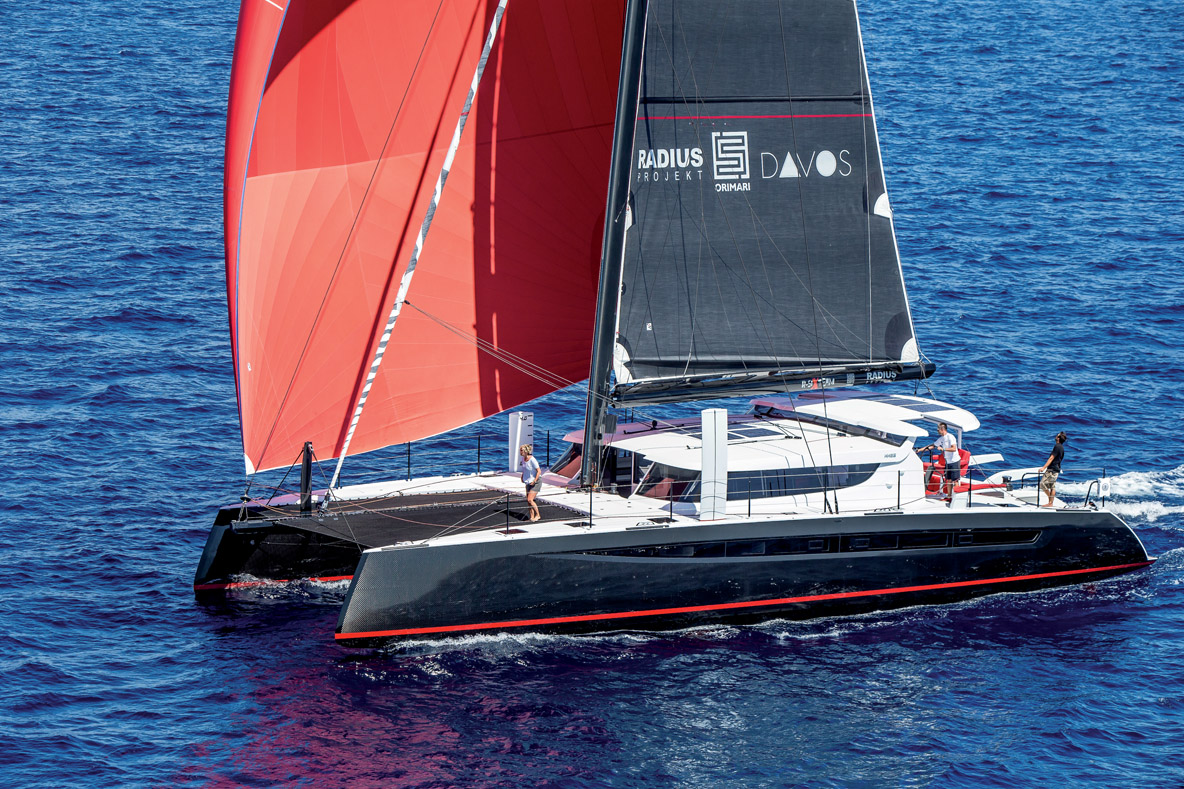
The cruising sector has also embraced foils, with several models successfully using lifting surfaces; this is particularly the case with the Gunboat, the Eagle Class 53 with its T-foils, the Rapido 40, and the Persico 72 and the small Libertists.
Powercats: The Reign of the Transverse Foil
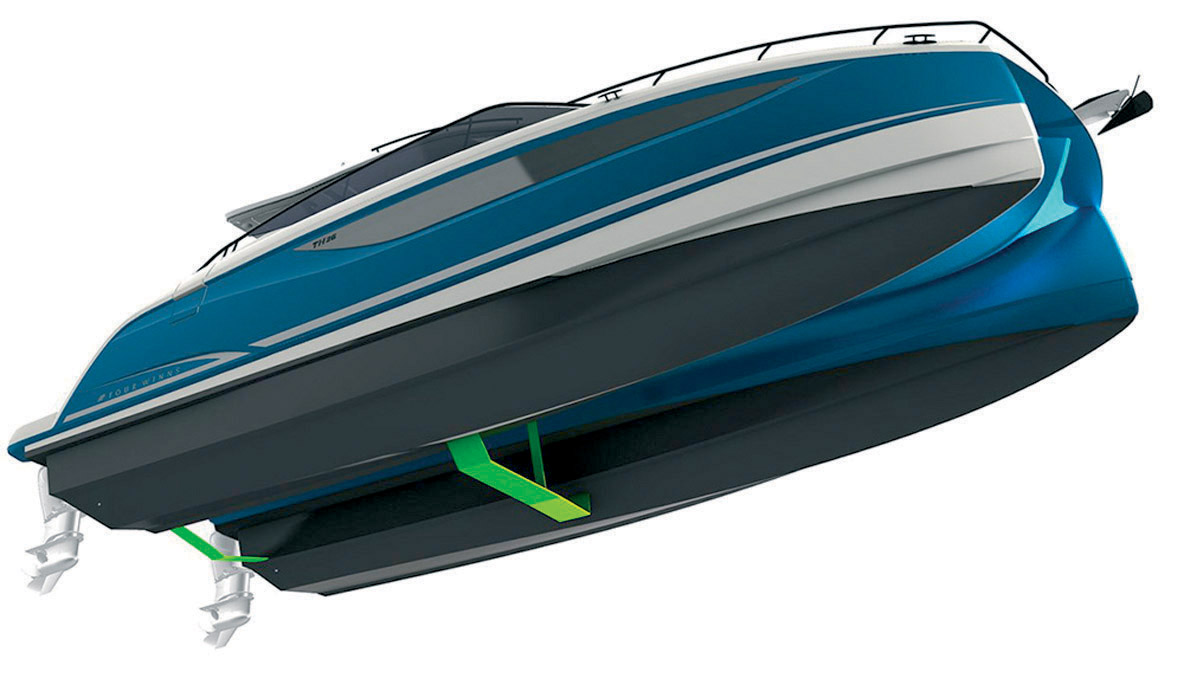
Multipowers - and particularly powercats - also benefit from the principle. While some pontoon boats (catamarans or trimarans) are content to add fixed fins under the tubes to lift the boat a little off the water, the big trend is rather the use of transverse foils attached between the hulls. This system is used in particular on Vandal catamarans, but also on the Four Winns TH36, the Makai M37 (see our Multipower pages), the Aventura 38 and also on the brand new Aquila 42 and 46 Coupe.
How it Works and Advantages
Foils are hydrodynamic parts attached under a hull (lateral foils) and/or grafted onto traditional elements (daggerboard, rudder). Their principle is based on the same principle as that of an airplane wing: when a boat or multihull reaches a certain speed, the foils generate lift that gradually raises the hull out of the water, thus reducing hydrodynamic drag and enabling speeds much higher than those of conventional craft to be reached.
Low Pressure and High Pressure
To put things in slightly more technical terms, as it moves forward, the foil creates low pressure above and high pressure below. The water that travels a greater distance on the side of the extrados (upper side), curved in the shape of an elongated half-droplet of water than on the intrados (lower side), which is completely flat, generates an upward force that lifts the boat.
Reduction of Drag
Once clear of the water, only a small part of the foils remain submerged, considerably reducing water resistance and also fuel consumption for a powercat.
Increased Speed
With all or part of the wetted surface of its hull(s) out of the water, the boat accelerates and can reach much higher speeds than a conventional boat.
Foils: Pros and Cons
Increased Speed
Since the creation of boats, the search for better performance has always been one of the primary motivations behind innovation. The foil is no exception, since the primary goal is to go faster. Regardless of the type of foil chosen, by reducing the wetted surface and therefore friction, the lifting surfaces will allow you to go faster, sometimes with more than impressive performances. Who would have believed 30 or 40 years ago that some multihulls would exceed 50 knots?
Greater Comfort
The second advantage of foils, at least on recreational multihulls, is improved comfort. By raising the hulls slightly or completely, the effect generated by the foils reduces the impact on the waves, and therefore makes sailing smoother, which is always pleasant.
Greater Energy Efficiency
The final advantage, particularly for powercats, is that the use of foils reduces the wetted surface area and therefore friction. This significantly reduces energy consumption, whether in the form of fossil fuel or electrical energy.
Complex Technology
The design and installation of foils requires the use of advanced technologies that must be expertly mastered. There is no room for amateurism here, because a bad foil will, at best, be ineffective, but, at worst, can become dangerous.
Sometimes Requires Experience at the Helm
On a real foiler, piloting requires experience before you can master flight, which is one of the reasons why some foiling systems are still only seen in high-level competition.
High Costs
Due to the technology used, the materials required or the complexity of the design and installation, foiling is a technology that remains expensive.
Not Effective in Light Airs
The final disadvantage is that foils on a multihull sailboat are only effective above a certain wind strength. If the wind conditions are light, it will not be able to take off, and this can even increase drag.
The Different Types of Foils
Foils come in many shapes and configurations, each with specific performance and uses depending on the boat they’re fitted to. The design of the lifting surfaces incorporates a compromise between lift, stability and maneuverability. Here is an overview of the most commonly used systems.
C-Foils
As their name suggests, C-shaped foils have a curved shape that is more or less pronounced depending on the model. C-foils do not allow the boat to fly out of the water. However, they do provide a lift effect that raises the multihull. Their main advantages are therefore to improve speed and comfort by providing semi-lifting. They are also very easy to control because they are less extreme than other foils. On the other hand, they do not provide the performance and sensations of fully-foiling systems. One of the best ambassadors of C-foils is the Rapido 40, a trimaran whose curved daggerboards reduce the wetted surface area, thus improving performance and comfort. C foils can also be found on the Nacra 17 in the Olympic version.
L-Foils
These are the foils that can be seen on ocean racing monohulls or on the new America’s Cup boats. They are recognizable by their L-shape with a horizontal part that generates lift. Their main advantage is that they improve stability compared to straight foils. They also offer better lift and provide a good compromise between performance and control. On the downside, L-shaped foils offer less stability than T-shaped foils and they also take up space, even when folded. This type of foil is particularly suitable for Figaro 3 or Imoca monohulls.
T-Foils
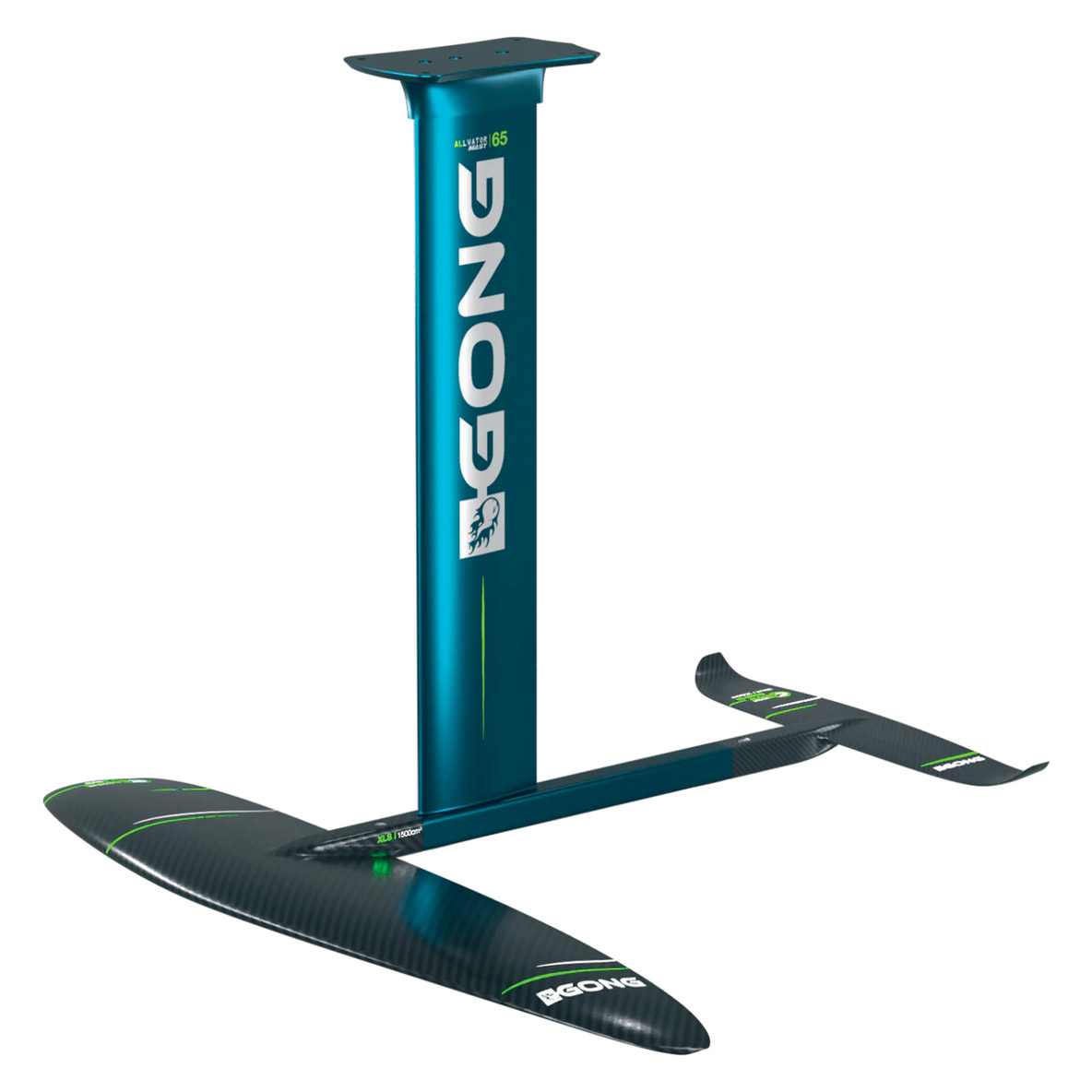
T-shaped foils consist of a vertical part and a horizontal perpendicular wing at the bottom of the foil. They have been used for a very long time, these being the ones found on boat rudders, on daggerboards, but also on surfboards with foils. T-foils have many advantages and, first and foremost, they offer great stability in flight and prevent pitching. They also allow for better control of your boat or board at high speed. On the negative side, they have greater hydrodynamic drag at start-up and are also less responsive during maneuvers. They can be used in a wide range of situations, from small dinghies to sports catamarans, including AC75s and surfboards with foils.
V-Foils
The V-shaped foil is widely used, particularly on racing multihulls. It consists of a blade inclined at approximately 45° towards the center of the multihull. The main advantage of this system is its simplicity, as it is more or less a single blade per hull. Another good point is that the V-foil is practically self-regulating, meaning that the boat regains its trim and balance almost automatically, even in rough seas. The V-foil also has a very small wetted surface area, and therefore little drag. This allows a multihull to fly at very high speeds, sometimes over 50 knots. There are few drawbacks to note, except for meticulous implementation with precise angle calculation, and sometimes the need to add a strut. The V-foil is used in particular on large ocean racing trimarans.
U Foils
U-foils are, as their name suggests, closed foils in the shape of a U or an elongated O. A system that appeared in the 1950s, but it is not very popular. The idea of the U-foil is to have a large bearing surface that varies little. This system has several advantages: first of all, sturdiness, because the profile is closed, stability and ease of implementation and use for an amateur. On the other hand, U-foils are a little less efficient because they offer more wetted surface, which certainly explains their low popularity.
Transverse Foils
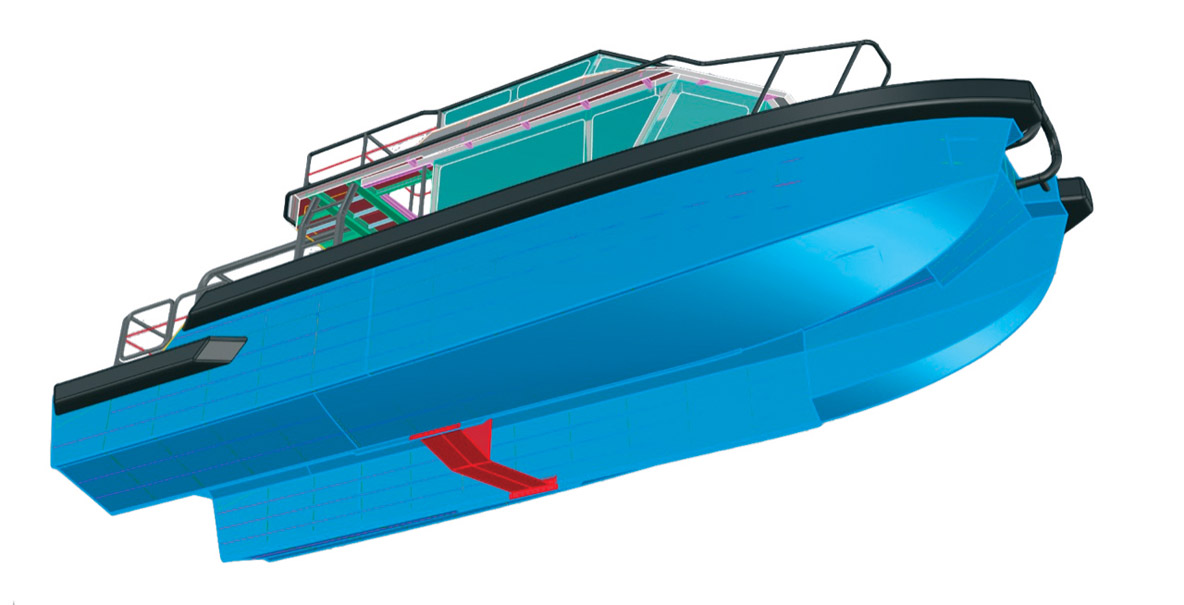
While power catamarans use other types of foils, particularly for commercial use, transverse foils are increasingly popular for this type of multihull. The transverse foil is in fact a blade that connects the two hulls. It acts like a hydrofoil that allows the boat to rise (slightly) out of the water while picking up speed. This system does not allow for flight in the strict sense of the word, but it lightens the catamaran, which reduces its wetted surface. This foil is most often supplemented by mini lifting surfaces on the rudders.
On the plus side, the transverse foil, by reducing the wetted surface, increases speed, but it also reduces fuel consumption. In addition, it significantly improves comfort, especially in choppy water, since the hulls will pass over the crests of the waves and the blade blocks rolling and pitching. Another good point is that it is a fixed and solid appendage that, in most cases, requires no adjustment.