
“We build catamarans because they are more environmentally friendly than monohulls”
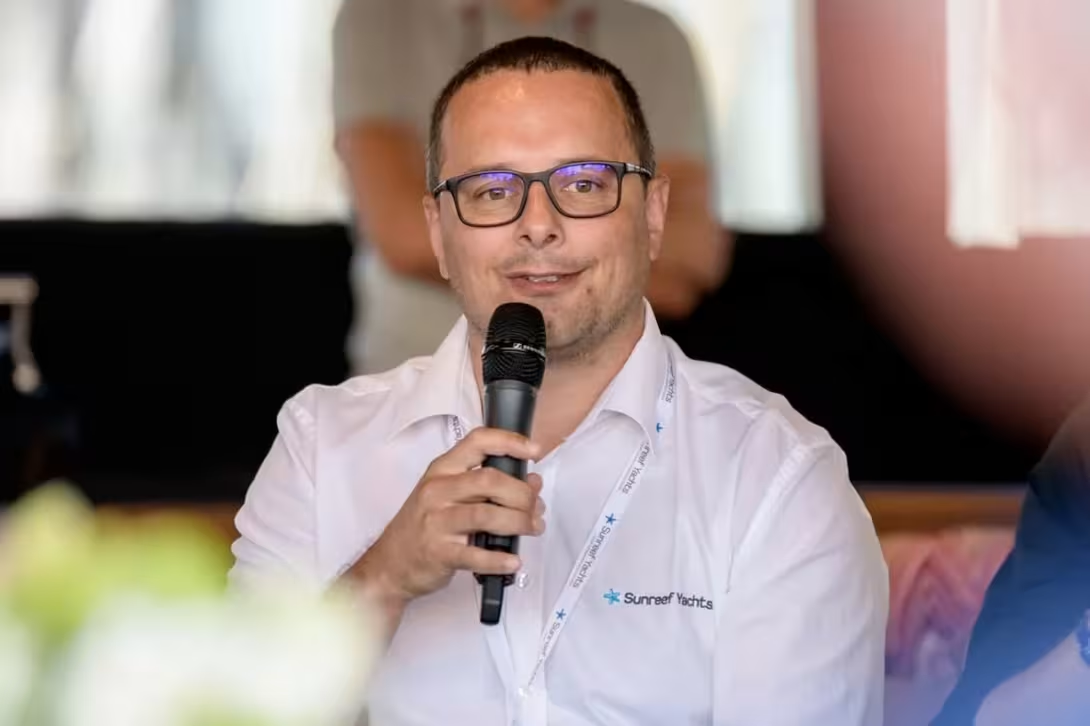
Since its creation, Sunreef has followed a slightly different path than many of its competitors, one that is above all more environmentally friendly, without sacrificing comfort on board. To learn more, we asked Nicolas Lapp, the brand’s vice president, about the shipyard’s philosophy on environmental protection.
Image
Image
Image
1
/
1
Publié le
03/07/2025
Par
Dominic Salander
Numéro :
SP24
Parution :
Sep.
/
Oct.
2025
Nicolas Lapp: In fact, environmental concerns have been a priority since Sunreef was founded. We chose to build catamarans because they are more fuel- efficient and therefore more environmentally friendly than monohulls. Then there was the project with Laurent Bourgnon in 2008, where we designed a catamaran with elongated bows to be more efficient and improve fuel consumption.
In the same vein, in 2013, we built a carbon fiber boat for a customer who wanted a light and fast catamaran. This reduced fuel consumption, and carbon fiber is also a recyclable material. Finally, on this boat, we also installed a separate electric circuit for air conditioning, which marked the beginning of the use of a battery bank for the shipyard. Following this project, we started using more and more lithium batteries for on-board appliances.
We reached a point where the only thing missing was electric propulsion, so in 2017 we launched our first models equipped with electric motors, a 50-foot sailboat and the 60 E, an electric powercat.
It was also at this time that we started using solar panels, then decided to switch our batteries to 620 volts and very quickly the generators, motors, and all the electrical equipment on board to the same voltage.
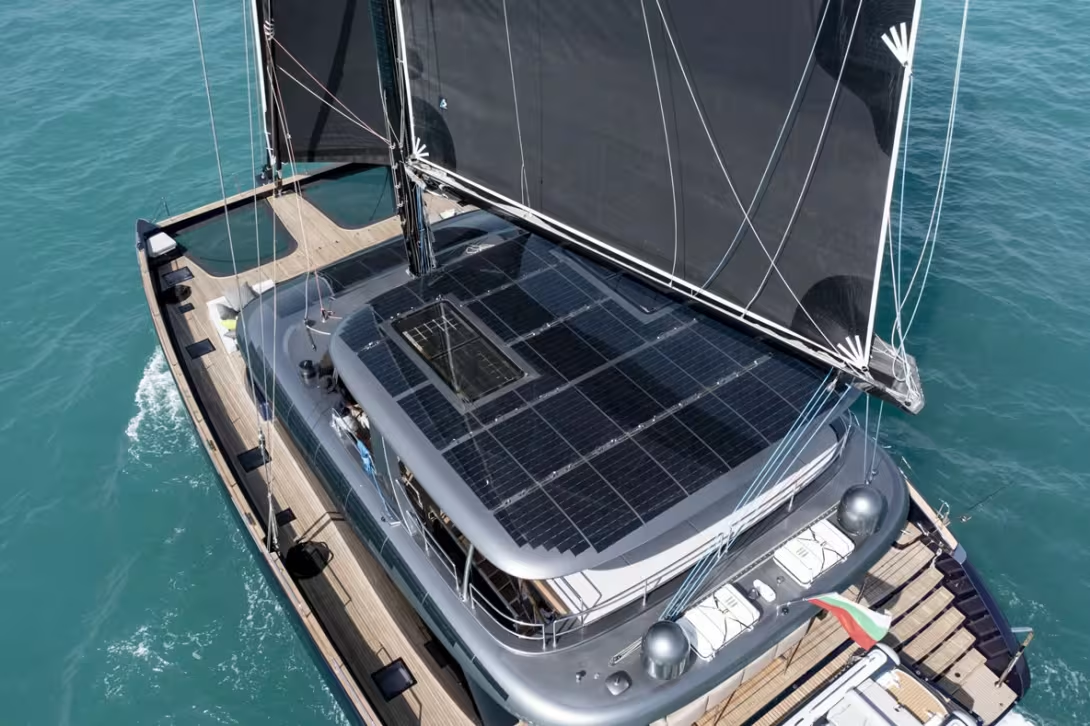
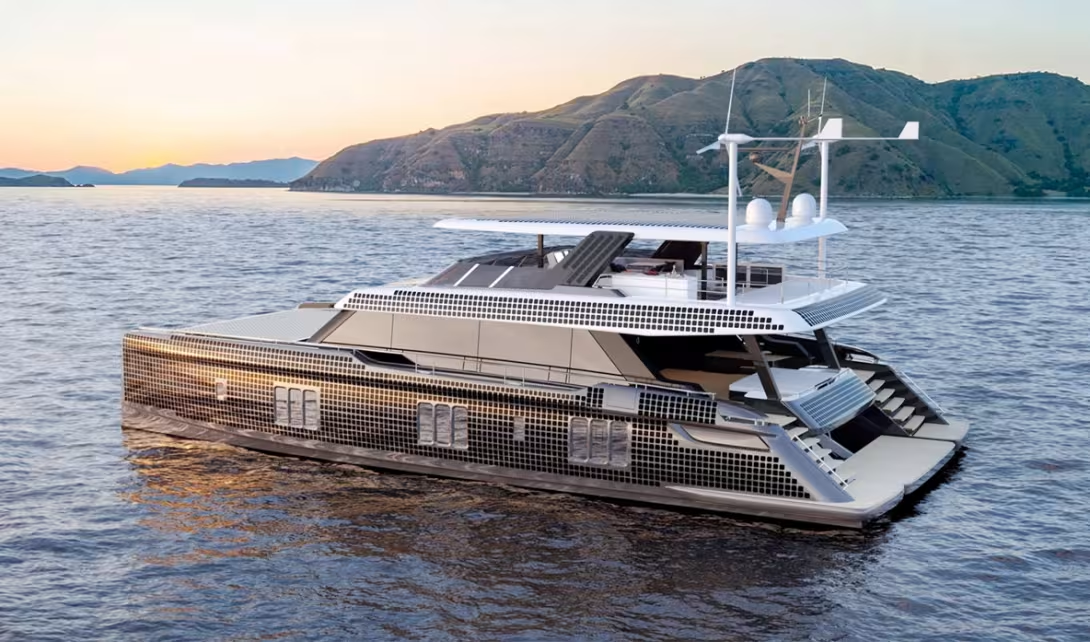
Finally, in 2022, we launched the first models in the Eco series, with solar panels integrated into the hull of the boat. However, the process doesn’t stop there. We design each catamaran as a whole and always try to find the most efficient system, the one that consumes the least energy. This includes appliances, but also gas air conditioning and water heaters that are five to six times more energy efficient than traditional models.
Similarly, when a system works, we roll it out across the range. Today, non-Eco models incorporate many features that were first used on Eco versions, starting with the batteries and electrical circuits, which are now 48 volts on all our models.
MW: Is this environmental concern limited to the electrical circuit and the propulsion system?
NL: Not at all. As I said before, we think about the boat as a whole. This means that we try to use more environmentally friendly products at every stage of the manufacturing process. For example, we use bio-sourced resins, recycled cardboard, basalt fiber, and many plant-based products such as flax fiber. Whenever possible, we use composite products that can be recycled.
NL: Absolutely! We have lots of innovations coming up. For example, on the boats, we are testing technologies that will detect the presence of a person in a cabin. This will allow the system to know when a cabin is unoccupied and therefore optimize air conditioning or better manage lighting, once again to reduce energy consumption.
In terms of propulsion, even though the trend is toward powercats, I remain convinced that sailing is one of the best ways to travel on water. However, it is still not very efficient, and above all, it is a bit complicated for a novice. We are therefore working on a system that will make sailing much easier, particularly with wing sails. The idea is to make sailing much more accessible and efficient and thus convince more recreational boaters to go down this route. We are actively working on several prototypes, and the initial results are encouraging. Finally, we want to improve hydrogeneration, which is also an excellent source of energy if used properly.
NL: I must admit that when we launched the Eco series in 2022, I didn’t expect to see such success. Customers really embraced the concept, and today it accounts for 50% of our sales, even though each Eco catamaran is still a little more expensive. As a result, even the rest of the range is becoming a little more Eco with components from the Eco series.
The brand-new Ultima 55 series, which we have just launched, is available in both classic and hybrid versions, and to date, most orders are for hybrid models. In addition to their ecological aspect, these hybrid catamarans no longer need to carry generators and whenever they sail at low speed, they do so in electric mode.
NL: No, honestly, I don’t think so. In fact, it’s quite the opposite, because on a larger boat, we have more space to install high-performance electrical systems, solar panels, batteries, and methanol tanks, which is an environmentally friendly fuel. We are currently producing three 43-meter models, all of which are Eco models. In fact, regardless of the size of the boat, if you take the time to look for it, you can really find solutions and equipment that consume much less energy. You just have to think differently, and that’s what we do at Sunreef.
