
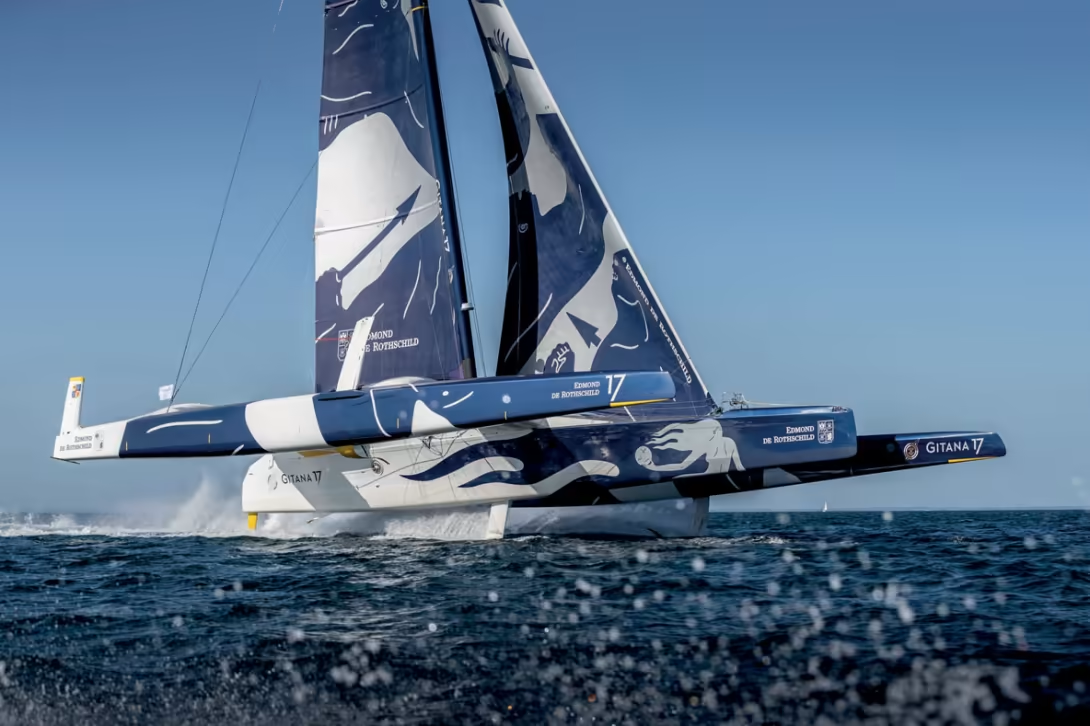

Building a racing yacht: judging the environmental impact?
Stan Thuret rightly points out in his press release that any activity that contributes to breaching the quota of 2 metric tons of carbon equivalent (tCO2e) per year per person - the value recommended by the IPCC for maintaining a liveable planet - should be called into question. The sailor also raises questions regarding the weight in tCO2e of different racing boats. This is an opportunity to study the available data.
The IMOCA 11th Hour team has carried out a complete life-cycle analysis of its latest racing beast: we learn that a 60-foot, 8-ton yacht like this one generates 553 tCO2e emissions - which is equivalent to the annual carbon footprint of 26 Americans. The pollution factors involved in the construction of racing boats are multiple. For a start, these yachts are mainly built from carbon fiber. This material comes from the mining industry, recognized as one of the world’s most polluting activities. Carbon is difficult to recycle, and fibers are imported from the other side of the planet. Add to this the various metal alloy parts and electronic equipment, and you get a total mining output equivalent to that required to manufacture 130 electric cars. The IMOCA class has introduced measures in its rules to encourage the use of bio-sourced materials. However, these measures favor teams in sporting terms, under restrictive conditions and within the limit of 220 lbs (100 kg) of alternative materials. In view of the 3 t of carbon used on average per IMOCA, this is insignificant.
For other classes such as Ocean Fifty, Class 40 or Mini 650, the use of carbon is prohibited or limited. However, even with fibers that are slightly less problematic for the environment, the use of resin from the petrochemical industry and the manufacturing processes remain polluting. The processing of composite materials requires a great deal of single-use plastic, from the trays used to mix the resins, to the various layers of plastic used for vacuum bagging and, depending on the technique used, the hoses and all the consumables required for resin injection.
The prepreg carbon used in abundance in the high-tech construction of racing yachts dispenses with this injection stage, but this fabric is a self-adhesive, which leaves behind its plastic film backing. During the construction of 11th Hour, 1.2 t of waste was weighed - more than 10% of the yacht’s displacement.
There are very few boatyards in the world that build racing yachts, and the relentless prototyping of these unique boats has meant that the small number of players have been left out of the industrialization process. We also note that within these small structures, optimization of water and electricity consumption can be improved. One example: the assembly of composite parts requires temperatures close to 68°F (20°C), and this operation is sometimes carried out in cold weather in uninsulated sheds. However, shipyards do seem willing to make an effort on energy issues, and CDK did contract a green energy supplier for the construction of 11th Hour.
There is a final factor that has a negative impact on the carbon footprint: the quest for excellence drives ocean racing teams to seek out the best - and the subcontractors they choose often have production facilities a long way from where the boats are assembled.
Wind-propelled vessels, maybe, but...
Once a yacht has been built, you’d think that the most polluting phase of its life would be behind it, as long as it travels under sail... Unfortunately, most racing multihulls are not maneuverable enough to be self-sufficient, each of their outings requiring the assistance of RIB whose engines are far more powerful than those of the multihull itself, which also carries fuel for its main combustion engine (and possibly an additional generator) to supply electricity to the on-board appliances. Hydrogenerators and solar panels are increasingly being used on many boats, but although these solutions are highly efficient, the volume of fuel on board has not decreased over the years. The latest generation of racing machines are equipped with increasingly energy-guzzling electrical systems.
Fuel consumption remains extremely low per mile sailed compared with the average for ocean-going vessels, but the escalating energy consumption of racing boats is absolutely indefensible today.
Another worry is the number of collisions between high-speed foilers and marine animals. Teams are actively working on these issues, but accidents of this kind are still too regular to be ignored.
Finally, damage to racing boats almost always results in the damaged part being jettisoned into the ocean. Admittedly, sails that have become useless on the last legs are no longer jettisoned into the sea, as was often the practice in the 1970s...
Ocean racing: an event-driven approach with a high environmental impact
Now that we’ve looked at the environmental issues associated with the boat itself, we can broaden the scope of our thinking, since ocean racing is part of a global ecosystem of sporting events. These events themselves are not pollution-free.
According to the collective La Vague, which questions the environmental implications of competitive sailing, the organization of the Route du Rhum discharges 145,000 tCo2e, i.e. the annual quota of 34,000 Americans. One of the most significant emissions generated by this event is the transportation of spectators and teams from mainland France to Guadeloupe. If we consider that for each of the 138 competitors, an average of 3 members of his or her team make the round trip by air, we’re already looking at more than 420 tCO2e.
The main problem with moving technical teams is reached with stage races. For The Ocean Race, nearly 100 people (not counting their families) will fly around the world to follow the boats. To this must be added the hundreds of pounds of equipment and spare parts and the containers moved by cargo ship.
Beyond the transportation of the teams, the whole philosophy of these events needs to be rethought. Race organizers are committed to the logic of «always more»: bringing in more spectators, from further afield, to give them a more exciting experience. This means more miles driven in individual cars, more spectator boats and, last but not least, the use of sound, lighting and other activities with a high environmental impact. In the end, 11th Hour calculated that the construction of their boat, while already highly polluting, only accounted for 25% of the greenhouse gas emissions of their entire 5-year campaign. These figures should be put into perspective against those of the yachting industry as a whole: the use of a cruising catamaran for 20 years has 4 times less environmental impact than its construction.
From the dream to the technology...
Should ocean racing be consigned to the garbage can? Is ocean racing really a fad with a permanently disastrous carbon footprint, or does it have something to contribute to our society that justifies saving it from the climate crisis?
The most obvious argument in its favor is the wonder that ocean adventures inspire. Few sports today are so capable of awakening the imagination, opening up horizons and fascinating crowds. Skippers vicariously involve their public in their adventures, their emotions...
The attention they generate highlights the importance of protecting the marine environment. Many skippers work with associations on these issues, and some race organizations are doing commendable work in this field. Offshore racing offers both an escape from the gloom and an excellent platform for the protection of marine ecosystems.
In motor sports, we often see a shift from the technologies used in racing prototypes to production models. By following this logic, racing yachts should be able to help decarbonize the entire maritime sector. It’s true that ocean racing has made a lasting contribution to the development of sailing. As far as commercial vessels (fishing, freight, etc.) are concerned, the bridge is not as obvious, but it is particularly encouraging to note that great racing yachtsmen such as Yves Parlier and François Gabart are working on decarbonizing cargo ships. In addition to the merchant navy’s still nascent environmental awareness, fuel costs and the gloomy future outlook for oil are pushing the industry to explore avenues that previously seemed improbable. Today, the optimization of propulsion systems no longer delivers significant efficiency gains. Optimizing hulls and adding structures to improve aerodynamics are therefore attracting a great deal of interest. These are subjects that are particularly well mastered by offshore racing designers...
What will the rules of the game look like tomorrow?
Many players in the ocean racing sector have already put forward proposals for a more virtuous environmental balance sheet. La Vague has put forward the idea of organizing arrivals and departures only in locations linked by soft transport (train or ferry). For major events, Forever Green actions could be given a higher priority in the media. OC Sport, organizer of the Route du Rhum, highlighted its partnership with the SNCF – the French national rail company - who doubled their services between the Breton capital city, Rennes, and Saint-Malo for the duration of the Race Village. A good start!
The introduction of the Sail GP circuit is also encouraging: rather than discarding the flying catamarans of the previous America’s Cup, the organizers have succeeded in establishing a one-design class. Admittedly, a world tour means a lot of air travel and air-conditioned containers on the docks... but at Sail GP, the Impact League has been established. This ranking is based on sporting results and rewards the team with the lowest CO2eq emissions.
Are we seeing the beginnings of a more environmentally friendly evolution in ocean racing? Today, to be a front-runner in a race, you need a state-of-the-art boat, which means that teams have barely finished making their boat reliable before they have to start thinking about building the next one. The most powerful teams with no financial restrictions have every interest in changing boats, sails and electronics on an ongoing basis. As we have seen, building a racing boat is currently extremely polluting. This one-upmanship is countered by certain rules that limit the «arms race». We could go much further and impose a «minimum active life» - 10 years for hulls, 3 years for sails and electronic equipment, etc. - but this is not enough.
This is where «slow evolution» one-design classes come into their own, as a yacht could be used for 10, 20 or even 30 years! It now seems inevitable that most of the rules governing ocean-racing yachts should take into account the environmental impact of the materials and equipment used. One way of doing this might be to weight performance against the sustainability of the project at all levels. If this incentive strategy does not yield sufficient results, it could be accompanied by a more restrictive strategy, for example, by granting each team taking part in a race a quota of kilograms of CO2eq that must not be exceeded. These different measures would require a great deal of educational work to make them easily understandable to the public and relayed by the media.
Recycling existing materials and using new ones
The announcements made in early 2023 by various naval architecture firms launching Mini 6.50s made entirely from recycled fiber are all excellent news. It is essential that bio-sourced, recyclable or recycled materials cease to be marginal products. Today, they have the reputation of being heavier for less mechanical strength and, above all, do not allow certification by the bodies that dictate the standards. A great deal of research and development, followed by intensive testing, is required to pass the certification hurdle.
However, we must bear in mind that these new materials do not solve all of the problems. As the least polluting object is the one that already exists, common sense dictates that we promote the reuse and repair of already manufactured products. The reuse of molds should be encouraged. Sometimes, what was waste for one team can become the raw material for another project.
This philosophy can be applied right from the boat design stage, or in the case of modifications to improve an existing boat. The design could be optimized not only for speed, but also for the conservation of raw materials. Structures that can be built on marble could be promoted, eliminating the need for molds. We could also limit the number of materials and/or types of fiber used: the patchwork effect generates more offcuts and therefore waste of material and multiplies the number of manufacturing stages.
In terms of work practices at shipyards, we could highlight the reusable silicone sheets used for vacuum bagging, which are still relatively rare. As for non-reusable consumables, yard teams could work on recycling them. There are plenty of ideas to be gleaned from the mass-production construction industry - which is already well versed in saving money, even if this isn’t primarily an environmental concern.
As we end this article, we can see that Stanislas Thuret’s comments open up a wide range of debates. It has the merit of obliging us to remove our heads from the sand. Offshore racing is a polluter, that’s a fact. Once this has been established, it’s up to each and every one of us to decide whether we want to put an end to this activity altogether or try to reform it.