
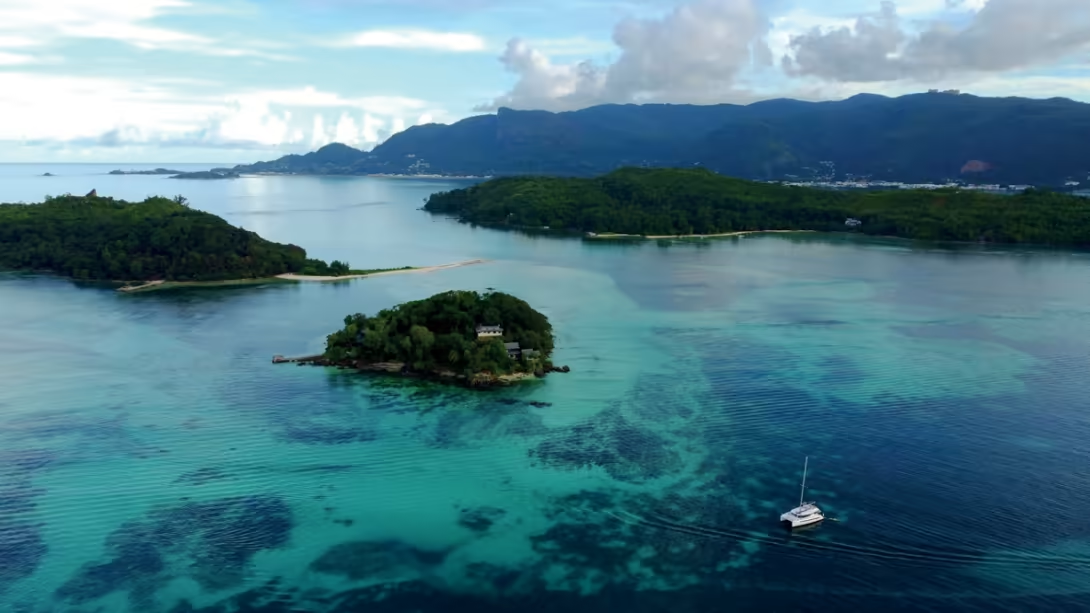
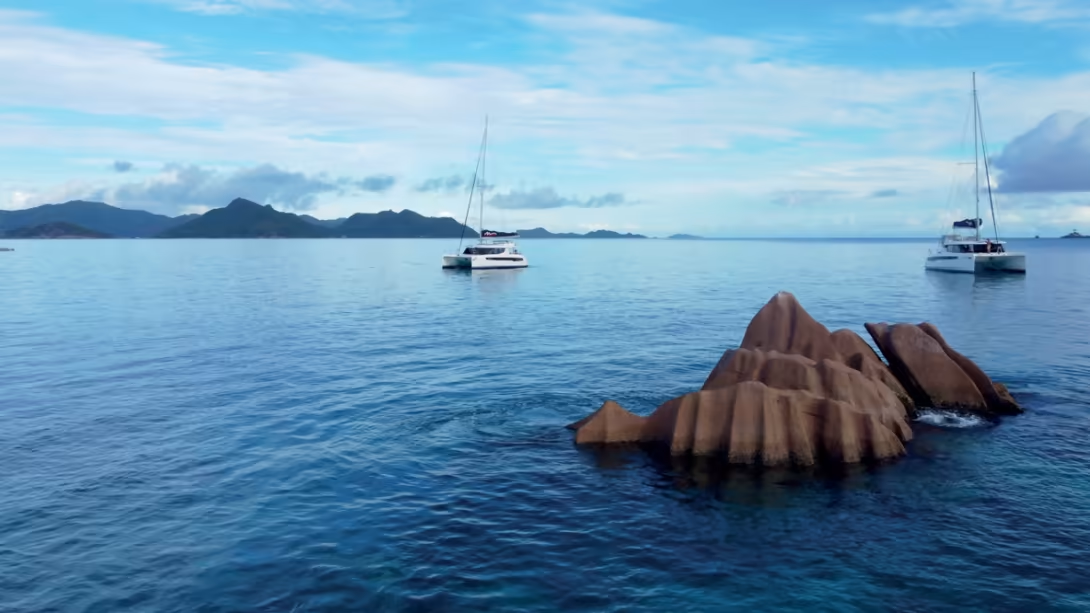



Forget the five-star hotels and don’t worry about pirates, who are further north. Instead, make the most of this extraordinary sailing area comprising 115 islands - only one of which, Eden Island (Victoria, Mahé), is man-made. The Seychelles archipelago, unlike so many others, is not just of coral origin. 40 islands form a small continent underpinned by a granite bedrock. Hence these incredible tangles of light-colored rock, carved out by erosion.
Your charter base: Mahé or Praslin
Our Moorings/Sunsail base is located in Victoria’s brand-new marina on Eden Island. It’s quite a distance from the center of the capital, but closer to the international airport (20-minute shuttle). Everything that you might need to stock up is just a short taxi ride away, and there are plenty of restaurants and small shops in the marina. You can also buy a few fishing lines. If you’re there on a Saturday, don’t miss the Victoria market for its atmosphere and, above all, its local produce (fish, vegetables and spices), which is much cheaper than in the shops.
The first thing that strikes the newcomer as they take possession of their multihull, especially if they come from a region gripped by the winter cold, is that here, just below the Equator, it’s very hot in the sun - especially as the humidity level is very high. With a north-westerly flow - see weather sidebar - the pontoons are somewhat ventilated. On the other hand, with a south- easterly monsoon (or if there is no wind), equatorial acclimatization is somewhat “imposed”, especially if you arrive in jeans with all your bags. In these conditions, it’s hard to turn off the air conditioning when you get on board... The second surprise is that there are a number of charter companies, but the fleets are small. It’s a far cry from the BVI. Dream Yacht Worldwide, a long-standing player in the area, has offices here, but most of the yachts are moored in Praslin, to the south of Baie Saint Anne. There is no other infrastructure for yachting, and maintenance facilities are very limited, which explains the lack of development of yacht charter here.
The skipper’s briefing is relatively simple: if you’re only staying for a week with a charter, you’ll concentrate on Mahé, the main island, and then head off towards Praslin, 25 miles to the north-east, and then La Digue and Curieuse. You are in a paradise of the most beautiful anchorages imaginable, which we will show you. Immediate options include the anchorages of Felicite, Mariane and Grande Sœur to the east. Another small island to the west awaits you too: Cousin. Cousine, however, is off-limits. Anchoring and/or disembarkation ashore are sometimes subject to a charge. For some islands, such as Curieuse, it is possible and even recommended to book and pay online, so it’s a good idea to have an internet connection on board. Old-school purists notwithstanding, you can also use the internet to keep track of the weather and any other events that might affect your sailing. Moorings offers 4G boxes, but the speed of the equipment we connected to on board proved very limited, (and that’s being polite). The ideal solution is to have a local SIM card (the Seychelles government offers them at a very competitive price) or a Starlink-type satellite communication system. If the weather is good and you don’t mind putting in the miles, you can venture north and west to Denis, Bird and Silhouette. These islands require 25-30 mile crossings, and you will have to pay to anchor and/or disembark ashore. If you have your own multihull - and presumably more time - you can discover many other, much wilder islands, such as Platte and Coetivy to the south, and Desroches, Poivre and Saint Joseph to the south-west. Further along this same cape, the Groupe Alphonse and the Iles Extérieures archipelago come into view. At this point, we’ve almost reached Madagascar and Mahé is already more than 400 miles in our wake...
Day 1: Our first dives, just twenty minutes from the base!
We settled aboard our Moorings 5000 (a “charter- version” of the Leopard 50), finished refueling and filled up with water. We fired up the 57 HP engines and were given a helping hand to leave the pontoon. There are no navigational marks in the Seychelles apart from the access to the main ports: on the whole, the sailing area is free of danger, but there are a few shallows that make it worth keeping an eye on the charts. Here, the tidal range is between 5 and 6 feet (1.5 to 2 m) over a cycle of around 6 hours.
Less than 2 miles from the base, 4 small islands (from north to south Île Sainte Anne, Île Moyenne, Île Longue and Île au Cerf) shelter a vast stretch of water that is protected in all weathers. The most attractive area is a marine park (200 rupees per person per night). In the main channel, the water is a little murky but becomes translucent further south. Snorkeling in a turquoise sea at 28°C is an irresistible activity, especially as the seabed is teeming with fish. The site is surprisingly calm given its proximity to the capital; apart from a few plumes of factory smoke visible to the north-west, you’re already in paradise enjoying a stunning first sunset! The south of Sainte Anne is occupied by a Club Med. Ile Moyenne boasts the Jolly Roger Bar (where you can have lunch), while Ile Longue has the more simple Leo’s Bar.
Day 2: La Digue and its magnificent beaches…
We’re at the end of April, so the south-east monsoon is likely to be in control of the weather. The forecasts predict a particularly rainy week, possibly punctuated by fairly heavy thunderstorms. Even though we’re on board a robust 20-ton catamaran, we must exercise caution... especially as we have Charlotte on board, who is only 3 years old, and we’re not going to force her into becoming a seasoned sailor! At the moment, the anemometer shows 15 knots of south-easterly wind: starboard crosswind conditions are therefore perfect for reaching the islands of La Digue, around 20 miles away. A small 3-foot swell barely moved us: that’s the advantage of sailing aboard a 50-foot catamaran! With Pierre-Yves at the helm, the Leopard easily maintained an average speed of 7.8 knots. On the port sugarscoop, Paul was busy with his freshly set line: the fishing was amazing, with two tuna caught in less than 30 minutes! The first was eaten immediately as tartare and the second was frozen...
We decided to head for the north-west anchorage of La Digue. The area is well protected from the south-easterly flow, but a swell sometimes manages to get around it, depending on the tide. This is one of the busiest anchorages, but it is very large, stretching from Anse Severe to the harbor, though this is currently being renovated. With a north-westerly flow, the anchorages to the south-west of Grande Anse, Petite Anse and Anse Cocos can be visited, but beware of the backwash when disembarking in dinghies. Once ashore, there are a number of bars and restaurants lost in the vegetation. It was here that Charlotte discovered the Seychelles’ first giant tortoises. This species, endemic to the Aldabra atoll in the very south of the archipelago, is the largest in the world - the largest specimens measure over a meter in length (3’) and weigh up to 300 kg (650lbs). These turtles are also the longest-lived (over 200 years!). All that’s left for us to do is to rent bikes and let ourselves be inspired by the local way of life. No cars, relaxed artisans, exceptional beaches (with a special mention for Anse Source d’Argent, to the south-west): we just didn’t want to weigh anchor again!
Day 3 – We all want to go diving at Ilet Coco!
We set a course for Ilet Coco, in the heart of a nature park. A string of small islands - Petite Sœur, Grande Sœur, Felicite and Mariane - offer (relative) all-weather protection. Strangely enough, the site has only one mooring buoy and... it’s free! Anchoring is possible on the sandy seabed a little further south, opposite the hotel on Felicite Island. The dive reveals an incredible diversity of underwater fauna - turtles, rays, (harmless) sharks and octopus. Many fish graze our arms and legs... which delights us - especially Charlotte, who is literally amazed by this dip in a giant aquarium! However, what was far less cheerful was the fact that 95% of the coral was dead. For me, who had visited this idyllic spot 15 years earlier, with its seabed still intact, it was a violent shock. It would appear that 2016 was a fatal year for the local coral, with the water at over 30°C (86°F) for a long time. The country is carrying out re-implantations using cages, and the process seems to be working well. You can swim ashore on the islet (although beware of the current). Paddleboarding or kayaking is a good option but beware of the surf! Between the granite blocks, tropical vegetation and a few coconut palms have managed to grow - a miniature Eden atmosphere guaranteed.
Day 4 – The tortoises of Curieuse Island
The anchorage at Laraie Bay, to the east of Curieuse Island, is one of the best organized in the area, with dozens of sturdy mooring buoys available - there is a charge for them, as there is for visiting the island from 9am to 6pm. You can also anchor at the entrance to the bay. Protection from the north-westerly winds is total, and logically less so in the south-easterly monsoon. But the fetch is not strong enough to generate unbearable conditions - just a little chop as long as the wind doesn’t get too strong. Curieuse Island has many attractions, starting with its nature reserve and its many tortoises - around fifty specimens -, great beaches to discover via hiking trails and finally the opportunity to enjoy a local meal prepared on site (must be booked in advance).
In the middle of the afternoon, we decided to shift to Anse St. Jose, a little to the south. In front of the beach and its turquoise waters, there are three mooring buoys or you can also anchor on a good sandy bottom. Numerous shuttles from hotels on the nearby island of Praslin drop tourists off here. So the site is busy, but that’s not a major problem. What annoyed us more here was that after three hours of non-stop deluge, the wind suddenly picked up to 40 knots from the north-west, making the anchorage very uncomfortable. After seeing a Lagoon 380 dragging its anchor, we decided at nightfall to head back to Laraie Bay.
Day 5 – Ilet Saint Pierre, the Seychelles’ very own picture postcard
Praslin is a relatively large island, with a north coast offering plenty of anchorages. From west to east, you’ll find Georgette cove and Lazzio cove, both open to the north-west - making them ideal for southeasterly winds. Better protected by Curieuse, the Anse Petite Cour anchorage offers four mooring buoys opposite a closed hotel. As we sail past the lighthouse at Pointe Zanguilles, we discover the islet of Saint Pierre, THE postcard island of the Seychelles. The granite blocks and coconut palms are reminiscent of Coco islet, but smaller and even more charming. Closer to many resorts, it is busier than Coco, so it’s best to get there early in the morning or just before sunset. The seabed here has also been completely destroyed. Expect to come face to face with a small shark - we can confirm that they won’t eat you! A little closer to the coast, to the south, the immense Anse Volbert offers a beautiful palette of green, blue and turquoise. The seabed is shallow and dotted with coral outcrops, but anchoring is nevertheless possible in good visibility (thanks to the welcome, overhead sun) to the north-west of Chauve Souris islet, opposite Côte d’Or Beach, and in Anse Gouvernement, to the very east. Continuing to the south-east, there is an excellent anchorage at Anse La Farine, which is almost completely protected in all weathers. Just to the south is the deep bay of Saint Anne, Praslin’s main port. Anchoring is possible between the marina and the ferry channel. The town encompasses Anse Lamour, which practically dries out at low tide. The area is used by local fishermen and charter companies. There is little of tourist interest here, but it is possible to stock up on supplies and, above all, to gain easy access to the famous Vallée de Mai to discover the endemic coconut palms (also found in Curieuse); these palms grow up to 25 m (80’) high and their fruit, the coco fesse (“fesse” means “buttock”! ), weighs up to 25 kg (55 lbs). The pulp of what is considered to be the world’s largest seed is highly prized in China for its supposed aphrodisiac properties. Each year, only 2,000 of them are harvested under particularly strict controls.
Day 6 – Return to Mahé!
Taking advantage of particularly calm weather before the forecast streng- thening of the south-easterly wind and swell, we decided to head back to Mahé. So we headed south-west under motor on a very still Indian Ocean. On the way, we found a daytime anchorage at Mamelles Island, a little further out from the reefs - we had to choose sides, port or starboard! To starboard, you can see North Island and Silhouette, whose anchorages are fairly well suited to the north-westerly monsoon. Catch of the day: a beautiful ‘job’ (greenish Aprion) immediately cooked by Paul on the plancha grill.
At the northernmost tip of Mahé, we landed on L’Ilot. This is an islet similar to Coco or Saint Pierre, but with no protection from the west. You can take the passage ashore and admire some incredible luxury villas. With its south-easterly flow, the island of Mahé is large enough to provide total protection from the swell along this north-westerly coastline. Many hotels have been built on the beaches here, but there are still some magnificent anchorages, such as Sunset Beach, where the coconut palms seem to be mocking a derelict establishment... We continue our journey to Beau Vallon, a popular village with the largest beach on Mahé. Strangely enough, we’re the only ones at anchor here! The sandy bottom is even, but watch out for the occasional coral «cage». There are a few jet-skis and a bit of hustle and bustle ashore, but it’s still a nice place to hang out. There are plenty of shops and a wide choice of restaurants.
Further east, Anse Jasmin is as wild as you could wish for and the seabed is of good quality, which is not the case in neighboring Anse Major. Just before sunset, we decided to head for Port Launay, one of the few all-weather shelters on this coast. Understandably, the anchorage is a little more popular than the others, but spending the night here is a delight: the surrounding green peaks, the white sandy beach and the coconut palms are the perfect picture postcard. On land, you can go to the famous Kabana bar: the prices are a little exorbitant, but the sunset is sublime!
Day 7 – The Spectacular Therese Island
Just south of Port Launay, Therese Island offers an excellent daytime stopover in translucent water. However, beware of the current - this is a channel. The island is steep and deserted. The large north-east-facing beach is magnificent. Another anchorage - much smaller - faces south-east.
Just to the east, an imposing building catches the crew’s eye. We approached it and the binoculars helped us confirm what we had suspected: it was a gigantic, abandoned hotel above the water... We were informed that this site, which has become an urbex attraction, entices many visitors. It’s the Mahé Beach Hotel, an establishment that enjoyed its heyday from the 1970s to the 2000s. Many celebrities visited here, and the Miss World beauty pageant was held here in 1998. However, it closed its doors in 2007 before being completely looted.
We embark on a long sail into the wind to reach the last shelter in this south-easterly wind. It’s a bit of a choppy ride, but then again, a 50-foot hull makes for a pretty comfortable passage! On the port side, some pretty beaches roll by, but they’re not accessible because they’re lined by coral flats and the swell is breaking. We entered Anse à la Mouche, in Port Boileau, perfectly sheltered from the south-east. It’s a relatively quiet spot, with no real tourist attractions, but it does offer food and refreshment.
Days 8 and 9 – A lovely stopover at Baie Ternay
It’s time to head back: from now on, we’ll be moving closer to the base. Rather than continue around Mahé via the south and be deprived of any shelter for a long time (they all face south-east), we decided to turn back and take advantage of the few anchorages we’d skipped on the way out. This windy day on a stretch of water protected from the swell was also an opportunity to sail. We stop off at Baie Ternay and its little Anse du Riz, to the north. This spectacular and completely wild site is a nature park with a few moorings. But there’s no problem when we arrive, as there are only three boats here. The sea bed rises very quickly at the end of the bay, so be careful. We continued on our way to Beau Vallon, where we spent the night after a pleasant evening ashore.
The next day, we set sail again for the Moorings base - but not before taking one last dip in the lee of Sainte Anne and sharing a tuna tartare for lunch (again!), freshly caught by Paul, who has become a real specialist!
Practical Information
The Seychelles archipelago is located in the Indian Ocean. The capital, Victoria (4° 37’’ S, 55° 27’’ E), is more than 550 nautical miles (1,000 km) north-east of Madagascar. The islands of Mahé, Praslin and La Digue form a microcontinent with a granite bedrock - hence the famous outcrops of rock. The Seychelles comprise 115 islands and islets, 40 of which are granitic and 75 coral.
The highest point in the Seychelles is Morne Seychellois (2972 feet/906 meters) on Mahé. The country has been independent since June 29th 1976.
Population: 91,000
Language(s): Seychellois Creole, English and French
Time zone: UTC/GMT + 4 hours all year round
Currency: Seychelles rupee - 1US$ = 13.38 Seychelles Rupee
Getting There: Mahé International Airport is perfectly connected with Africa, Asia, Europe and the Middle East. Dubai is now the main stopover for reaching the Seychelles from certain European destinations and especially the United States.
Entry formalities: All you need is a valid passport and a government document showing your return flight ticket and your holiday address (charter base).
Main Charter Companies Present:
Sunsail/The Moorings, Dream Yacht Worldwide, Catamarans Seychelles Nesi, Vavé’a Catamaran Seychelles, VPM Yachtcharter Seychelles, Wind Seychelles ltd, Sailoe.
Anchorages, reserves and marine parks
The Seychelles developed an extensive environmental conservation program very early on, setting up vast marine parks and nature reserves. Access to most of them is subject to a fee and, occasionally, is forbidden.
Taxes generally take into account the number of people on board. They are charged by boat guards and can sometimes be paid by credit card - bring cash though! For Curieuse, payment is made online.
Prices vary from 200 to 300 SCR per person. Allow 200 SCR for an overnight mooring.
Moorings 5000
The Flagship Catamaran
At Moorings, the 5000 is currently the largest sailing catamaran available for charter. This model comes in a 4- or 5-cabin version, with or without skipper.
Builder: Robertson & Caine
Length: 50’6” (15.4 m)
Beam: 26’5” (8.04 m)
Light displacement: 45,400 lbs (20.6 t)
Draft: 5’3” (1.6 m)
Mainsail: 972/1,028 sq ft (90.3/95.5 m²)
Genoa: 688 sq ft (63.9 m²)
Engines: 2 x 57 HP
2023 Price: € 799,000 ex-tax

