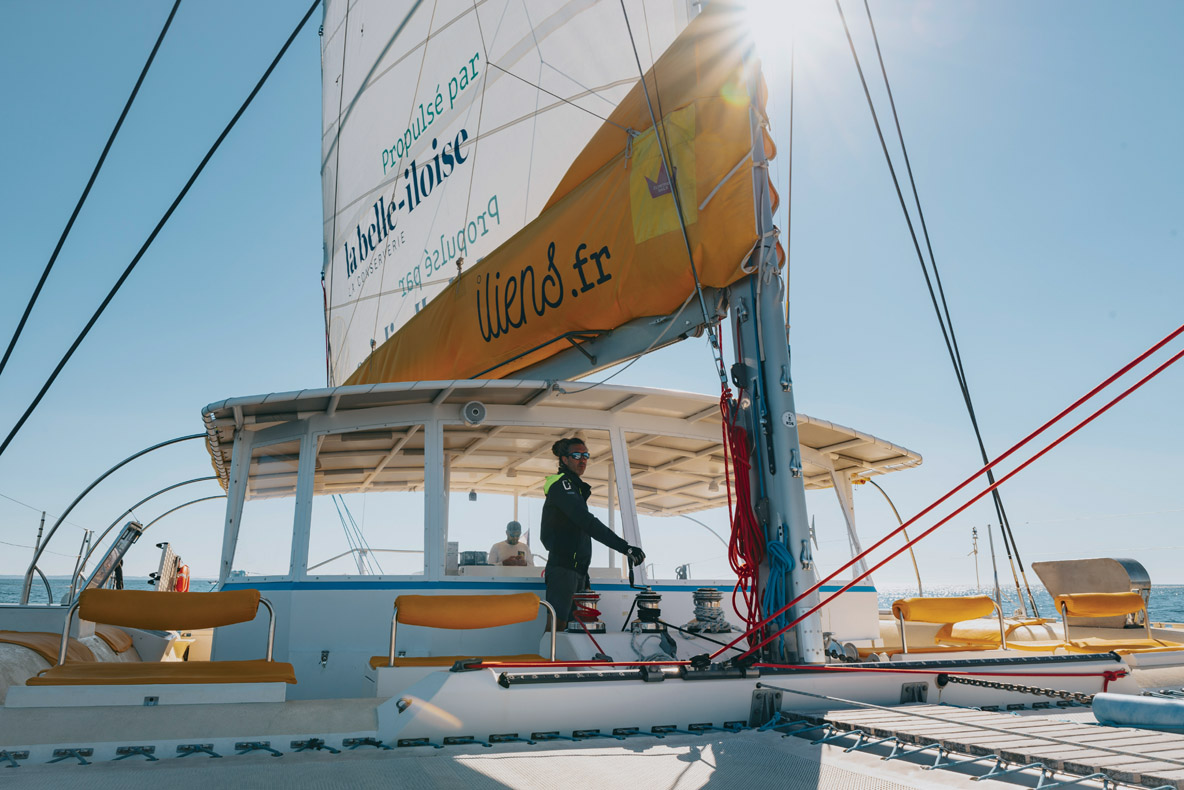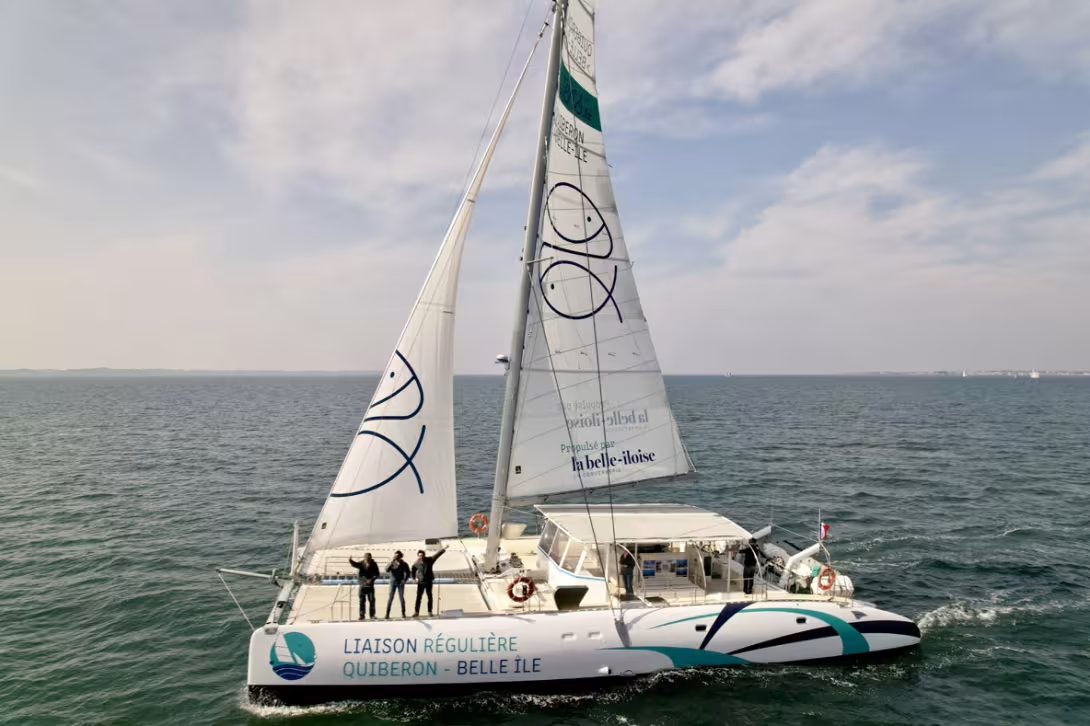
Multihull ocean racing is a particularly French specialty, which is undoubtedly why France is the first country in the world to see a return to passenger sailing. Four regular sailing routes have now been opened or are about to be. The pioneers of this revival are four young people from Brittany who decided to launch the Îliens shipping company in 2020. Their target? The crossing between Quiberon and Belle-Île, in Brittany, in the west of France, a journey taken every year by more than a million passengers. Proud of their profession as sailors, but keen to reduce their impact on the environment, Lou, Inès, Jonas and Léon bought a second-hand Ocean Voyager catamaran. This multihull was initially intended for day-chartering, but its stability and large platform were judged to be particularly well suited to carrying passengers. In fact, the catamaran can accommodate up to 79 people on board, partly sheltered under the rigid bimini, and in all cases by the forward windshield. There’s even an outside bar serving hot and cold drinks, as well as pastries and sandwiches. By their third season, the quartet were carrying more than 20,000 passengers and breaking even. Admittedly, capturing less than 2% of traffic is a drop in the ocean, but that’s not the point. By sailing between 60% and 80% of the time and only cancelling 2% of crossings due to bad weather, they have proved that the concept is both viable and attractive.
The aim: to sail in as little as 7 knots of wind
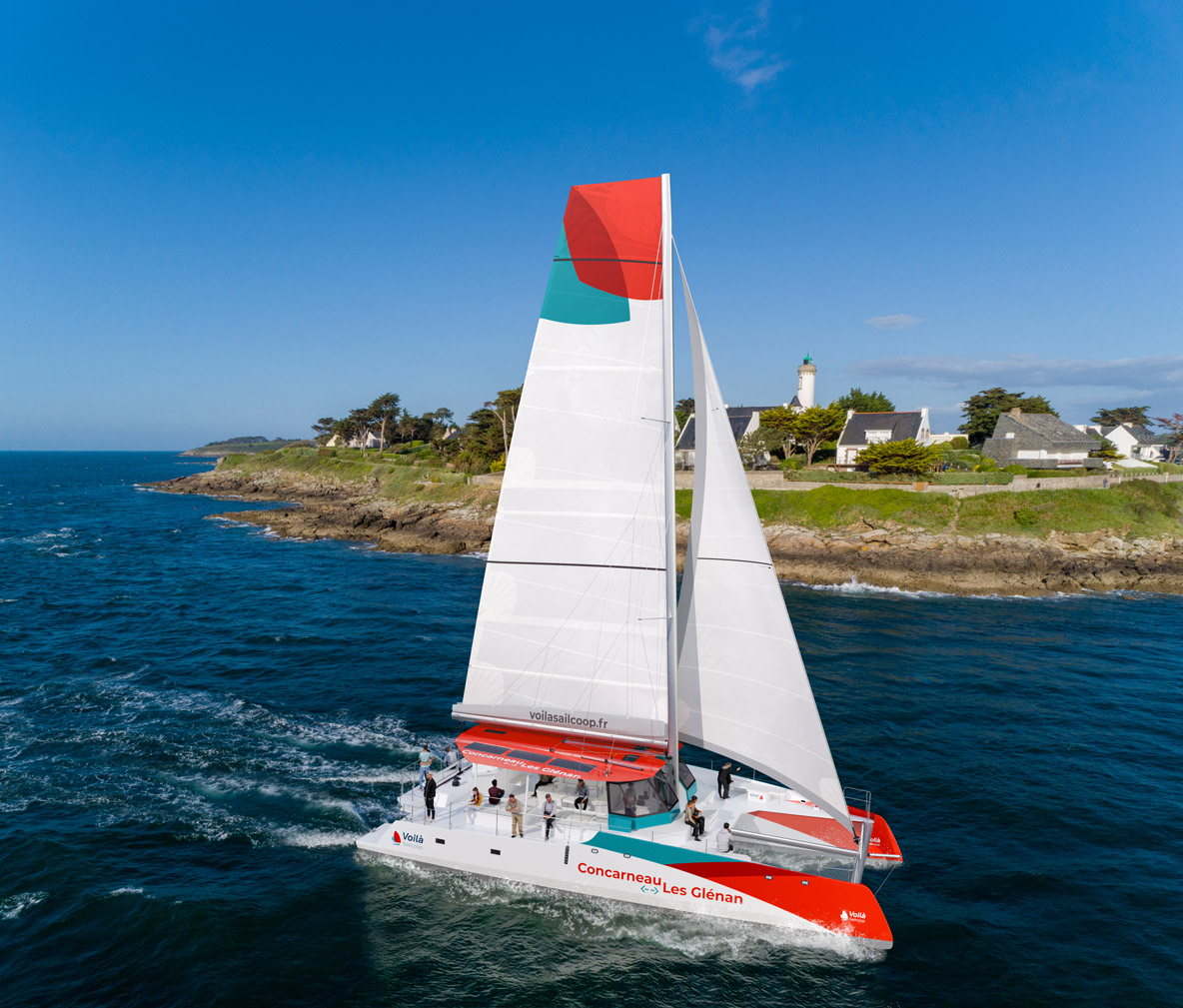
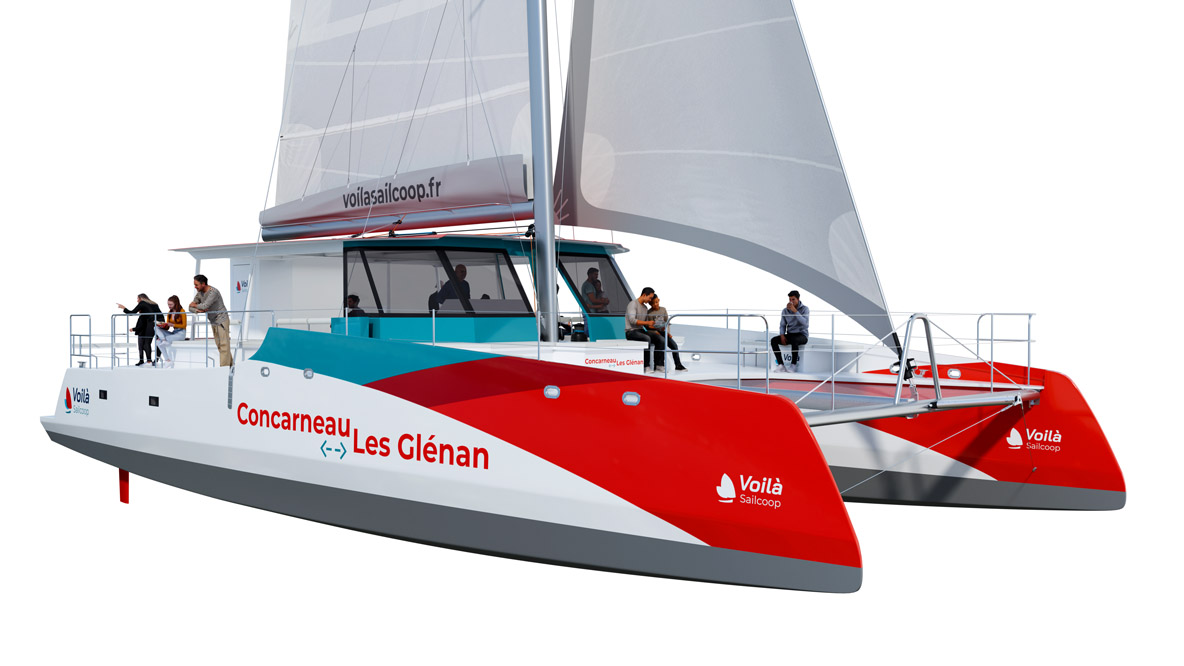
The Îliens are perfectly willing to share all their data, and their experience is providing inspiration to others - not least the ocean racing enthusiasts who founded Sailcoop in 2021. These sailors have set themselves the goal of “Offering carbon-free alternatives to sailing wherever possible.” Three markets have been identified: short, medium and long distance (over 300 nm). Sailcoop immediately launched into the second with a link between the French Côte d’Azur and Corsica (100 nm). They came up with a management-operations contract and convinced two owners to entrust them with their 50-foot yachts. With 120 passengers carried in the first year, 1,200 last year and the prospect of 1,800 for the 2024 season, which has just begun, a break-even point is in sight, giving them the confidence to launch a new boat and a new route. Confidence and a legal framework because, initially, sailboats approved for commercial use were not allowed to operate on regular routes. But the administrative court ruled in Sailcoop’s favor, and the Affaires Maritimes (France’s maritime administrative division) is working with them to change the regulations and open the way to medium-distance passenger transport under sail. So, from June 2024, they will be serving the magnificent Glénan archipelago, with 3 round trips a day, just like the traditional ferries, but under sail! To achieve this, the sailors from Sailcoop have designed a catamaran that is truly adapted to coastal passenger transport. The team proposed a joint venture between Chantier de l’Arsenal de La Rochelle and VPLP, founded by Marc Van Peteghem and Vincent Lauriot Prévost, with the aim of improving the performance of the shipyard’s standard model. They have kept using the technique of assembling the panels without a mold as it is very interesting from an ecological point of view, creating little waste - but the input of the naval architects has enabled the boat to be nearly 10 tons lighter than the original model. As for the sail plan, it has been boosted up to 1,940 square feet (180 m²): “The idea is not to go fast under sail, but to get under sail as quickly as possible”, says Yann Royer, from Sailcoop, with a big smile. This translates as being able to switch off the engines as soon as there are 7 knots of breeze. With a capacity of 80 passengers, including 45 fully sheltered from the wind and sea spray, access and toilets for people with reduced mobility and a platform for bicycles and luggage, the passenger experience has been particularly well thought out - whatever the weather. The daggerboard multihull is 60 feet (18.6 m) long, 8.67 m (28’5”) wide and weighs 15.8 t lightship - compared with 24 t for Îliens’ Ocean Voyager. The catamaran, which cost €1.6 million excluding VAT, was financed one-third by the cooperative’s 2,500 members, one-third by private investors and one-third by a bank loan.
100% of passengers are satisfied with the experience
If the Mediterranean experience is anything to go by, the profile of the passengers will be fairly young (25-35 years old), with a keen interest in ecological and environmental issues. While 80% have never spent a night at sea, many have never even been on a boat. 100% of customers are satisfied with their experience on the crossings to Corsica. “Instead of 2000 people crammed into a ferry, we sail with 8, we can talk to the skipper, we spend the night “on watch” and the route crosses a pelagic sanctuary. On 90% of the crossings, passengers can see dolphins, pilot whales and other cetaceans - you could almost put it in the contract!” Andrew Simons, the British head of SailLink, agrees. For this sailor-scientist who has launched a new cross-Channel link between Dover and Boulogne-sur-Mer, choosing sailing “is both a mode of transport and an experience. Conventional ferries are really designed to be connected to major highways, and when you like to travel by train, by bike or on foot, you realize that the connections aren’t really designed for that”.
SailLink docks in the heart of towns and cities, and its passengers don’t just pass through, they also eat and sleep, usually for at least one night, in the ports it serves. The most pleasant surprise came from the authorities, whether local, maritime, customs or border police. Andrew was expecting to hear “It will never work” and, “We have enough problems as it is.” However, in the end, the authorities welcomed his initiative enthusiastically and are doing everything they can to facilitate his catamaran’s activities.
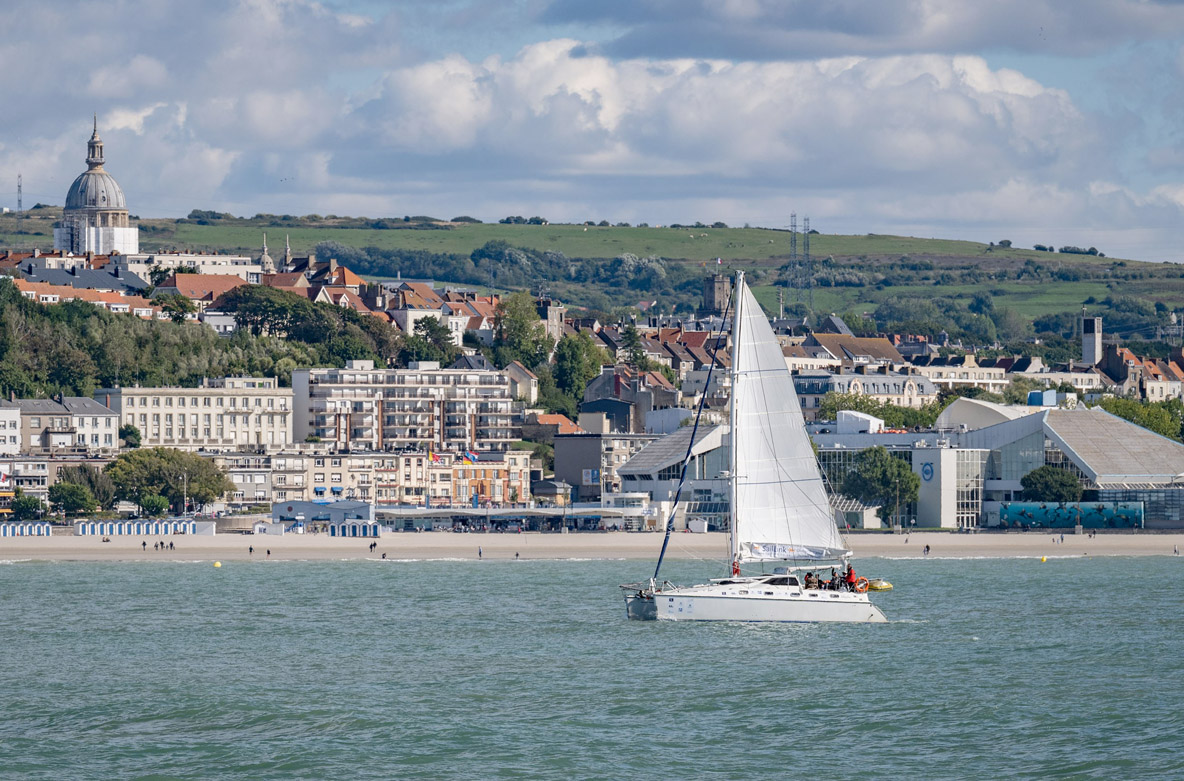
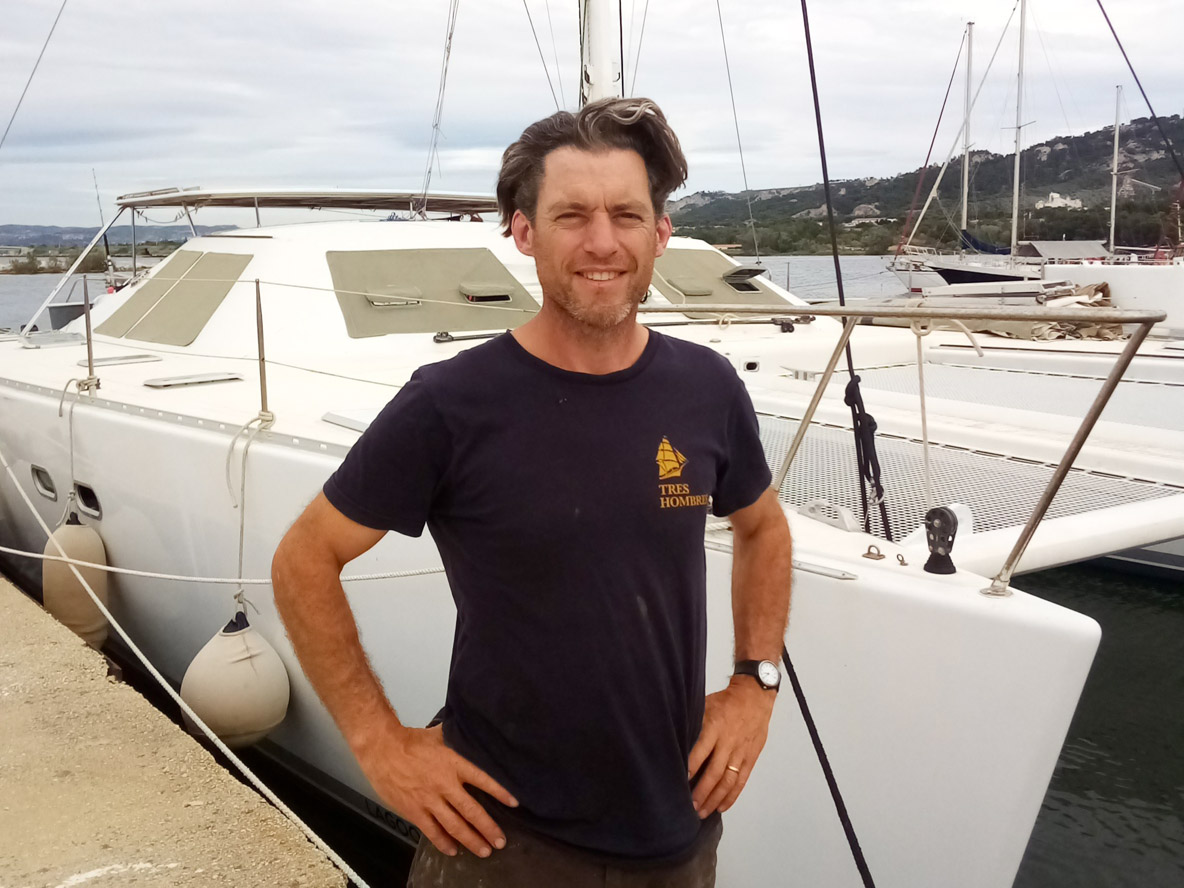
SailLink started out on the best possible route, taking into account the distance, of course, but also the wind, the tides, the currents, the cargo rail route, the ease of access to the ports of departure and arrival - and not forgetting the proximity of a railway station... As a result, Andrew was able to confirm that it would be possible to cross every day between Dover and Boulogne, and to determine the number of rotations that would be possible. Most of the time, the SailLink crew manage to cross on a single tack, with a journey time of between 3½ and 4 hours. To do this, the sailors have to sail at between 9 and 10 knots with the help of the tides of course. This is something that only a large, fast catamaran is capable of achieving. That’s why Andrew has just bought a 1993 Lagoon 57S with the help of investors. Previously, the entrepreneur tested a 40-foot (12-meter) Privilège catamaran for four and a half years - including the Covid period. On board the Lagoon, twelve people, instead of the previous six, can take their places in the cockpit, without interfering with any of the maneuvers, all of which are the responsibility of the helmsmen. The cockpit is fully protected so that neither rain nor sea spray can disturb the passengers: “The idea is not to go inside, sit down and start looking at your phone. We want our passengers to maintain visual contact with the sea, for their own comfort, but also because they’ve come specifically for this experience. We prefer to keep the interior space for the bikes, as they need more protection than we do!” The catamaran is registered under a British flag and has been certified with the help of its original architects - VPLP again - for the stability checks. A single ticket costs 110 euros, plus 20 euros for a bicycle, and around 180 euros for a return trip. SailLink has no plans for a new build: the most ecological multihull is still a second-hand catamaran. On the other hand, there are a number of modification projects in the pipeline, such as fitting an aft platform between the sugarscoops to accommodate a bicycle garage, modifying the interior so that passengers can sit facing the direction in which they are sailing and still see the sea, installing a hybrid propulsion system to enter and leave the port in electric mode, or fitting solar panels on the bimini and deckhouse... In any case, Andrew is confident: “The development of goods transport by sail gives us a reason to believe, because if it works for freight, it should also work for passengers.”
He is even looking into setting up a second line, perhaps between Cherbourg and Weymouth, or Newhaven and Dieppe - right on the London- Paris cycle route.
Over much longer distances, Sailcoop’s attempt to complete a transatlantic crossing between the Mediterranean and the West Indies (40 days) with their two 50-foot monohulls was a great success, with a 100% occupancy rate. But the failure of their winter season between Guadeloupe and Martinique meant they decided not to repeat the experience. For this market, they are therefore exchanging ideas with companies that transport goods by sail in order to market their passenger transport capacity. While passenger transport is still at an experimental stage, cargo transport is 15 years ahead of the game - in fact, supply has literally exploded. This is coming from specialist operators such as TOWT, Neoline, Grain de Sail, Windcoop, Hisseo and Zéphyr & Borée. But sailing has also won over some of the world’s biggest shippers and shipowners. In August 2023, the world leader in cereals, Cargill, fitted its huge bulk carrier Pyxis Ocean with two rigid wings. They save an average of 3 tons of fuel per day, and up to 11 tons when wind conditions are favorable. While the WindWings developed by BAR Technologies were inspired by the aviation industry, the AYRO Oceanwings designed by VPLP (them again...) are based on the wing developed for the BMW-Oracle trimaran and the America’s Cup. There are four of them, each measuring 363 m² (3,907 sq ft), on board the Canopée, the ship chartered by ArianeGroup to transport the components of the Ariane 6 rocket to Kourou in French Guiana. Although the vessel uses a combination of diesel and sail propulsion, the results are above expectations for the sail propulsion. The 121 m (397-foot) vessel displacing 3,150 t has already reached 11 knots just under sail with 25 knots of wind on the beam in the trade winds. Louis Dreyfus Armateurs, meanwhile, is working to open a ro-ro service between Europe and the east coast of the United States by 2027, with ships combining diesel propulsion and bio-methanol, with the aim of reducing CO2 emissions by 70%.
A giant trimaran, faster than freighters
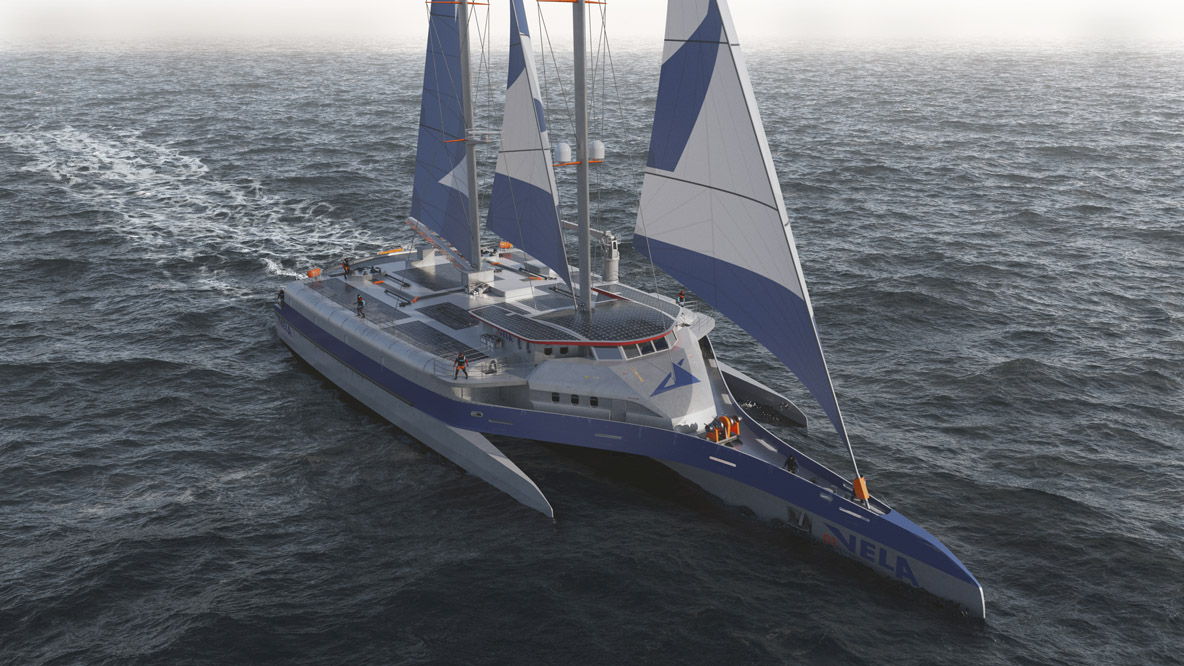
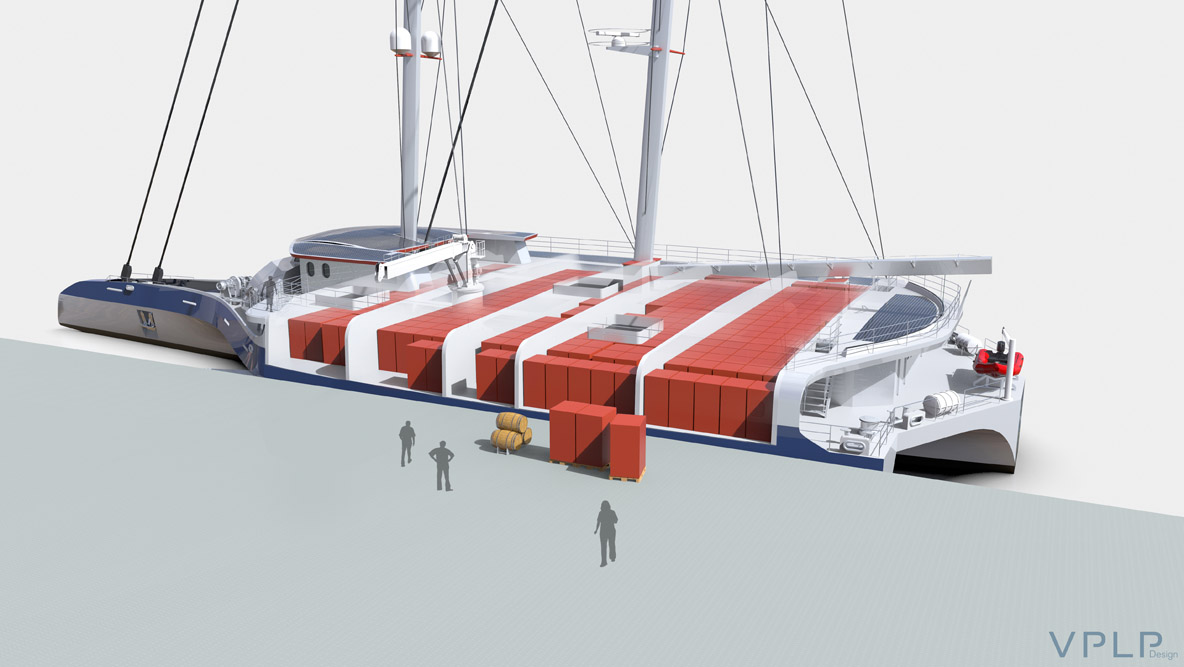
However, all the examples of cargo ships cited above involve monohulls. Yet pure sailing boats could reduce these emissions by 90%. Couldn’t multihulls be THE ideal solution? That, in any case, is the opinion of the founders of the French start-up Vela, launched at the end of 2022. These five engineers, entrepreneurs and sailors - including a certain François Gabart (Vendée Globe winner, Round-the-World record holder, etc., etc.) - have set their sights on designing and fitting out a new type of cargo sailboat. The aim is to offer a low-carbon alternative to international maritime freight, with a high-performance solution for transporting goods that is 100% sail-powered. This notion of performance covers a number of aspects: ecological performance, of course, but also economic performance, with costs, timescales and reliability in line with market practice. Vela is therefore relying on two partners of choice for the development of its future vessels: Mer Concept, François Gabart’s company in charge of the Ultim SVR-Lazartigue trimaran, and once again, VPLP Design. The original dream was to design, in the words of the multi-titled skipper, “a seaplane, but without oil and therefore 100% under sail”. Drawing on technology transfers from ocean racing while respecting merchant navy standards, the team designed a 67-meter (220-foot) trimaran with two masts and a 61-meter (206-foot) air draught. With a beam of 25 m (82 feet), the whole structure provides a formidable single level loading platform, facilitating handling operations. The ship can accommodate up to 500 pallets, the equivalent of 25 semi-trailers or 51 TEU (20-foot equivalent unit) containers, with a maximum load of 340 tonnes (375 US tons).
Their studies confirm that the trimaran is the fastest and most efficient craft in any weather conditions. It is even faster than a conventional ship on a transatlantic route. In the Europe-US direction, the crossing is estimated to take 8-10 days, compared with 10 to 13 days in the opposite direction. What’s more, the multihull’s natural stability will also enable it to do without ballast, eliminating any risk of transporting invasive species. While the first ship is due to be delivered in early 2025, by 2028 a full-scale fleet should be offering one departure a week. Capable of calling at secondary ports close to its customers, the VELA trimaran will also optimize pre- and post-transportation. Now independent of oil prices, freight rates will also have the stability of a multihull, giving shippers peace of mind. This maritime route will reduce CO2 emissions by 95% for pure transport compared with a conventional container ship, by 80% over the trimaran’s entire life cycle, and will have 700 times less impact than air transport. By associating their image with that of a modern, ecological, sailing mode of transport derived from ocean racing, there should be no shortage of potential customers. And many of them are already interested in what VELA has to offer. They all hail from high value-added sectors: technological products, lifestyle (wine, cosmetics, etc.) or arts and crafts. Admittedly, the return of sailing may seem anecdotal compared with the 99,800 internal combustion engine-powered merchant ships in service around the world. But the International Maritime Organisation (IMO) has pledged to reduce the sector’s CO2 emissions by 50% by 2050. Shipowners, whether they are passengers, transporters, fishermen or scientific researchers, are all part of a global economy with global issues at stake. These players are beginning to realize that wind propulsion is a real alternative. In this context, the sailing multihull is a particularly environmentally friendly means of transport, conveying an image that is both modern and positive.
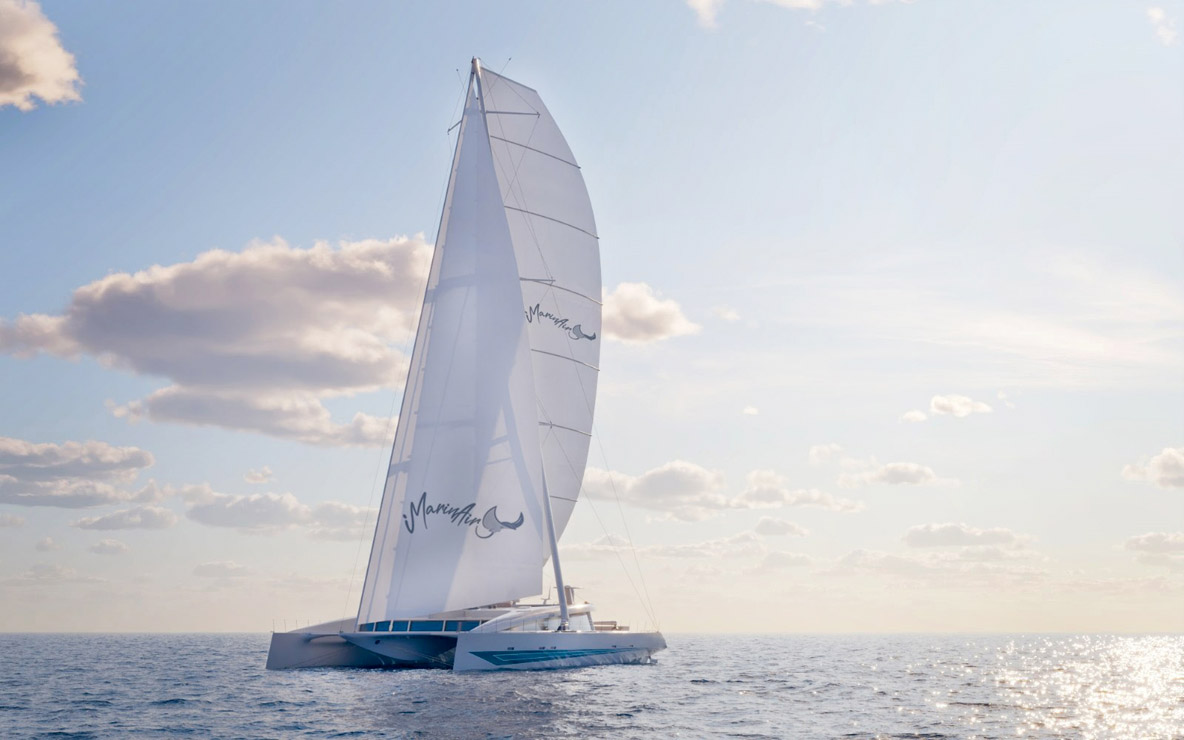
So, are these new sail-powered transport vessels an innovation or a throwback to the way things used to be? While the expression “Pioneers of renewal” may seem a little too simplistic, it also sums up the relevance and urgency of turning back to this inexhaustible and clean energy, as old as life on earth - the wind. And there’s no better way of using it to travel fast and far than on a multihull, even if they have only been around for 5,000 years! Will foils be the future? It’s impossible to know whether one of today’s Ultims will one day be transformed into a passenger ship. But the customer experience would be as exciting as it would be incredible. And perhaps flying over the waves could even be comfortable...
To book your ticket:
www.sailcoop.fr - www.iliens.fr - www.saillink.co.uk