
“I fell in love with multihulls”
Is there really any need to introduce Mike Horn? No, because his expeditions have been so widely followed and shared that everyone knows him. But yes, because today he’s at the forefront of modernity in the field of energy transition. We got a chance to catch up with him.
Image
Image
Image
1
/
1
Publié le
25/01/2024
Par
Emmanuel van Deth
Numéro :
194
Parution :
Mar.
/
Apr.
2024

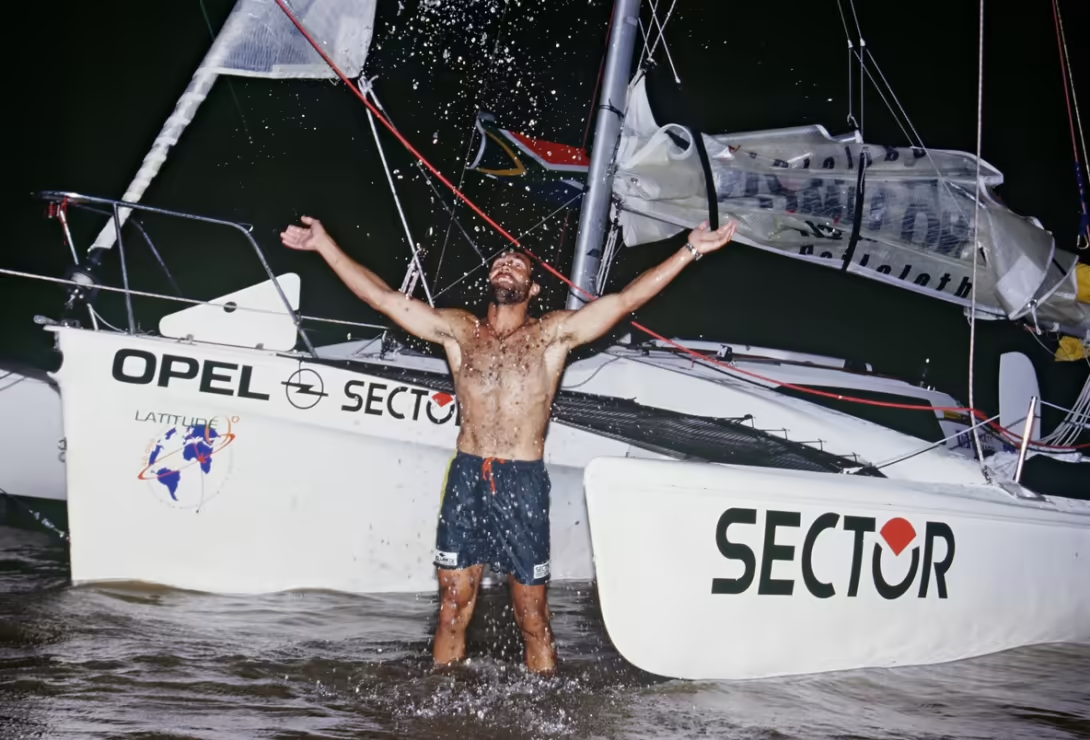
Carrying the name of the most feared cape on the globe might lead one to think that, in the end, history was written: Mike Horn was bound to become one of the most famous and respected sailors, sooner or later. Come to think of it, our man isn’t the only one to be called Horn, and not every Hatteras or Lewin is a top sailor... And Mike Horn didn’t start his exploits on the oceans at all, but rather ashore: following a military career in South Africa, he settled in Switzerland. There, he ran a youth hostel and launched a career as an adventurer. From 1991 onwards, Mike climbed the highest peaks and undertook some extreme exploits. Water was sometimes on the menu - white water rafting, riverboarding - but it remained gentle! It wasn’t until 1998 that Mike was approached, against all odds, by Laurent Bourgnon, then skipper of the trimaran Primagaz: “You’ve never sailed before? Perfect!” The other crew members were none other than Thomas Coville, Stève Ravussin and Ellen MacArthur, to name names! For Mike, gliding under sail was a revelation: “I fell in love with multihulls,” he concludes.
Our adventurer then set out to circumnavigate the globe at latitude 0. The program included walking, cycling, canoeing and... sailing! Laurent advised Mike to opt for a small folding trimaran, a Corsair 28. “It was one of the first models,” Mike explains, “No aft cabin, almost nothing inside, just two solar panels and two batteries. It was thanks to a Swiss sponsor that I was able to complete my budget. I reinforced the trimaran before crossing the Atlantic: it was my first solo sail! At first, I called my sailing buddies for all sorts of advice... and then I learned on the job. I went on to the Pacific, then the Indian Ocean. There, I had to endure some major storms, broke a shroud and even ended up being dismasted – but I managed to repair it, that’s what adventure is all about!”
In 2000, Laurent Bourgnon asked Mike to design a low-energy ocean-going power catamaran for divers. The project was entrusted to Francis Laap, who had just set up his own shipyard, Sunreef. The three men remained very close, until Laurent was sadly lost in a diving accident.
Much later, Francis launched an ECO range and invested in renewable energies, while Mike announced the creation of INOCEL, a start-up collaborating with the CEA research center in Grenoble to develop hydrogen propulsion systems. Mike and Francis could only collaborate and innovate together!
The charismatic adventurer might feel his head swell when people call him a visionary: he soberly recalls that Jules Verne predicted in his famous novel The Mysterious Island that hydrogen was destined to become an inexhaustible source of energy... That was 1875, and the brilliant author was probably right!
