A wonderful, self-taught naval architect
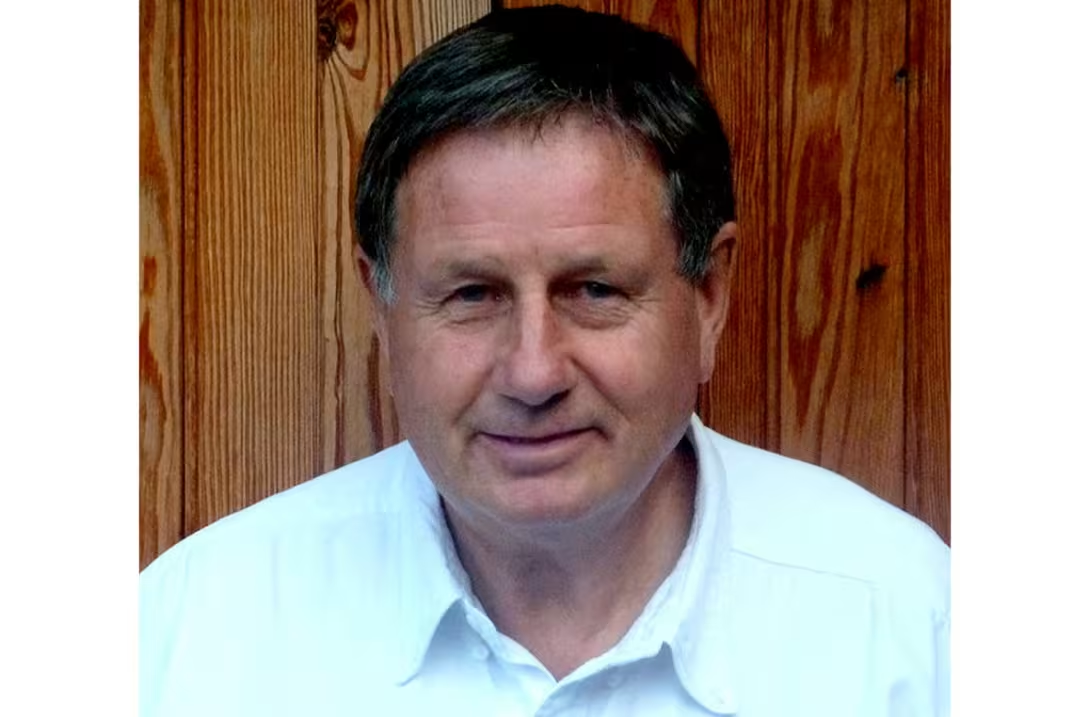
Over the last twelve years, during which time I have written profiles of the leading figures in the world of multihulls, no renowned naval architect, designer or skipper has failed to include the name of Nigel Irens among the masters of multihull design. As inspired as he is inspiring, the self-taught British designer has been responsible for many projects, but above all for numerous trimarans and catamarans that have left their mark on the history of ocean racing, as much for their elegance as for their performance.
Image
Image
Image
Image
1
/
1
Publié le
21/03/2024
Par
François Trégouët
Numéro :
195
Parution :
May.
/
Jun.
2024
Over three hours of interviews conducted half in English, half in French, (“learnt on the pontoons”), we discussed some of the greatest names in multihull sailing, a veritable pantheon of sailors on two or three hulls. There are, of course, the Anglo-Saxon pioneers - Dick Newick, Tony Bullimore and a certain Canadian, Mike Birch. 100% self-taught due to a lack of specialized training at the time, Nigel was working for a trimaran builder in Bristol when he met Mike in 1976. The Val 31 with which the skipper had just completed the OSTAR transatlantic race capsized on the return trip back to Europe. Nigel helped the skipper restore the boat and set sail with him on the Round Britain and Ireland race. They became friends and together they extended the legendary yellow trimaran, Olympus, with which Mike won the first Route du Rhum. Nigel then designed his first trimaran for himself, Gordano Goose (currently for sale at www.catamaran-4sale.com). On board, he won his first and only solo race, the 24 Heures de Saint Malo, just ahead of a certain Philippe Poupon. It was enough for him to start making a name for himself on the other side of the Channel. But it was British sailor Tony Bullimore who would be his first client with the trimaran IT82. This was followed by Mike Birch’s catamaran Vital, which came third in the 1982 Route du Rhum, and then the magnificent Apricot, again for Tony Bullimore. This elegant, high-performance trimaran won all her races in 1985, including the 1985 Round Bitain.
During the Tour of Europe that year, the crew won every leg and finished “two days ahead of everyone else” in Toulon, thanks to one of Nigel’s brilliant ideas: when all of Apricot’s rivals were still trying to sail downwind under symmetrical spinnaker, as on a monohull, the architect had the idea of using a flatter sail, made from a material that was lighter but stiffer than nylon. The gennaker was born. She luffed up sharply, deviating from the direct course but increasing from 2 to 7-8 knots. Nigel, with humility, speaks of ‘luck’ and ‘coincidence’, but in reality, he invented a new way of sailing, in which the straight line is not necessarily the fastest. From that moment on, the speed of multihulls meant that you could choose your weather.
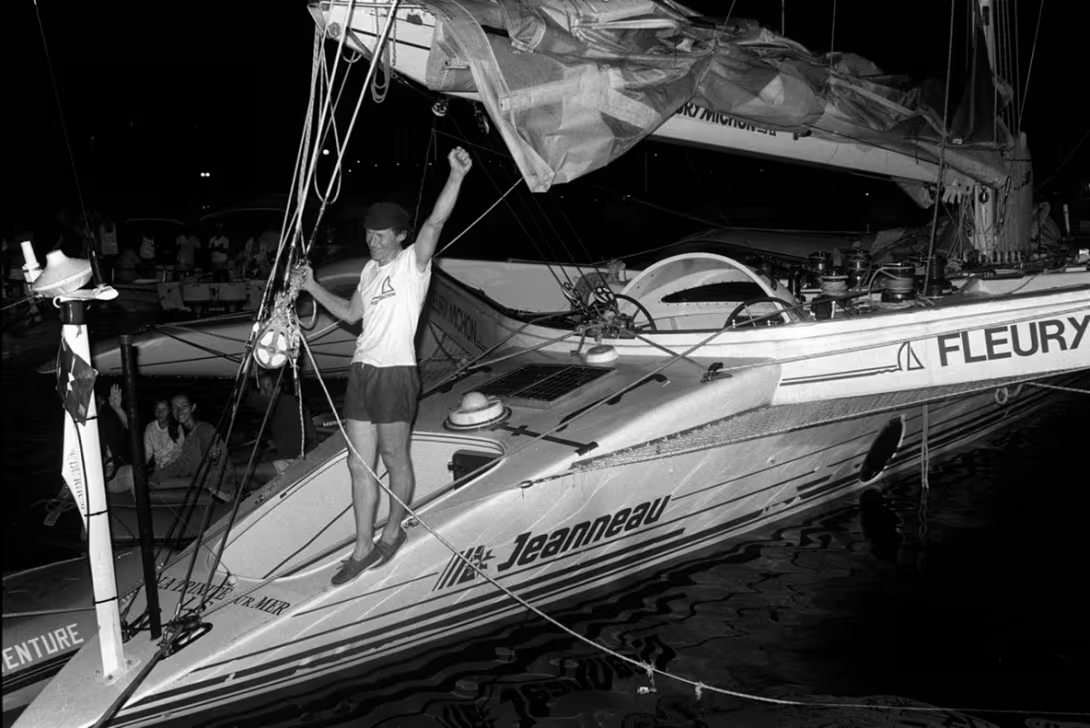
The French are definitely under his spell. Particularly Philippe Poupon, who had just seen his giant catamaran break up during this same race. So the French skipper decided to entrust the design of his future multihull to this talented Brit. “At the time, it wasn’t possible to design from England. Jean-François de Prémorel, who was in charge of building racing multihulls at Jeanneau, didn’t even have a fax machine! So I went to work in France, in Les Herbiers, and I often went to La Trinité where I met up with Mike.” After Philou won the 1986 Route du Rhum on Fleury Michon VIII, 48 hours ahead of Bruno Peyron, the orders poured in. Then came the trimaran Laiterie Mont Saint Michel (1987) for Olivier Moussy, and Fleury Michon IX (1988), again for Philippe Poupon, built especially for the 1988 OSTAR. The trimaran won the race before passing into the hands of Florence Arthaud. Nigel has a real admiration for French sailors, especially the quiet ones, those who don’t put themselves forward, who aren’t ‘m’as-tu-vu’ (a french expression that means “did you see me”) - Tabarly, Birch, Joyon - for whom he would design Idec. Probably because Nigel is a similar type of character.
The architect says he loves original ideas, breaking new ground and ‘thinking outside the box’. “I think I was lucky to be in the right place at the right time,” he says, “Because in reality it wasn’t difficult for me to think outside the box, precisely because there was no box. When we designed Gordano Goose, we just tried to imagine how we could do it, taking a bit of inspiration from what Dick Newick was doing and the experience we had of the Round Britain Race, but I didn’t have any framework, just a great structural guy, who was also from Bristol. As the years went by, more and more data became available, but in those pioneering years you had to be very open to new ideas and be able to say, “Let’s try this”. But from the 2000s onwards I realized that the box was getting busier, and that there were people like Guillaume Verdier. Younger than me, this talented architect arrived in a world where the database was bursting at the seams. And I realized that I had to do something else because I wouldn’t be able to compete with guys like him. Talent and inspiration wouldn’t be enough.” Nigel’s vision is undoubtedly particularly accurate if we go by the words of Guillaume Verdier, who wrote about the Gitana Ultim: “We started from what had been initiated in multihulls by Nigel Irens with very supple shapes that allow us to move well through bigger seas.” It’s hard to imagine a more courteous compliment from the pupil to the master...
Suggesting an empirical approach, following one’s intuition, finding virgin ground: this is what Nigel Irens will also do with power multihulls. When invited to take part in a multihull race, he was distressed to see the media boat being shaken in all directions and, above all, unable to keep up with the pace of the sailing boats; on board, of course, it proved impossible to capture any images. “So when I got home, I drew up a design for a motor trimaran, with small floats because they didn’t have to withstand the power of the sails. It was to be Ilan Voyager, a 70-foot trimaran on which we sailed around Great Britain without refueling in 72 hours at 21 knots. An extraordinary boat, a real pleasure to sail. Ten years later, I was asked to design Cable & Wireless, a 115-footer, which set a new round-the-world record of 22,600 miles in 74 days (with revictualing this time, of course).”
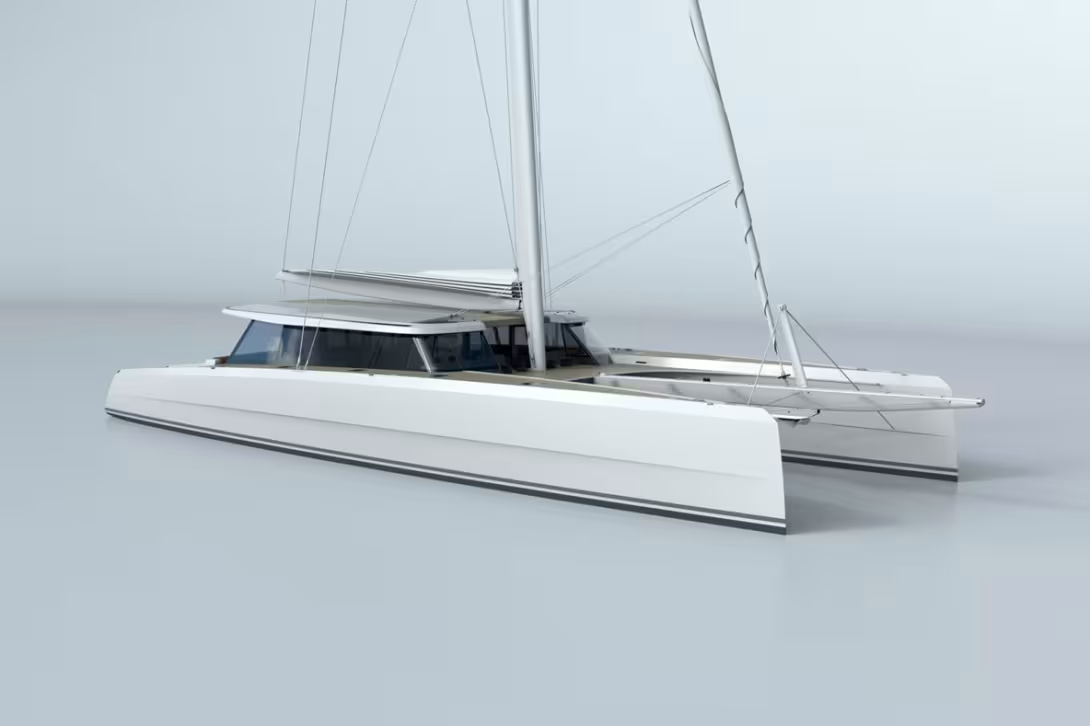
Nigel Irens’ only notable forays into the world of cruising catamarans are the performance-oriented Gunboat 55 and 60. There is also the Vantage 86 Explorer, which is ready to be built. To date, the architect’s latest three-hull work is Paradox, a magnificent 62-foot carbon racing/cruising trimaran built from Loïck Peyron’s Fujifilm molds. This multihull is capable of covering 300 to 350 miles a day. For the same reason that he left the world of competition, Nigel feels that his empiricism no longer makes sense in the world of cruising multihulls. “I work from home, concentrating on powerboats. After seven versions of the same model, I’m still learning and learning, with the aim of improving stability and reducing fuel consumption.” He insists that this is in line with the climate change that is forcing us to “truly and honestly” reduce our environmental impact, wary as he is of green washing.
Before we end our conversation, I ask him which boat has particularly marked him. “The big adventure for me was Formule Tag in Canada with Mike, who was already a long-standing friend. A catamaran that I’ll never forget and which is experiencing a sort of magnificent retirement* at 6 knots,” he says with a mischievous laugh. Nigel, who is very attached to human relationships, also admits that he has “always enjoyed working with Loïck Peyron, a great professional. As a designer, I can tell you that he’s a great guy, who knows how to listen, thinks a lot and is always very pleasant.” Nor does he omit Dame Ellen MacArthur, for whom he designed the record-breaking solo round-the-world trimaran, “a wonderful experience”. For Nigel, aged 77, “This is the time when all the ideas come together, the time when intuition and mathematics converge towards the right solution. But I remain convinced that there are still untouched fields of exploration.”
*editor’s note: under the name Energy Observer