Grand departure on October 17th 2021
Hakuna Matata was launched in the spring of 2021 and put through her paces in the Mediterranean that summer. The motors originally installed, belt-driven modules, quickly caused problems. “We switched them out for two 20-kW Bellmarine motors,” explains Stéphane Groves, Windelo’s Executive Director. “A good choice, as we’ve had no problems since. In fact, we’re installing this equipment as standard on all our catamarans from now on.”
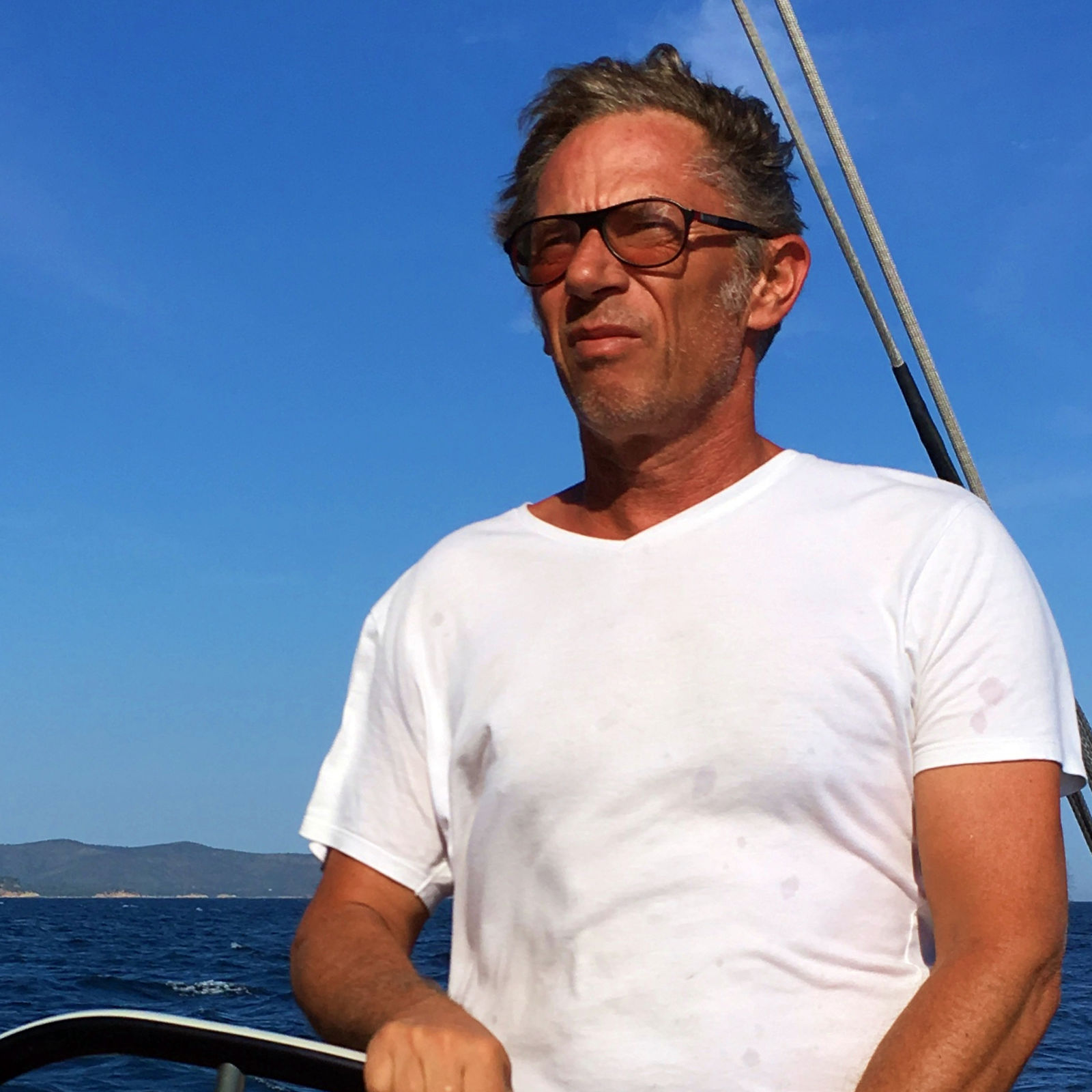
On familiarizing himself with his Windelo 50, Mathieu said “I immediately tasted the pleasure of electric propulsion. There’s no ignition key, you just turn it on and maneuver it using two digital joysticks. It’s very practical for moving the catamaran around or tensioning a mooring line. We’ve never had any doubt that it’s not going to work.”
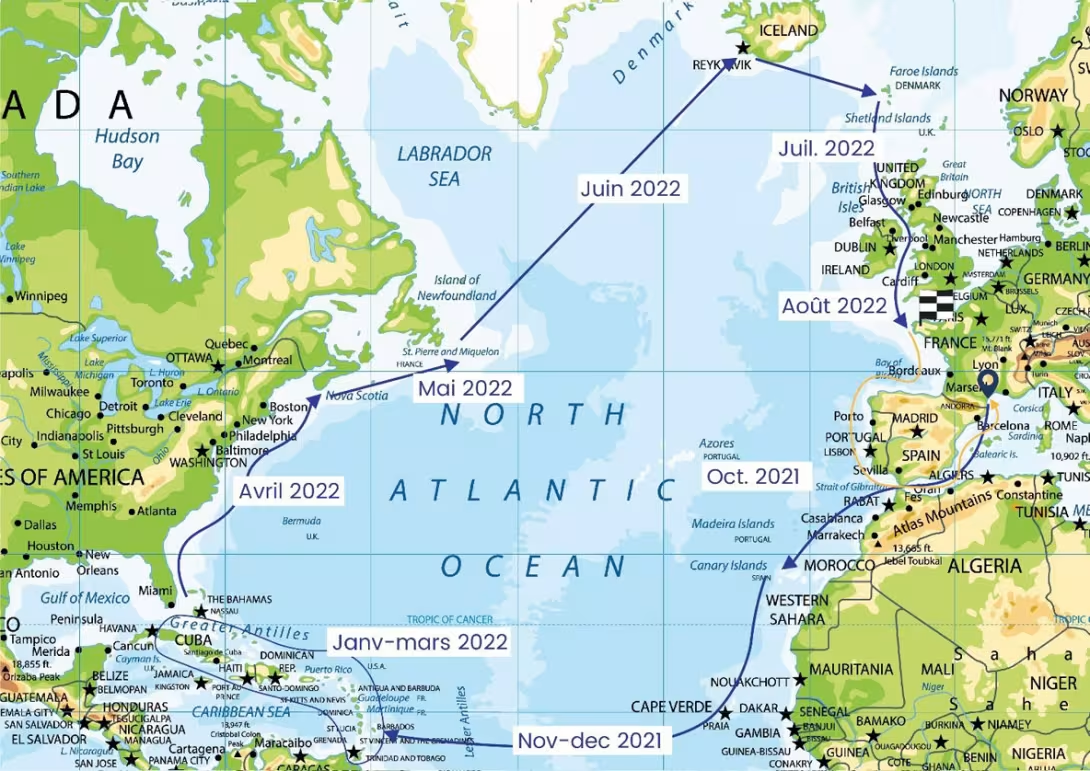
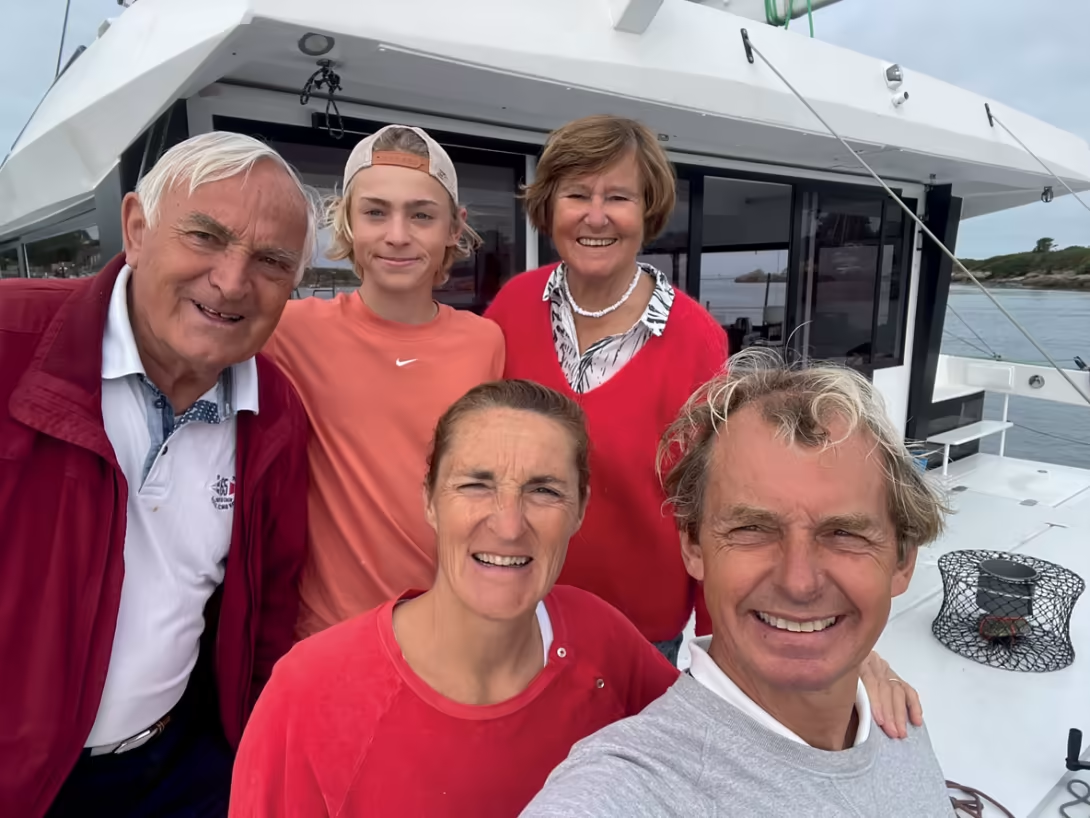
Mathieu, Perrine and their son Youri boarded their Windelo 50 Adventure for a 10-month voyage around the Atlantic. Hakuna Matata set out from the port of Canet-en-Roussillon in the South of France on October 17, 2021, bound for Spanish waters – those off Las Palmas, Gran Canaria. The catamaran had been signed up for the ARC, to give them a first taste of a safe transatlantic passage...
Unfortunately, Covid-19 came aboard uninvited, disrupting the crew’s plans. However, the 17-day transatlantic to Martinique went off without a hitch, thanks to hydro- generation and solar panels. As for noise, Mathieu points out that the propellers are louder than the generator. The skipper is learning to manage his catamaran. To begin with, it was a bit complicated. Firstly, because Mathieu is not a seasoned technician, but also because the user manual wasn’t detailed enough for his liking. Starting out with a minimum of spare parts, the skipper didn’t have to deal with any major problems, just a few issues with the heater, watermaker and hot water ta nk. The builder provided exemplary after-sales service for his first multihull, with visits to the Canaries, the West Indies and later Iceland...
“These minor running-in issues are perfectly normal for a first catamaran,” notes Mathieu. There are always going to be 500 things to fix, and we’ve found 100 or 200 of them. But we’re talking about plumbing issues, module integration that needs improving, sheets and halyard leads that need improving, nothing more than that! I’m well-aware that we’ll have to carry out many more tests before we can 100% validate the 54 Yachting.” This “test skipper” approach doesn’t bother Mathieu in the slightest, firstly because the builder has always responded, and secondly because “having problems in port means your assured of meeting some great people!”
After several weeks sailing in the West Indies and the Caribbean, Hakuna Matata and her owners reached the coast of the United States, sailing north to Florida, then New York, Boston and on to Canada. Mathieu and Perrine wanted to complete a North Atlantic circuit, sailing in all conditions and latitudes. This has now been achieved, with a return crossing from Saint-Pierre-et-Miquelon to Iceland, before setting sail for the Faroe Islands, Scotland and back to France’s west coast. This beautiful family adventure was rounded off in August 2022, as they got to the coast of Brittany. Hakuna Matata was then delivered by a skipper all the way to the Mediterranean to reach her home port of Canet-en-Roussillon in the South of France.
Performance and forward cockpit
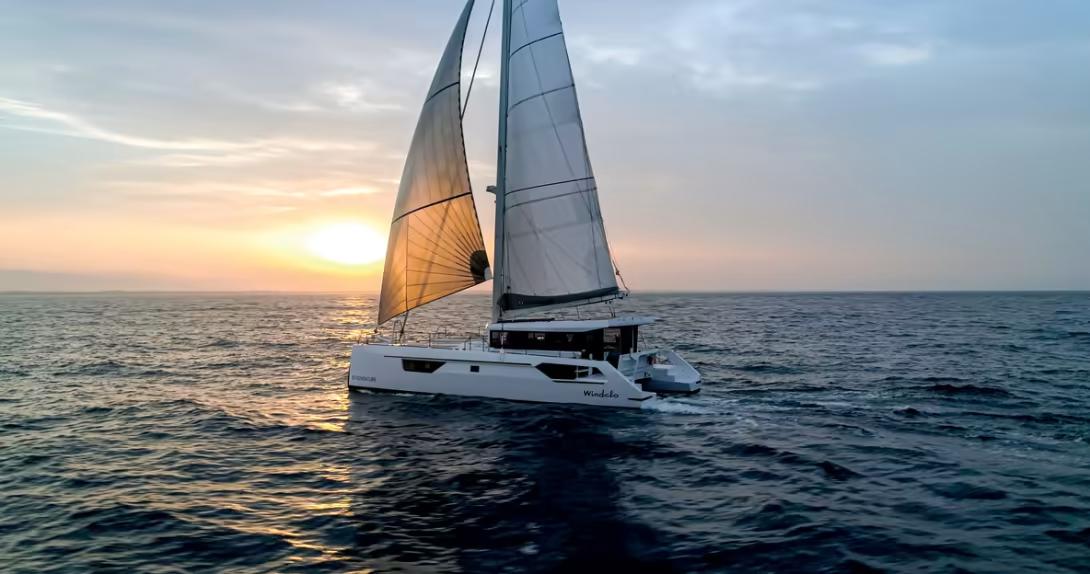
“Sailing aboard the Windelo 50 is extremely pleasant,” says Mathieu, “This is a catamaran that accelerates well, is quick in light airs and very stable on the water. She goes upwind exceptionally well, which was a big surprise for me, as I’d never had the chance to sail on a catamaran with daggerboards before.” The Windelo 50 Adventure’s light displacement of just 24,700 lbs (11.2 t) obviously favors good performance. “We’ve always had around 3,300 lbs (1.5 t) of load out of the 4,400 lbs (2 t) we had planned, bearing in mind that the catamaran has a payload of 5,730 lbs (2.6 t). As the weight distribution is well centered and lowered, the center of gravity is always well positioned. We regularly sailed at 13, 14, 15 knots, and up to 23/ 24 knots in the surf.
Hakuna Matata sails easily at 35° to the apparent wind, and the self-tacking solent makes tacking a breeze. The catamaran tacked easily in just 3 knots of wind.”
“Now that I’ve had a taste of a forward cockpit, I couldn’t bear to go back to an aft helm station. In the forward cockpit, we were perfectly protected from spray and wind, especially when it was closed up. Everyone is safe in the cockpit - including young children - in all conditions. And in calmer weather, you can open the windows and enjoy the sailing as if you were outside. Over 20,000 nautical miles and eight months of sailing, we took on the equivalent of a bucket of water in the cockpit. The Windelo is a true sailor’s boat, with particular attention paid to crew comfort when under way. Add to this the openness of the saloon and the fact that the helmsman is never isolated from the rest of the family, and you’ve got the ideal multihull for anyone like us who loves to eat up the miles.”
While he was certainly convinced by the performance of his catamaran and the comfort and safety of the forward cockpit, Mathieu would do without the up-and-over aft door, something he considers unnecessary. While he was certainly convinced by the performance of his catamaran and the comfort and safety of the forward cockpit, Mathieu would do without the up-and-over aft door, something he considers unnecessary.
Just over 200 gallons of diesel in eight months
“We only consumed 800 liters (210 US gallons) of diesel in eight months, which is extremely low when you consider that consumption includes our heating during the period we were sailing in colder areas,” explains Mathieu. The boat was almost self-sufficient in fossil fuels, hardly ever needing to refuel. We’ve got 3,500 W of solar panels, and of course hydrogeneration as soon we’re under way under sail. We love sailing, and we’re the type of people keener to build up the miles than to spend several days in the same anchorage. As a result, we were often sailing with full batteries, and once we arrived in an anchorage, we had plenty enough power for life on board. On our outward crossing from the Canaries to the West Indies, there were four of us on board and we never once needed to switch on the generator. When we arrived in Le Marin, Martinique, all maneuvering was under full electric motor. It’s so nice. [Windelo] is an innovator in electric/hybrid propulsion. After a few months’ testing at the shipyard, the system was fully mature and really proved its worth during our trip. It is, to my knowledge, the first sailing catamaran with a truly integrated electric and hybrid configuration.” Thanks to a new coach roof, future models will be able to deploy 5,680 Wp of solar panels without charge controllers and with optimized shade zone management.
Top marks for the structure
While electric propulsion represented quite a challenge for the young shipyard in the context of its first particularly intensive use, the validation of the eco-composite structure was on everyone’s mind at Windelo: “Having spent several years working on this project - its design, construction and fine-tuning - the departure of our first catamaran was a magical moment in Windelo’s history,” enthused Gautier Kauffmann, the yard’s co-founder. “Thanks to this voyage of over 20,000 nautical miles in tropical and then cold climates, the eco-composite structure - basalt fiber and PET foam - the electric powertrain and the production of green energy were rapidly and extensively tested. And the results confirm our conviction that greener, more environmentally friendly boating is possible and viable for tomorrow”.
Conclusion
The final tally of 20,000 nautical miles aboard an electric catamaran is therefore very positive... at least positive enough for Mathieu to sell his 50 Adventure and buy a 54 Yachting! With this new model, the owner now enjoys even greater performance, a top-of-the-range finish, a new design and, of course, an even more reliable and optimized technical installation. The program is - unsurprisingly - even more ambitious than the previous one: after two years in the Mediterranean and one year in the Caribbean, the Windelo 54 is set to embark for two years on a long Pacific circuit, before returning to Europe via Panama.
Energy management in figures
BATTERY BANK (LFP Batteries)
53.8 kWh 48 V for propulsion
6.7 kWh 24 V for service
20-80 % CHARGING CYCLES FROM SINGLE POWER SOURCES
Solar up to 4,500 W: 22 hours of sunshine
Solar up to 5,680 W: 17 hours of sunshine
Hydrogeneration: 24 hours at 10 knots
1 generator (17.9 kW): < 3 hours
Shore Power (220 V 32 A): < 8 hours
TYPICAL USE CASES:
Day at anchor
Making 200 L (53 US gal) of water and using all comfort equipment (washing machine, dishwasher, electric hobs & oven, etc.) would use 10 kWh. 3,000 W of solar will provide a positive energy balance.
Even better, 4,500 W of solar will produce 18 kWh giving you 8 kWh to spare.
Motoring only
Cruise 4 hours full electric at 6 knots and top up with the generator in 75 minutes OR motor up to 1,100 nm with the generator, in self-sufficiency mode.
Coastal Cruising
For example, motor 1-2 hours and sail 3-4 hours with hydrogeneration. The multihull will be recharged by the evening when you reach the anchorage.
Long passages
Fully autonomous and constantly charged from green energies only (solar & hydrogeneration).
Technical specifications
Length: 50’ (15.24 m)
Beam: 26’1” (7.95 m)
Light displacement: 24,700 lbs (11.2 t)
Draft: 3’5”/7’7” (1.03/2.32 m)
Mainsail: 990 sq ft (92 m²)
Genoa: 463 sq ft (43 m²)
Fuel: 130 US gal (500 l)
Water: 105 US gal (400 l)
Berths: 12
Motors: 2 x 20 kW
Price: from € 895,000 ex-tax