The 4.0, the smallest boat in the Bali range continued her career under the title of the 4.1. In total, more than 300 units have been built in the last 5 years. The second-hand market is now open to this best-seller whose production has recently stopped.
Infos pratiques
- Le chantier : Bali 4.0
- La fiche technique
-
 Découvrez notre vidéo exclusive
- Financez votre Bali 4.0/4.1
- Assuez votre Bali 4.0/4.1
- Articles autour du Bali 4.0/4.1
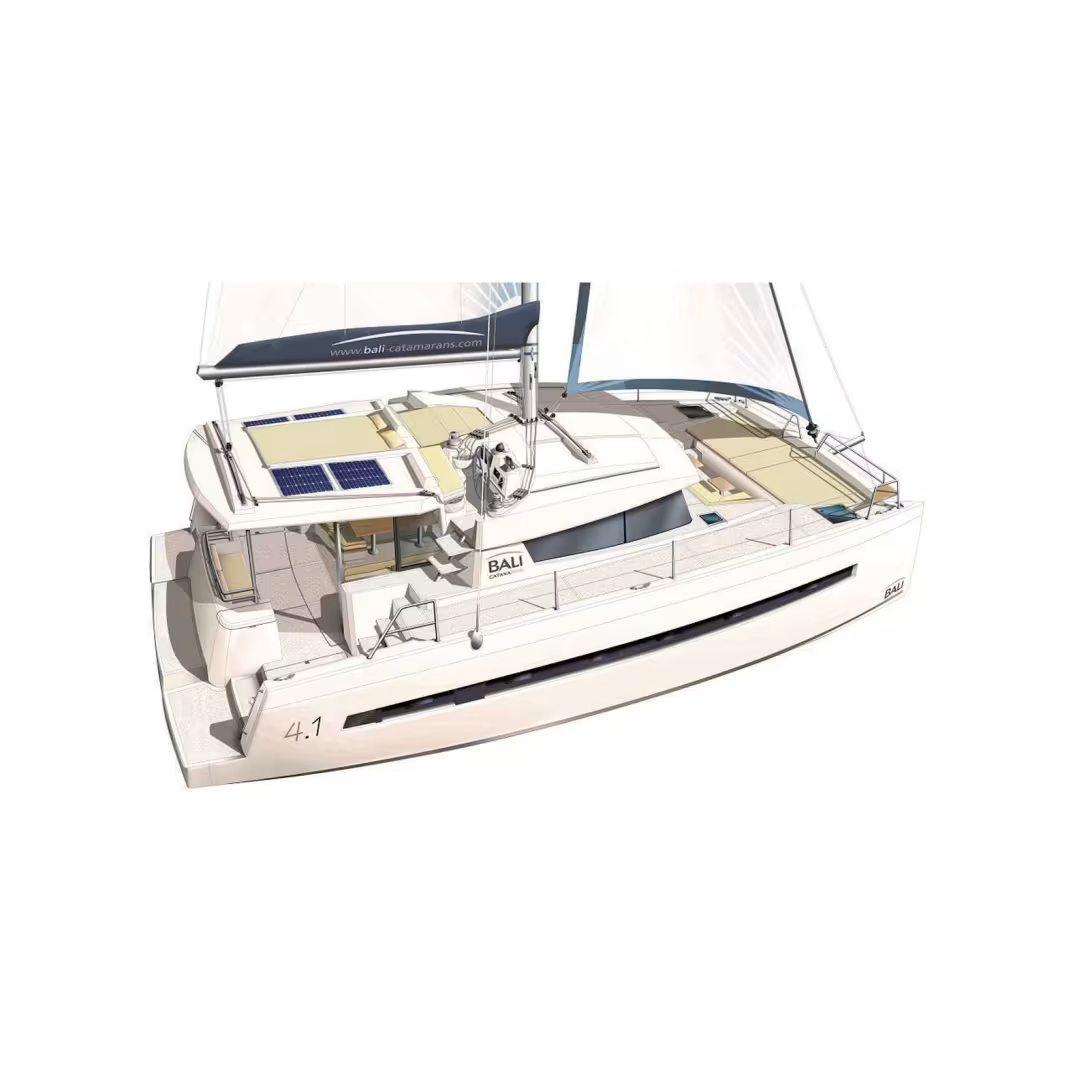
In the Bali family, I ask for the little one! The Bali 4.0 was launched in September 2015: this catamaran was aimed at the typical charter market in her four-cabin version, though was nevertheless available in an Owner’s version. 154 examples were built up until April 2018, when her successor, the Bali 4.1 came on the scene. This second version coexisted for a while with the first one before becoming the definitive model. But what was new? First of all, a fixed aft platform between the sugarscoops. With this modification, the Bali 4.1 joined the idea of exploiting the entire available deck area - a concept seen on all the latest Balis. As a result, the 4.1 gained an aft bench seat. Inside the nacelle, a little change with an L-shaped saloon instead of the more traditional table that the first 4.0 featured. One hundred and fifty Bali 4.1’s have been delivered - production of this model has just come to an end, and now the Bali Catspace and the 4.2 have taken over.
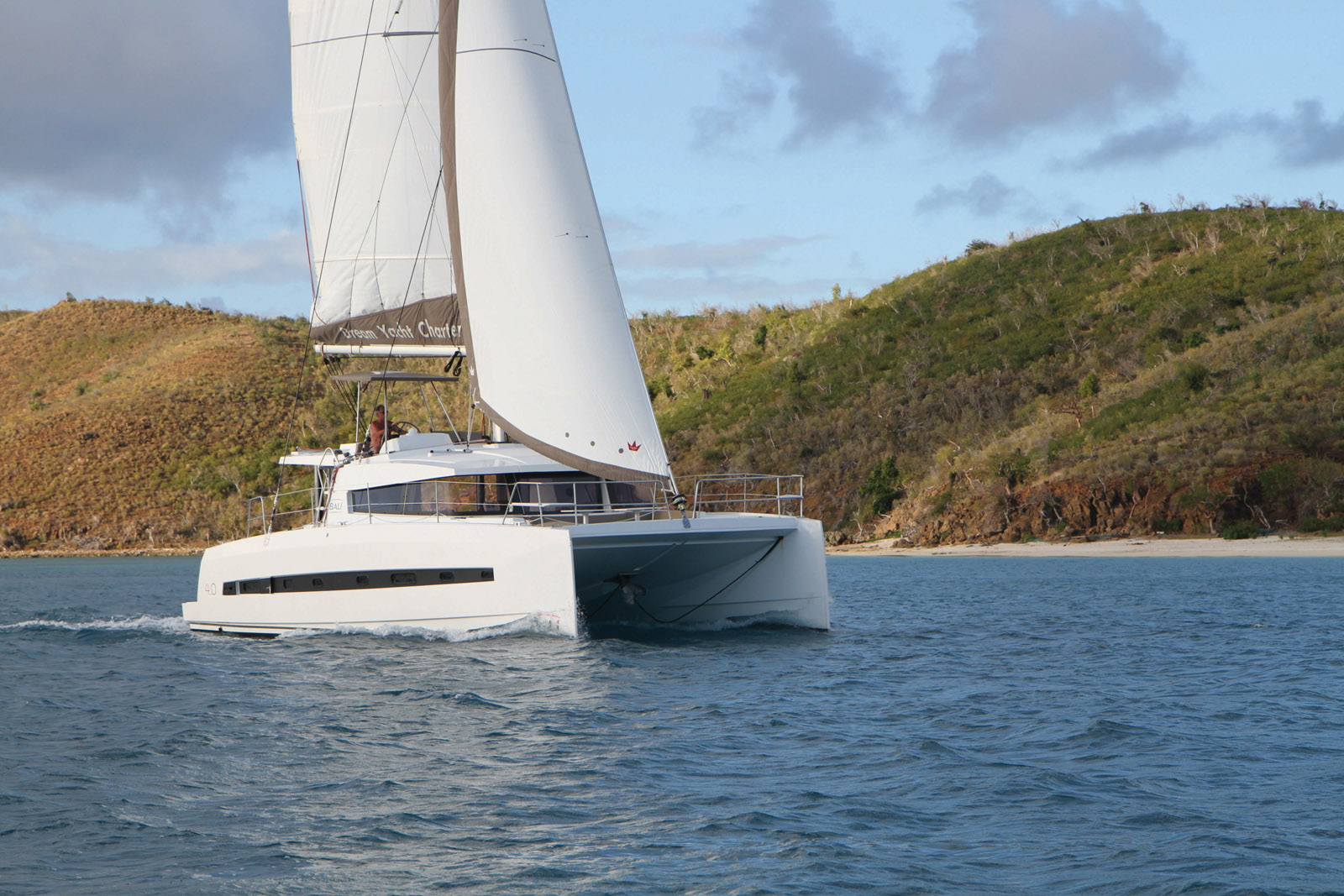
The Bali 4.0 is fast, as long as you’re not sheeted in too hard - and there’s a breeze!
An innovative catamaran
Despite the high freeboard, the silhouette from both the front and the sides passes rather well. The fine-entry bows at the waterline are overhung by an elegant deflecting chine. This creates volume and reduces the verticality of the freeboard. The topsides are skillfully underlined by a rib under the deck edge; a longitudinal reveal houses the hatches. The stemheads are subtly broken by a short, inverted edge. The architectural tour-de- force undoubtedly lies in the intelligent integration of the rigid foredeck: between the hulls, there is a large ski-shape spatula that is particularly conducive to good seakeeping behavior with heavy seas from behind. The design of the coachroof, with its protective ‘eyelid’, is particularly successful - it protects the nacelle from the most vertical rays of the sun and echoes the identity of the other Bali models. However, seen from astern, the Bali is less elegant: the nacelle appears quite imposing.
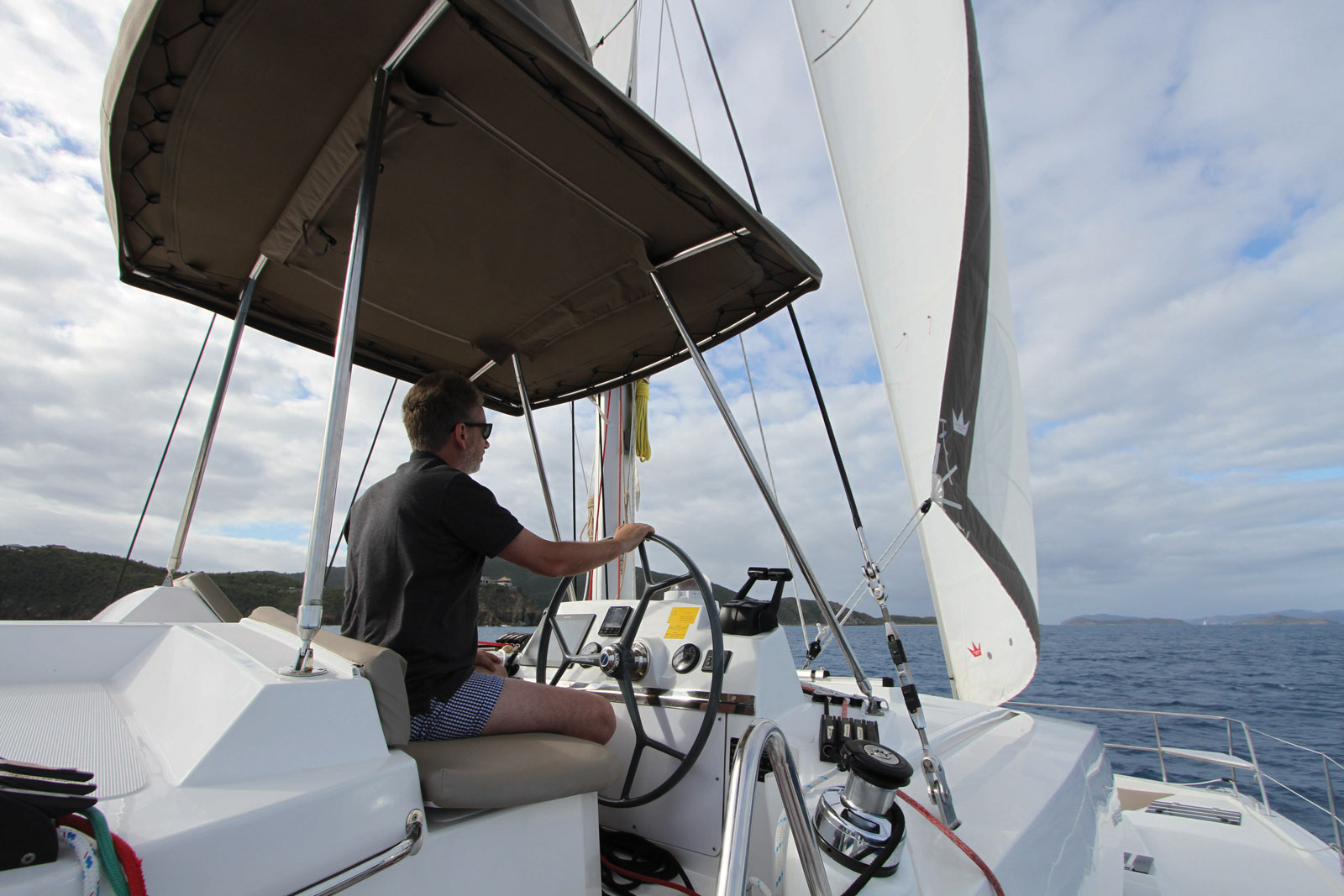
The raised helm station and the deck hardware fitted by the yard lend themselves perfectly to solo management when sailing with a short-handed crew.
Honorable performance under sail
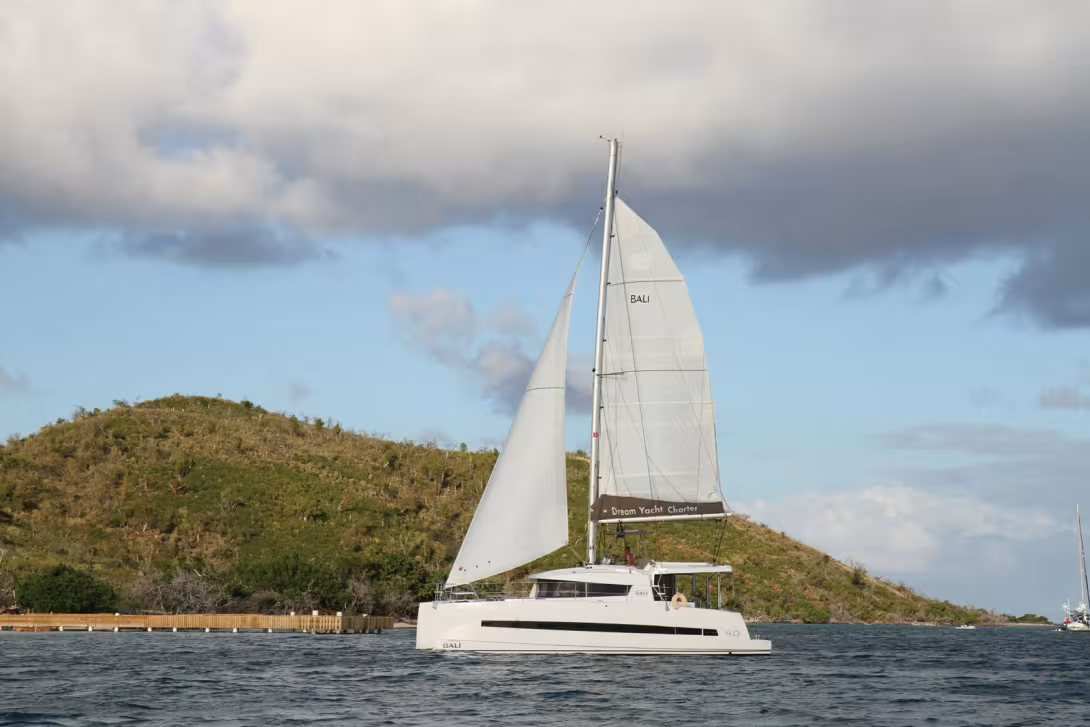
The excellent surprise that the smallest of Bali reserves for you is that she actually goes pretty well under sail! Admittedly, her high freeboard and the shallow depth of the keels at 3’8” (1.12 m) won’t allow you allow to sail upwind valiantly: heading is limited to 50/55° off the true wind, and the speed is limited to 5/6 knots provided there’s a breeze and the sea is manageable. Otherwise, starting an engine will considerably improve the efficiency, at around half a US gallon (2 liters) per hour... But as soon as the sheets are freed-off a little, the Bali quite frankly comes alive. During our test – on a boat with folding propellers, let’s specify - we found her very lively in 12 knots of wind at 100° to the apparent. Under solent and full main, the catamaran proved to be dynamic. With the asymmetrical spinnaker, she was gliding along between 9 and 10 knots in 15 knots true, with a peak at 10.2 knots. Good performance for a reasonably sized multihull more oriented towards idleness than sport. During our test, the average speed was 7.2 knots over 25 miles mixing 1/3 sailing under spinnaker and 2/3 upwind under mainsail and solent. Not super-impressive, but very honorable!
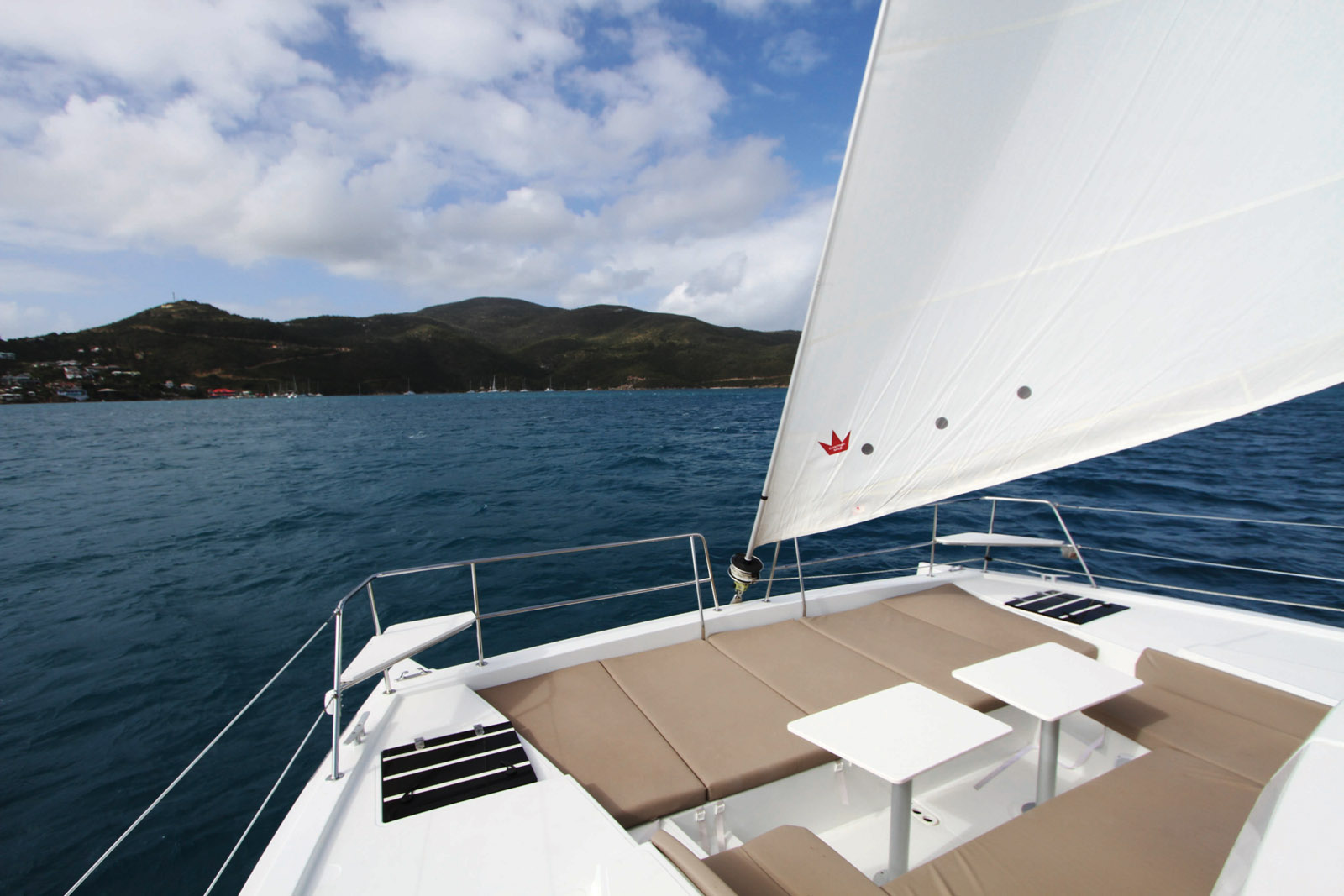
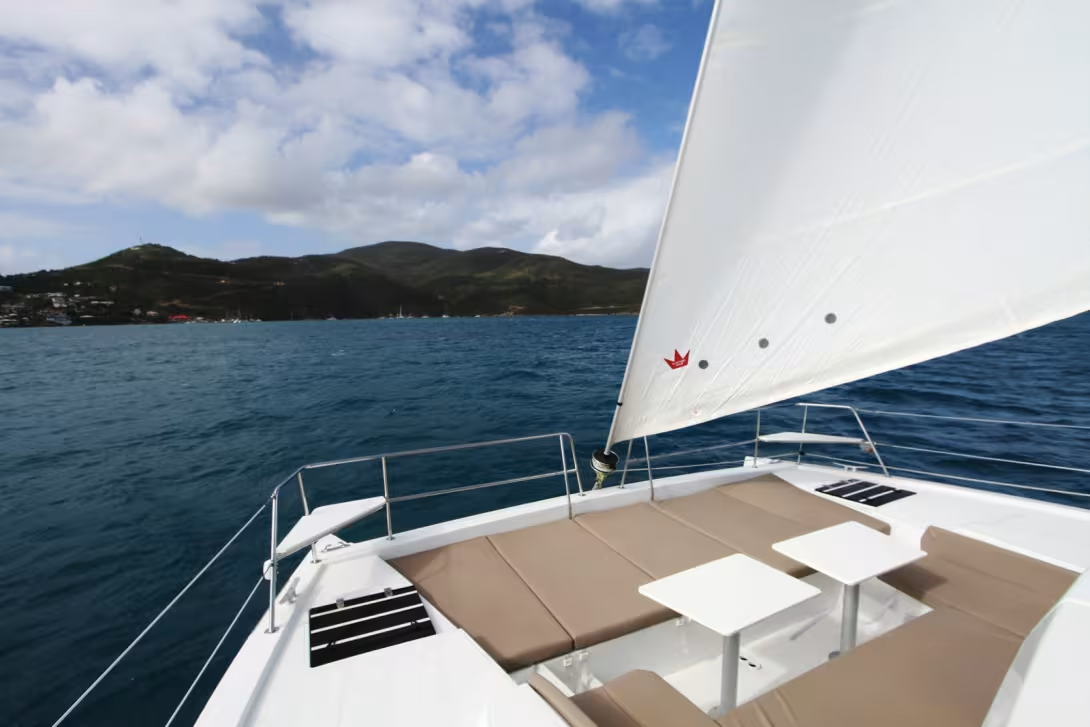
The forward cockpit of the Bali: the crew loves it, but there is a lot of upholstery outside…
Simple and intuitive deck layout
The Bali 4.0 and 4.1 didn’t join the flybridge generation of the newest models. The helm station is simply raised: it is comfortable, with an elegant and very direct steering wheel working via cable drives. Standing as well as sitting is possible. There is little spray to fear, this catamaran barely gets wet thanks to her high freeboard and solid foredeck. The change in engine manufacturer (Volvo as opposed to Nanni) allowed for the removal of the ignition keys, that were very exposed. The quality of the hardware (AntalRutgerson) allows fluid and easy maneuvers, even single-handed, and I must underline the flexibility of the large Rutgerson mainsheet traveler. The side decks and their access steps are wide and clear. The foredeck becomes a fitted-out terrace capable of accommodating numerous guests. To port, an independent staircase allows access to the bimini’s sundeck without disturbing sailing maneuvers or the helm. The new aft bench seat on the 4.1 is comfortable, integrating three XXL-sized lockers offering storage space suitable for fenders, mooring lines, outboard motor and dive gear.
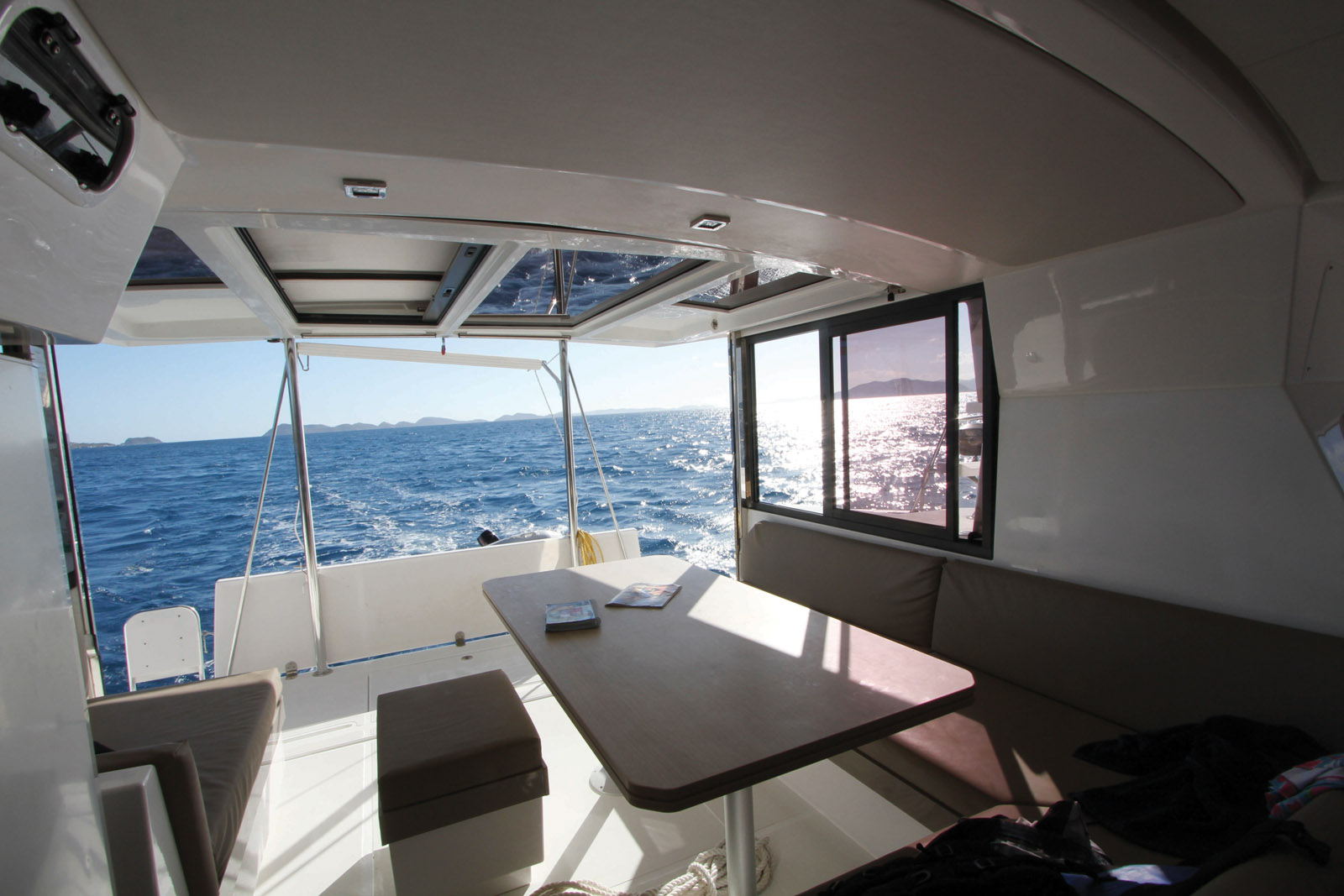
The ‘Open’ concept works thanks to the multitude of possible openings.
An open nacelle
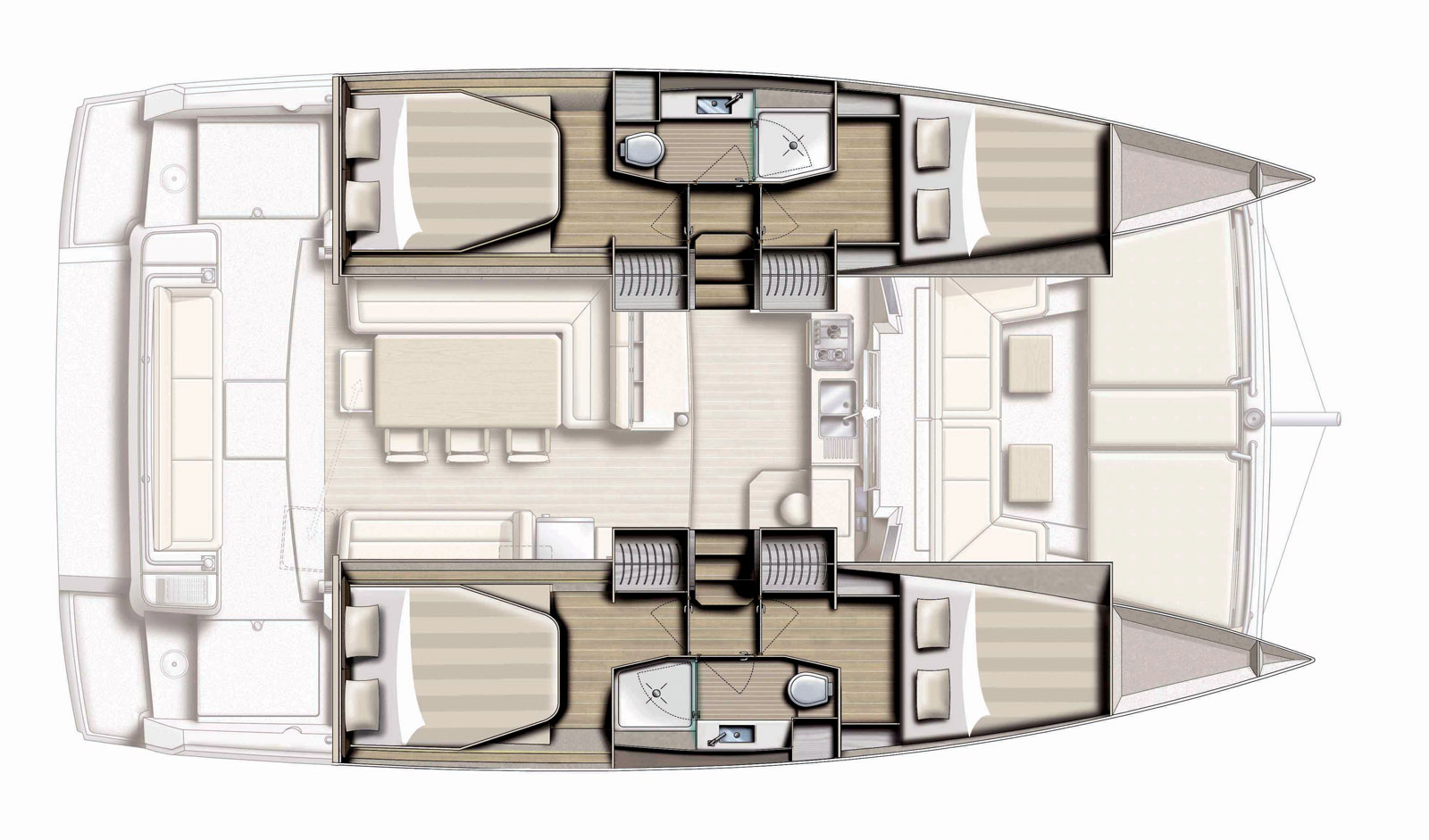
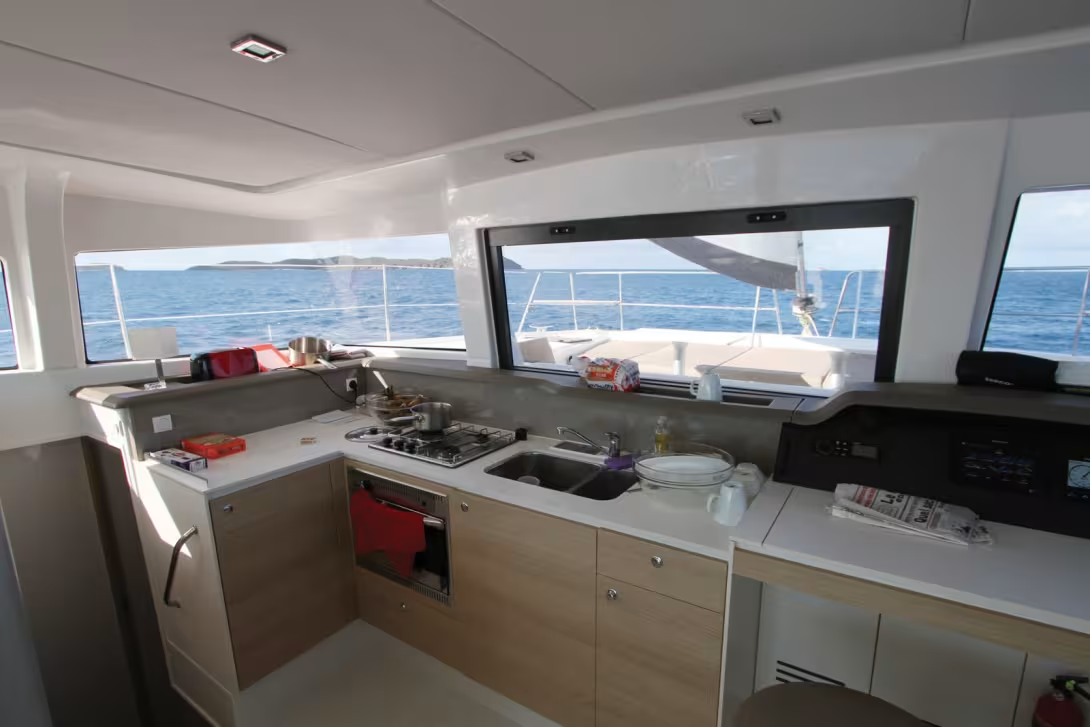
The 4.0 offers astonishing volumes and an innovative pod organization with a wide opening front window - a plexiglas panel slides vertically with three positions - combined with the opening aft bulkhead and opening lateral bay windows. The living area can thus be completely opened up, blurring the boundary between the saloon and the cockpit. In good weather, with the aft bulkhead folded up, the Bali functions like a much larger catamaran. You’d be forgiven for thinking that this Open concept would only work in hot countries and in summer in more temperate regions... But in the end, feedback shows the formula works well - as long as you have a small forced-air heater. Aboard the 4.1, the L-shaped saloon centered around a large table for eight guests is different from the very early examples of her predecessor: the installation of a multi-purpose bar unit really optimizes the use of the galley. Samer Lasta’s interior design is a success. The quality of manufacture of the fittings (Catana joinery) reinforces the feeling of a simple but meticulous finish. In the owner’s version, the port hull offers a beautiful perspective. The use of contemporary materials contributes to a clear, comfortable and functional atmosphere. The two double cabins to starboard, separated by the bathroomshower, are spacious and private. Only the circulation between the central corridor and the aft cabin is a little cramped. The battery bank is located in the center of the catamaran, beneath the saloon floor. Access to the three main circuit breakers is easy.
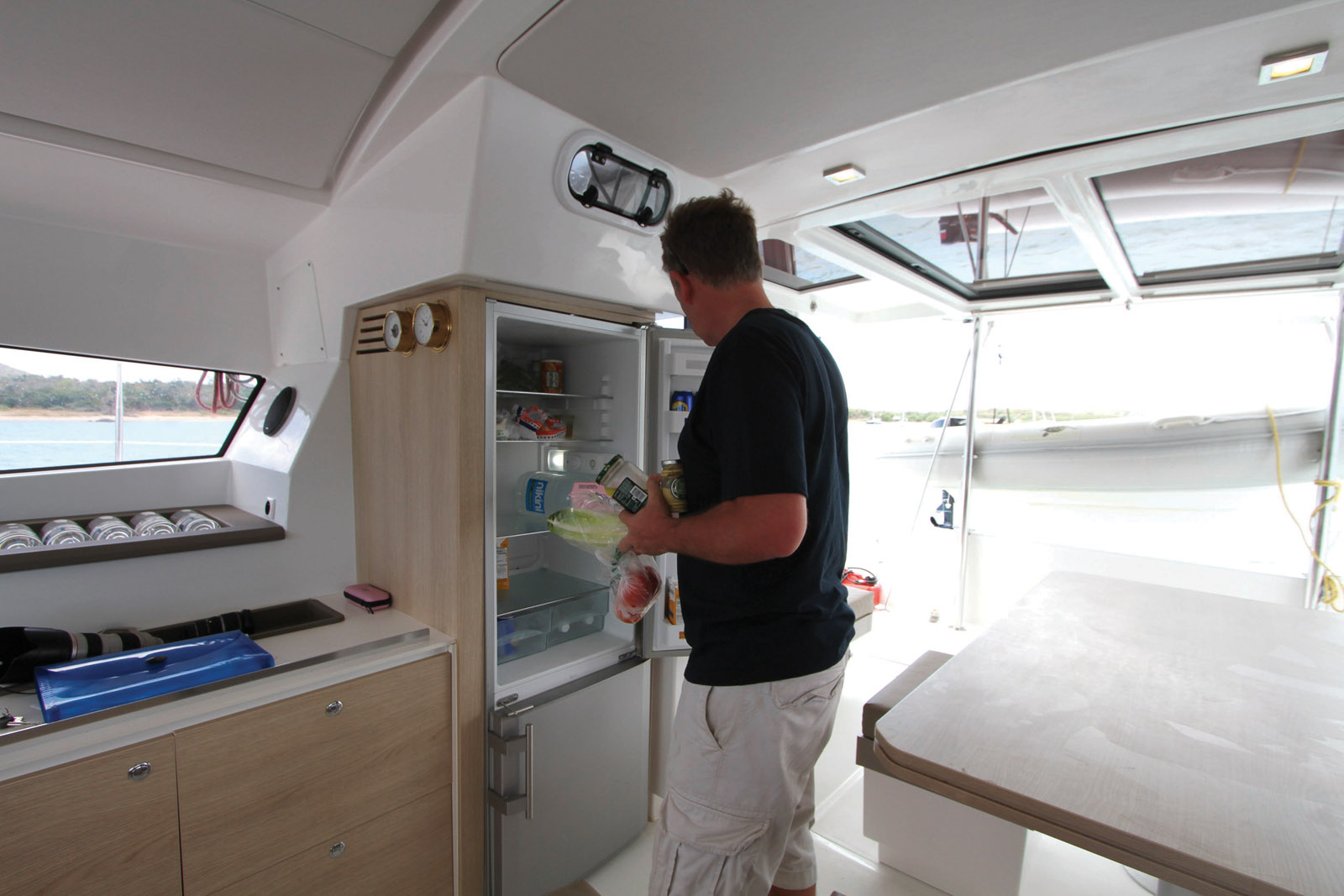
With 9.4 cubic feet (265 l) of chilled storage (refrigerator + freezer), the smallest of the Balis doesn’t take the victualling management lightly!
Conclusion
The Bali 4.0, and her evolution with the 4.1, is a very relevant choice for a cruising or a sabbatical year project; this catamaran is perfectly suited for a couple and two children and offers unusual living volume for this size. The same goes for the usable surface areas offered by the deck plan. Offshore, her limited length won’t provide the same level of comfort as a unit 5 feet longer, but she’s easy to handle. Another nice surprise is the significantly lower maintenance cost.
The Pluses
+ Catamaran comes alive as you come off the wind
+ Very pleasant to helm
+ Highly effective natural ventilation
+ Well thought-out modularity of spaces
+ Space in the engine compartments and installation of the battery bank
The Minuses
- Aesthetics of the helm station bimini
- Lots of upholstery to stow
- Glass surfaces would be complicated to replace
- Visual perception from astern is a bit heavy
POINTS TO CHECK
The life expectancy of a leisure yacht is around 40 years - taking into account the various perils of the sea: that means that a catamaran barely 5 years old is barely run in! Models straight out of charter may have suffered a little from intensive use. Sails, engines and peripherals, electronics and electrical circuitry deserve a good inspection. In theory, except for hurricane-hit catamarans, there are no structural problems to be feared, considering the “monobloc” construction, which is quite substantial. To be checked: the lifting system for the tender is well thought-out, but the stainless-steel tubes are a little light in diameter. As for the overhead door, this sometimes needs to be adjusted in order to be perfectly positioned - both at the top and at the bottom.
TECHNICAL SPECIFICATIONS
Builder: Bali Catamarans
Architect: Xavier Faÿ
Designers: Olivier Poncin and Yves Chabaud
Interior design: Lasta Design
Material: foam/glass/polyester sandwich (infusion)
Length: 40’6” (12.35 m)
Beam: 22’1” (6.72 m)
Draft: 3’8” (1.12 m)
Displacement: 19,620 lbs lightship/ 26,000 lbs max. load (8.9 t/11.8 t)
Mast height: 58’7” (17.85 m)
Upwind sail area: 872 sq ft (81 m²)
Mainsail: 516 or 538 sq ft in square-topped version (48 m² or 50 m²)
Self-tacking solent: 355 sq ft (33 m²)
Engines: 2 x 20/2 x 40 HP
Fresh water: 211 US gal (800 l)
Fuel: 105 US gal (400 l)
Second-hand price: from € 240,000 ex-tax