All you need to know about leeway... with mini-keels
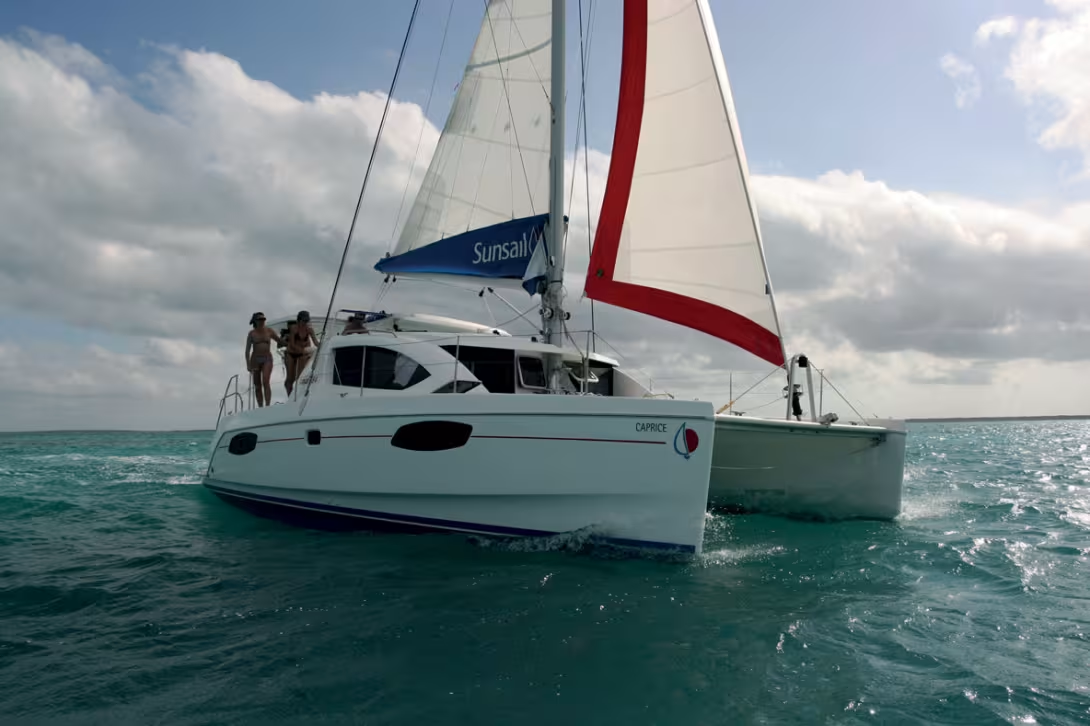
I’m going to be chartering a sailing catamaran this summer for four weeks. It’s a Leopard 39 from 2011. I’d like to know the leeway resulting from different wind strengths (let’s say 5, 10, 15, 20 and 25 knots for example) and according to points of sail (close hauled, a fine reach, wind on the beam, broad reach, deep reach). I can’t find this information on the internet, nor does it appear in the catamaran owner’s manual. As for the builder and charter company, they were unable to provide any information. Gilles, Paris
Image
1
/
1

Publié le
15/05/2024
Par
Emmanuel van Deth
Numéro :
196
Parution :
Jul.
/
Aug.
2024
It might come as somewhat of a surprise, but the data you’re looking for is practically undocumented - at least not in the detail you’d like. The potential for speed and windward gain, on the other hand, is covered by speed polars - supplied to us by Leopard Catamarans, which you can find here.
These curves for different sail configurations indicate the speed of the Leopard 39 for a given heading and wind strength and include the leeway in optimal sailing conditions. In concrete terms, the course indicated is the true course, i.e. that of your chartplotter, and not the compass course - the difference between the two would be the aforementioned leeway angle you’re looking for, provided there’s no current to take into account. Visually, this leeway can be roughly estimated by measuring the angle between the catamaran’s centerline and its wake. So why not publish this leeway? Because it’s so multi-factorial that it can only be managed empirically. Roughly speaking - and naval architects Morelli & Melvin may be able to refine our comments - a catamaran like the Leopard 39 equipped with short mini-keels will incur leeway of 6 to 8° in the most unfavorable conditions, i.e. upwind in light airs. Note that a multihull equipped with deep daggerboards will only drift off half as much. The faster a catamaran goes, the less its leeway. The further off the wind you come, the less noticeable the leeway. So much for theory. But there are many other factors which can also have a major influence on the smooth sailing and leeway of your catamaran. For a start, the helmsman is in the firing line: if he persists in climbing above 50°, the leeway can quickly exceed 10°, especially in light airs - a bit like the effect you get just coming out of a tack. Correct sail trim is also essential - to a lesser extent, so is the condition and quality of the sail area. As for sea state, it influences leeway if the sea is head-on. Finally, the use of fixed propellers, the addition of windage due to paddleboards or kayaks stowed against the guardwires and/or a dirty hull are all factors likely to increase a catamaran’s leeway.
In the past, controlling leeway while sailing, as well as following currents, was essential for compass-based dead reckoning. Today, it’s still essential for optimizing performance, but now “integrated” into your chartplotter. This means you know you’ll need to tack one more time to pass a particular headland... or start one or both motors; when the wind is shifting and the sea kicking up a bit, getting upwind is made easier by starting the leeward engine at low rpm. With the mainsail trimmed flat, you get good balance at the helm, correct speed and heading (with little or no leeway), minimum fuel consumption and battery recharging to boot. No shame in leaning on the engine when cruising!
Technical specifications
Architect: Morelli & Melvin
Material: GRP/balsa sandwich
Length: 37’6” (11.43 m)
Waterline length: 36’1” (11 m) Beam: 19’10” (6.04 m)
Draft: 3’5” (1.05 m)
Displacement: 20,075 lbs (9,105 kg)
Upwind sail area: 990 sq ft (92 m²) Mainsail: 613 sq ft (57 m²)
Genoa: 376 sq ft (35 m²)
Gennaker: 1,011 sq ft (94 m²)
Motors: 2 x 21 or 29 HP inboards
Fresh water: 206 US gal US gal (780 l)
Fuel: 92 US gal (350 l)
Cabins: 3 or 4
Production: 195 units built from 2009 to 2014
Secondhand price: € 230,000 ex-tax
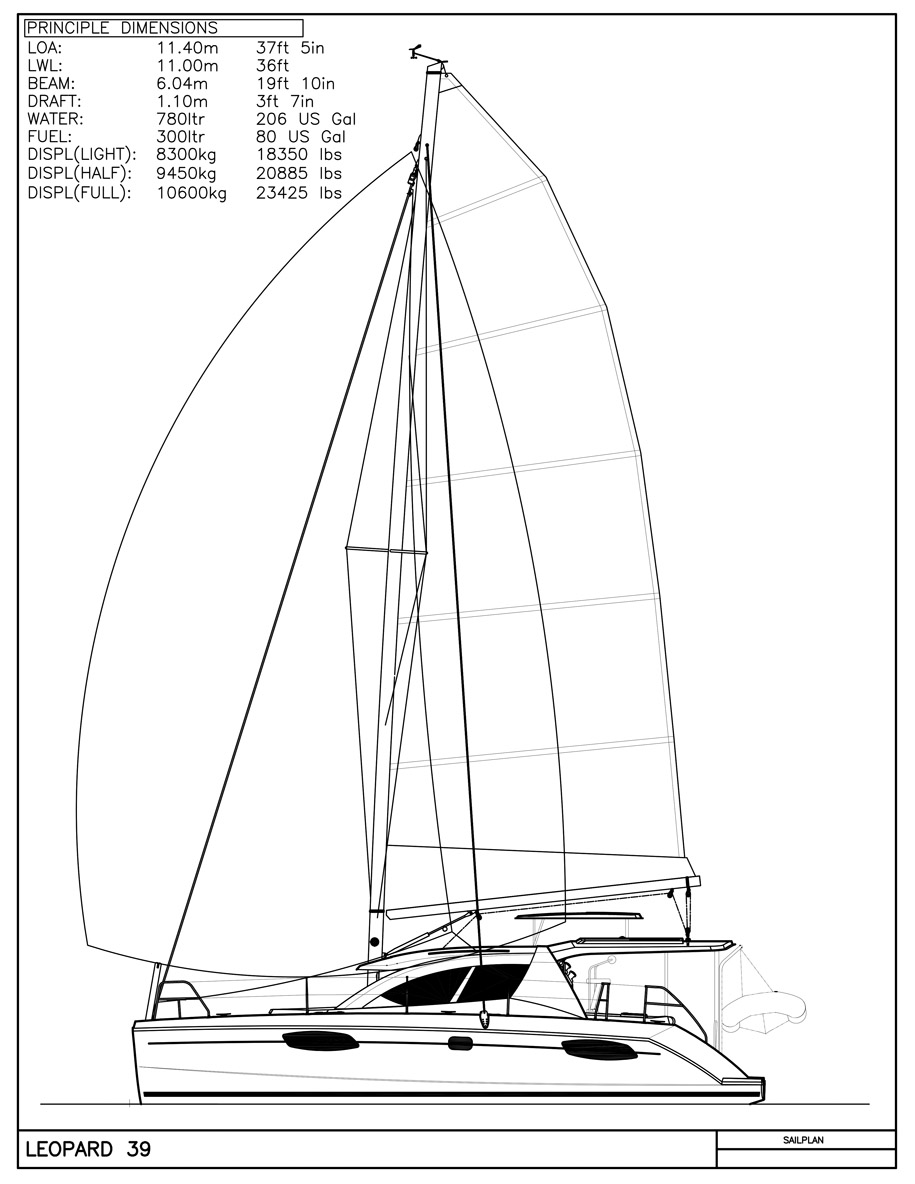
Nearly 200 Leopard 39s were produced between 2009 and 2014.
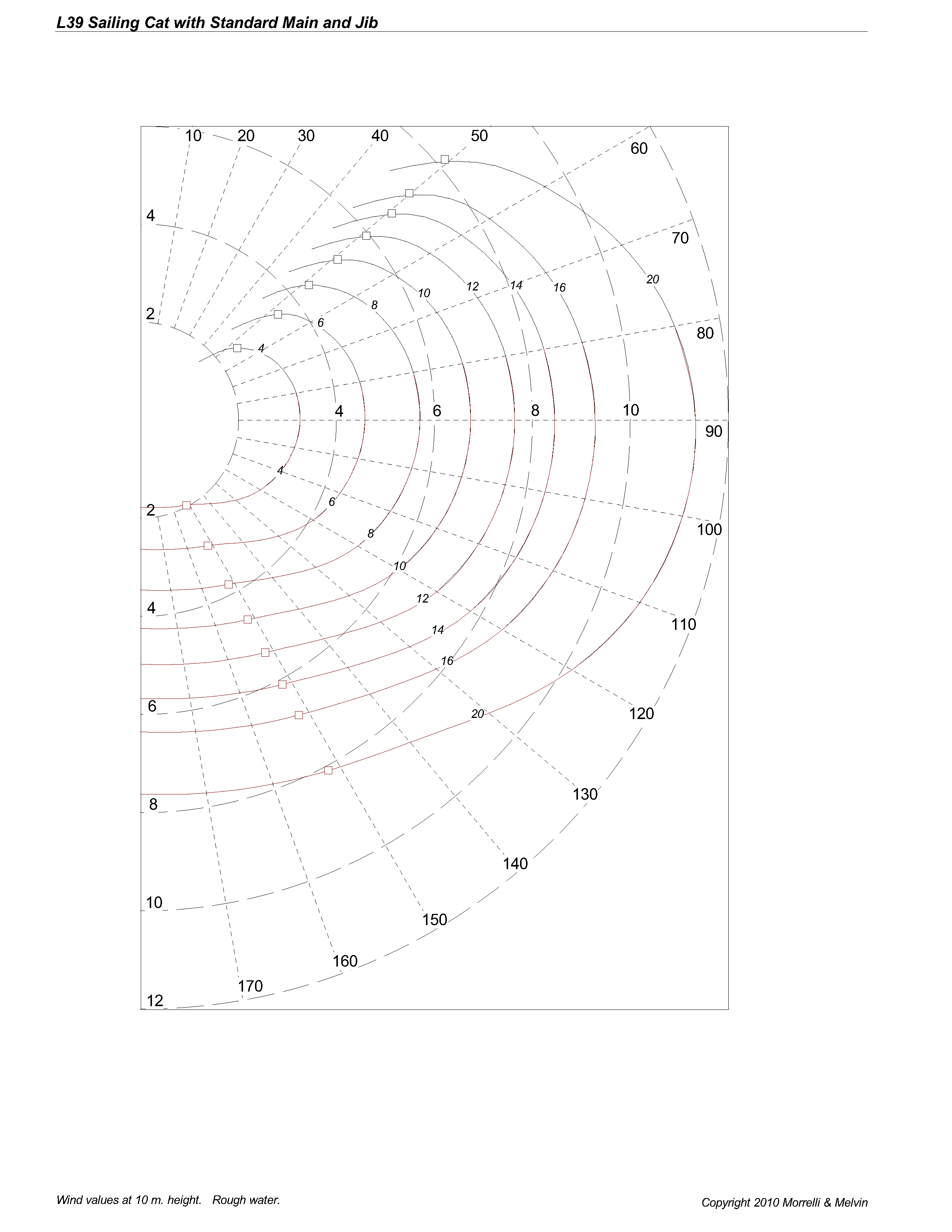
The Leopard 39 speed polars shown here are built with the standard mainsail and genoa - the most common charter configuration.