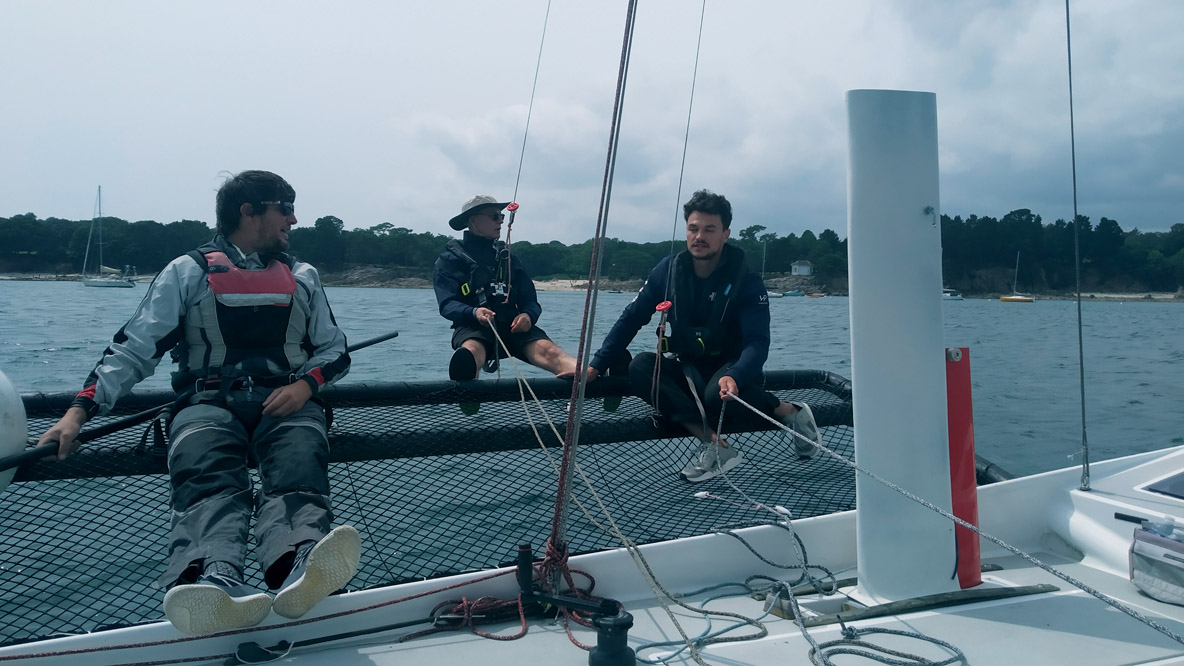
The world of sailing is constantly innovating. While most technological advances are dedicated to optimizing performance, some are aimed at making life easier for sailors. The ACCWing falls into this category: it’s a technical and innovative sail, but its ambition is to make sailing easier for everyone, including committed powerboaters. That, too, is the Forever Green vision!
Infos pratiques
- Le chantier : ACCWing
- La fiche technique
-
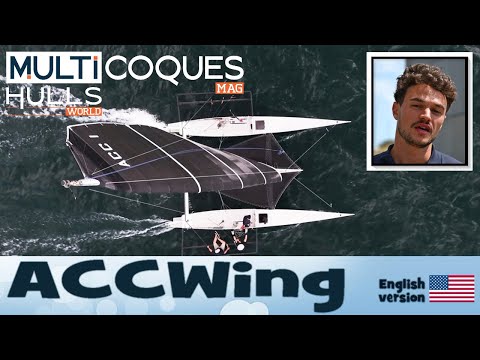 Découvrez notre vidéo exclusive
- Financez votre ACCWing
- Assuez votre ACCWing
- Articles autour du ACCWing
Conditions:Southwesterly 15-20 knots and gusty. Smooth to slight sea state.
As boat tests go, this one was a little out of the ordinary, since it wasn’t really the boat we were testing, but its rig, and more specifically, its sail. We went along to Port la Foret in southern Brittany (one of the realms of offshore racing) to test this new ACCWing, as it is called. A few steps further down the dock from our catamaran was Éric Defert’s MOD 70, Axciss Group, so we were clearly in good company.
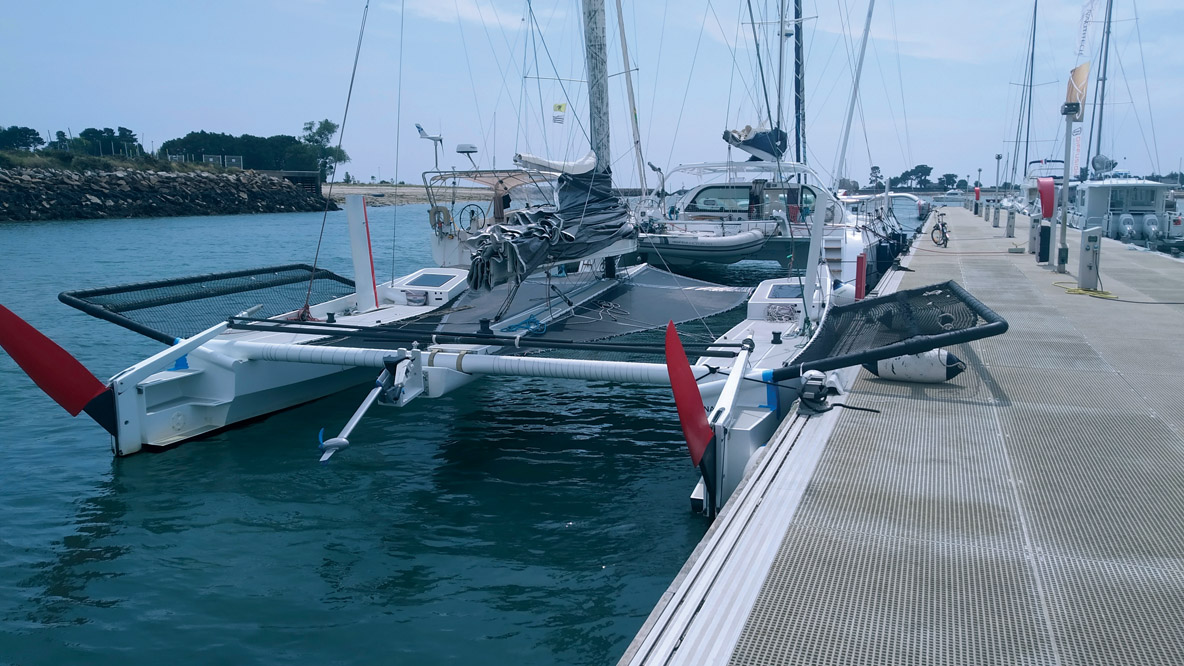
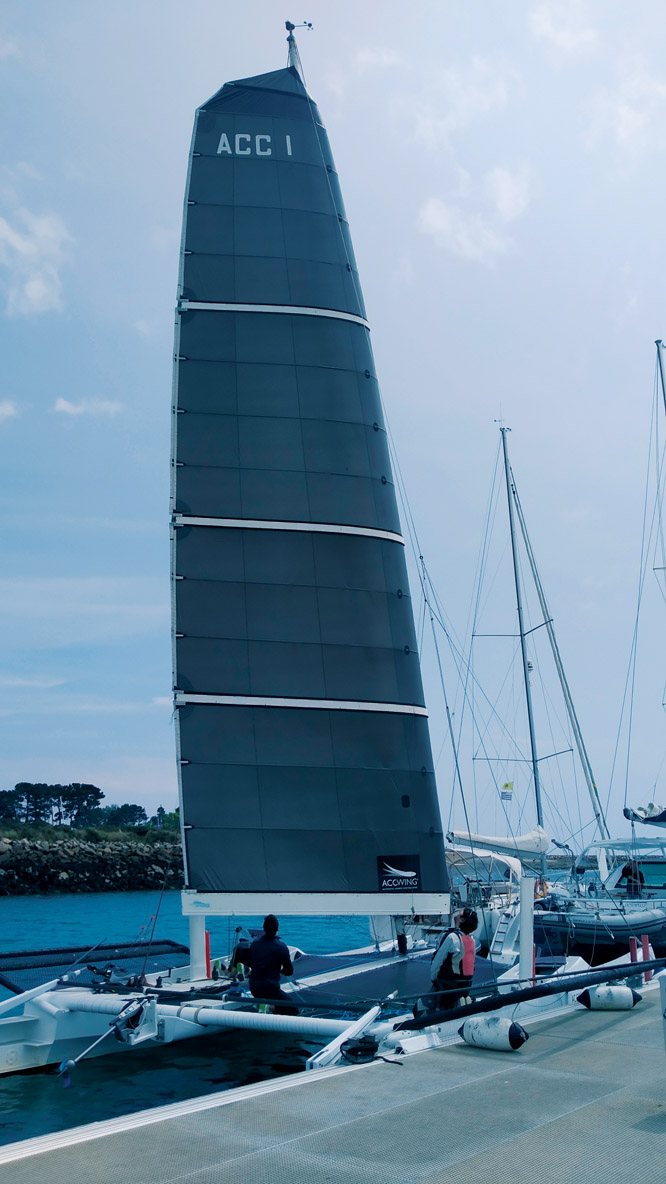
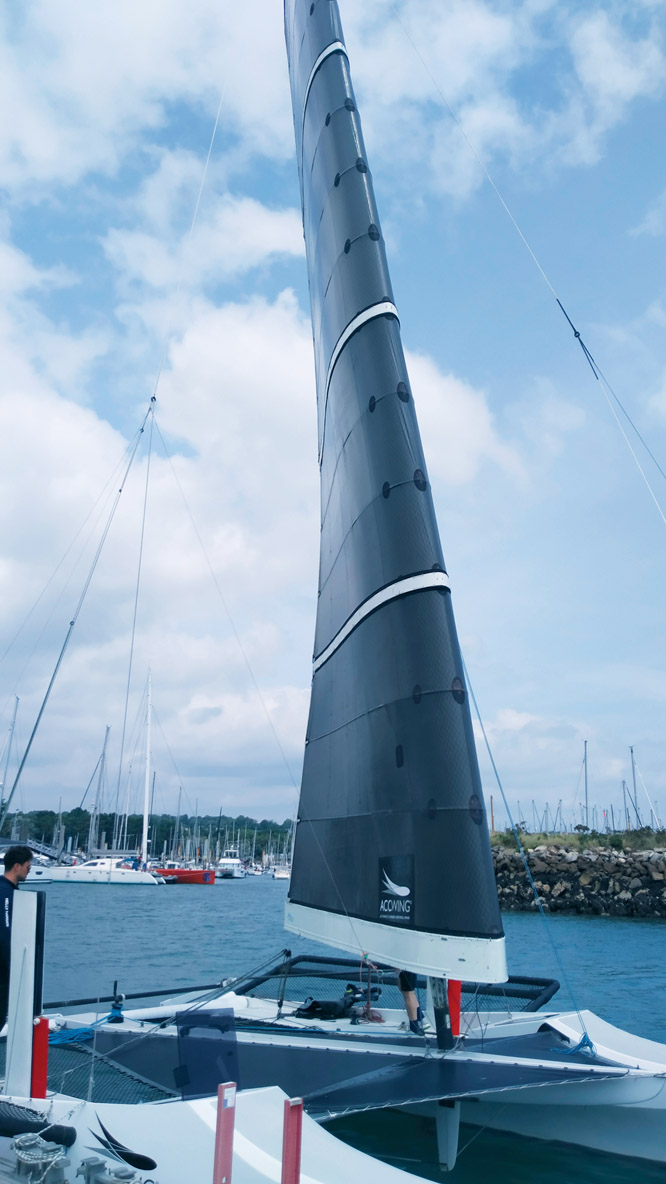
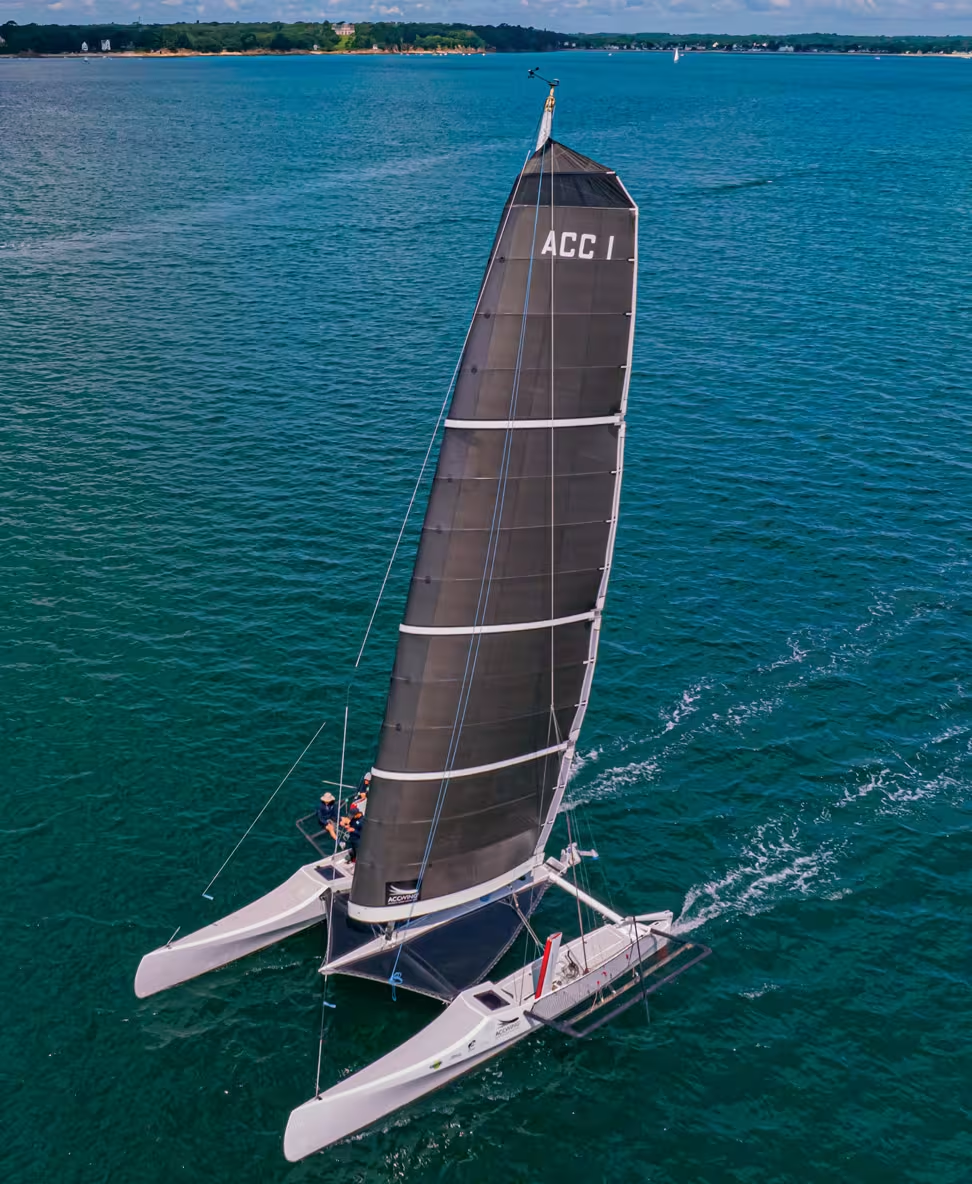
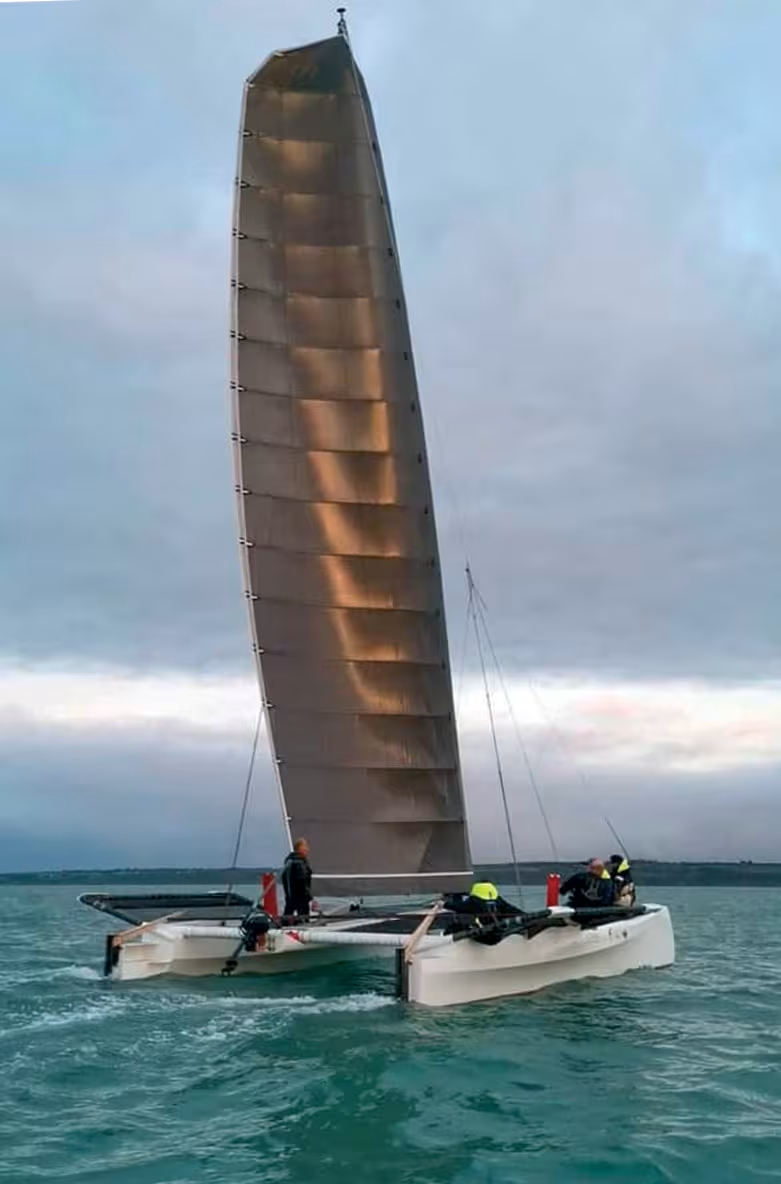
With elegant canoe bows, there’s no lack of allure, but it’s not the lines that catch the eye... instead, you look up a little to discover a 55-foot (17-meter) carbon rig that supports an astonishing 645-square foot (60 m²), very wide, yet flexible wing.
At the origin of the project is Philippe Markovich, the director of Sicomin, a major chemical and composite products company here in France that’s widely known as a formulator and supplier of epoxy resins. Philippe teamed up with Hugues de Turckheim who actually developed the ACCWing. Hugues was formerly a designer with TIGA sailboards, a company that had become the world’s leading manufacturer of windsurfers by the mid-1980s. He is an alumni of Arts et Métiers, France’s top engineering school, and is passionate about fluid mechanics and innovation in general and has collaborated on numerous projects within the marine industry. They are joined in the project by Philippe’s son Sam, an avid watersports enthusiast.
A concept that combines performance and ease of use
While you might think you know a bit about wingsails, particularly if you’re a fan of the America’s Cup or the Sail GP series, this one is something quite different. Like most wingsails, those on the AC72s featured twistable flaps along their trailing edge, with the structure of the wing comprising rigid ribs that the sailcloth is attached to. But the fact that they’re effectively one piece means that such wingsails are not the sort of thing we’ll ever see on our cruising multihulls. Apart from anything else, the wings on both AC and GP boats are enormous structures that need to be lifted into place with a crane. It’s the rigidity of the wings helps that maximize lift and keep the boats flat.
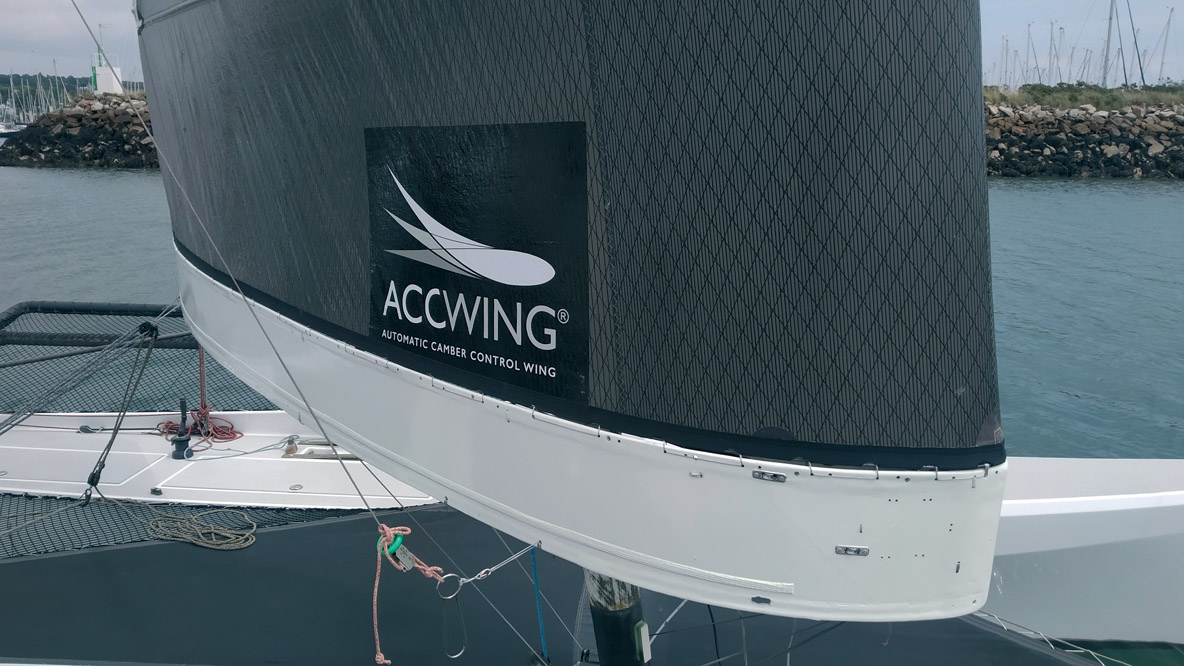
The big difference with the ACCWing is that it’s not rigid, but flexible, and can be hoisted like a normal sail. On conventional sailboats, you always have to fine-tune the sail to find the perfect shape, the one that most closely resembles an “airplane wing” shape, and therefore offers the best performance. Indeed, more camber creates more power - and better acceleration - while less camber, i.e. a flatter sail, generates less power, but also less drag. The pros and cons of each are pretty clear, and the idea of Philippe and the ACCWing team was therefore to create a sail whose camber can be directly modified, without having to make all the other traditional adjustments. ACC, by the way, stands for Automatic Camber Control.
A carbon catamaran as a test platform
Though the boat we’re testing today is ultimately just a platform for this very particular propulsion system, it is, in itself, something quite special. It was originally designed by Englishman Julian Spooner, who had studied yacht design at Southampton Institute in the UK and has worked for the likes of Pendennis Shipyard and Princess Yachts. Philippe Marcovich bought the molds from Spooner, and then used them to have the boat built by Cobra, a composites manufacturer in Thailand. With some modifications and the addition of outrigger-style ladders/trampolines, the 33-foot (10-meter) long day-sailing catamaran was constructed using carbon cloth, Sicomin Greenpoxy 33 and Airex R63 foam, and weighs in at barely a ton!
During 2020, the hulls lay at the Crazy Lobster shipyard in the port of Le Légué at Saint Brieuc, on the north coast of Brittany. Here, the tall mast was built, in carbon/epoxy using the infusion process. The rig is spreaderless, and the crossbeam of the catamaran is of relatively small diameter. This is because the ACCWing induces little compression loads as it does not require tension in the stays. The hulls remain fairly traditional, not equipped with foils, because the aim is to focus on the use of the wing, but it could of course be used on foilers.
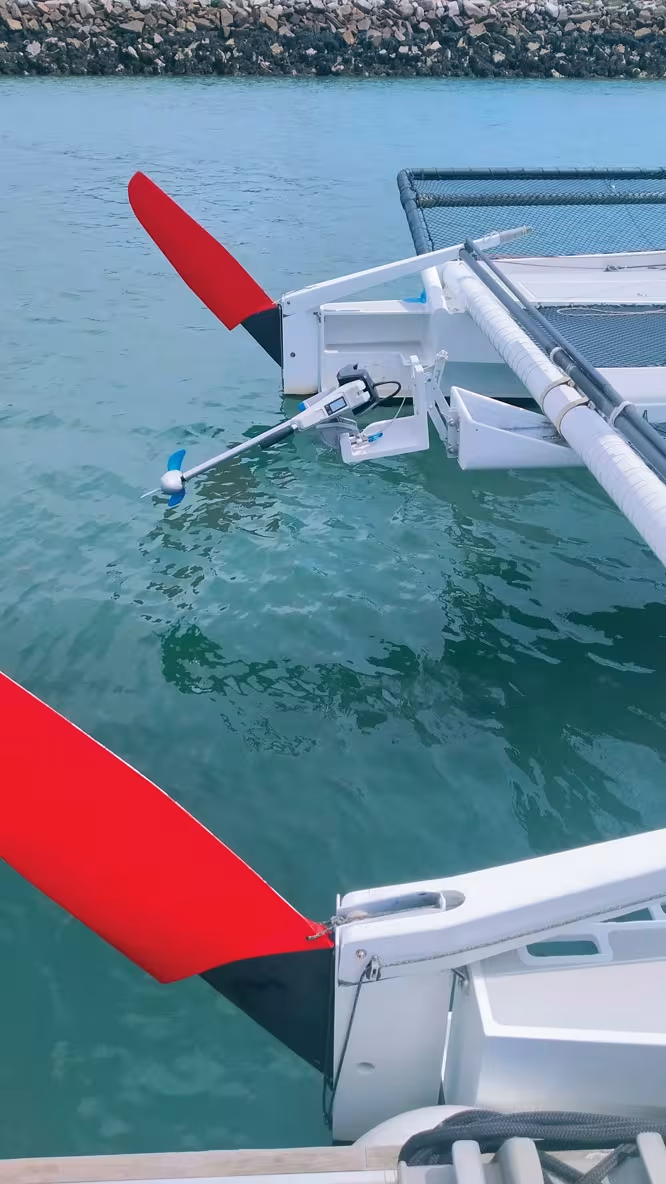
Daggerboards and lifting rudders mean this catamaran has very little draft, and the tillers are linked by a bar with a long tiller extension at either end, allowing the helmsman to hike out on the outriggers if necessary. Auxiliary power is provided by an E-Propulsion electric outboard. The underwater hulls are coated with an experimental copper-based epoxy to provide antifouling properties that are more respectful of the environment.
The ACCWing, a “muscle” for the boat
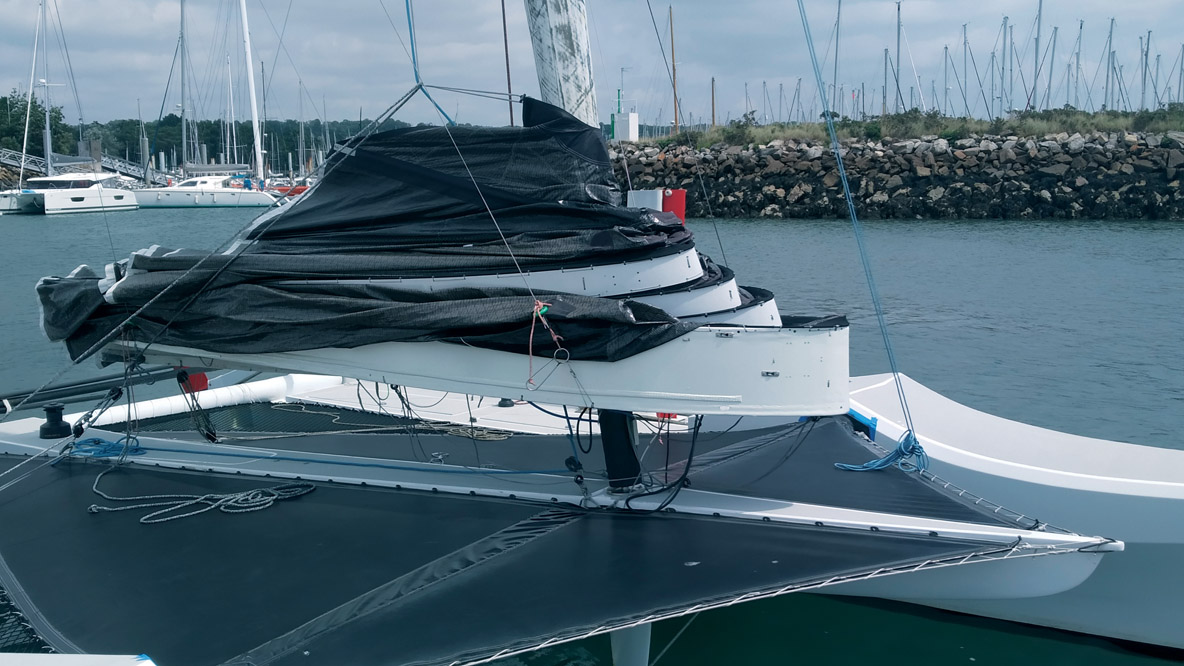
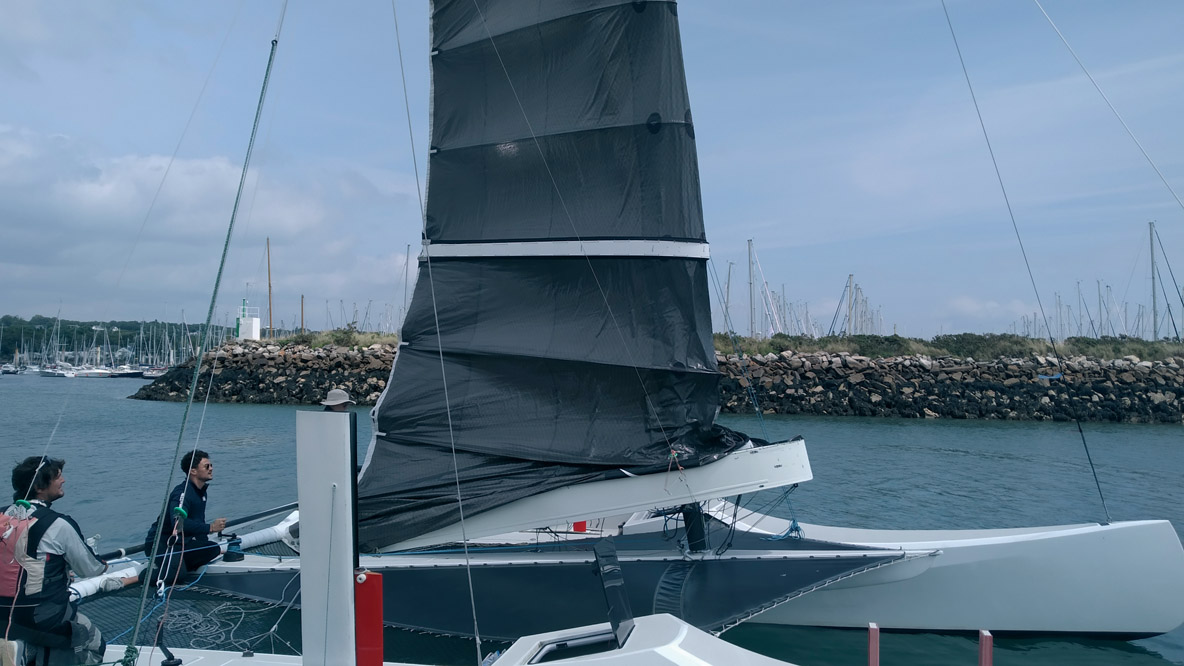
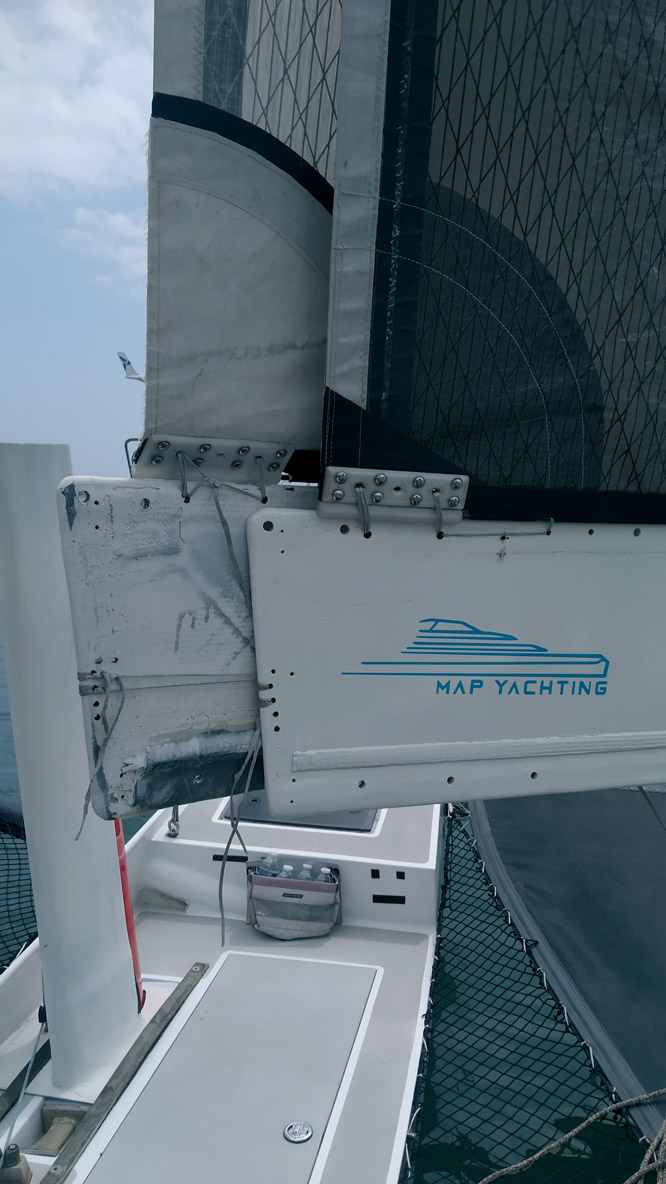
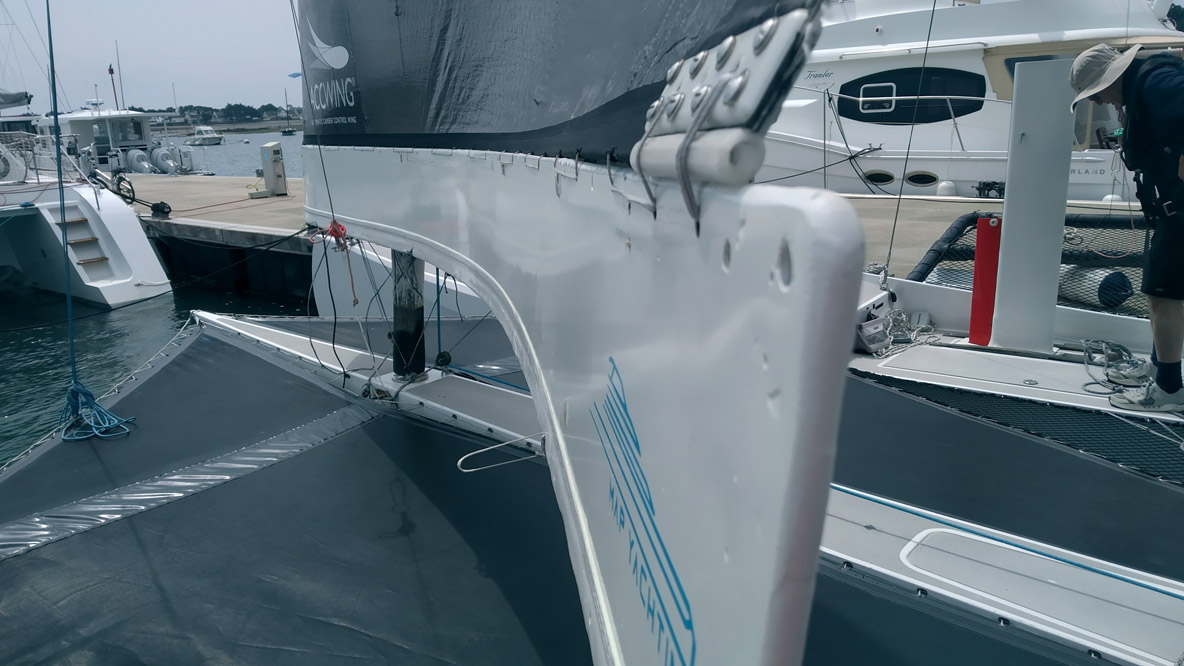
The thing that’s most intriguing about this sail is how it sits on the rig. The patented system is made of several components, and it wraps around the mast – passing well forward of the mast – and back again, thus forming a double skin, or double layer to the sail. The fact that it comes forward of the mast means that it’s balanced around it, much like a balanced rudder. This leads to minimal outhaul forces and translates into very light loads on the sheet, as was clearly evident during our test sail. There are actually four individual sections of sailcloth, each separated by a “mini-boom”. The main boom at the foot of the wing is larger, but the three mini-booms, spaced almost equidistantly, adopt the same principle. And this is the clever bit… the booms are made of a semi-rigid (or flexible) composite material comprising carbon infused with bio-sourced Infugreen resin, so are strong and light in weight, but, critically, they “bend” to induce the famous camber.
But how do you make them bend where you want? Along the inside face of each boom is a series of small-diameter tubes that are, in fact, air lines fed by compressed air. By putting more air into the tubes on the leeward side of the boom, and less air on the windward side, the wing shape takes on more camber. The booms can thus be made straight, or with a neutral axis, or cambered to suit the wind strength and point of sail, and exactly when you want it: more available power in light to medium conditions. This effectively means the booms are like a “muscle”, with the air lines being the “tendons” that provide the force.
As for the air itself, this comes from a standard scuba diving tank, secured below deck. This is the perfect solution, because we’re talking about a reasonable amount of pressure, but relatively little volume of air. Philippe assures me that the 10-liter scuba tank will last for ages. Aboard this particular boat designed for daysailing, it’s easy enough to take the tank ashore to refill, but maybe for a cruising boat planning some serious passage-making, a dive compressor might be needed.
Another advantage is that as the rig is spreaderless, the amount of chafe suffered is going to be less than you’d get with a conventional rig, even though the sail does wrap around the mast.
Out on the water, acceleration is immediate
The day of our test, we were joined by Philippe and his son Sam, along with Gaël Douguet, a very experienced racing sailor who also happens to be the Sales Director at JFA Yachts, builders of the Long Island range of catamarans. It was breezier than the team would have liked - given that this incredible machine is still in a trials phase – with a fairly consistent 20-plus knots. And gusty. Approaching the end of the channel, the sail was hoisted easily by hauling on the halyard. The effect of the wingsail feeling the breeze was instantaneous. All of a sudden, we were accelerating out to sea, quickly reaching double-digit speeds. Despite there being more wind than we really wanted, it remained west of south which meant that the water across the expanse of the Bay of Concarneau remained reasonably flat. Having put in a few tacks to make our way across the bay, it became obvious that this boat points very high. Very high indeed. I estimated that we were tacking through a maximum of about 70°, something Philippe confirmed, telling me their tests have shown upwind course-keeping typically 10° higher than a regular mainsail, and suggests that it could point up to 25° off the true wind. Combine that with the fact that the wingsail is seemingly impossible to stall, and you’ve got one heck of a tacking machine here. Philippe assures me, “There’s no need for a jib, because we can tack extremely well, but if you were planning to sail long distance, you could have a jib, and either a code 0 or an asymmetric spinnaker for offwind conditions in light airs.”
Great ambitions for a wider market
Aside from the notion of performance, Philippe’s main goal is simplicity. This simplicity is aimed at motorboat users who are put off by the complexity of sailing, or at those who are looking for a simpler way of sailing, either because of taste or age. For now, the ACCWing must still be hoisted with a halyard and trimmed with a sheet (although, as mentioned above, the loads on the sheet are very light). As for camber, this has to be adjusted separately in each mini-boom using individual remote controls. This means that the system remains somewhat complex and physical. The next stage of development is therefore to automate all this by developing software capable of managing all the settings. An ambitious but credible goal.
According to the designer, the ACCWing can be adapted to any boat. There is a project under way with well-known sailor for a large cruising catamaran that will be fitted with a 240 m² (2,580-square foot) version of the wingsail. But their ambitions don’t stop there: several designs of merchant vessels can be seen on the ACCWing website including a 75-meter (250-foot) wind-driven container ship, with a capacity of 100 TEU. With the shipping industry currently getting a bad rap on environmental grounds -notably emissions – the wingsail option could be an interesting step in the right direction, with obviously unlimited range. Hugues de Turckheim, suggests that for a large size cruising catamaran, 2 free standing masts in each hull would be advantageous, fractioning by four the total surface area for the easiest maneuvers and lowest center of effort. As for the viability of that idea? Watch this space…
Conclusion
Despite the fact that this rig could be fitted to just about any type of craft, our test boat in Concarneau, with an overall beam of almost 29 feet (8.8 m), demonstrated that a catamaran is the perfect platform to enable one to comfortably sit and admire/contemplate the ACCWing. We’ll be keeping an eye on the development of this innovative -, and green - propulsion system and look forward to seeing other multihulls opting for this rig in the future.
Pointing ability
Speed and acceleration
Motor a bit small for this particular boat
Technical Specifications
ACCWing Designer: Hugues de Turckheim
Catamaran architect: Julian Spooner
Length: 33’ (10 m)
Max beam (with ladders/trampolines): 29’ (8.8 m)
Wingsail area: 645 sq ft (60 m²)
Mast length: 56’ (17 m)
Price: By quotation
www.accwingsail.com