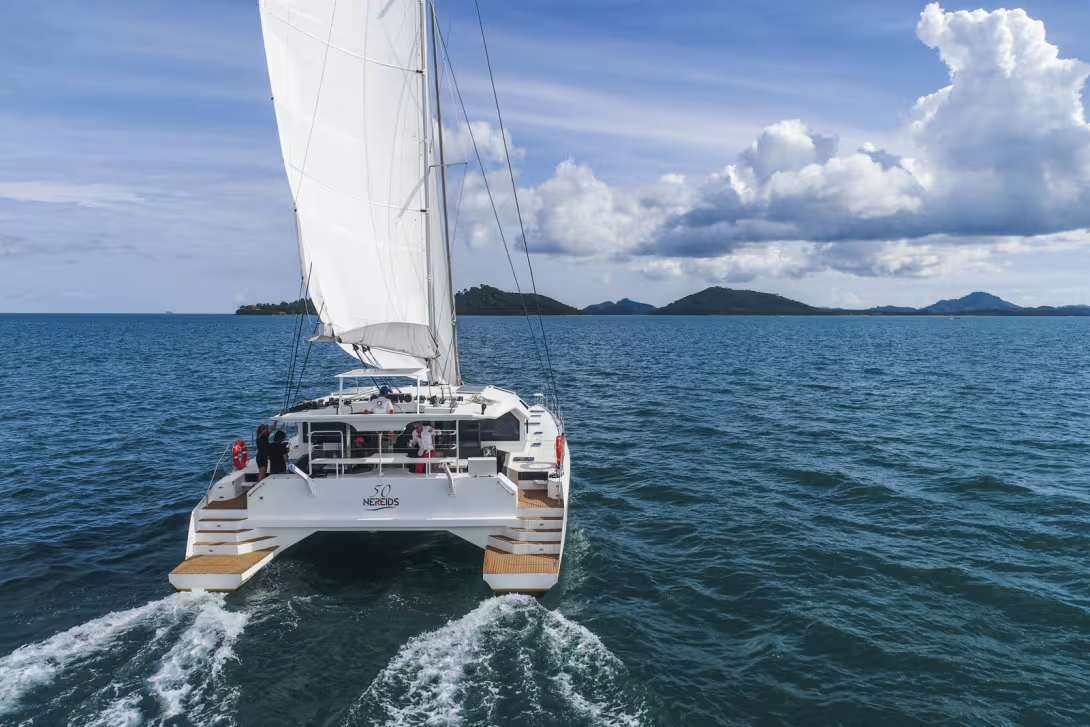
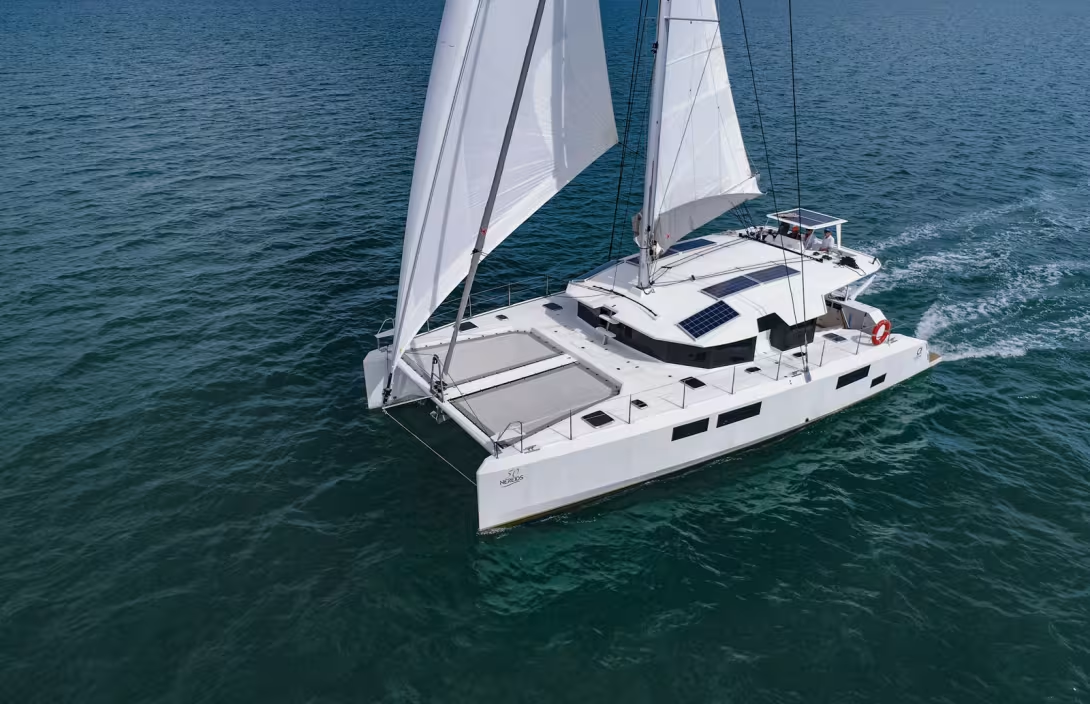
From a distance, the Andaman 50 could be confused with a Lagoon 50 with her vertical saloon windows and her aft-set mast on the coachroof... but apart from this vague resemblance, the Andaman 50 stands out completely from most of her competitors. Much lighter, livelier and above all, cheaper, this new model is clearly moving the goalposts. And that’s no bad thing!
Infos pratiques
- Le chantier : Andaman 50
- La fiche technique
- Découvrez notre vidéo exclusive
- Financez votre Andaman 50
- Assuez votre Andaman 50
- Articles autour du Andaman 50
Test location: Phuket, Thailand
Conditions: calm sea, wind 9 to 15 knots
A new light and powerful multihull has just been launched at the Catathai shipyard. This original and local yard was founded by Frenchman Hervé Le Touzé in 2004, and taken over by Gilles Reigner two years ago. Originally based in Phuket, Catathai has recently relocated further north, in the Prachuap region, not far from Koh Samui. Gilles has designed a totally new range, with elegant catamarans, ready to cruise and built to last. This range is currently based on three models - the Tropical 36, the Andaman 42 and the 50, so this is the largest of the three multihulls we’re presenting here. These catamarans are a real modernization of the old Catathais, which have proven themselves on all the oceans of the world. The builder remains a small shipyard: far from the constraints of large production, they’re offering, on the contrary, custommade catamarans that can be modified to suit the owner’s specifications.
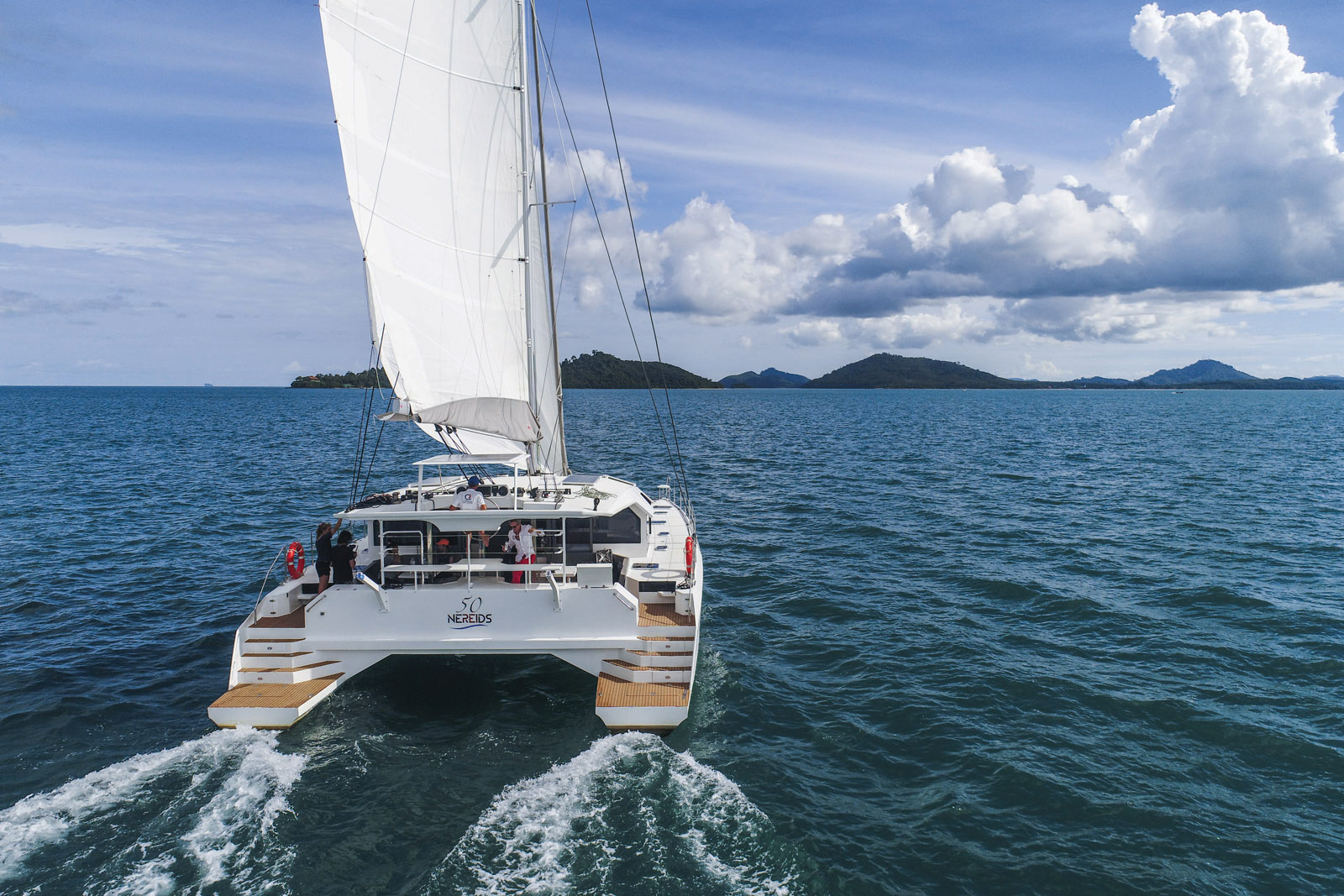
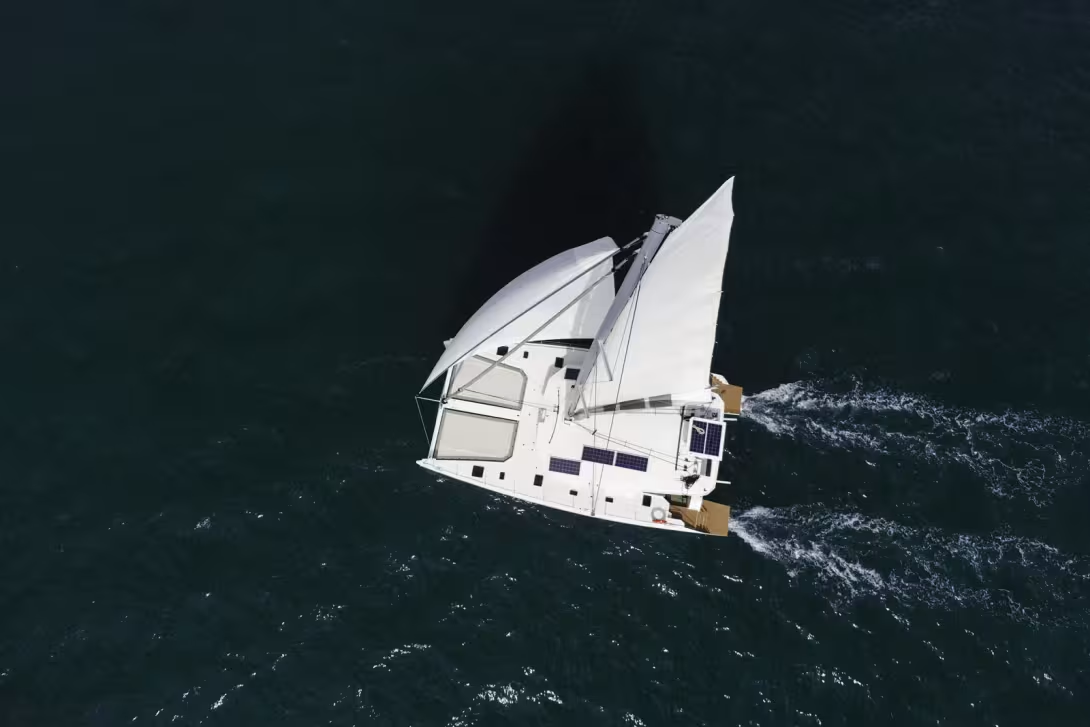
At the slightest breeze, the Andaman 50 quickly establishes a pair of wakes.
Local know-how since 2004
The shipyard has retained a “Made in France” level of know-how; since its creation, the builder has combined Divinycell (a very resilient expanded foam), numerous layers of fiberglass and finally specific perpendicular inserts on all surfaces to prevent any delamination. A commendable precaution even if the adhesion of Divinycell is already excellent. We are therefore dealing with a light, sound and very robust sandwich construction. Kevlar ® fabric has been added on the outside to further strengthen the hulls in the event of a violent impact. Gilles Reigner is constantly innovating his constructions: a Doctor in physics specializing in structural dynamics, he is concerned about perfection and tries to apply it in the best way possible in the boatbuilding field.
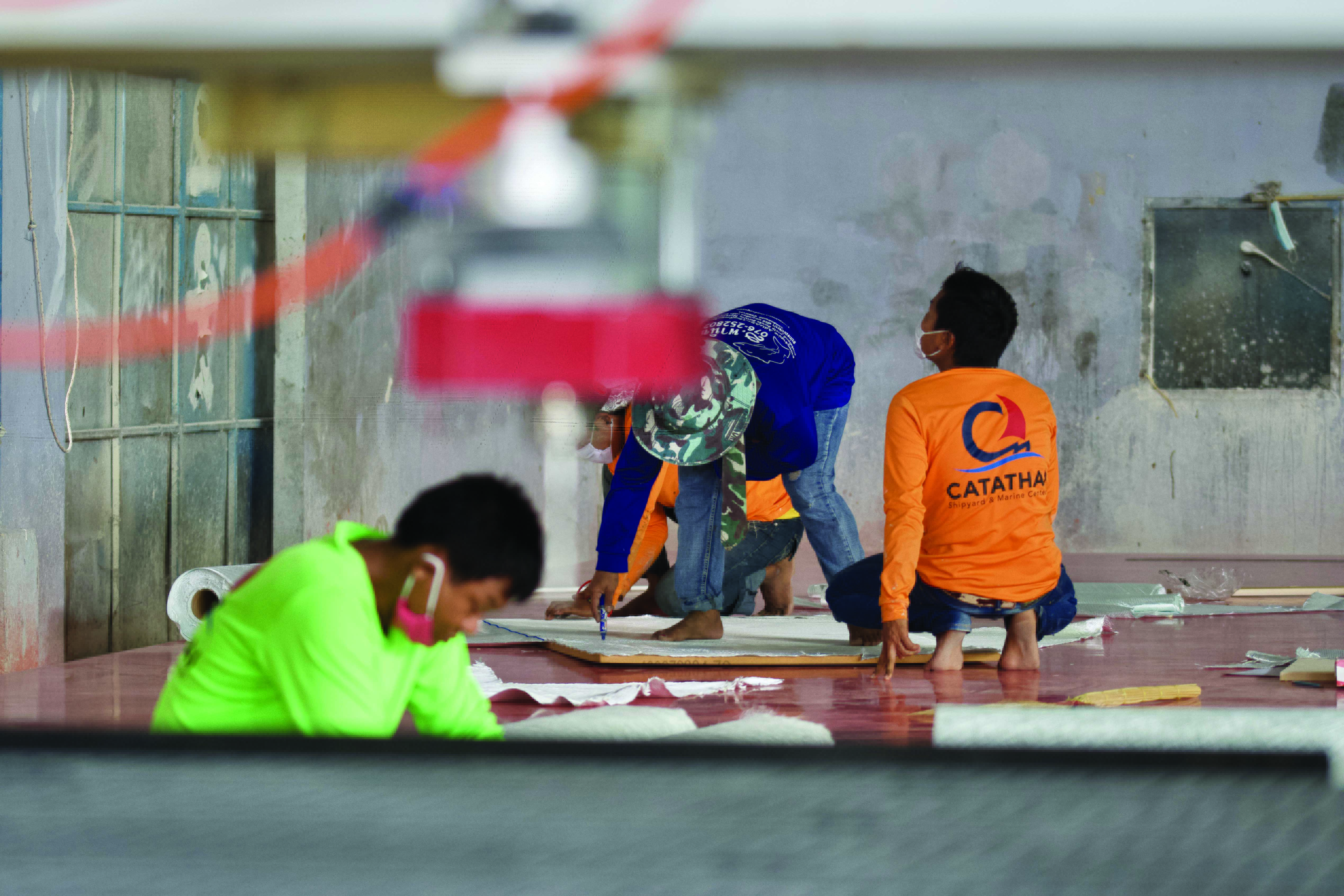
Catathai is a small yard with about 10 employees (with 10 more employees usually working on small motorboats) – and each one is a specialist in their field.
New plans are followed by laser and digital cutting, for optimal precision.
An incredibly light catamaran
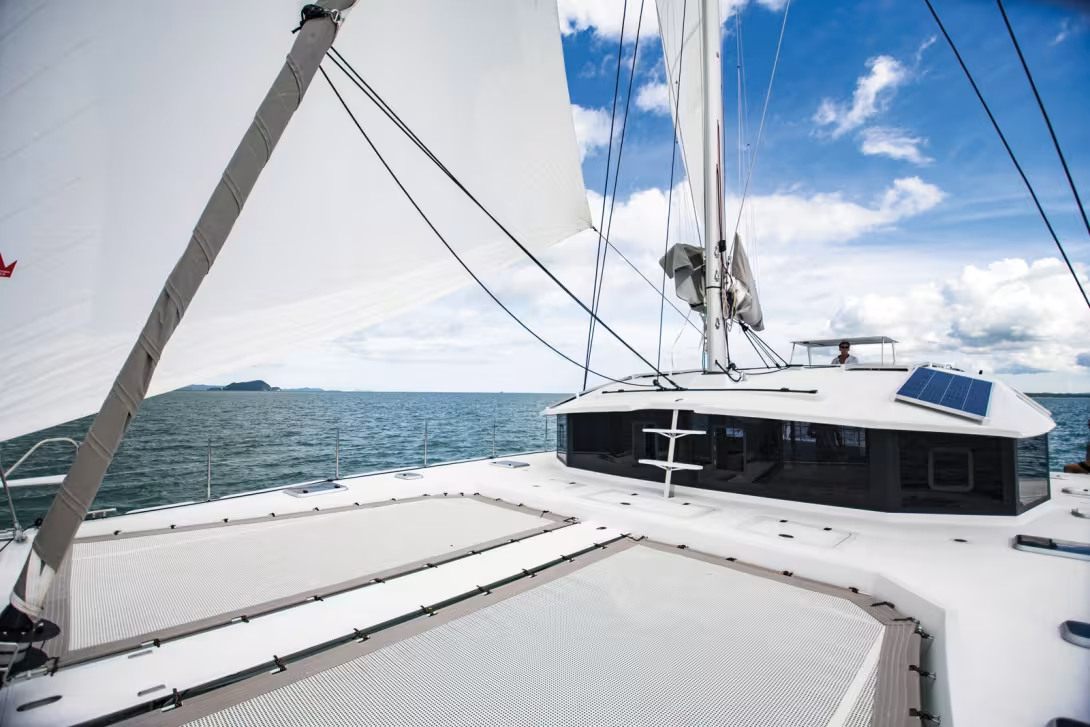
Seen from the dock, the Andaman is very imposing and appears high off the water. However, her lines are harmonious and skillfully combine sharp angles and curves. An obvious coherence emanates from this catamaran. Everything is in its place: the deck is clean and well designed. The trampolines have a large surface area and the bridgedeck clearance under the nacelle - which is very far back - is over three feet (almost one meter). The beam of this catamaran and her rather slender hulls complete the picture of a seaworthy multihull that is unlikely to see any slamming in a rough sea and little pitching. A (very) positive point for the blue water cruising and ocean passage-making. But the main surprise of the Andaman 50 is her featherweight: just 9.5 tons of light displacement! Just to remind you of the displacements of her main competitors: 20.83 t for the Lagoon 50; 20.6 t for the Leopard 50; 16.8 t for the Privilège 510 Signature, 15.7 t for the Saba 50; 13.15 t for the HH50 OC... Ultimately there’s only the TS5, at 8.6 t, which is in the same league.
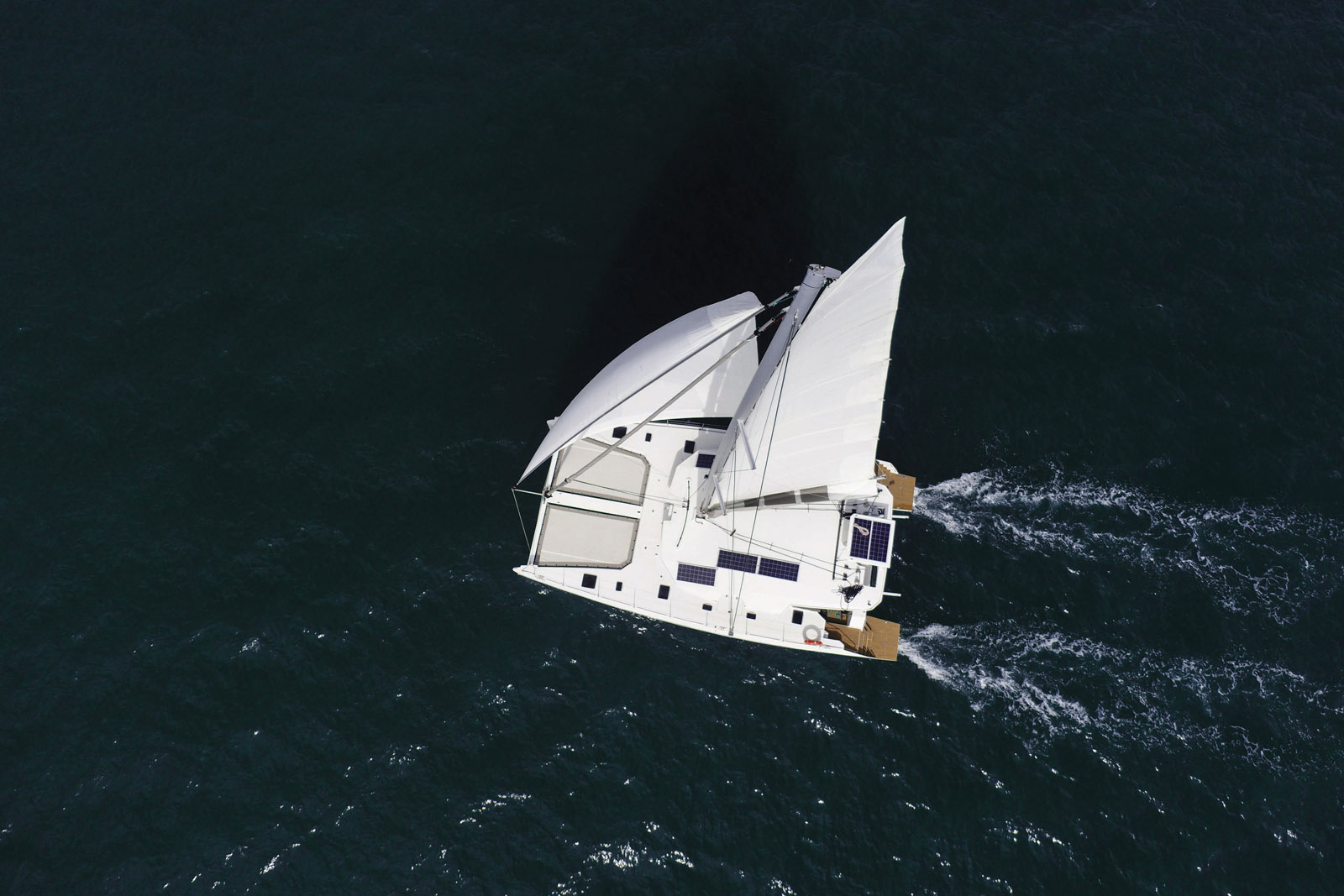
The gennaker is mounted on a furler.
An original and functional deck layout
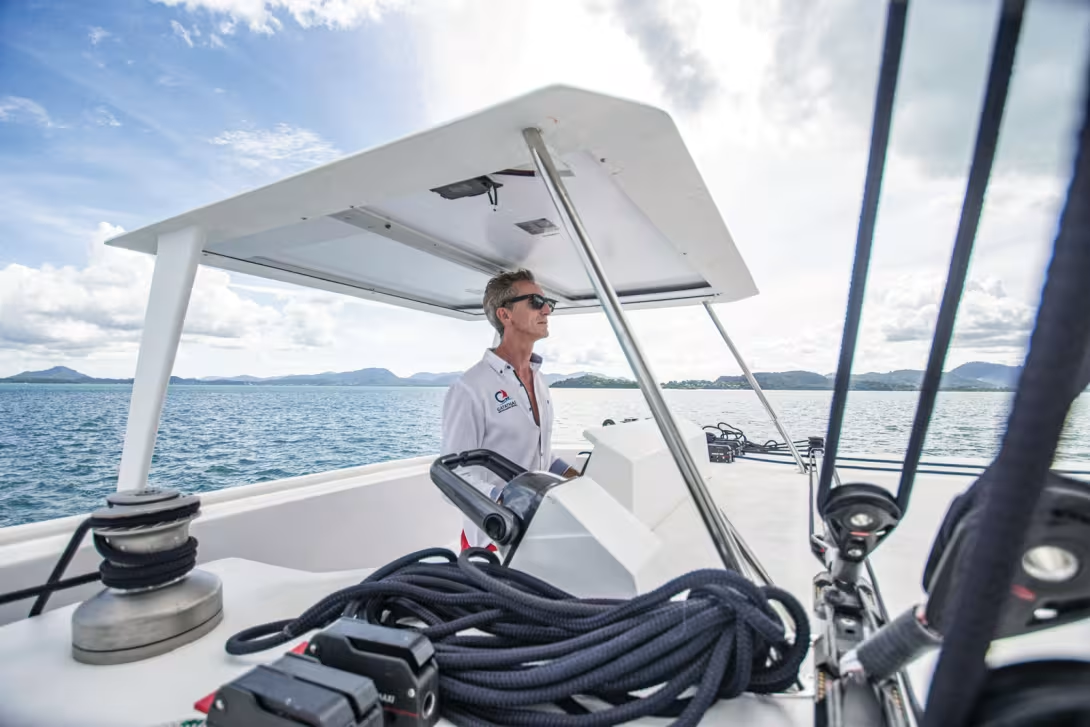
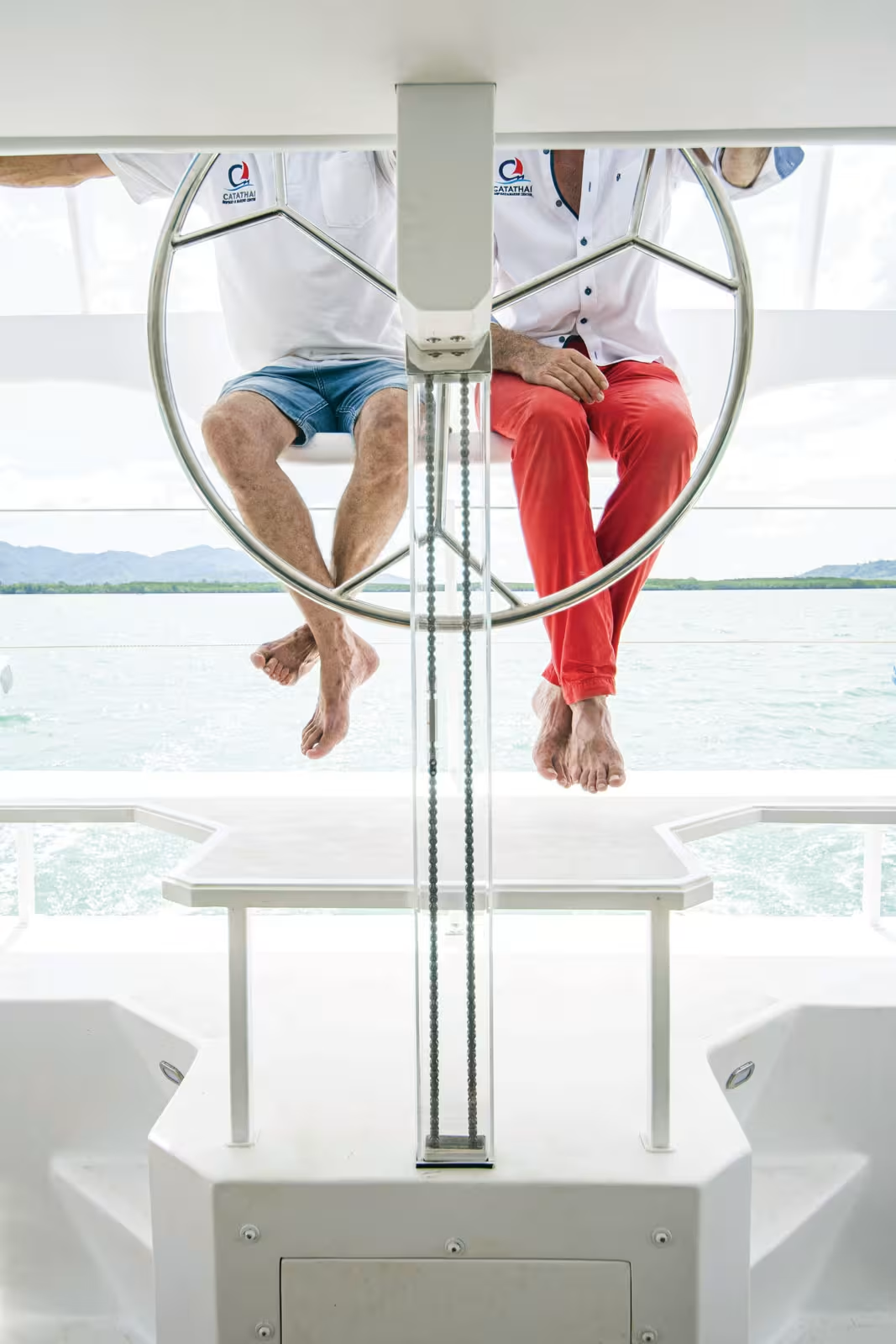
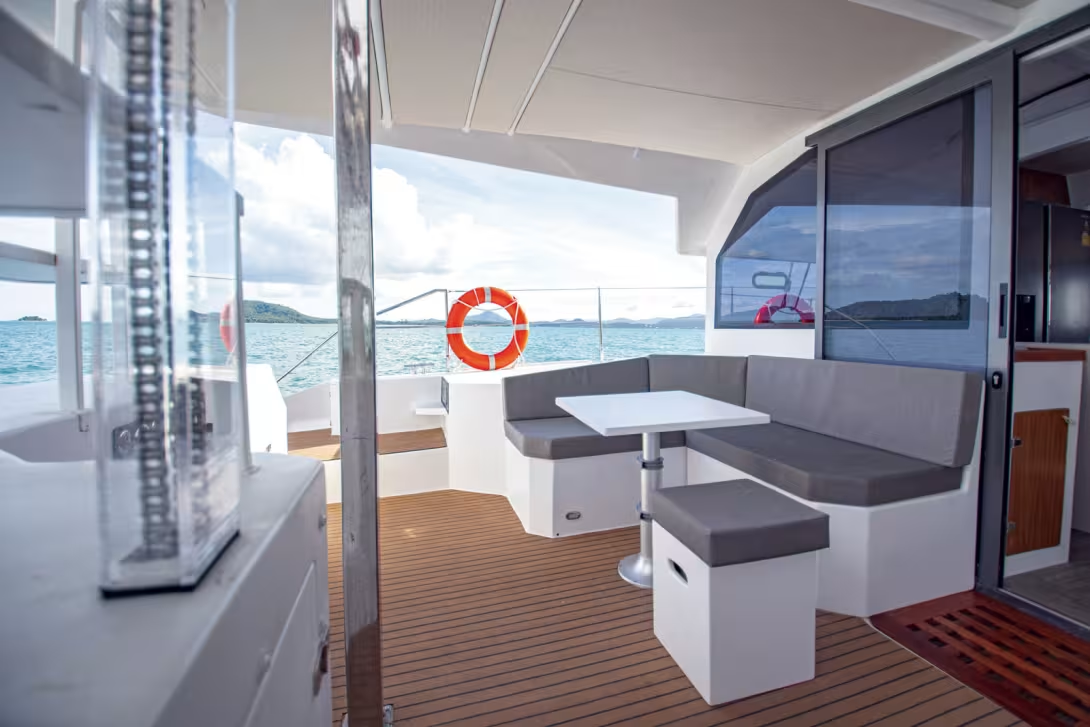
Getting aboard is very easy thanks to the huge sugarscoops. The exterior living space is divided into two small symmetrical lounges. The entrance to the saloon is through a central sliding door. Gilles decided to install the helm station at the very back of the coachroof, centralized and high up. Access is from both sides of the helm. This is an innovative and unusual setup among 50-foot cruising catamarans. All the sails can be hoisted from the cockpit: an electric winch has been added for the mainsail - with its 19 meters of luff, it’s not a lightweight... Another personal touch: the stainless-steel transmission chains of the steering system remain visible. On the forward face of the coachroof, wide steps allow easy access to the mast foot. The Andaman 50 is equipped with two 42 hp Solé diesel engines - a marinized Mitsubishi block. This power is very comfortable for maneuvering. The engines are coupled to propshafts and are placed in the center of the hulls for dynamic balance. Access to the engine compartments is only from the deck, thanks to a lateral recess in the coachroof. The engine rooms are therefore very spacious - given they are the same height as the freeboard, you can stand up in them. As for electrics, this catamaran is well catered for – there’s no risk of running out of power! A few figures: 1,000 Ah of lithium batteries, 1,300 W of solar panels, and all this connected to a Victron Energy Quattro 5000 inverter/charger. Knowing that this new generation of lithium batteries can be almost fully discharged, there’s plenty of power for many years to come!
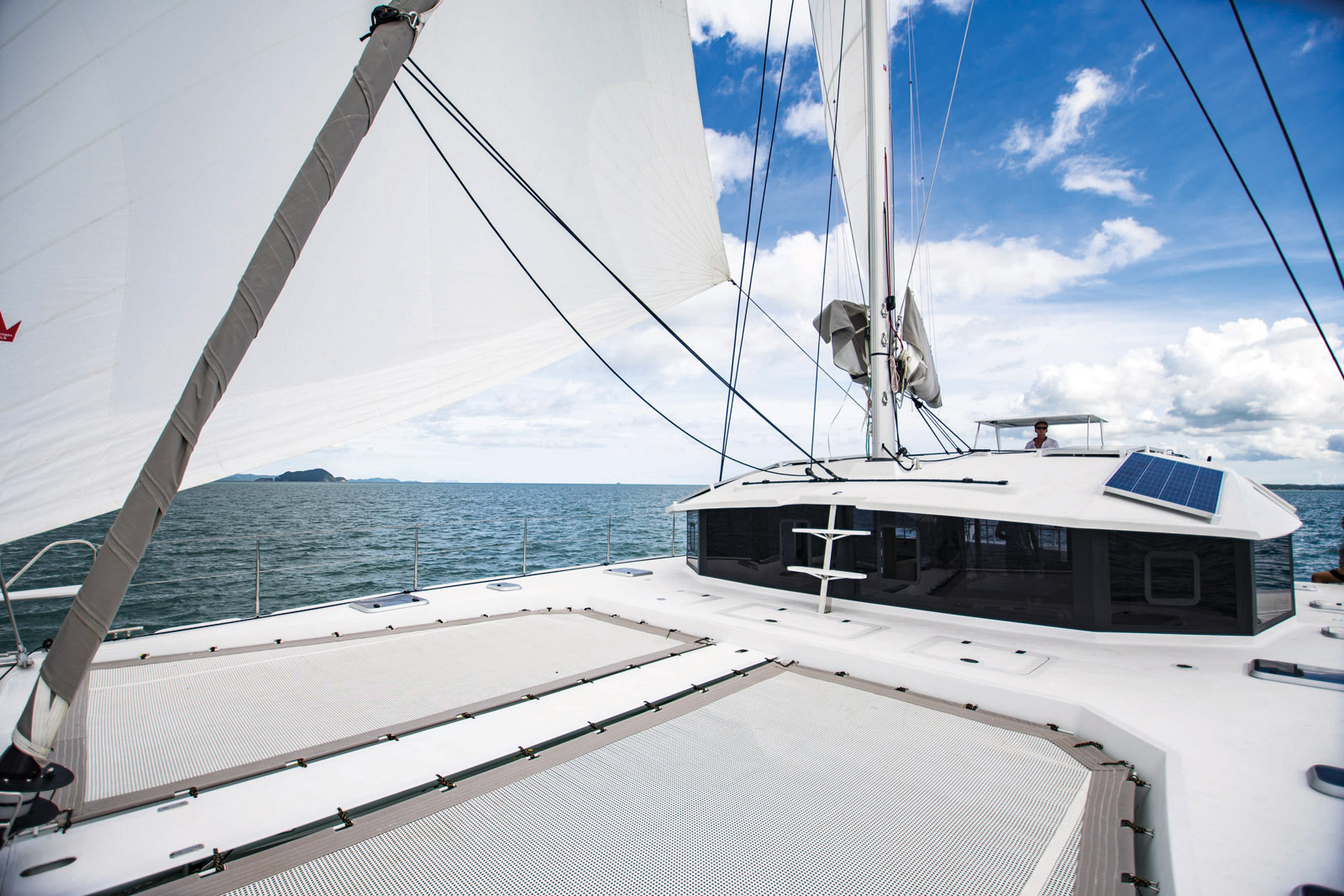
These steps provide easy access to the mast foot.
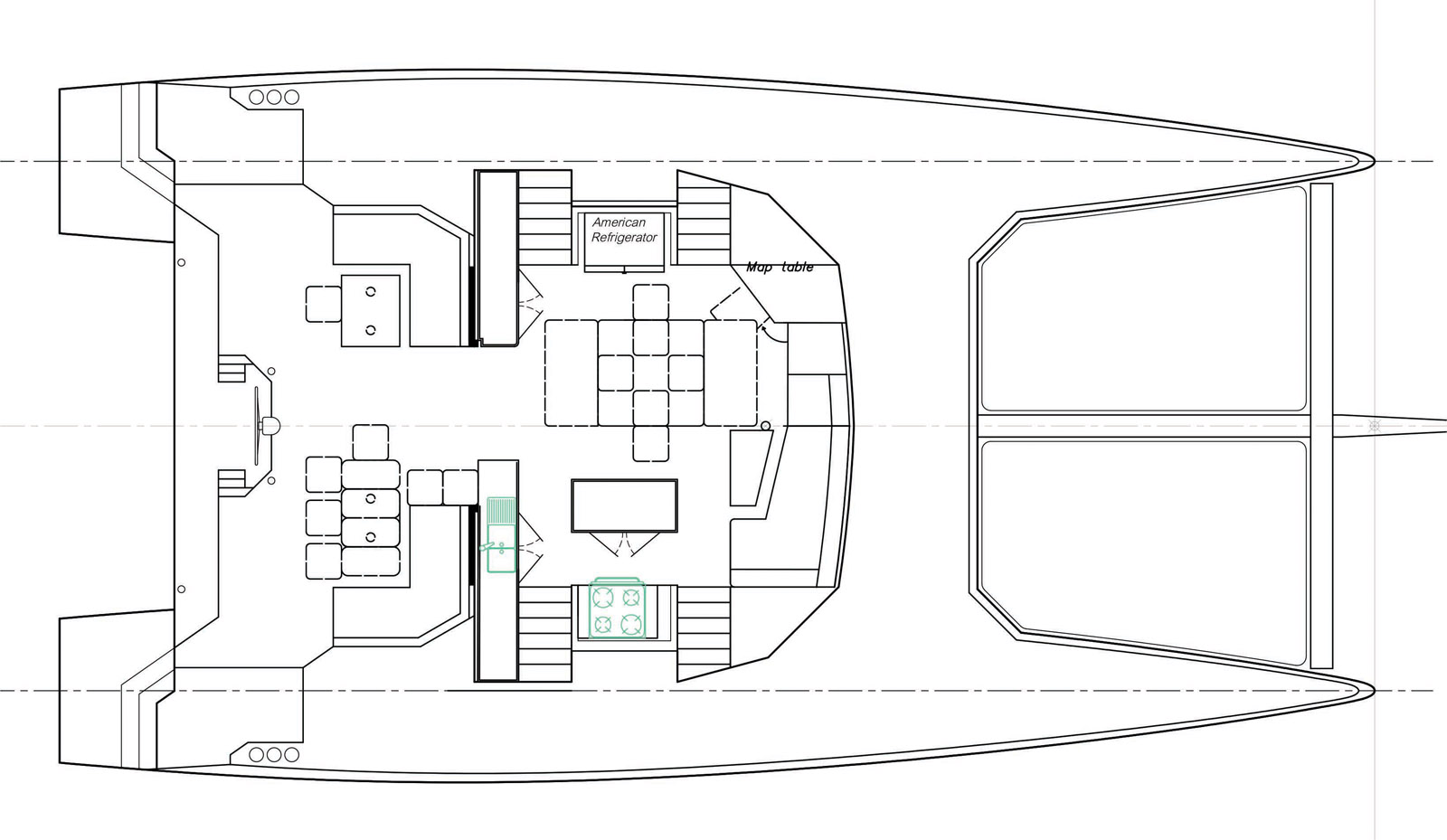
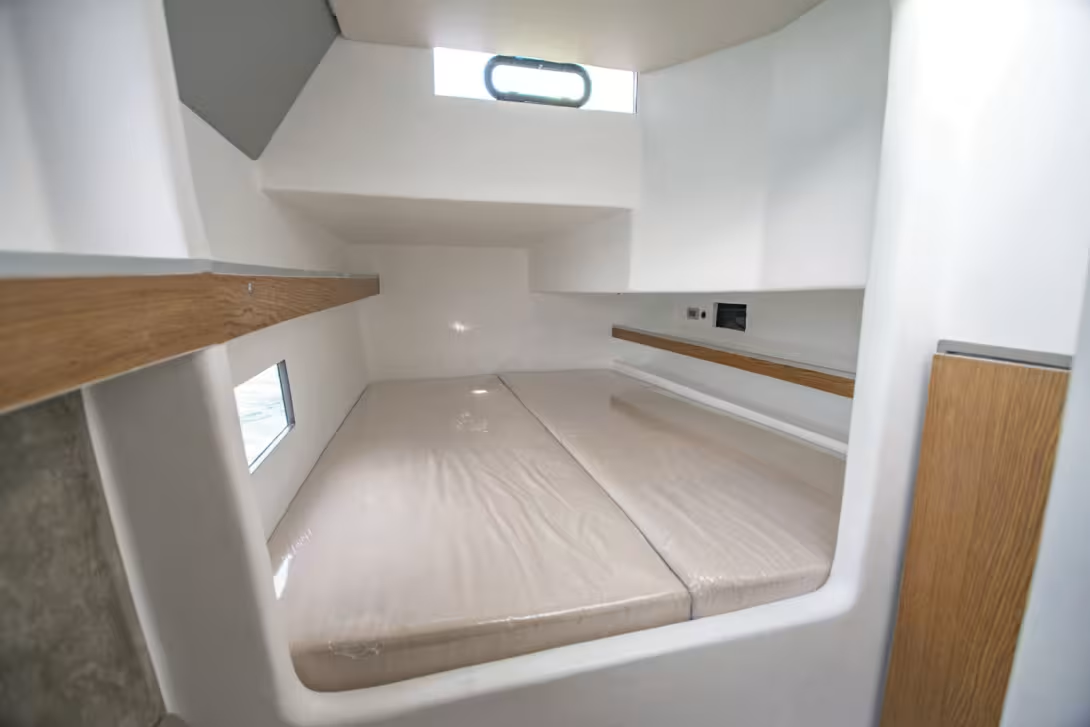
Hulls separated in two The interior saloon is very well thought out; aboard a 50-foot boat, it’s important to offer a sense of space and volume inside the nacelle. Gilles didn’t hesitate to significantly increase the headroom throughout the catamaran - the old Catathais can be a bit limiting for the taller sailor. There are three distinct areas: the galley to starboard; the table, oven and XXL size American refrigerator in the center; and finally the chart table, perfectly placed at the very front, facing forward. If you add in the two cockpit tables, you have theoretical seating for 18 guests, but in three different places – but it would difficult to seat 8 all at the same table (note: the larger cockpit table has a folding panel that brings it to 55”x55” / 140x140 cm). It also has two hidden removable extensions to reach 55”x79” / 140x200 cm). This is not a problem for family crews, but perhaps not ideal in charter configuration. The engines positioned in the center of the hulls lead to there being four companionways - the hulls being split in two by the engine rooms. On board this first Andaman 50 charter version, there are four, almost-identical cabins. The berths are generous: 79”x63” (200 x 160 cm) forward and 87”x67” (220 x 170 cm) aft. As for the bathrooms, there are the same number as there are cabins, and they what I can only describe as integral. That is to say that you enter by the bathroom to reach the bed. It probably sounds strange reading that, but it’s much less so when you’re on board: Gilles has thought a lot about this configuration. In the end, each cabin is decompartmentalized and spacious - the bathroom blends into the décor. You’re probably thinking of the toilets... don’t worry, they are separated and accessible through a second door, parallel to the entrance. The model we tested also included fitted-out forepeaks – a crew cabin with two bunks to starboard and a mini bathroom with another folddown bunk to port.
All the parts and equipment of this catamaran are easily accessible - a good point for maintenance and ease of servicing. As for the stowage space, there is plenty, both in the nacelle and in the cabins.
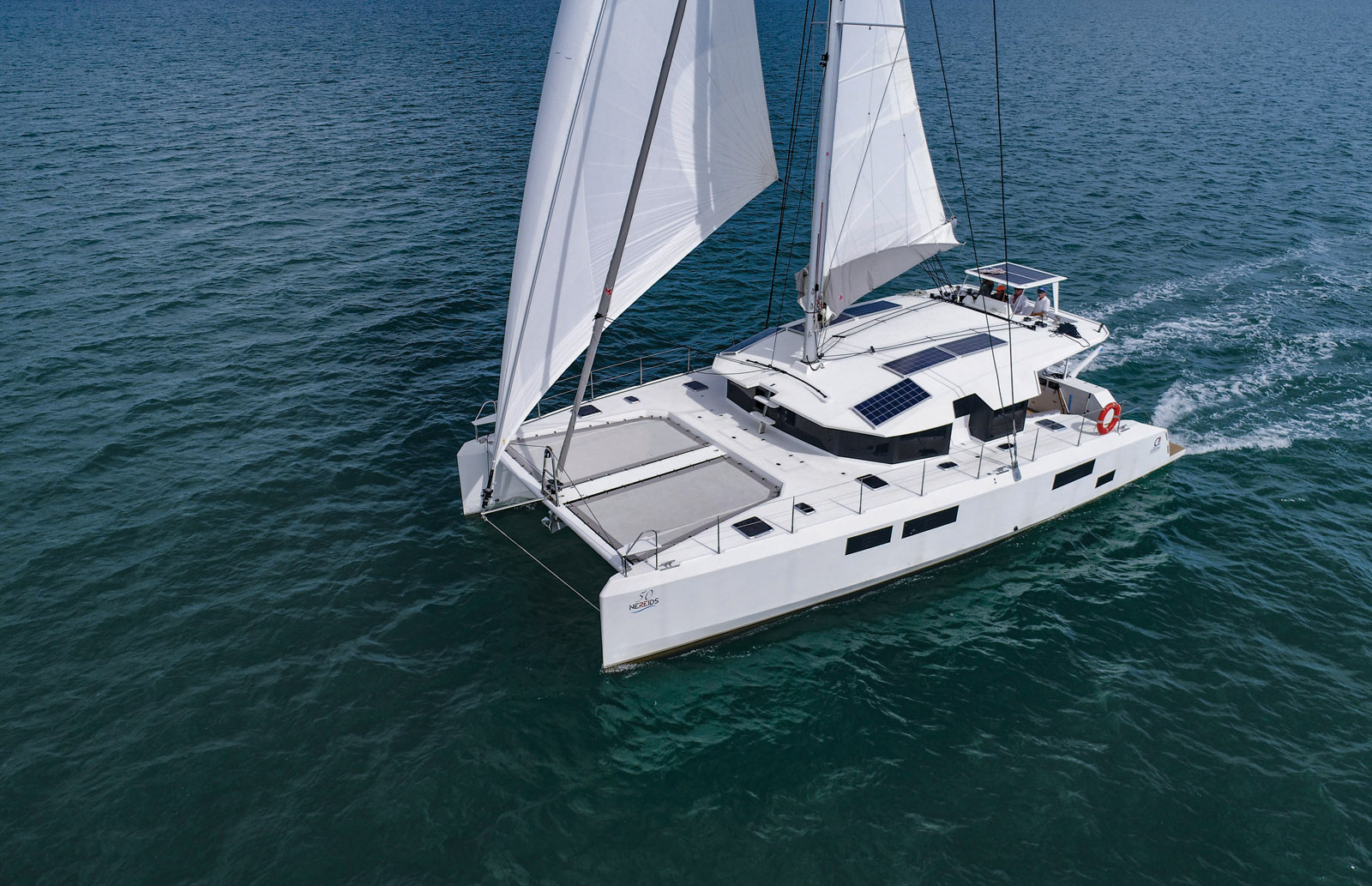
The lateral openings in the coachroof are the accesses to the engine rooms.
Double-digit averages!
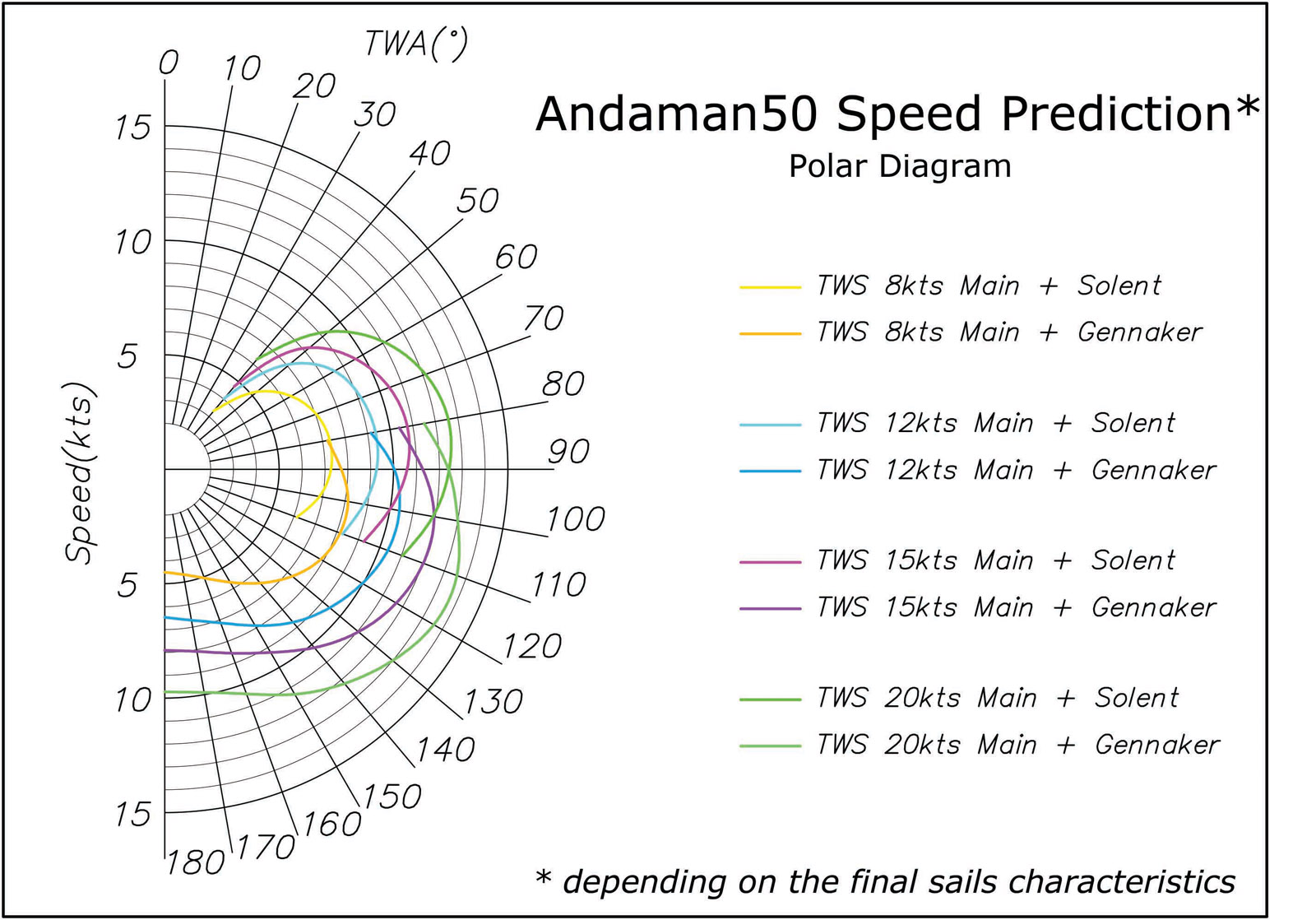
A look at the polars clearly indicates the potential of the Andaman 50: from 12 knots of wind, 10 knots on the water are achieved. Basically, the catamaran designed by Fortabat Yacht Design sails at 60/70% of the windspeed - we are talking about medium conditions, not heavy weather of course! Note that the figures calculated by the architect are based on a slightly less-powerful rig – the Andaman could therefore produce better results. It was time to validate these figures in real life. But the thing is, here in Thailand, winds are often capricious. The notion of established wind does not really exist in these waters. We were under full mainsail and the gennaker (i.e. 2,075 sq ft / 193 m² of sail area), sailing on practically flat seas, with a not terribly consistent 10 knots of wind. Our average was 6.5 knots. The upwind course was good despite the absence of daggerboards (the skeg keels give a draft of 4’9” / 1.45 m, all the same) and we were able to tack through 90°. The self-tacking jib obviously simplifies the process. The same goes for the furling gennaker - it can be unfurled in moments, and also left in place. No need to stow it in a sailbag and store it below or on deck. At the slightest lift in the breeze, you can feel the acceleration immediately - just make sure you don’t fall over backwards! The helmsman is positioned aft and quite high, with excellent visibility on the water - and the Andaman 50 looks very big! The overall impression that comes from sailing is the ease of maneuverability and handling. The light displacement and the good feel from the helm – almost a little fiery - contribute to being a real pleasure on the water. The Andaman is just waiting to swallow up the miles!
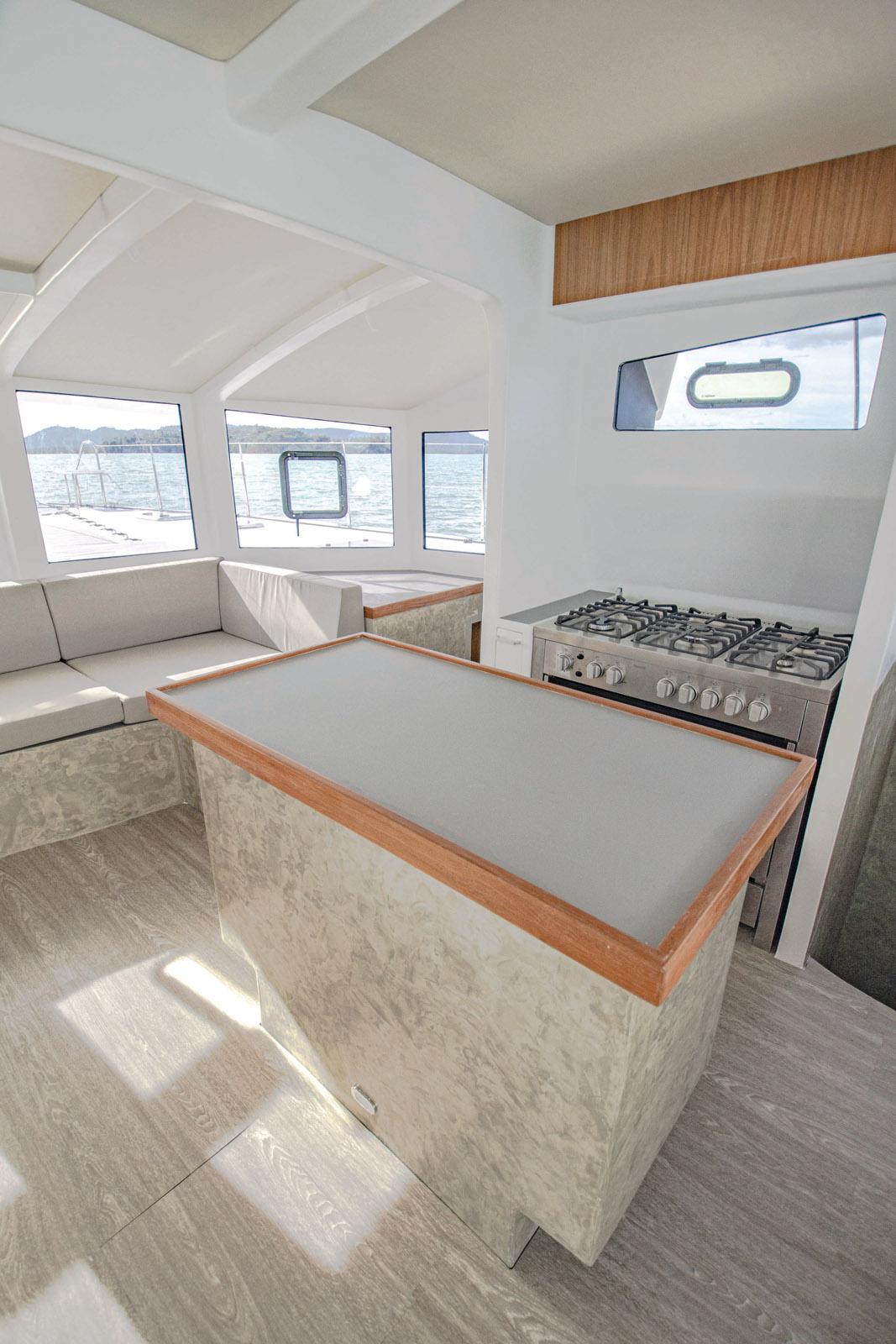
The saloon houses a central island; to starboard, the stove is installed between the two companionways.
Conclusion
Catathai has a new look for 2020. They’ve moved a long way from the old design of the 40 or 50, built a decade ago. Gilles Reigner has managed to maintain the reputation of the yard while creating a new modern image. The Andaman 50 is jumping into the very competitive market of 50-foot cruising catamarans, inviting herself to join in, like a dog at a game of skittles! In this category, some models are at the over-$1 million mark (before tax) and very few are in the 600,000 range – the Lagoon 50 excepted. With a starting price of € 525,000 (approx. US$ 620,000), the Andaman 50 has therefore some serious arguments to put forward. She obviously benefits, like with other multihull builders, most often top of the range, from the low labor costs on the Asian continent. But this is not a discount product: we are dealing with a functional, fast and tailor-made multihull. The rig is none other than a Z-Spars, Ronstan for the deck hardware, and Andersen winches. The sails are signed by Elvstrøm, and the very complete electronics are provided by Raymarine.
But what about the build quality? With this attractive price, some will look for defects, of course! The answer is that the Andaman 50 is very well built; her structure is perfect and the materials used are sound and very resilient. Personally, knowing this type of construction well, I can guarantee that Divinycell sandwich does not move over time.
The Pluses
+ Flattering performance
+ Very well-placed price
+ Interesting and convincing innovations
The Minuses
- No large table in the saloon to seat a big crew all together
- Access to the berths
- As yet, systems not fully validated in long-term blue water cruising
TECHNICAL SPECIFICATIONS
Builder: Catathai Boats
Naval architect: Fortabat Yacht Design
Construction: Divinycell foam 80 kg/m3 vinylester sandwich + Kevlar ®.
Overall length: 53’10” (16.40 m)
Waterline length: 50’ (15.25 m)
Beam: 26’7” (8.10 m)
Draft: 4’9” (1.45 m)
Light displacement: 20,950 lbs (9.5 t)
Mainsail: 945 sq ft (88 m²)
Solent: 665 sq ft (62 m²)
Self-tacking jib: 450 sq ft (42 m²)
Code 0: 1,130 sq ft (105 m²)
Mast height: 65’7” (20 m)
Engine Power: 2 x 42 hp Solé Diesel
Transmission: propeller shaft
Fuel capacity: 2 x 10⁵ US gal (2 x 400 l)
Water: 4 x 66 US gal (4 x 250 l)
Price Owner’s version 3 cabins: € 521,000 ex-tax
Price 4-cabin charter version: € 525,000 ex-tax