
In 2009, the Lipari 41 took the place of the Lavezzi, condemned by its canvas bimini and mainsheet traveler in the cockpit. An effective restyling in 2013 extended the career of this popular catamaran (nearly 200 were built), but the arrival of the new style (with the Helia 44) sounded the death knell of this previous generation. Between the future Lucia and Helia, the Lipari was no match, especially in terms of the interior design. The Astrea 42 now occupies a pivotal place within a completely renewed range from going from 40 to 67 feet. Has the builder’s flagship yard at Aigrefeuille hit the bull’s eye?
Infos pratiques
- Le chantier : Astrea 42
- La fiche technique
-
 Découvrez notre vidéo exclusive
- Financez votre Astrea 42
- Assuez votre Astrea 42
- Articles autour du Astrea 42
A new boat put into perspective
It’s easy to praise the exterior design of the Astrea because the Berret-Racoupeau design team seems to have pulled out all the stops to achieve their goal: to make a desirable new 42’ catamaran! In terms of architecture, modern catamarans were first inspired by their ancestors in the Pacific before conquering a form of British-inspired western independence. In the 1980s, France, the new "Multihull melting pot" really fired things up, breathing life into the emerging world of multihull racing taking foreign influences and propelling more modern, faster and trendier catamarans onto the market than their counterparts across the Channel.
In recent years, layout and interior design issues have become the main concern for most builders: accompanying (or preceding) new uses: chartering / leasing, or customers with their own vision of "yachting". The style of "bodywork" is now a new issue. Builders need to show imagination and know-how to adapt hydrodynamics and rigs to these new and sometimes contradictory requirements... So, has the Astrea managed this tour de force?
A silhouette in keeping with the times
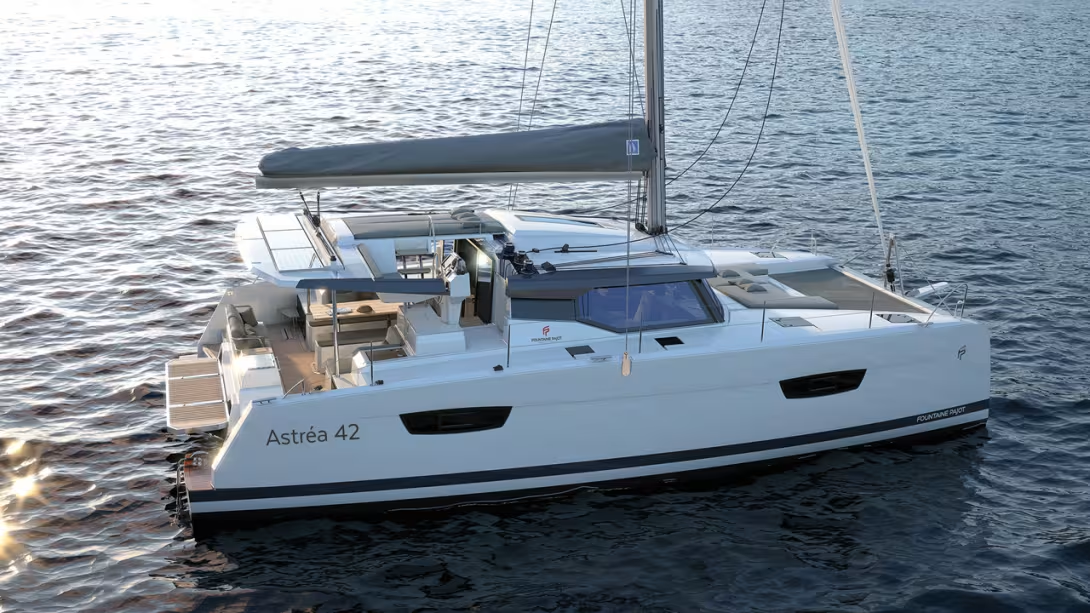
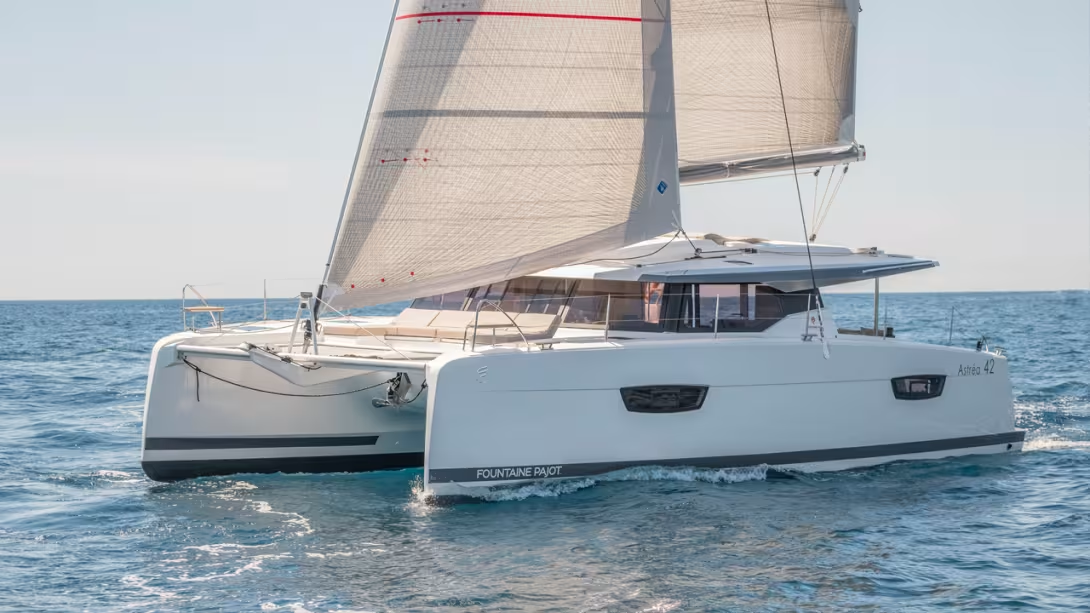
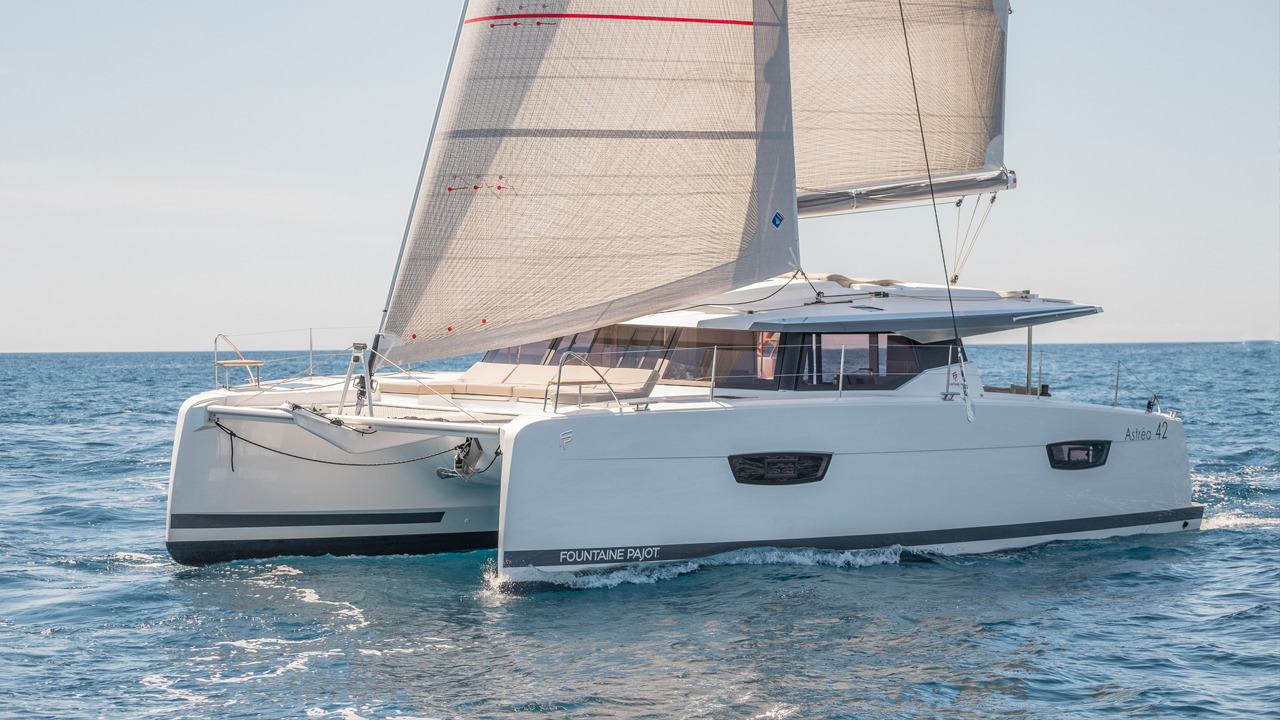
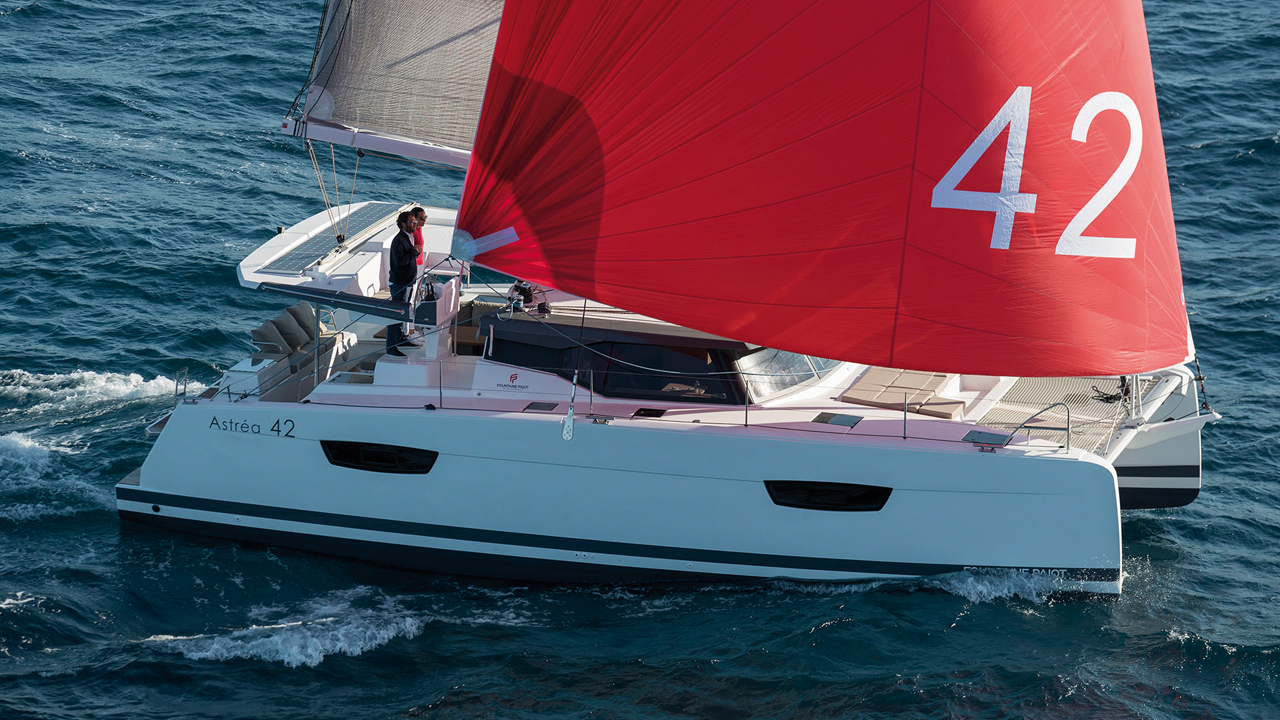
Whether they work with styling software or not, the new recipes from design firms all work rather well! On the Astrea, the delicate ratio of coachroof-hull proportions is sound. A discreet rib at the upper third of the topsides, rounded bows, a slight curvature of the deck-edge, and the creative portlight design should allow the hulls to assert a contemporary style that will last for years. The side sunshades of the anthracite gray roof, the uprights, the black windshield frames and the choice of a dark-tinted polycarbonate significantly enhance the appearance of the deck saloon, an element of design which is always delicate on a catamaran. The care given to blending it with the deck also contributes to the result. The only downside is that the roof’s “peak” does not appear to provide much cover, and the angle of attack of the windshield, expose the interior to UV. The gooseneck setup remains elegant despite the height under the boom required for the sunbathing area (and the helm position bimini option!). The helm-station (without the famous additional head cover, which is useful but not very sexy!) is perfectly integrated into the overall lines. The indispensable forward cockpit looks good, the bimini remains fluid and the new aft cockpit layout (equipped with upholstery developed with supplier Serge Ferrari) plays a part in the boat’s overall attractiveness.
Well-mastered construction
The glass/balsa/polyester sandwich of the hulls and the underside of the nacelle is produced in an infusion process (with careful preparation of the composite in the female mold before evacuation and suction of the resin via a drained network allowing diffusion-impregnation of the polyester and an optimal cloth-resin ratio). The end-grain balsa is retained for its numerous advantages: it is a renewable resource endowed with excellent mechanical qualities and adhesiveness. Both the deck and the coachroof come from injection molding molds on PET foam (Airex). These manually prepared parts are produced in a single operation: the composite is put under a high pressure resin transfer molding (RTM) machine. This is exclusive to Fountaine Pajot, and is a two-sided, high-pressure tool (a bit like a waffle machine!). All in all, it is a high-tech production method, creating perfect parts which require no retouching.
A Guided tour of a 42 footer... which seems much bigger!
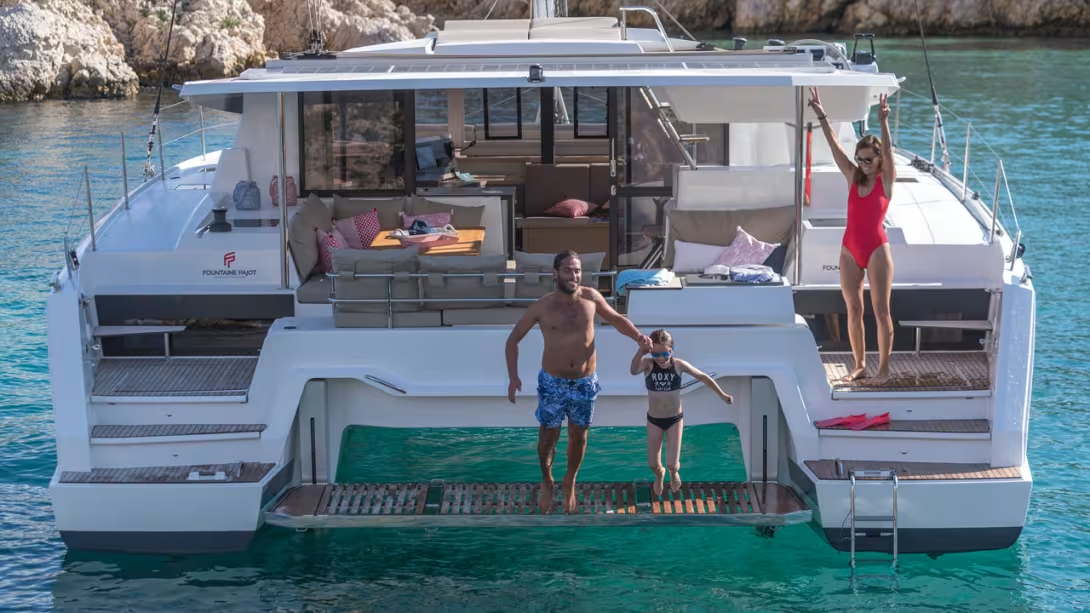
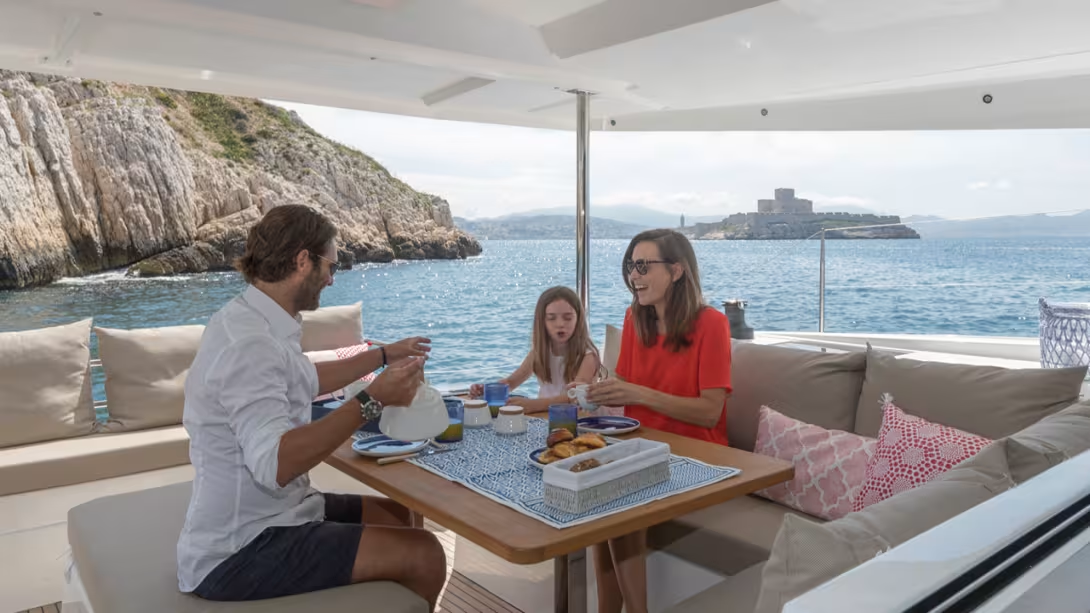
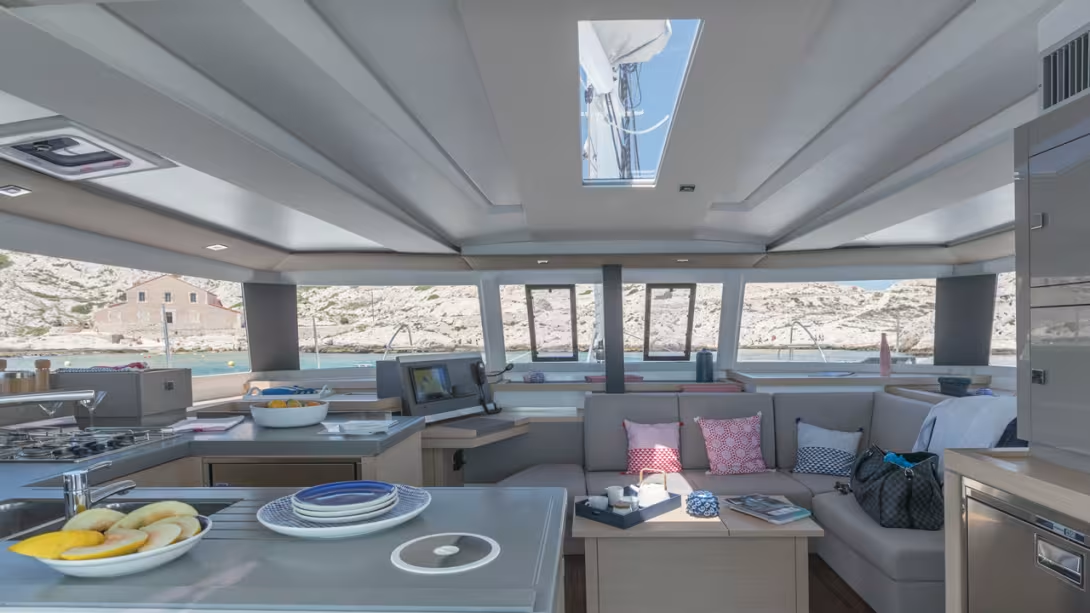
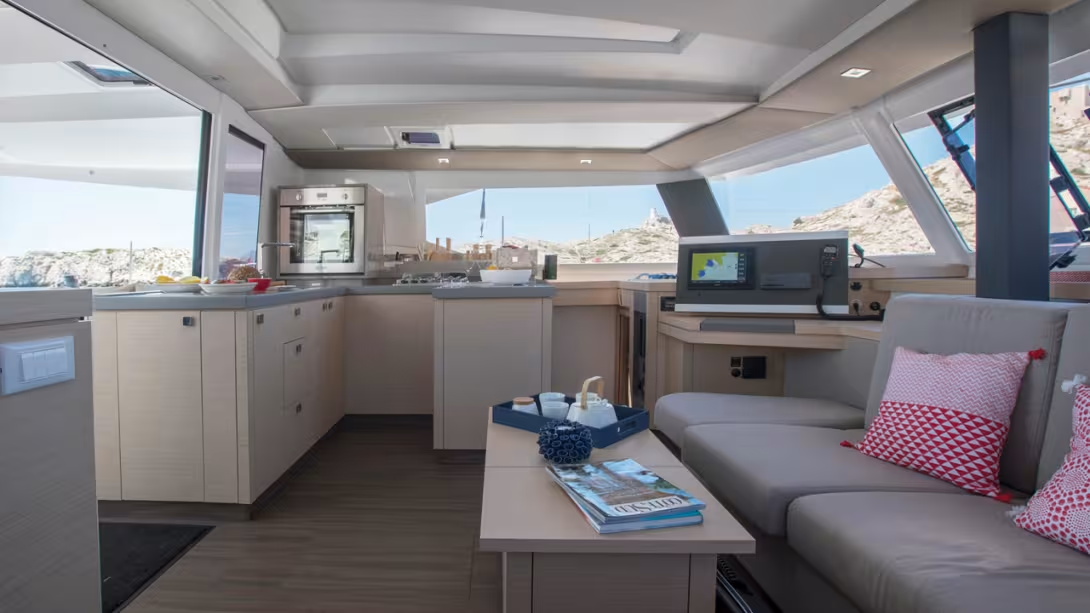
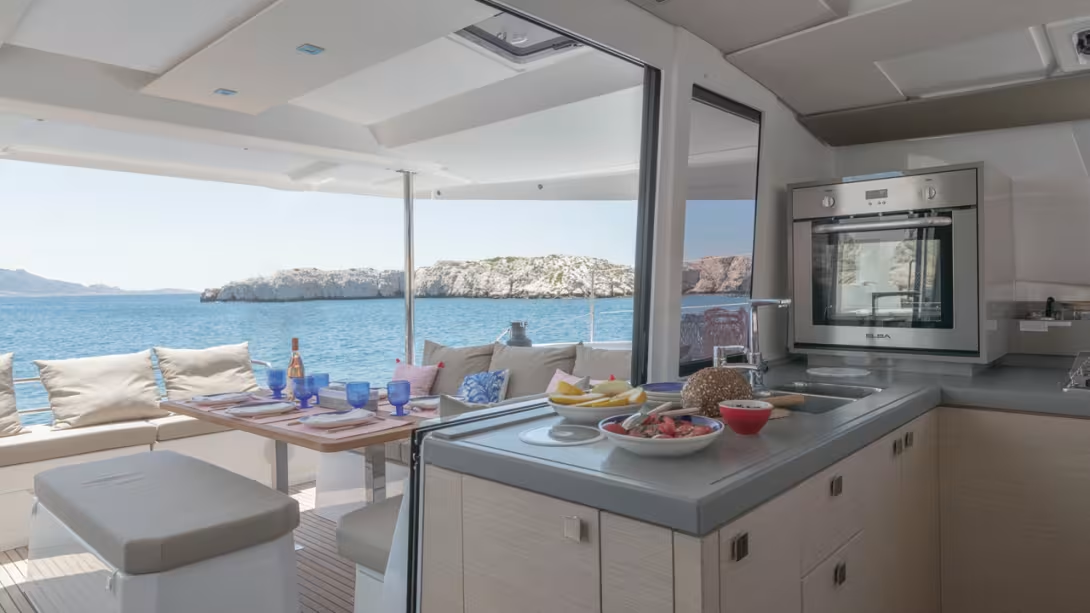
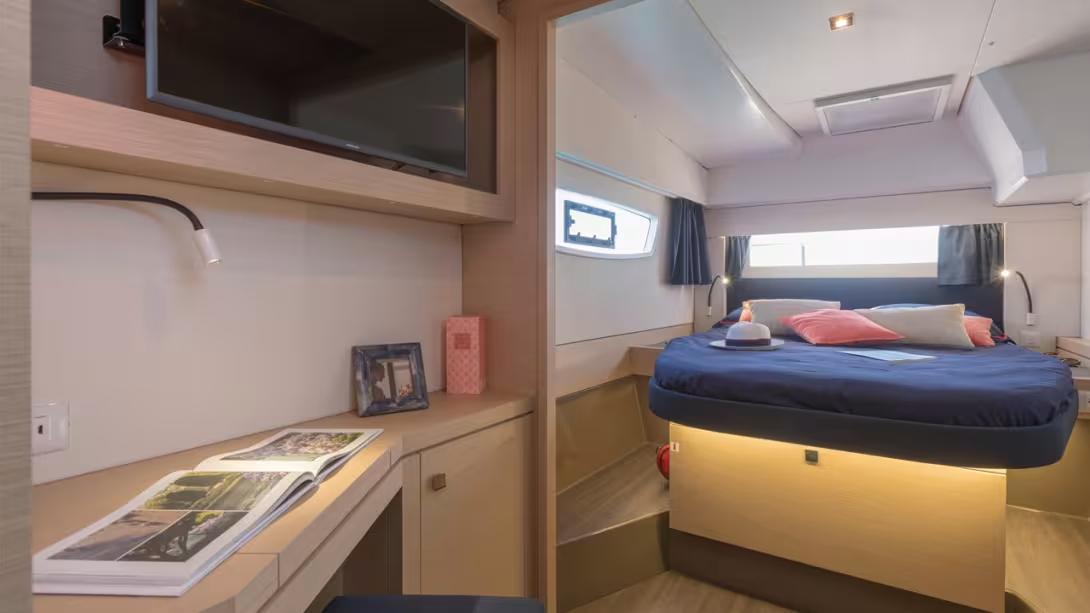
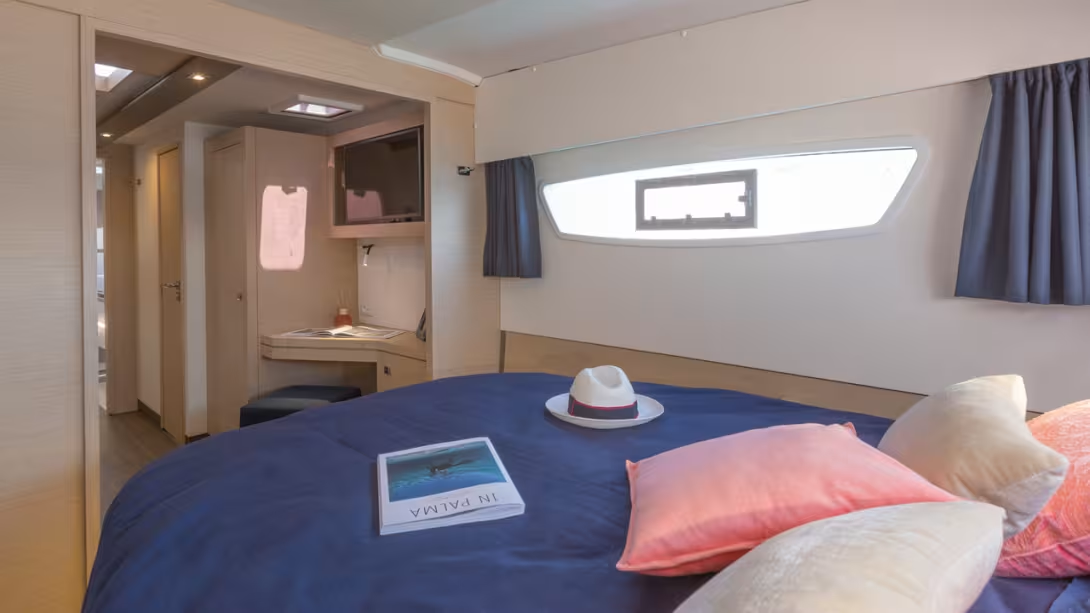
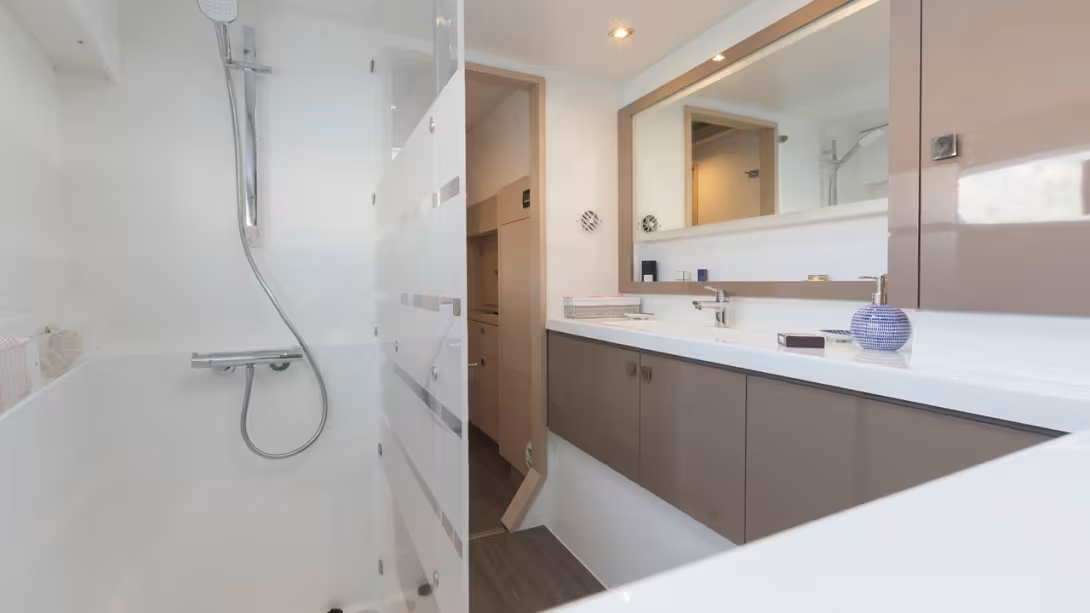
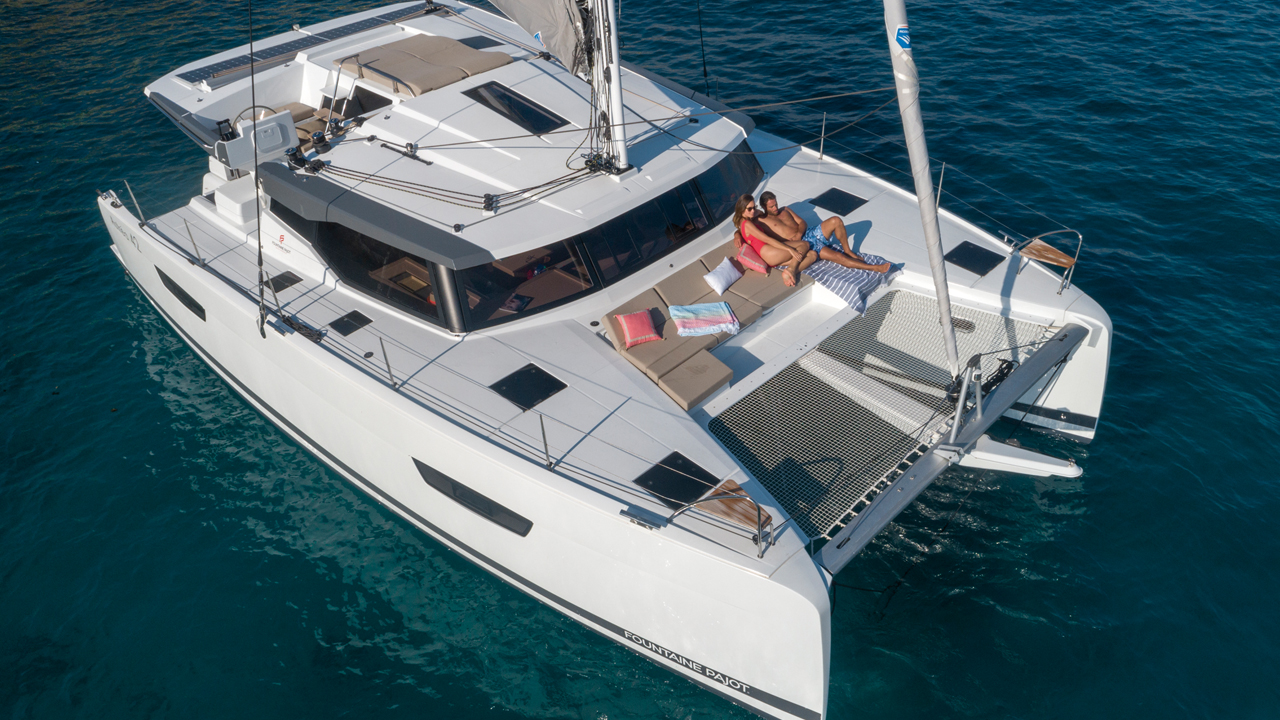
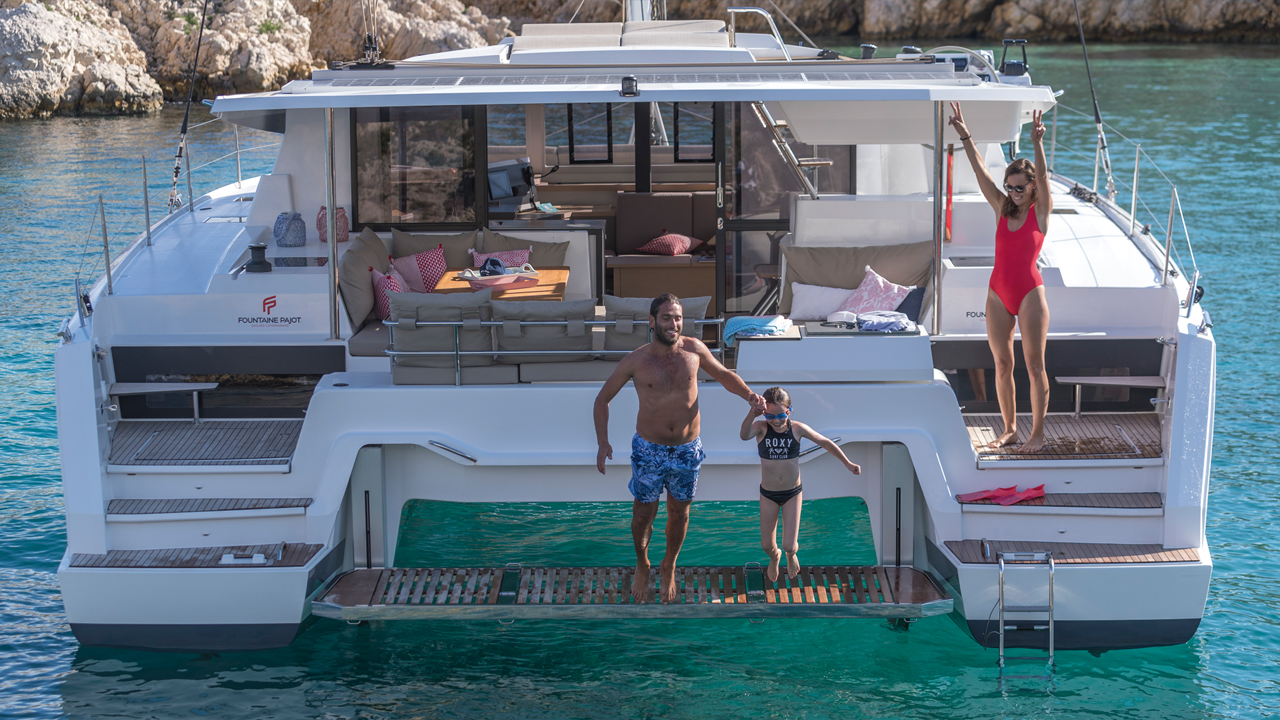
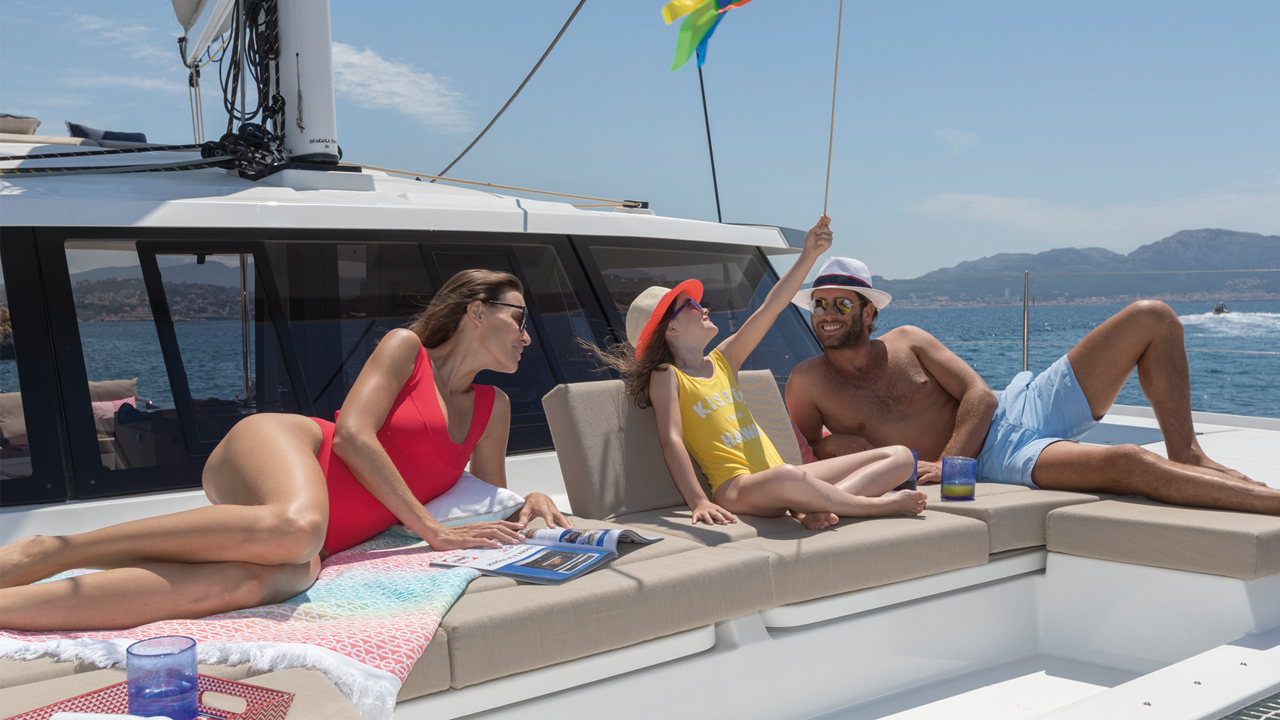
Aft bench seats, a lounger in the cockpit and outdoor dining are the essential attributes of this contemporary catamaran. Fountaine Pajot are showing off their maturity and style with their philosophy of the interactions between the multiple on-board activities. Access to the water is neat with a nice rear deck and a solid and deep swimming ladder (the optional electric platform could be justified for some programs, but it is expensive and adds significant weight, so the traditional davits remain very relevant). Access to the helm-station is easy and the watchkeeper’s seat is really comfortable and very reassuring in a choppy sea. The large sundeck on top of the coachroof is attractive in good weather; and with the forward lounge area and cockpit, it offers a full range of outdoor solutions! With this new range, Fountaine Pajot has deliberately detached itself from the “traditional” style of layout, and has gone for a marine take on "Urban chic" and has been doing so since 2012. With the Helia, light begins to cross the boat, the austere gelcoated surfaces have largely been done away with, the contrast of materials enhances the atmosphere, making it more luxurious, and the owner’s cabins are more welcoming. The Astrea continues this trend in which outdoor spaces meet the expectations of a hedonistic customer, rather than marine customer. Both crew and guests will appreciate it. The upholstery is quite revolutionary in its abandoning of straight ergonomic cuts. Springy cushions are becoming widespread, but this abundance will require more attention to be paid when it comes to the maintenance! The bathroom is also one of the new spaces the interior designers have conquered, and on the Astrea, they are almost unimaginable aboard a 42 footer! She is beautiful, practical and absolutely functional.
Engine compartments
Here, the Astraea really does well! Despite the battery bank being located in the starboard engine compartment, the accessibility of everything mechanical, the visibility of the essential verification points (coolant level, water filter, saildrive) is very good. A welded aluminum bracket bolted to the watertight bulkhead supports the upper bearing of the rudder tube, the quadrant arm, the autopilot ram and the transmission cables for the steering. All these features seem resistant, well-dimensioned and remain accessible without requiring contortions or disassembly. A glance in the engine compartment allows quick and frequent checks that prevent future worries. 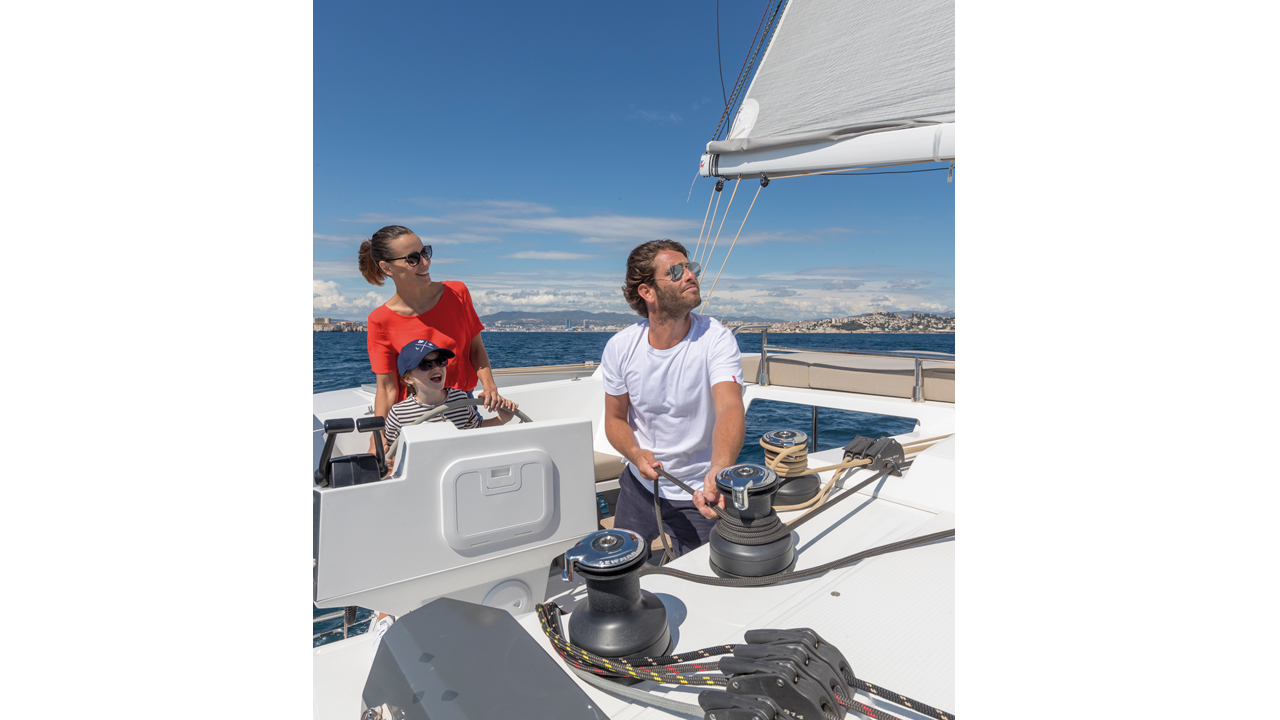
Seatrial
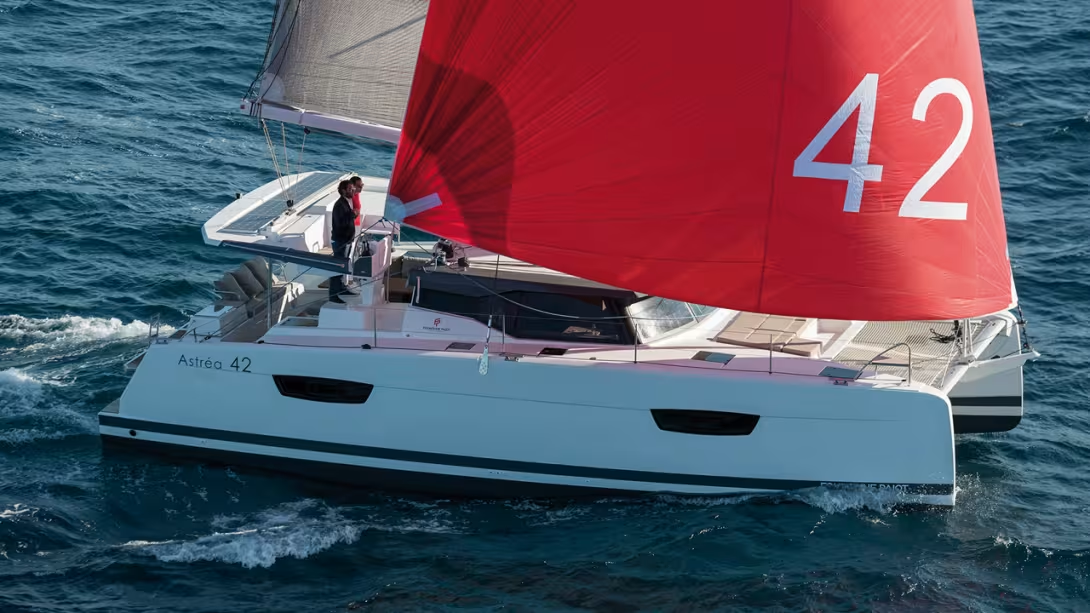
I had the opportunity to discover our model following the end of the International Multihull Show at La Grande Motte in the South of France. It was a luxuriously refurbished demonstration model (carbon mast, fiber rigging, membrane sails by Incidences Sails), but the electric platform, generator and air conditioning options on this boat don’t make it the lightest Astrea! We had few hours at sea to familiarize ourselves with the boat, but the conditions were too light to bother making a second trip. So the next opportunity came in Marseille at the end of June. We had plenty of fuel and water tanks 50% full, perfect for a test in real conditions. The carbon mast provides a better mechanical response and reduced weight up high, and the fiber rigging reduces cable inertia and whip movement which can be so harmful to stainless steel swages. On the day of our test (1.50m of westerly swell), this argument rang true. Leaving from Le Vieux Port (the dealer from Midi-Nautisme welcomed us and accompanied us on his home waters), we encountered a rough sea which had shifted relative to the axis of the wind (in fact a head sea), a leftover from strong northwesterlies. The area between Frioul, Planier and the tower of the Château d'If is a real water sports stadium that offers 25-30 miles of varied and invigorating sea and wind conditions which were the best of the week in Marseille. The westerly wind was well established around 15 knots true, and our perfectly dimensioned membrane made the most of this, proving itself to be the ideal material, with the genoa clew just flush with the coachroof, giving the illusion of a downward effect... and perfect for excellent cruising upwind. There is genuine support on the water, and the boat picks up within the first few lengths with conviction. Close-hauled at more than 8 knots average reveals the platform’s good balance and pleasant movement despite the relatively high speed for a cruising catamaran (especially one with a generator in the trunk)! Further offshore, the sea was still building and from the bows, I could see how easily the hulls were passing through the water in this big chop: pretty astounding! The first time we sailed the boat in the Baie d’Aigues Mortes, I felt the agility of this 42 footer, but here it was confirmed! With a minimum of effort we were doing between 8 and 9 knots, which was not bad at all! Later under screecher (a gennaker in spinnaker cloth) in a slightly gentler breeze, we bore away to 140° off the wind which was between 8 and 9 knots, sometimes, 10 and instruments reported a peak at 12.1 knots that honestly I did not feel (the comfort in the galley during lunch was misleading!). The autopilot did sterling work in a well-formed sea, a sign that the effort that went into hydrodynamics had borne fruit. Despite these very positive results on the water, there is still the small regret of not accelerating more downwind, but we have to put all this in the context of a very comfortable boat that hides some of the sensation of speed, whilst remaining very real. Sliding across the water will occur later downwind in a bigger breeze, no doubt.
Conclusion
A beautiful cruising machine which is comfortable and accessible (technically)! The relationship between ease of handling, maneuverability in congested marinas and (interior-exterior) benefits is remarkable. Stealthy enough to slip into a small Greek port; agile and seaworthy enough to create long wild blue wakes or taking a quiet trip on the coast, the Astrea is a multihull full of qualities. I appreciated its dynamic qualities and think the owners who have the wisdom not to overload it will enjoy a catamaran which easy to live on and to set off on (subject to the budget of course!).
Technical specifications
Architect and designer: Cabinet Berret-Racoupeau
Builder: Fountaine-Pajot
Construction: Balsa / glass / anti-osmosis polyester resin
Length: 12.58m
Beam: 7.20m
Draft: 1.25m
Light displacement: 11,580kg
Maximum displacement: 15,600kg
Mainsail area: 66m²
Genoa: 40m²
Water: 2x350l
Fuel: 1x470l
Motors: 2x30hp (2x40hp option)
Transmission: Saildrive
Price ex-tax: € 345,000 in 3-cabin Maestro version (€349,000 in Quatuor version)
Price ex-tax of the boat we tested: € 480,000
Principal options in Euros ex-tax
40hp motors + three-bladed folding propellers: 3,902
Carpeting in the cabins: 1,162
Outdoor grill: 2,233
Garmin 1electronics pack with autopilot: 13,000
Oven: 1,613
5kg-load washing machine: 1,841
400W solar panels: 4,246
Gennaker + deck hardware and bowsprit: 11,066
Electric genoa sheet winch: 2,827
Carbon mast: 60,314
Antifouling on epoxy primer: 2,884
Commissioning and training: 13,600
We liked
- The overall lines
- Agility on the water
- The outdoor spaces and the interior layout
- Effective reefing system
We didn’t like so much
- The system for securing the exterior upholstery
- The lifting platform (optional, but heavy and expensive)
- The aesthetics of the bowsprit
- Lack of clutches for the genoa sheets
The Astrea 42, by Isabelle Racoupeau, interior designer
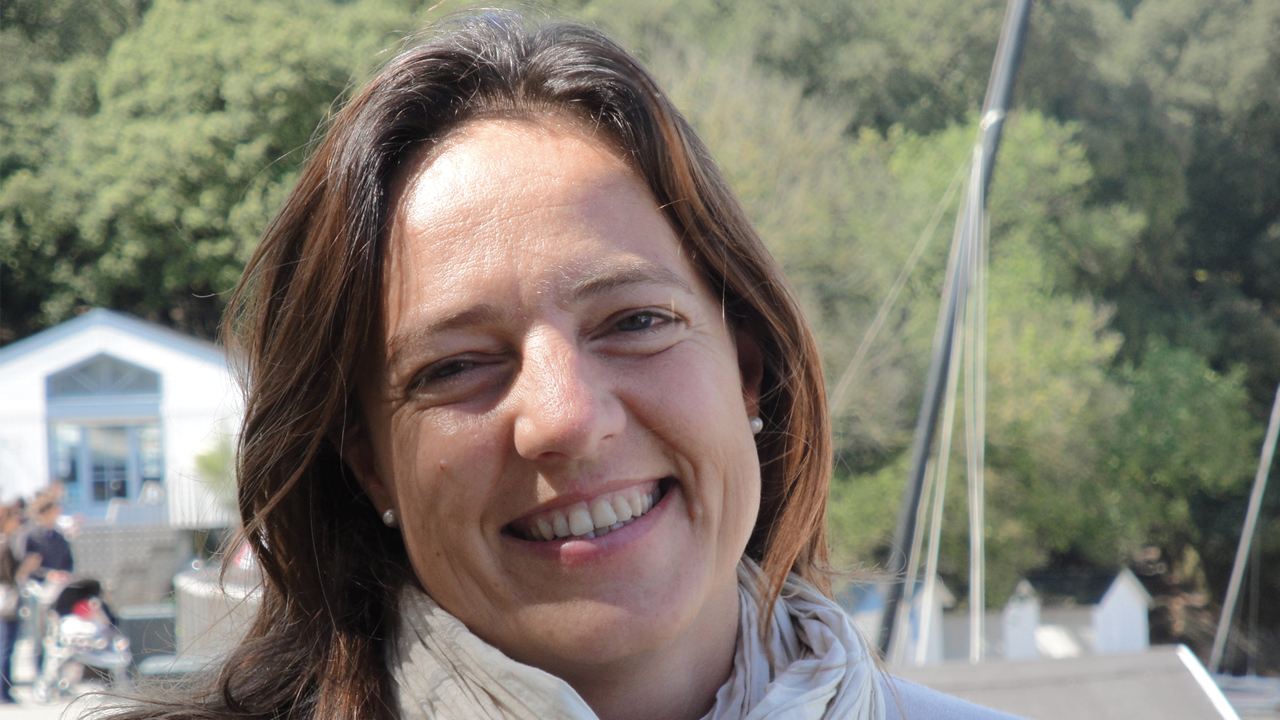
Our work on the interior design was coordinated between upgrading the living spaces, harmonizing the lines and integrating the functions to make everything clear and intuitive to use. I rely on strong, visual lines that make it possible to understand and organize the spaces in a logical way and to delimit the living areas. On the Astrea 42, the galley is a U-shape, and it offers great opportunities for storage and accessories. Its volume is housed within the ergonomics and space of the saloon. The large bay windows onto the cockpit contribute to a very fluid life on board, by promoting circulation inside and outside. The owner's hull is very spacious and offers an innovative, refined bathroom, with redesigned ergonomics. Lines, colors and materials are all elements that intuitively indicate the function of each space. Our work on the evolution of the interior style was done simultaneously with the work on the exterior design in order to bring true coherence in the development of the range of the Fountaine Pajot sailboats.
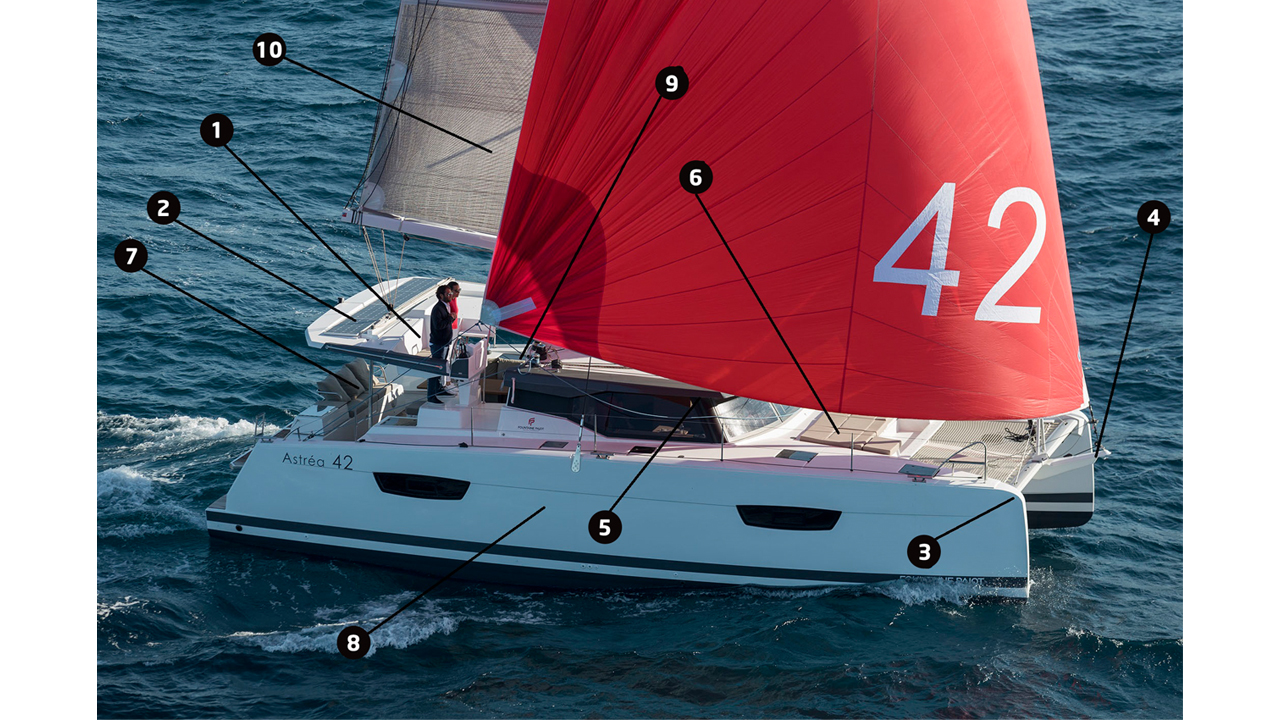
1: The helm seat is wide and comfortable, and doesn’t hinder access to the sunbathing area or sail trimming
2: Thumbs up for the area set aside for solar panels
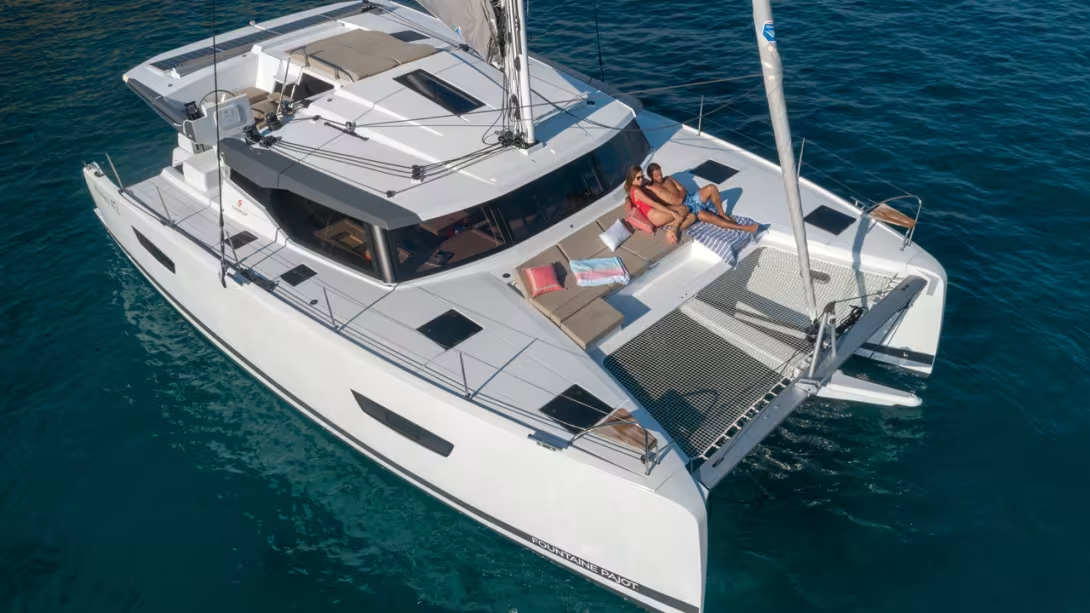
3: The shape of the bows is elegant
4: The foresails are secured down to a structural bowsprit which is connected to the compression beam. An excellent solution, but the design could be reviewed
5: The “eyebrows” of the anthracite gray gelcoat of the coachroof and the black uprights contribute positively to the look of the coachroof
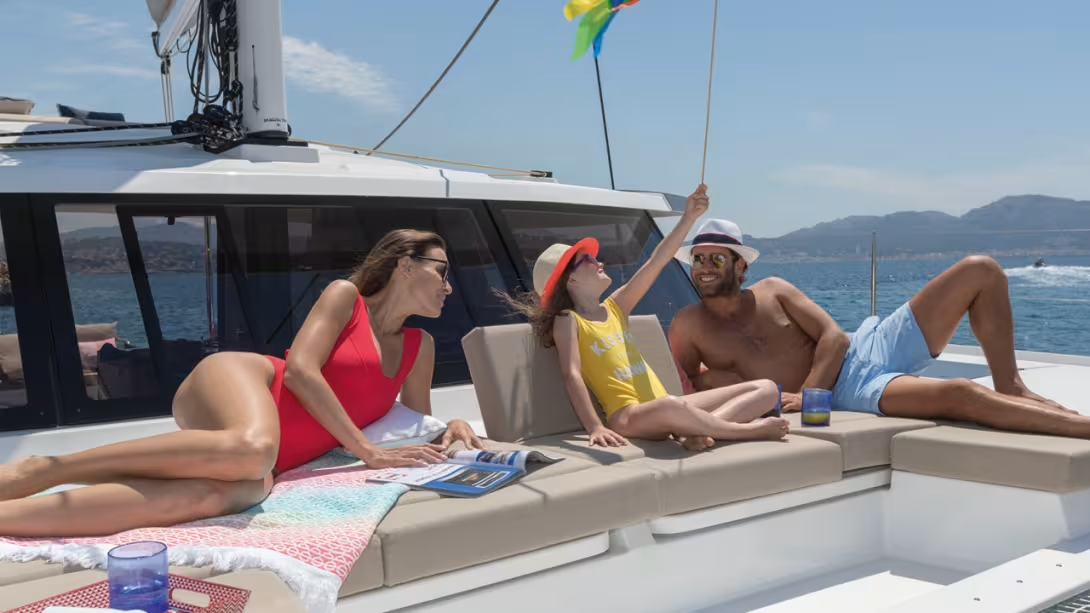
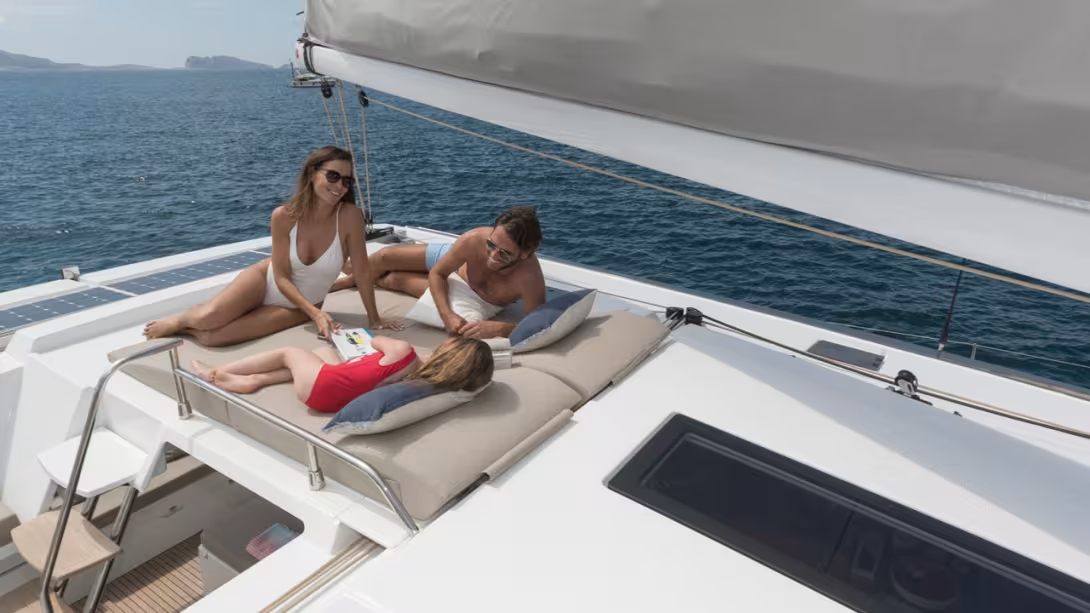
6: The forward sunbathing area, a new, much-appreciated outdoor space. The temperature here could be controlled with a shade at anchor
7: The comfort of the aft bench seat perfectly illustrates the new approach of the upholstery no longer being an accessory, but an important comfort factor.
8: With a slightly rounded deck-edge, a break in the stem, and a rib running along the upper third, the design of the hulls really adds to the seductive outline
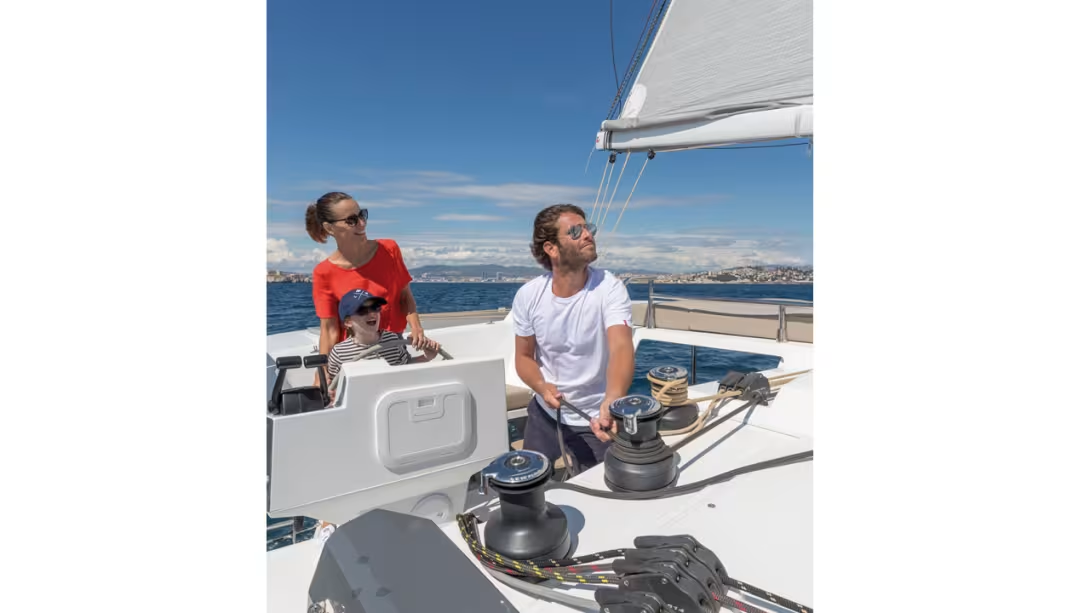
9: The helm station is a real success: the position of the wheel (cable linkage), clarity of the deck layout and ease of sail handling (reefing, tacking)
10: Beautiful sails! Without going as far as membrane sails, a little bit extra invested in sail power increases the appeal… but maybe at the expense of other options!
|
Model |
Builder |
Upwind sail area in m° |
Weight in kg |
Basic price in €, £ or $ ex-tax |
|
SEAWIND 12.60 |
SEAWIND |
90 |
8,240 |
$ 410,000 |
|
CATANA 42 |
CATANA |
102 |
8,900 |
€ 543,080 |
|
BALI 4.3 |
BALI |
89,5 |
11,300 |
€ 350,440 |
|
LAGOON 42 |
LAGOON |
94 |
12,000 |
€ 314,000 |
|
|
|
|
|
|
