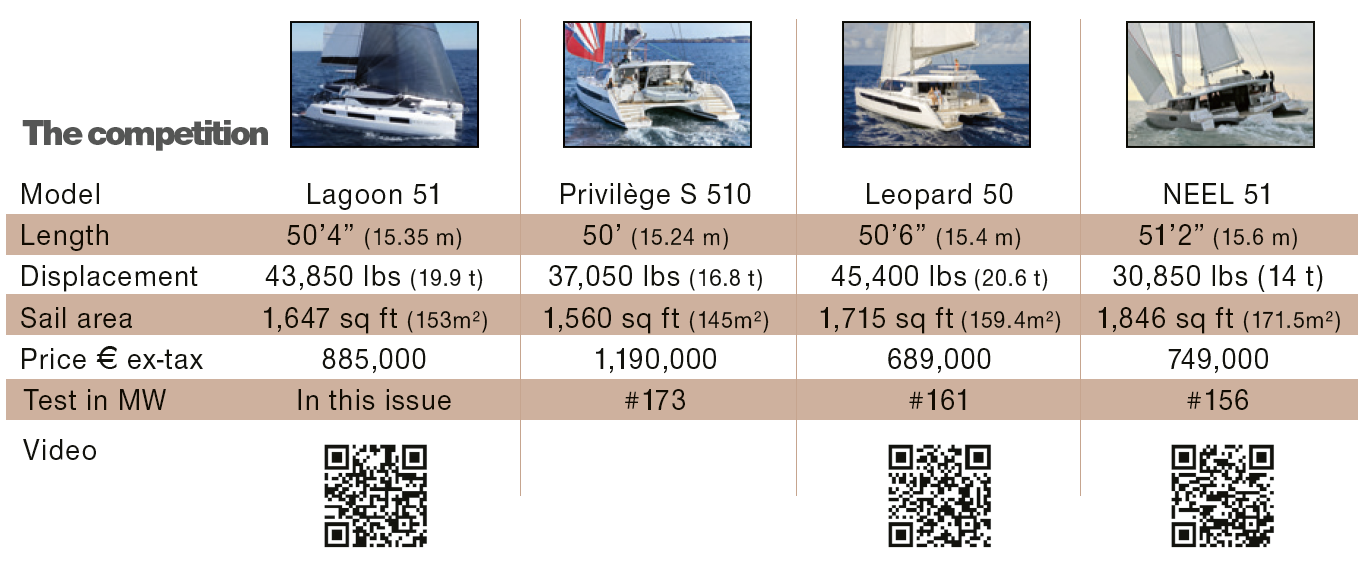
The heart of the cruising catamaran market, hovering in recent years at the 45-foot mark, now seems to be increasing a little in size... The 50-foot sector, which can be sailed without the help of a crew, is becoming fiercely contested, as shown by the almost simultaneous launch of the Aura 51 and the Lagoon 50. We got the chance to discover hull #1 in La Rochelle.
Test location: La Rochelle, France
Conditions: N-NW wind 11 to 16 knots, slight chop

Infos pratiques
- Le chantier : Aura 51
- La fiche technique
-
 Découvrez notre vidéo exclusive
- Financez votre Aura 51
- Assuez votre Aura 51
- Articles autour du Aura 51
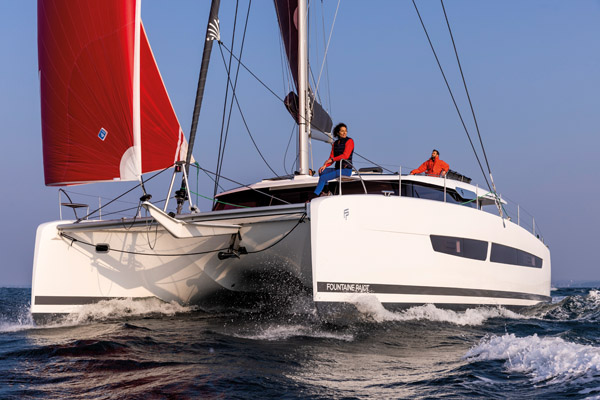
While certain brands in the boating industry might appear somewhat hesitant in the field of design and spirit of their ranges, this is certainly not the case for Fountaine Pajot: just like big auto manufacturers, the shipyard in La Rochelle has managed to put the same stamp on all its catamarans. This is how it already was, with the previous Joubert/Nivelt-designed generations. The family spirit was again brought to the fore with the signature of the first “small” Berret Racoupeau Yacht Design - this was the Helia 44 back in 2012. The current generation, with its inverted bows, was debuted by the Saona 47 in 2017 (which became the Tanna in 2021) and quickly bolstered by the Astrea 42 and Alegria 67 in 2018, the Elba 45 in 2019 and finally the Samana 59 in 2020. The Aura 51 picks up on all the same codes – and is very successful because of that. The superstructures are lighter thanks to the pronounced deck camber, the coachroof with a cap that barely protrudes in front of the mast foot and the bimini, which is refined to the maximum and covers practically the entire cockpit. The only notable evolution of this latest generation is the slope of the bows, now reversed.
 |
 |
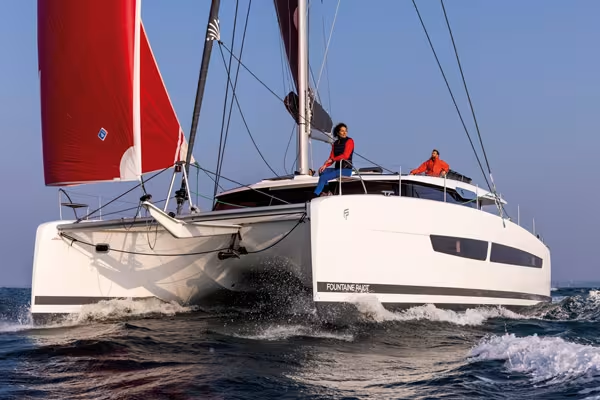
Despite her relatively high displacement, the Aura 51 performs well under sail in all conditions.
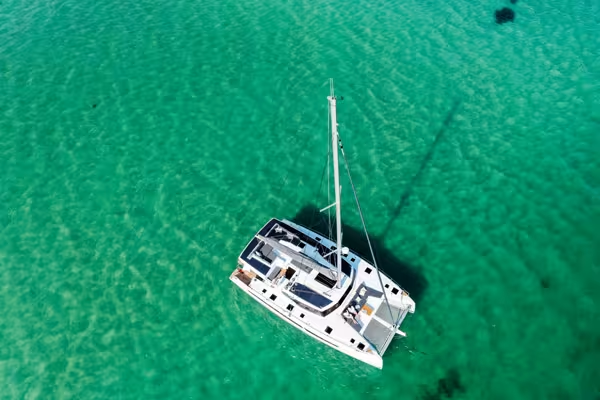
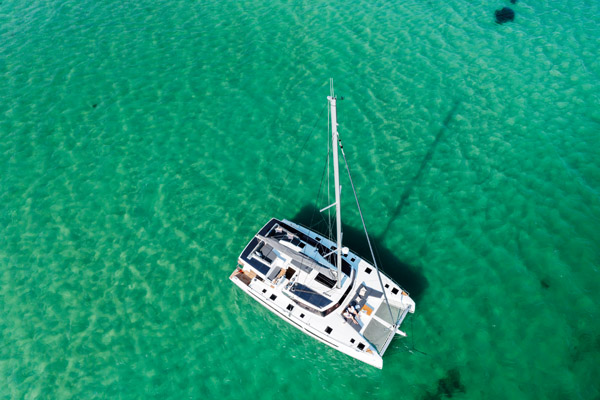
The coachroof and flybridge have been designed to provide maximum usable area for solar panels, which are integrated into the overall design. Only the lead for the lines to starboard needs to be reworked.
Manageable by a couple
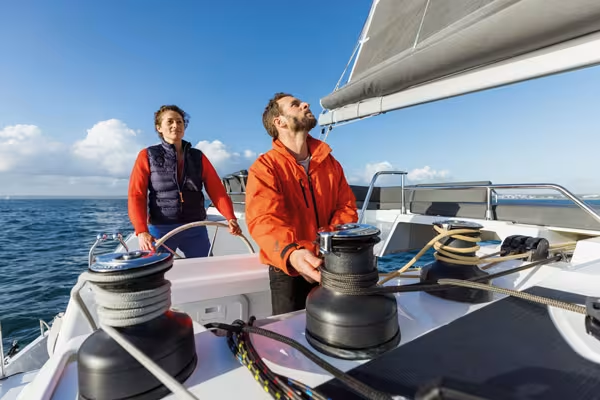
As we’ve often said before, 50 to 55 feet is the size where a cruising multihull that’s not specifically designed with “short-handed” sailing in mind, can demand a professional crew. The Aura 51 retains the dual forward maneuvering station and aft helm station used on all of the manufacturer’s models from 42 feet and above. In terms of practicality, this arrangement isn’t essential in our opinion, but it does have the merit of keeping the area clear while only requiring reduced width – of which the flybridge (at 175 square feet / 16.2 m²), does not fail to take advantage, with its imposing U-shaped bench seat and sunbathing area. Another benefit, that we’ll come back to later, is that the helmsman remains in contact with the occupants of the flybridge, of course, but also with the crew in the cockpit and even those in the galley.
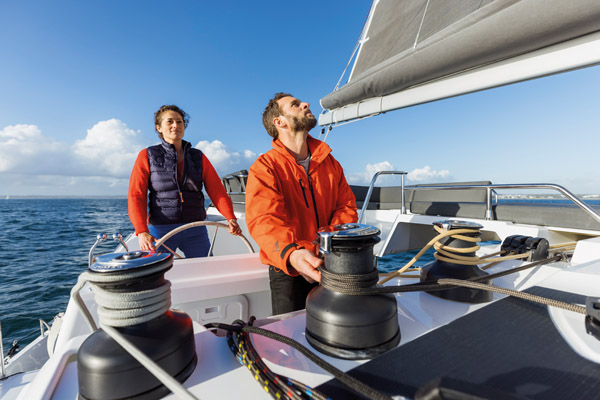
A flybridge means a raised boom: here, the gooseneck remains anchored relatively low, but the cut of the mainsail raises the boom significantly at the clew end. The cars for the sheets of the overlapping genoa sit on tracks set well inboard - the port sheet passes under a false deck to reach the maneuvering station. There are three winches and two banks of clutches. Halyards, sheets, traveler lines: everything can be adjusted from this station except the port gennaker (or spinnaker) sheet which requires a dedicated winch on the deck, near the return block. The entire coachroof and flybridge are bordered by an impressive area of solar panels - up to 2,000 Wp - which have been specially cut to elegantly cover the dedicated space. The only drawback: the use of the false deck would deserve to be applied for the return of starboard maneuvers - the lines run over the solar panels. A detail easy to correct - let’s not forget that the model we tested is the #1 of the series.
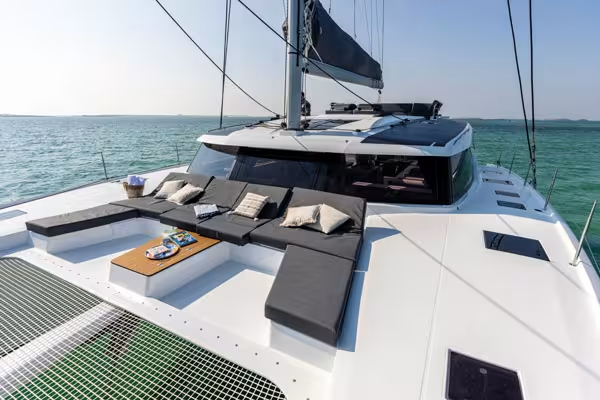
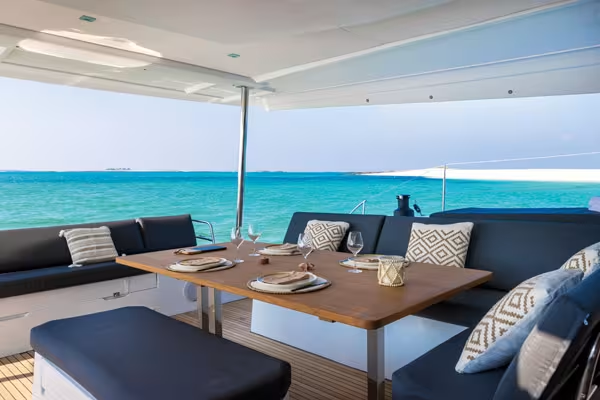
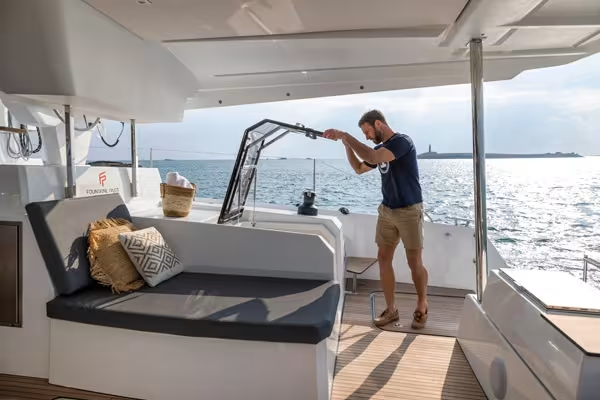
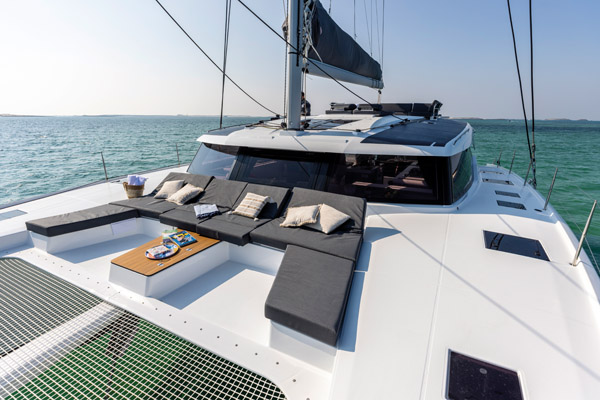
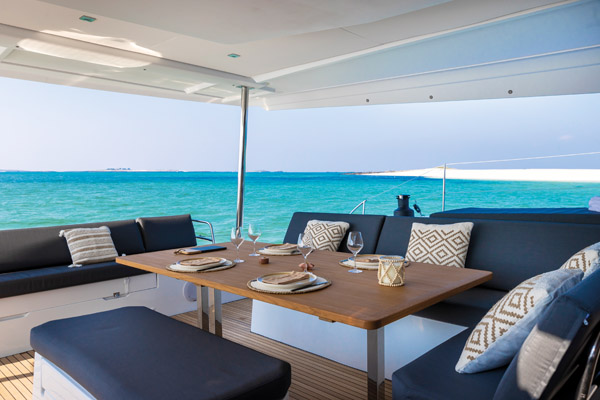
The forward deck is occupied by a generous sunbathing area (82 sq ft / 7.6 m²) and two large trampolines. The chain locker is cleverly topped by a wooden cover - which serves as a small table. There is no lack of lockers forward of the mast, but their use is hampered by the upholstery. The two forepeaks offer very large volume, and these can be fitted out as crew berths. As for the side decks, they are always wide and perfectly clear: the lower level of the cockpit is reached by three easy-to-cross steps. This aft cockpit is particularly welcoming with a large table (81” x 39” / 205 x 99 cm) capable of seating 10 guests, two lateral loungers, and a beautiful 7’6” (2.28 m) aft bench seat. There’s a hatch that opens onto the flybridge - this offers a bit of ventilation that would likely be welcome and can help communication from the sun lounger. Further aft, there is a gas grill, a compartment for the liferaft, two equipped sugarscoops and, between them, a hydraulic platform (440 lbs / 200 kg max).
 |
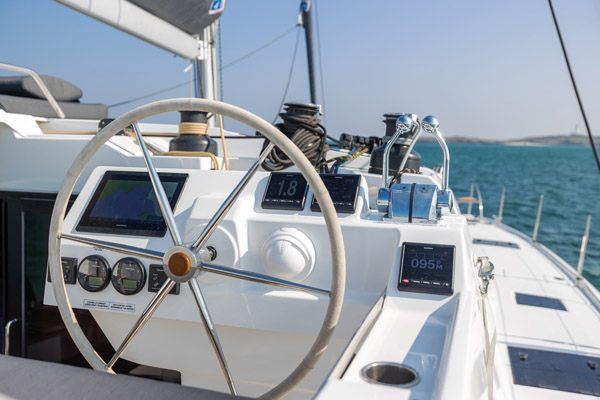 |
Maneuvering station in front, helm station behind - the typical all-in-one control position is split on most Fountaine Pajot catamarans.
That feeling of gliding
The model we tested was equipped with the optional 75 HP motors (2 x 60 HP is the standard). These larger engines make maneuvering even easier: very straightforward to make a U-turn on the spot and to hold yourself alongside the dock or a pontoon with the help of a spring or bow/stern line. On clearing the harbor, we were picked up by an ideal 11 to 16 knot northwest wind. The Aura 51 immediately demonstrated her excellent capabilities under full mainsail and genoa, settling at a speed of 8 to 9 knots with the wind on the beam. The Incidences D4 sail wardrobe (not included in the manufacturer’s options) and the folding propellers provided a welcome turbo effect. During a more pronounced gust, the GPS even indicated 10 knots. The sailplan adapts perfectly and easily to sailing close to the wind - in particular thanks to the overlapping genoa with its sheeting point set well inboard. Obviously, at speeds below 5 or 6 knots, the relatively short skeg keels (4’4” / 1.32 m) won’t eliminate all the leeway. But above a Force 3, you’re able to make a course a little sharper than 50° without stalling the catamaran. Under gennaker, during our photo shoot, the Aura 51 was able to maintain an average speed of over 10 knots. These performances are excellent considering the displacement quoted - and the level of comfort observed. Comparing the specifications of the Aura 51 and the Saba 50, you’ll notice the displacement increases from 15.7 t to 18.1 t. The sail area of the 50 is 1,518 square feet (141 m²), whereas the 51 has 1,658 sq ft (154 m²). The Saba 50’s sail to weight ratio is therefore 8.98 m²/t as opposed to 8.51 - a decreasing value while the Aura 51 is certainly faster than her predecessor.
The smoothness of the helm and the good view over the water and the rig obviously contribute to the sailing pleasure. You don’t feel any spectacular acceleration, but rather an impression of power and serenity that invites you to continue heading offshore…
 |
 |
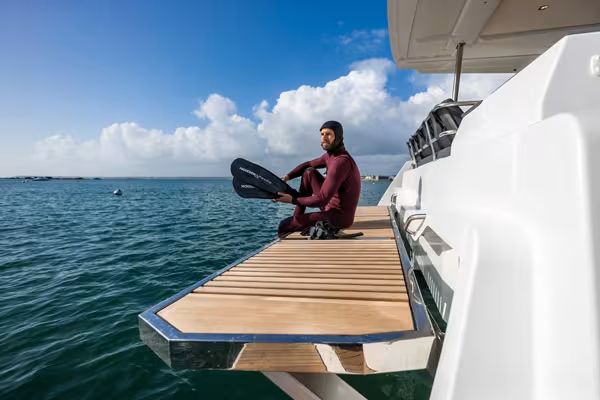
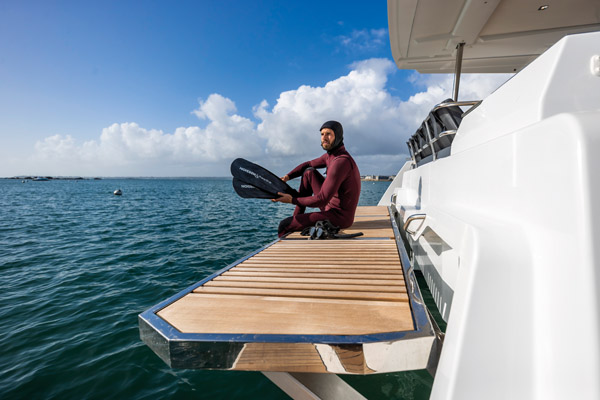
The aft platform can support a 440 lb (200 kg) tender. At anchor, it serves as a ‘beach club’.
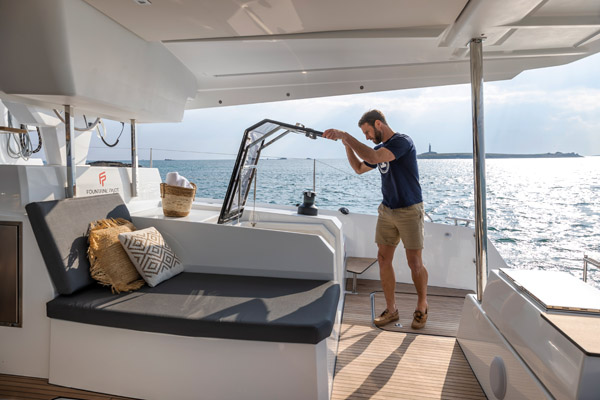
The foredeck is also a lounging area. The wood cover that protects the windlass doubles as a table - clever, eh?
A galley that spills over to the outside
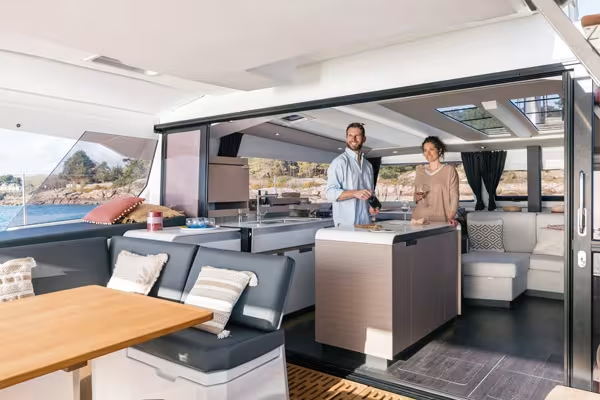
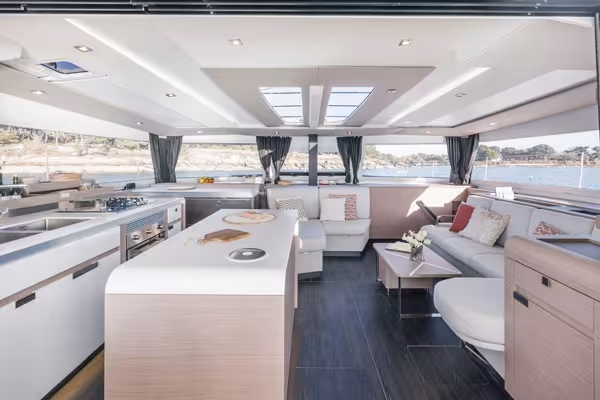
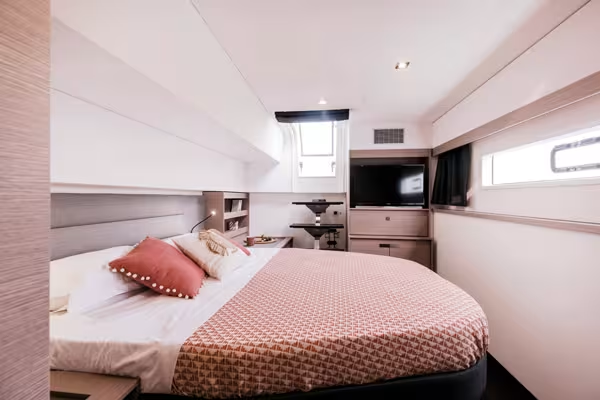
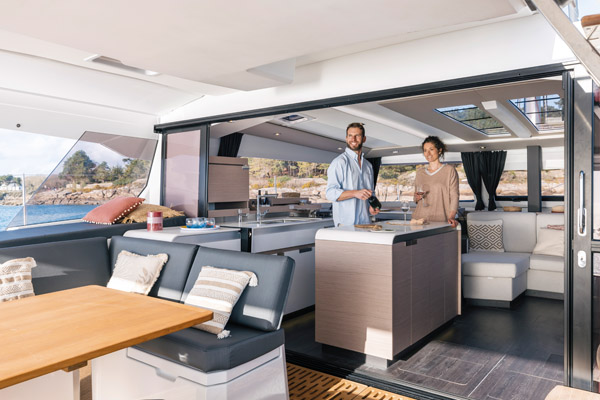
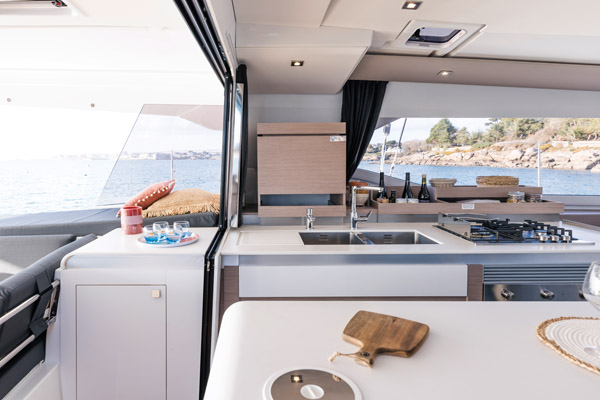
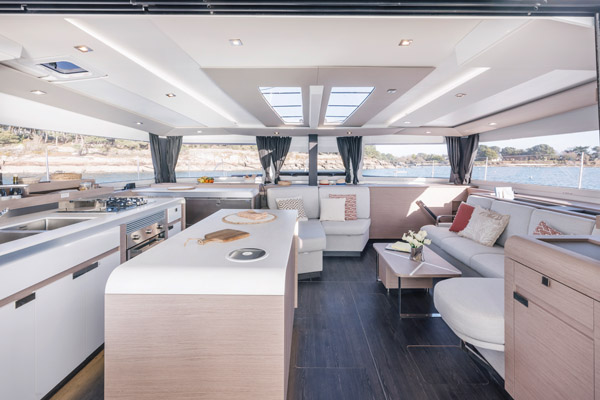
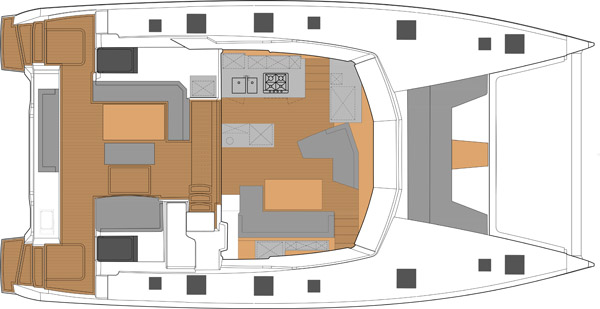
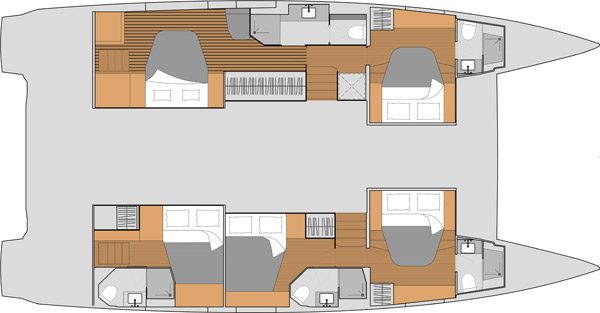
In addition to the numerous solar panels that surround the flybridge, the main innovation to be found aboard the Aura 51 is the extra-wide opening of the nacelle and the galley that overflows into the cockpit. The bay windows comprise three large panels that retract next to the helm station, offering a potential opening over 6 feet (1.86 m) high by 7½ feet (2.29 m) wide. On the port side, the galley unit extends outward and supports an additional 21” (53 cm) window. Thanks to the central island design, the chef doesn’t get in anyone’s way and can work almost outside. This inside/outside configuration seemed very convincing to us. To top that, this famous galley is particularly well-equipped with storage space and additional refrigeration can be ordered. The nacelle is very bright - it is also suitable for taller sailors, with headroom of 7’1” (2.17 m) near the entrance. The finishing everywhere is neat, without playing the bling card. The saloon extends on the starboard side and is constructed around an L-shaped bench seat. Our test model had a coffee table, but in the absence of a “proper” chart table, the multifunction, electrically-operated high table option - including an extra bed – would seem more judicious, if only to have a desk if necessary. The watchkeeping and navigation aspects have been catered for by the shipyard using the central lounger, which offers a view of the sail plan as well as power outlets for plugging in a tablet. Our Aura 51 was the 5-cabin version (2 to port and 3 to starboard), but other options include 4 cabins with the attractive Full Maestro version, which reserves the entire port hull for the Owner, or a 6-cabin version. All of them have beds installed athwartships (with widths of 5’ or 5’3” / 1.5 m or 1.6 m) and their own heads compartment. The two cabins furthest aft have access to the cockpit. In the hulls, the headroom is higher than 6’6” (2 m) throughout.
 |
 |
 |
One of the main innovations of the Aura 51 is the very wide opening from the nacelle and the galley (with central island) that ventures into the cockpit.
The large cockpit table (with optional extension) features seating for up to 10 people.
Conclusion
With 120 units ordered off plan (for now, only the Astrea 42 has done better), the Aura 51 looks to be already assured of a very good commercial career. A well-deserved success for this new model with an attractive design. Comfortable, carefully finished and high-performance, the 51 is already establishing itself as one of the most serious competitors in the 50-foot cruising catamaran sector, even before her official launch which is scheduled for the Yachting Cannes Festival.
 |
 |
 |
The nacelle clearly prioritizes the galley function over the saloon. However, the saloon can be equipped with an electrically height-adjustable table. There is no nav station, but a lounger for the watchkeeper with a good view of the sail plan.
The aft cabins have access to the cockpit via a few steps and a large hatch on rams.
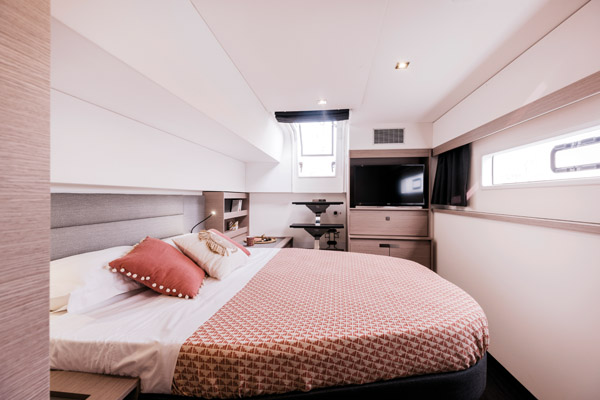
Whichever layout version you choose, the bunks in all the cabins are fitted athwartships.
THE PLUSES:
+ Design
+ Performance on all points of sail
+ Ease of handling
THE MINUSES:
- No chart table
- Distribution of the solar panel area could be improved
 |
 |
TECHNICAL SPECIFICATIONS
Builder: Fountaine Pajot
Architects: Berret Racoupeau Yacht Design
Length: 51’ (15.54 m)
Beam: 26’6” (8.08 m)
Draft: 4’4” (1.32 m)
Displacement: 39,900 lbs (18.1 t)
Sail area: 1,658 sq ft (154 m²)
Mainsail: 1,023 sq ft (95 m²)
Genoa: 635 sq ft (59 m²)
Berths: 4 to 6 double cabins + forepeaks
Fuel: 2 x 119 US Gal (2 x 450 l)
Water: 238 US Gal (900 l)
Engines: 2 x 60 or 75 HP
Price Full Maestro 4-cabin: € 865,311 ex-tax
Price of the model we tested (with standard sails): € 1,216,340 ex-tax
Main options in € ex-tax
Comfort Pack: 80,000
Garmin electronics pack #3: 16,500
Offshore sails (Hydranet): 23,500
Gennaker: 8,000
Pole and gennaker fittings: 6,352 2
VOLVO D2 75HP motors: 3,967
Four-bladed folding propellers/VOLVO 75: 4,080
Dinghy platform: 26,299
Electric davit winch: 2,500
3.4 m dinghy and 15 HP outboard: 8,367
Exterior upholstery for forward saloon: 3,600
Integrated gas grill: 1,650
Electric multifunction table: 6,065
Central heating: 15,200
Air conditioning: 35,964
Additional batteries (2 x 150 Ah): 1,500
Underwater lighting: 2,860
Generator: 23,152
Watermaker: 11,193
Full safety equipment: 3,807
10-person liferaft: 2,000
32 kg (70 lbs) anchor + chain: 1,546